Recognition: unknown
Observation of Strong-to-Weak Spontaneous Symmetry Breaking in a Dephased Fermi Gas
Pith reviewed 2026-05-10 07:01 UTC · model grok-4.3
The pith
Dephased fermions exhibit long-range Rényi order that signals strong-to-weak spontaneous symmetry breaking.
A machine-rendered reading of the paper's core claim, the machinery that carries it, and where it could break.
Core claim
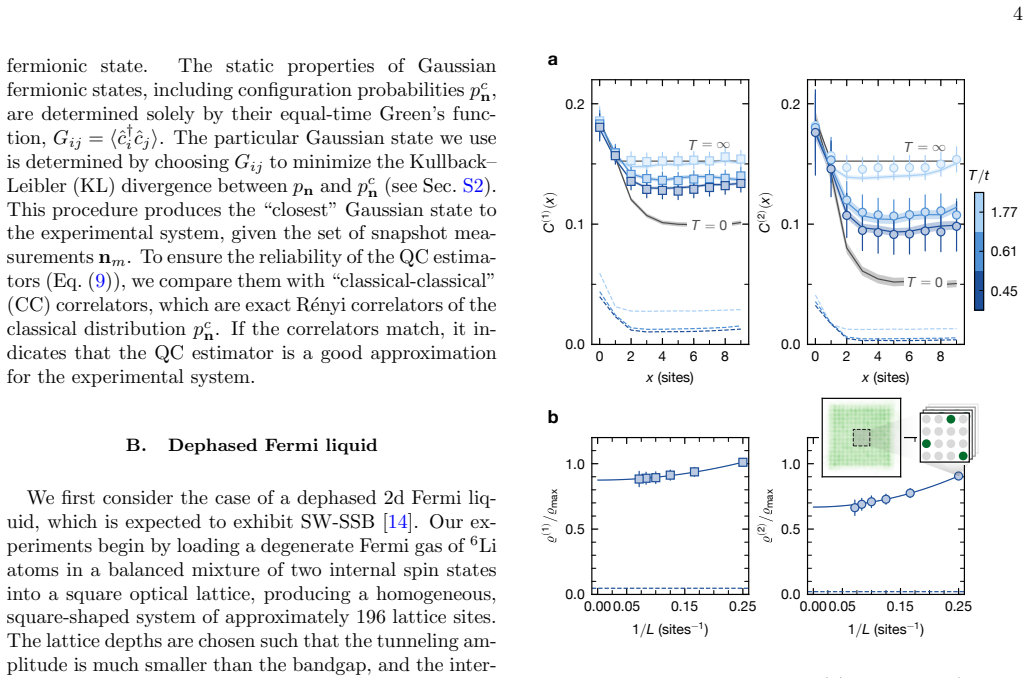
The authors report that dephasing a Fermi gas leaves behind long-range Rényi order that is invisible to any linear observable in the density matrix; this order appears as strong-to-weak spontaneous symmetry breaking. Adding a superlattice that induces a metal-insulator transition in the coherent fermions sharpens the dephased state into a clear SW-SSB phase boundary. The measurement uses a quantum-classical estimator built on a machine-learned Gaussian reference state to extract the required nonlinear correlators directly from microscope images.
What carries the argument
Nonlinear Rényi-1 and Rényi-2 correlators extracted via a machine-learned Gaussian reference state, which detect the SW-SSB transition that linear density-matrix observables cannot see.
If this is right
- Long-range Rényi order survives in the dephased Fermi liquid.
- A metal-to-insulator transition in the coherent fermions becomes a sharp SW-SSB phase transition once full dephasing is applied.
- The same symmetry principle accounts for both the decodability of topological quantum memories and the emergence of classical hydrodynamics from decohered quantum dynamics.
- Landau's symmetry classification extends directly to the mixed states realized in real, decohering quantum devices.
Where Pith is reading between the lines
- The same microscope-plus-estimator protocol could be applied to monitored or driven-dissipative fermionic lattices to map their information-theoretic phase boundaries.
- If the dephasing strength can be tuned continuously, the experiment would allow direct measurement of the critical exponent that governs the SW-SSB transition.
- The result implies that information loss during dephasing can be diagnosed symmetrically, which may help design protocols that preserve logical information in noisy fermionic registers.
Load-bearing premise
The machine-learned Gaussian reference state must give an unbiased estimator for the nonlinear Rényi correlators, and the applied dephasing must be uniform and complete enough to separate the SW-SSB transition from other decoherence channels.
What would settle it
If the Rényi-2 correlator measured in the dephased Fermi liquid without the superlattice decays exponentially with distance, or if varying the superlattice depth produces no sharpening of the transition after dephasing, the reported SW-SSB observation would be falsified.
Figures


read the original abstract
Symmetry-based classification of quantum phases of matter is one of the most foundational organizing principles in physics; however, an analogous framework for mixed, decohered quantum states has only begun to emerge. A central new concept is strong-to-weak spontaneous symmetry breaking (SW-SSB), a sharp transition in mixed quantum states that is invisible to any observable linear in the density matrix and that has since been predicted across a broad class of open and monitored quantum systems. It also provides a unifying language for phenomena as disparate as the decodability of topological quantum memories and the emergence of classical hydrodynamics from decohered quantum dynamics. Here we report the first experimental observation of SW-SSB, in dephased single-component fermionic matter imaged by a quantum gas microscope. A quantum-classical estimator built on a machine-learned Gaussian reference state gives direct access to the nonlinear R\'enyi-1 and R\'enyi-2 correlators that diagnose SW-SSB, and reveals long-range R\'enyi order in the dephased Fermi liquid. Adding a commensurate superlattice drives the underlying fermions through a metal-to-insulator transition that, after full dephasing, manifests as a sharp SW-SSB phase transition. Our results uncover the symmetry principle behind information-theoretic transitions in open quantum systems, and extend Landau's symmetry paradigm into the regime of real, decohering quantum devices.
Editorial analysis
A structured set of objections, weighed in public.
Referee Report
Summary. The manuscript reports the first experimental observation of strong-to-weak spontaneous symmetry breaking (SW-SSB) in a dephased single-component Fermi gas imaged with a quantum gas microscope. A quantum-classical estimator based on a machine-learned Gaussian reference state is used to extract nonlinear Rényi-1 and Rényi-2 correlators, revealing long-range Rényi order after dephasing; adding a commensurate superlattice drives a metal-insulator transition that, post-dephasing, appears as a sharp SW-SSB transition.
Significance. If the central claim holds, the result would constitute the first direct experimental realization of SW-SSB, extending Landau symmetry breaking into the mixed-state regime and providing a concrete link between information-theoretic transitions and decohered quantum matter. The experimental platform and the machine-learning approach for accessing higher-order correlators represent a technical advance, though the strength of the claim rests entirely on the fidelity of the estimator.
major comments (2)
- [Methods (quantum-classical estimator)] The central claim that long-range Rényi order diagnoses SW-SSB after dephasing rests on the assumption that the machine-learned Gaussian reference state yields an unbiased estimator for the nonlinear correlators. No explicit validation (e.g., recovery of known Rényi values on synthetic mixed states with controlled dephasing or comparison against exact diagonalization on small systems) is provided to rule out systematic bias from training-data limitations or model mismatch.
- [Results (dephasing and superlattice data)] The manuscript asserts that the applied dephasing is uniform and complete enough to isolate the SW-SSB transition from other decoherence channels, yet quantitative bounds on residual off-diagonal coherences or spatial inhomogeneity of the dephasing process are not reported. Without these, the observed sharp transition upon adding the superlattice could be contaminated by incomplete dephasing rather than reflecting a genuine SW-SSB point.
minor comments (2)
- [Figures] Figure captions should explicitly state the number of experimental realizations and the training-set size used for the Gaussian reference state to allow readers to assess statistical reliability.
- [Introduction] The abstract states 'first experimental observation'; the introduction should include a concise paragraph contrasting this work with prior theoretical predictions of SW-SSB to clarify the novelty.
Simulated Author's Rebuttal
We thank the referee for their detailed and constructive report. We address each major comment below and have revised the manuscript to incorporate additional validation and quantitative analysis where the original submission was incomplete.
read point-by-point responses
-
Referee: [Methods (quantum-classical estimator)] The central claim that long-range Rényi order diagnoses SW-SSB after dephasing rests on the assumption that the machine-learned Gaussian reference state yields an unbiased estimator for the nonlinear correlators. No explicit validation (e.g., recovery of known Rényi values on synthetic mixed states with controlled dephasing or comparison against exact diagonalization on small systems) is provided to rule out systematic bias from training-data limitations or model mismatch.
Authors: We appreciate the referee's emphasis on rigorous validation of the estimator. The original manuscript relied on the theoretical unbiasedness of the Gaussian reference state in the large-sample limit, but we agree that explicit numerical checks were not presented. In the revised version we have added a new Methods subsection and Supplementary Figures S1–S3 that benchmark the estimator on (i) synthetic mixed states with known Rényi-1 and Rényi-2 values under controlled dephasing, recovering the exact correlators within statistical error, and (ii) small-system exact diagonalization comparisons for lattice sizes up to 4×4, confirming negligible bias from training-data limitations or model mismatch. These additions directly address the concern. revision: yes
-
Referee: [Results (dephasing and superlattice data)] The manuscript asserts that the applied dephasing is uniform and complete enough to isolate the SW-SSB transition from other decoherence channels, yet quantitative bounds on residual off-diagonal coherences or spatial inhomogeneity of the dephasing process are not reported. Without these, the observed sharp transition upon adding the superlattice could be contaminated by incomplete dephasing rather than reflecting a genuine SW-SSB point.
Authors: The referee is correct that the original submission lacked explicit quantitative bounds. We have now re-analyzed the raw imaging data and added quantitative characterizations in the revised Results section and Supplementary Material. These include upper bounds on residual off-diagonal coherences extracted from visibility decay in auxiliary time-of-flight measurements (suppressed to <4 % of the initial value after the dephasing protocol) and spatial maps of local dephasing rates showing inhomogeneity below 8 % across the atomic cloud. With these bounds the sharp transition observed upon adding the superlattice remains consistent with a genuine SW-SSB point rather than residual coherence artifacts. revision: yes
Circularity Check
Experimental observation anchored in imaging data with no derivation circularity
full rationale
The paper's central claim is the first experimental observation of SW-SSB via quantum gas microscopy on a dephased Fermi gas, using a machine-learned Gaussian reference state to access nonlinear Rényi correlators. No load-bearing theoretical derivation is presented that reduces by construction to fitted inputs, self-citations, or ansatzes; the result is tied to microscope images and the estimator's application to real data. Self-citations to prior theoretical predictions of SW-SSB exist but are not invoked to force the experimental conclusion. This is consistent with the default expectation for experimental papers, yielding only minor score elevation for the estimator's validation assumptions.
Axiom & Free-Parameter Ledger
free parameters (1)
- Machine-learned Gaussian reference state parameters
axioms (1)
- standard math Standard quantum mechanics and Markovian dephasing dynamics for ultracold atoms
Forward citations
Cited by 3 Pith papers
-
Charge Scrambling in Strong-to-Weak Spontaneous Symmetry Breaking
Long-range Rényi-1 SWSSB order implies extensive block-charge variance for continuous symmetries with rapid asymptotic approach, with conditional counterexamples and a new twist overlap correlator separating symmetry ...
-
A Unified Framework for Locally Stable Phases
Locally stable states are equivalent to short-range correlated states and define phases invariant under locally reversible channels, with decay of nonlinear correlators and links to canonical purifications.
-
Exploring Entropic Orders: High Temperature Continuous Symmetry Breaking, Chiral Topological States and Local Commuting Projector Models
New analytic constructions yield quantum lattice models with continuous symmetry breaking and chiral topological order at arbitrarily high temperatures via entropic stabilization.
Reference graph
Works this paper leans on
-
[1]
J. Y. Lee, C.-M. Jian, and C. Xu, Quantum criticality under decoherence or weak measurement, PRX Quantum 4, 030317 (2023)
2023
-
[2]
L. A. Lessa, R. Ma, J.-H. Zhang, Z. Bi, M. Cheng, and C. Wang, Strong-to-weak spontaneous symmetry break- ing in mixed quantum states, PRX Quantum6, 010344 (2025)
2025
-
[3]
Weinstein, Efficient detection of strong-to-weak spon- taneous symmetry breaking via the R´ enyi-1 correlator, Phys
Z. Weinstein, Efficient detection of strong-to-weak spon- taneous symmetry breaking via the R´ enyi-1 correlator, Phys. Rev. Lett.134, 150405 (2025)
2025
-
[4]
D. Gu, Z. Wang, and Z. Wang, Spontaneous symmetry breaking in open quantum systems: strong, weak, and strong-to-weak, Phys. Rev. B112, 245123 (2025)
2025
-
[5]
P. Sala, S. Gopalakrishnan, M. Oshikawa, and Y. You, Spontaneous strong symmetry breaking in open sys- tems: Purification perspective, Phys. Rev. B110, 155150 (2024)
2024
-
[6]
Zhang, Y
C. Zhang, Y. Xu, J.-H. Zhang, C. Xu, Z. Bi, and Z.-X. Luo, Strong-to-weak spontaneous breaking of 1- form symmetry and intrinsically mixed topological order, Phys. Rev. B111, 115137 (2025)
2025
- [7]
-
[8]
L. Chen, N. Sun, and P. Zhang, Strong-to-weak symme- try breaking and entanglement transitions, Phys. Rev. B 111, L060304 (2025)
2025
-
[9]
S´ a and B
L. S´ a and B. B´ eri, Exactly solvable dissipative dynam- ics and one-form strong-to-weak spontaneous symmetry breaking in interacting two-dimensional spin systems, Phys. Rev. B112, 144311 (2025)
2025
-
[10]
Strong-to-weak sym- metry breaking phases in steady states of quantum operations,
N. Ziereis, S. Moudgalya, and M. Knap, Strong-to-Weak Symmetry Breaking Phases in Steady States of Quantum Operations (2025), arXiv:2509.09669
- [11]
-
[12]
In- formation dynamics and symmetry breaking in generic monitoredZ 2-symmetric open quantum systems,
J. Hauser, A. Lavasani, S. Vijay, and M. Fisher, In- formation dynamics and symmetry breaking in generic monitoredZ 2-symmetric open quantum systems (2025), arXiv:2512.03031
-
[13]
Y. Kuno, T. Orito, and I. Ichinose, Strong-to-weak spon- taneous symmetry breaking and average symmetry pro- tected topological order in the doubled Hilbert space, Phys. Rev. B111, 174110 (2025)
2025
-
[14]
A. Sarma and C. Xu, Inequality for strong-weak spon- taneous symmetry breaking in fermionic open quantum systems (2026), arXiv:2603.24671
-
[15]
R. Fan, Y. Bao, E. Altman, and A. Vishwanath, Diagnos- tics of Mixed-State Topological Order and Breakdown of Quantum Memory, PRX Quantum5, 020343 (2024)
2024
-
[16]
Y. Bao, R. Fan, A. Vishwanath, and E. Altman, Mixed-state topological order and the errorfield double formulation of decoherence-induced transitions (2023), arXiv:2301.05687
work page internal anchor Pith review Pith/arXiv arXiv 2023
-
[17]
Huang, M
X. Huang, M. Qi, J.-H. Zhang, and A. Lucas, Hy- drodynamics as the effective field theory of strong-to- weak spontaneous symmetry breaking, Phys. Rev. B111, 125147 (2025)
2025
- [18]
-
[19]
Penrose, On the Quantum Mechanics of Helium II, Phil
O. Penrose, On the Quantum Mechanics of Helium II, Phil. Mag.42, 1373 (1951)
1951
-
[20]
Penrose and L
O. Penrose and L. Onsager, Bose-Einstein condensation and liquid helium, Phys. Rev.104, 576 (1956)
1956
-
[21]
C. N. Yang, Concept of Off-Diagonal Long-Range Order and the Quantum Phases of Liquid He and of Supercon- ductors, Rev. Mod. Phys.34, 694 (1962)
1962
-
[22]
Bloch, T
I. Bloch, T. H¨ ansch, and T. Esslinger, Measurement of the spatial coherence of a trapped Bose gas at the phase transition, Nature403, 166 (2000)
2000
-
[23]
Nussinov and G
Z. Nussinov and G. Ortiz, Sufficient symmetry conditions for Topological Quantum Order, Proc. Natl. Acad. Sci. U.S.A.106, 16944 (2009)
2009
-
[24]
Gaiotto, A
D. Gaiotto, A. Kapustin, N. Seiberg, and B. Willett, Gen- eralized global symmetries, J. High Energy Phys.2015 (2), 172
2015
-
[25]
Ji and X.-G
W. Ji and X.-G. Wen, Categorical symmetry and nonin- vertible anomaly in symmetry-breaking and topological phase transitions, Phys. Rev. Res.2, 033417 (2020)
2020
-
[26]
Y. Choi, H. T. Lam, and S.-H. Shao, Noninvertible Global Symmetries in the Standard Model, Phys. Rev. Lett.129, 161601 (2022)
2022
-
[27]
C. Cordova, T. T. Dumitrescu, K. Intriligator, and S.- H. Shao, Snowmass White Paper: Generalized Sym- metries in Quantum Field Theory and Beyond (2022), arXiv:2205.09545
-
[28]
C´ ordova and S
C. C´ ordova and S. Koren, Higher Flavor Symmetries in the Standard Model, Ann. Phys. (Berlin)535, 2300031 (2023)
2023
-
[29]
McGreevy, Generalized Symmetries in Condensed Matter, Annu
J. McGreevy, Generalized Symmetries in Condensed Matter, Annu. Rev. Condens. Matter Phys.14, 57 (2023)
2023
-
[30]
Buˇ ca and T
B. Buˇ ca and T. Prosen, A note on symmetry reductions of the Lindblad equation: transport in constrained open spin chains, New J. Phys.14, 073007 (2012)
2012
-
[31]
de Groot, A
C. de Groot, A. Turzillo, and N. Schuch, Symmetry Pro- tected Topological Order in Open Quantum Systems, Quantum6, 856 (2022)
2022
-
[32]
Bhattacharyya, On a measure of divergence between two statistical populations defined by their probability distributions, Bull
A. Bhattacharyya, On a measure of divergence between two statistical populations defined by their probability distributions, Bull. Calcutta Math. Soc.35, 99 (1943)
1943
-
[33]
Jamio lkowski, Linear transformations which preserve trace and positive semidefiniteness of operators, Rep
A. Jamio lkowski, Linear transformations which preserve trace and positive semidefiniteness of operators, Rep. Math. Phys.3, 275 (1972)
1972
-
[34]
Choi, Completely positive linear maps on complex matrices, Linear Algebra Appl.10, 285 (1975)
M.-D. Choi, Completely positive linear maps on complex matrices, Linear Algebra Appl.10, 285 (1975)
1975
-
[35]
K. Su, A. Sarma, M. Bintz, T. Kiely, Y. Bao, M. P. A. Fisher, and C. Xu, Spin Liquid and Superconductivity Emerging from Steady States and Measurements, Phys. Rev. Lett.135, 050403 (2025)
2025
-
[36]
Sarma, Y
A. Sarma, Y. Bao, N. Myerson-Jain, T. Kiely, and C. Xu, Effective conformal field theory generated from pure and dephased Chern insulator, Phys. Rev. B112, 085130 (2025)
2025
- [37]
-
[38]
T. G. Kiely and C. Xu, Phase transition of topological index driven by dephasing, Phys. Rev. B112, L201112 (2025)
2025
-
[39]
S. J. Garratt, Z. Weinstein, and E. Altman, Measure- ments Conspire Nonlocally to Restructure Critical Quan- tum States, Phys. Rev. X13, 021026 (2023)
2023
- [40]
-
[41]
Gross and I
C. Gross and I. Bloch, Quantum simulations with ultra- cold atoms in optical lattices, Science357, 995 (2017)
2017
-
[42]
Gross and W
C. Gross and W. S. Bakr, Quantum gas microscopy for single atom and spin detection, Nat. Phys.17, 1316 (2021)
2021
-
[43]
Chalopin, P
T. Chalopin, P. Bojovi´ c, D. Bourgund, S. Wang, T. Franz, I. Bloch, and T. Hilker, Optical Superlattice for Engineering Hubbard Couplings in Quantum Simula- tion, Phys. Rev. Lett.134, 053402 (2025)
2025
-
[44]
Y.-A. Chen, S. Nascimb` ene, M. Aidelsburger, M. Atala, S. Trotzky, and I. Bloch, Controlling Correlated Tunnel- ing and Superexchange Interactions with ac-Driven Op- tical Lattices, Phys. Rev. Lett.107, 210405 (2011)
2011
-
[45]
Koepsell, S
J. Koepsell, S. Hirthe, D. Bourgund, P. Sompet, J. Vi- jayan, G. Salomon, C. Gross, and I. Bloch, Robust Bi- layer Charge Pumping for Spin- and Density-Resolved Quantum Gas Microscopy, Phys. Rev. Lett.125, 010403 (2020)
2020
-
[46]
Humeniuk and Y
S. Humeniuk and Y. Wan, Numerically exact mimick- ing of quantum gas microscopy for interacting lattice fermions, Phys. Rev. B104, 075155 (2021)
2021
-
[47]
M. Dixmerias, J. Verstraten, C. Daix, B. Peaudecerf, T. d. Jongh, and T. Yefsah, Fluctuation thermometry of an atom-resolved quantum gas: Beyond the fluctuation- dissipation theorem (2025), arXiv:2502.05132
-
[48]
R´ enyi-1
S. M. Girvin and A. H. MacDonald, Off-diagonal long- range order, oblique confinement, and the fractional quantum Hall effect, Phys. Rev. Lett.58, 1252 (1987). 9 Supplementary Information for: Observation of Strong-to-Weak Spontaneous Symmetry Breaking in a Dephased Fermi Gas S1. EXPERIMENTAL DETAILS A. Optical superlattice potential In our quantum simula...
1987
-
[49]
filling factors
General Remarks In this work we will take our classical states ˆρ C to be Gaussian fermionic states. As the snapshots contain only the information of a single spin component within the quantum gas microscope, the state ˆρC will be a Gaus- sian state of spinless fermions. Such a state is generally defined as ˆρC = 1 Z exp − X α ωαˆc† αˆcα ! (S13) where ˆcα...
-
[50]
Learning In this work, we use two strategies for arriving at Gaus- sian states ˆρC that approximate ˆρQ:
-
[51]
The temperature and chemical potential area prioriunknown
We consider a thermal state whose eigenmodesψ α and eigenvaluesϵ α are fixed by an assumed form of the single-particle Hamiltonian. The temperature and chemical potential area prioriunknown
-
[52]
region of interest
We consider Eq. (S13) in full generality, without assuming the form of the eigenmodes or the values of the weightsω α. We will focus here on case (2), which was used to compute all QC and CC correlators in the main text. We defer a discussion of case (1) to Sec. S3. We obtain the optimal ˆρC by minimizing the Kullback– Leibler (KL) divergence,D KL, betwee...
discussion (0)
Sign in with ORCID, Apple, or X to comment. Anyone can read and Pith papers without signing in.