Recognition: unknown
Charge Scrambling in Strong-to-Weak Spontaneous Symmetry Breaking
Pith reviewed 2026-05-08 15:44 UTC · model grok-4.3
The pith
Long-range Rényi-1 order with rapid saturation forces extensive subsystem charge variance for continuous symmetries.
A machine-rendered reading of the paper's core claim, the machinery that carries it, and where it could break.
Core claim
For continuous symmetries, the combination of a long-range Rényi-1 correlator and a sufficiently rapid approach to its nonzero asymptotic value forces the block-charge variance to obey an extensive lower bound, or equivalently forces extensive curvature in the truncated symmetry expectation. This supplies a precise static footprint of charge scrambling. The implication is shown to be conditional by constructing dephased superfluids that retain Rényi-1 SWSSB yet keep subextensive charge variance when the tail decays too slowly, and sparse fixed-charge projectors that exhibit extensive variance but lack long-range conditional mutual information or local charge-transfer Rényi-1 order.
What carries the argument
The Rényi-1 correlator, which diagnoses strong-to-weak spontaneous symmetry breaking and, when long-range and rapidly saturating, enforces an extensive lower bound on block-charge variance.
If this is right
- Block-charge variance acquires an extensive lower bound under the stated conditions on the Rényi-1 correlator.
- The truncated symmetry expectation develops extensive curvature as an equivalent diagnostic.
- The newly introduced twist overlap correlator decomposes local charge fluctuations into strong- and weak-symmetry channels.
- The weak-symmetry channel isolates coherent charge fluctuations and equals the Wigner-Yanase skew information.
Where Pith is reading between the lines
- The separation between nonlinear order, total charge variance, and coherent fluctuations may help design static probes that distinguish scrambling from other forms of symmetry breaking in lattice models.
- Because the twist overlap works for both discrete and continuous symmetries, it could serve as a uniform diagnostic across a wider range of symmetry-protected phases.
- The counterexamples indicate that specific forms of decoherence or charge projection can decouple these quantities, suggesting that phase diagrams may contain additional intermediate regimes not captured by either diagnostic alone.
Load-bearing premise
The Rényi-1 correlator must approach its nonzero asymptotic value sufficiently rapidly.
What would settle it
A concrete model with long-range Rényi-1 order but subextensive charge variance when the correlator tail decays slowly, or a model with extensive charge variance but no long-range Rényi-1 order, as realized by the dephased superfluid and sparse projector constructions.
Figures

read the original abstract
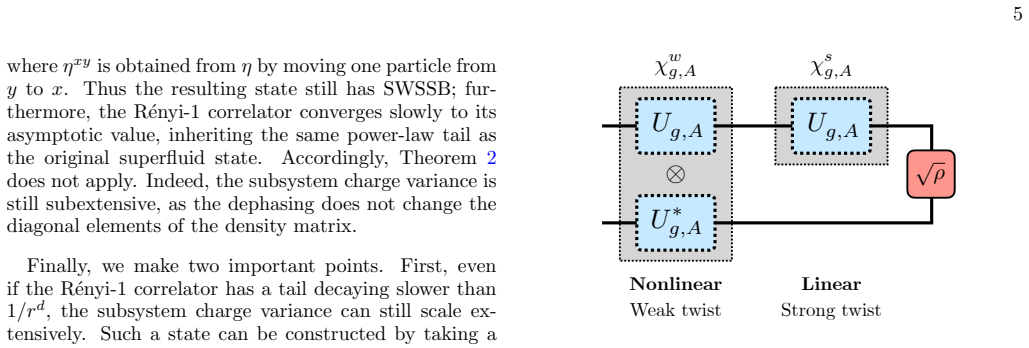
Strong-to-weak spontaneous symmetry breaking (SWSSB) is diagnosed by nonlinear correlators, but its direct static implication for conserved charge fluctuations is not automatic. We show that, for continuous symmetries, long-range R\'enyi-1 correlator, together with a sufficiently rapid approach to its nonzero asymptotic value, forces subsystem charge indefiniteness: the block-charge variance has an extensive lower bound; equivalently, the truncated symmetry expectation has extensive curvature. This gives a precise static fluctuation footprint of charge scrambling. We construct examples to show that the implication is conditional and non-reversible: dephased superfluids retain R\'enyi-1 SWSSB with subextensive charge variance when the R\'enyi-1 tail is too slow, while sparse fixed-charge projectors have extensive charge variance but no local charge-transfer R\'enyi-1 order or long-range conditional mutual information. Finally, we introduce a \emph{twist overlap} correlator, which serves as an analogue of charge variance applicable to both discrete and continuous symmetries. This naturally decomposes local block-charge fluctuations into strong- and weak-symmetry channels. We found that the weak-symmetry channel isolates coherent charge fluctuations and is directly related to the Wigner--Yanase skew information. Taken together, these results give a unified understanding for distinguishing nonlinear SWSSB order, local charge indefiniteness, and coherent charge fluctuations.
Editorial analysis
A structured set of objections, weighed in public.
Referee Report
Summary. The manuscript shows that for continuous symmetries, a long-range Rényi-1 correlator approaching its nonzero asymptotic value sufficiently rapidly implies an extensive lower bound on block-charge variance (equivalently, extensive curvature of the truncated symmetry expectation). This supplies a static fluctuation signature of charge scrambling in strong-to-weak spontaneous symmetry breaking. Counterexamples establish that the implication is conditional and non-reversible: dephased superfluids retain Rényi-1 SWSSB with subextensive variance when the tail decays too slowly, while sparse fixed-charge projectors exhibit extensive variance without local Rényi-1 order. The authors introduce a twist-overlap correlator that decomposes local charge fluctuations into strong- and weak-symmetry channels and relates the weak channel to the Wigner-Yanase skew information.
Significance. If the central implication holds, the work supplies a precise, falsifiable link between nonlinear SWSSB diagnostics and conserved-charge fluctuations, together with a symmetry-channel decomposition that applies to both continuous and discrete cases. The explicit counterexamples (dephased superfluids and sparse projectors) and the connection to skew information are concrete strengths that clarify distinctions among order, indefiniteness, and coherence. These results should be useful for classifying symmetry-protected phases and for diagnosing scrambling in many-body systems.
major comments (2)
- [Section deriving the variance lower bound from the Rényi-1 correlator] The positive implication (rapid Rényi-1 approach forces extensive variance) is stated as conditional on a quantitative rate; the manuscript should give an explicit bound (e.g., exponential decay faster than 1/r^α with α>1) in the theorem statement, because the counterexamples only demonstrate necessity of some rate and do not quantify the threshold.
- [Paragraph stating the equivalence for continuous symmetries] The equivalence between the extensive block-charge variance bound and extensive curvature of the truncated symmetry expectation is asserted to follow directly from the definitions for continuous symmetries; an explicit one-line derivation (or reference to the relevant identity) should be inserted to confirm there is no hidden assumption on the support of the charge distribution.
minor comments (3)
- [Abstract] The abstract packs three distinct results into its final sentence; splitting the sentence or adding a clause separator would improve readability.
- [Counterexample section] In the dephased-superfluid counterexample, state the precise form of the dephasing channel (e.g., local phase damping rate) so that the slow tail can be reproduced independently.
- [Definition of the twist overlap correlator] The twist-overlap correlator is defined via an auxiliary twist operator; add a short remark comparing its scaling to the standard Rényi-1 correlator when the symmetry is continuous.
Simulated Author's Rebuttal
We thank the referee for the positive assessment and constructive suggestions. We address each major comment below and will revise the manuscript accordingly.
read point-by-point responses
-
Referee: [Section deriving the variance lower bound from the Rényi-1 correlator] The positive implication (rapid Rényi-1 approach forces extensive variance) is stated as conditional on a quantitative rate; the manuscript should give an explicit bound (e.g., exponential decay faster than 1/r^α with α>1) in the theorem statement, because the counterexamples only demonstrate necessity of some rate and do not quantify the threshold.
Authors: We agree that an explicit quantitative rate strengthens the theorem. In the revised manuscript we will state a sufficient condition in the theorem, for example that the deviation of the Rényi-1 correlator from its asymptotic value decays at least as fast as O(r^{-1-ε}) for ε>0 (which is weaker than exponential but stronger than the counterexample tails). This makes the implication precise while preserving the counterexamples as demonstrations that the rate condition is necessary. revision: yes
-
Referee: [Paragraph stating the equivalence for continuous symmetries] The equivalence between the extensive block-charge variance bound and extensive curvature of the truncated symmetry expectation is asserted to follow directly from the definitions for continuous symmetries; an explicit one-line derivation (or reference to the relevant identity) should be inserted to confirm there is no hidden assumption on the support of the charge distribution.
Authors: We will insert the requested one-line derivation: for a continuous U(1) symmetry generated by the total charge Q, the curvature of the truncated expectation value is ∂²/∂θ² ⟨e^{iθ Q_A}⟩|_{θ=0} = -Var(Q_A), which holds by direct differentiation under the trace (no assumption on the support of the charge distribution is required beyond the existence of the generator). A reference to this standard identity will be added. revision: yes
Circularity Check
No significant circularity; derivation is self-contained
full rationale
The paper establishes a conditional implication: for continuous symmetries, a long-range Rényi-1 correlator that approaches its nonzero value sufficiently rapidly implies an extensive lower bound on block-charge variance (equivalently, extensive curvature in the truncated symmetry expectation). This follows directly from the definitions of the quantities involved, with the rapidity condition stated explicitly as necessary. Counterexamples (dephased superfluids with slow tails and sparse projectors) are constructed to demonstrate that the implication is non-reversible and does not hold without the condition. No load-bearing step reduces by construction to a fitted parameter, self-definition, or self-citation chain; the twist overlap correlator is introduced as a new diagnostic that decomposes fluctuations without circular renaming or ansatz smuggling. The central claim remains independent of its inputs.
Axiom & Free-Parameter Ledger
axioms (1)
- domain assumption Systems possess continuous symmetries such as U(1).
invented entities (1)
-
twist overlap correlator
no independent evidence
Reference graph
Works this paper leans on
-
[1]
Buˇ ca and T
B. Buˇ ca and T. Prosen, A note on symmetry reductions of the lindblad equation: transport in constrained open spin chains, New Journal of Physics14, 073007 (2012)
2012
-
[2]
V. V. Albert and L. Jiang, Symmetries and conserved quantities in lindblad master equations, Phys. Rev. A 89, 022118 (2014)
2014
-
[3]
J. Y. Lee, C.-M. Jian, and C. Xu, Quantum criticality under decoherence or weak measurement, PRX Quantum 4, 030317 (2023)
2023
-
[4]
Ogunnaike, J
O. Ogunnaike, J. Feldmeier, and J. Y. Lee, Unify- ing emergent hydrodynamics and lindbladian low-energy spectra across symmetries, constraints, and long-range interactions, Phys. Rev. Lett.131, 220403 (2023)
2023
- [5]
-
[6]
P. Sala, S. Gopalakrishnan, M. Oshikawa, and Y. You, Spontaneous strong symmetry breaking in open sys- tems: Purification perspective, Phys. Rev. B110, 155150 (2024)
2024
-
[7]
L. A. Lessa, R. Ma, J.-H. Zhang, Z. Bi, M. Cheng, and C. Wang, Strong-to-weak spontaneous symmetry breaking in mixed quantum states, PRX Quantum6, 10.1103/prxquantum.6.010344 (2025)
-
[8]
Y. Kuno, T. Orito, and I. Ichinose, Strong-to-weak sym- metry breaking states in stochastic dephasing stabilizer circuits, Phys. Rev. B110, 094106 (2024)
2024
-
[9]
D. Gu, Z. Wang, and Z. Wang, Spontaneous symmetry breaking in open quantum systems: Strong, weak, and strong-to-weak, Phys. Rev. B112, 245123 (2025)
2025
- [10]
-
[11]
J. Y. Lee, Y.-Z. You, and C. Xu, Symmetry protected topological phases under decoherence, Quantum9, 1607 (2025)
2025
-
[12]
L. Chen, N. Sun, and P. Zhang, Strong-to-weak symme- try breaking and entanglement transitions, Phys. Rev. B 111, L060304 (2025)
2025
-
[13]
Z. Liu, L. Chen, Y. Zhang, S. Zhou, and P. Zhang, Diag- nosing strong-to-weak symmetry breaking via wightman correlators, Communications Physics8, 274 (2025)
2025
-
[15]
Zhang, Y
C. Zhang, Y. Xu, J.-H. Zhang, C. Xu, Z. Bi, and Z.-X. Luo, Strong-to-weak spontaneous breaking of 1- form symmetry and intrinsically mixed topological order, Phys. Rev. B111, 115137 (2025)
2025
-
[16]
X. Feng, Z. Cheng, and M. Ippoliti, Hardness of observ- ing strong-to-weak symmetry breaking, Phys. Rev. Lett. 135, 200402 (2025)
2025
-
[17]
Y. Kuno, T. Orito, and I. Ichinose, Intrinsic mixed-state topological order in a stabilizer system under stochas- tic decoherence: Strong-to-weak spontaneous symmetry breaking from a percolation point of view, Phys. Rev. B 111, 064111 (2025)
2025
-
[18]
Y. Guo, S. Yang, and X.-J. Yu, Quantum strong- to-weak spontaneous symmetry breaking in decohered one-dimensional critical states, PRX Quantum6, 10.1103/4vs5-l54f (2025)
-
[19]
N. Ziereis, S. Moudgalya, and M. Knap, Strong-to-weak symmetry breaking phases in steady states of quan- tum operations (2025), arXiv:2509.09669 [cond-mat.stat- mech]
- [20]
-
[21]
Holographically Emergent Gauge Theory in Symmetric Quantum Circuits
A. Vijay and J. Y. Lee, Holographically emergent gauge theory in symmetric quantum circuits (2025), arXiv:2511.21685 [quant-ph]
work page internal anchor Pith review arXiv 2025
-
[22]
A. Vijay and J. Y. Lee, Information critical phases under decoherence (2025), arXiv:2512.22121 [quant-ph]
- [23]
-
[24]
Y. Kusuki, S. Pal, and H. Tajima, Resource-theoretic quantifiers of weak and strong symmetry breaking: Strong entanglement asymmetry and beyond (2026), arXiv:2601.20924 [hep-th]
work page internal anchor Pith review Pith/arXiv arXiv 2026
- [25]
-
[26]
Moudgalya and O
S. Moudgalya and O. I. Motrunich, Symmetries as ground states of local superoperators: Hydrodynamic implica- tions, PRX Quantum5, 040330 (2024)
2024
-
[27]
C. O. Akyuz, G. Goon, and R. Penco, The schwinger- keldysh coset construction, Journal of High Energy Physics2024, 10.1007/jhep06(2024)004 (2024)
-
[28]
L. V. Delacr´ etaz, A bound on thermalization from diffu- sive fluctuations, Nature Physics21, 669 (2025)
2025
-
[29]
Huang, M
X. Huang, M. Qi, J.-H. Zhang, and A. Lucas, Hy- drodynamics as the effective field theory of strong-to- weak spontaneous symmetry breaking, Phys. Rev. B111, 125147 (2025)
2025
- [30]
-
[31]
Barratt, U
F. Barratt, U. Agrawal, A. C. Potter, S. Gopalakrishnan, and R. Vasseur, Transitions in the learnability of global 8 charges from local measurements, Phys. Rev. Lett.129, 200602 (2022)
2022
-
[32]
Agrawal, A
U. Agrawal, A. Zabalo, K. Chen, J. H. Wilson, A. C. Potter, J. H. Pixley, S. Gopalakrishnan, and R. Vasseur, Entanglement and charge-sharpening transitions in u(1) symmetric monitored quantum circuits, Phys. Rev. X12, 041002 (2022)
2022
-
[33]
H. Singh, R. Vasseur, A. C. Potter, and S. Gopalakr- ishnan, Mixed-state learnability transitions in moni- tored noisy quantum dynamics, Physical Review B113, 10.1103/6b9y-scyz (2026)
-
[34]
E. P. Wigner and M. M. Yanase, Information Contents of Distributions, Proceedings of the National Academy of Science49, 910 (1963)
1963
-
[35]
S. L. Luo, Quantum versus classical uncertainty, Theo- retical and Mathematical Physics143, 681 (2005)
2005
-
[36]
Hansen, Metric adjusted skew information, Proceed- ings of the National Academy of Sciences105, 9909–9916 (2008)
F. Hansen, Metric adjusted skew information, Proceed- ings of the National Academy of Sciences105, 9909–9916 (2008)
2008
-
[37]
[38]Tdenotes the transpose in the occupation-number basis used to define the vectorization
But it does not mean thatQ + is the strong symmetry generator. [38]Tdenotes the transpose in the occupation-number basis used to define the vectorization. In this basisc T x =c † x be- cause the matrix elements ofc x are real. Thusc T x creates charge on the second copy: [Q T , cT x ] =c T x . The state- ment is basis-dependent; what is basis-independent ...
-
[38]
Generalization to anyO(1) charge transfer case is straightforward
-
[39]
H. P. Robertson, The uncertainty principle, Phys. Rev. 34, 163 (1929)
1929
-
[40]
H. Yoshida, Uniqueness of steady states of gorini- kossakowski-sudarshan-lindblad equations: A sim- ple proof, Physical Review A109, 10.1103/phys- reva.109.022218 (2024)
-
[41]
More precisely, this is the superposition of extremal states as the local order parameter vanishes
-
[42]
Rachel, N
S. Rachel, N. Laflorencie, H. F. Song, and K. Le Hur, Detecting quantum critical points using bipartite fluctu- ations, Phys. Rev. Lett.108, 116401 (2012)
2012
-
[43]
L. P. Kadanoff and H. Ceva, Determination of an oper- ator algebra for the two-dimensional ising model, Phys. Rev. B3, 3918 (1971)
1971
-
[44]
Fradkin, Disorder operators and their descendants, Journal of Statistical Physics167, 427 (2017)
E. Fradkin, Disorder operators and their descendants, Journal of Statistical Physics167, 427 (2017)
2017
-
[45]
Levin, Constraints on order and disorder parameters in quantum spin chains, Communications in Mathemat- ical Physics378, 1081–1106 (2020)
M. Levin, Constraints on order and disorder parameters in quantum spin chains, Communications in Mathemat- ical Physics378, 1081–1106 (2020)
2020
-
[46]
Marvian and R
I. Marvian and R. W. Spekkens, The theory of manipula- tions of pure state asymmetry: I. basic tools, equivalence classes and single copy transformations, New Journal of Physics15, 033001 (2013)
2013
-
[47]
Gibilisco, D
P. Gibilisco, D. Imparato, and T. Isola, Inequalities for quantum fisher information, Proceedings of the American Mathematical Society137, 317 (2009)
2009
-
[48]
S. Wang, T. G. Kiely, D. Tell, J. Obermeyer, M. Baren- dregt, P. Bojovi´ c, P. M. Preiss, A. Sarma, T. Franz, M. P. A. Fisher, C. Xu, and I. Bloch, Observation of strong-to-weak spontaneous symmetry breaking in a dephased fermi gas (2026), arXiv:2604.16137 [cond- mat.quant-gas]. 9 CONTENTS I. Introduction 1 II. Main Result 2 III. Twist overlap 5 IV. Discu...
work page internal anchor Pith review Pith/arXiv arXiv 2026
-
[49]
Vanishing R´ enyi-1 Order yet Extensive Subsystem Charge Variance 11
-
[50]
diagonal
Conditional mutual information: sparse projectors versus the uniform ensemble. 15 D. Structure Factor 18 Appendix A: Doubled Hilbert space For simplicity, here we assumeGis a finite Abelian symmetry group with unitary representationU g on a Hilbert spaceH. SinceGis Abelian,Hdecomposes into charge sectors H= M q∈ bG Hq,(A1) where bGis the character group. ...
-
[51]
X n Inyn 2 # = 1 r2
Vanishing R´ enyi-1 Order yet Extensive Subsystem Charge Variance In this appendix we show that the converse of Theorem 2 is false: extensive subsystem charge variance does not, by itself, imply SWSSB. The counterexample is a typical sparse classical projector inside a fixed-charge sector. Setup.Fix a filling fractionν, and consider a sequence of systems ...
-
[52]
fLaj8UvQG/94ZZtesO+I7rJ7k20=
Conditional mutual information: sparse projectors versus the uniform ensemble. Another important diagnostic of SWSSB is the von Neumann conditional mutual information (CMI)I(C:E|B) for a tripartition of the system into a center regionC, a shielding regionB, and an environment regionE: <latexit sha1_base64="fLaj8UvQG/94ZZtesO+I7rJ7k20=">AAAVhnicjZjbbtw2EIa...
discussion (0)
Sign in with ORCID, Apple, or X to comment. Anyone can read and Pith papers without signing in.