Recognition: unknown
The Reverse Tableaux: a Gateway to the Surjectivity of the Component Map
Pith reviewed 2026-05-10 03:32 UTC · model grok-4.3
The pith
Reverse tableaux factorize invariants to prove the surjectivity of the component map onto nilfibre components.
A machine-rendered reading of the paper's core claim, the machinery that carries it, and where it could break.
Core claim
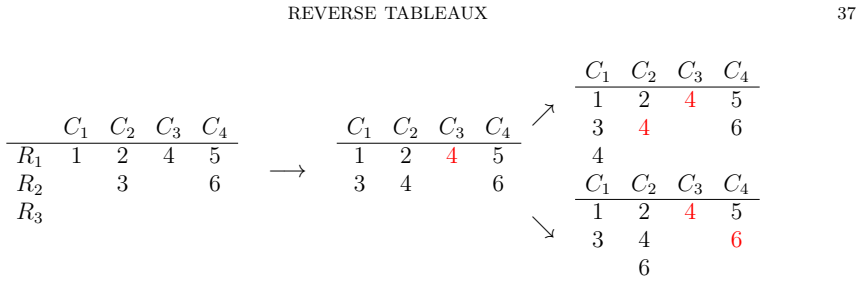
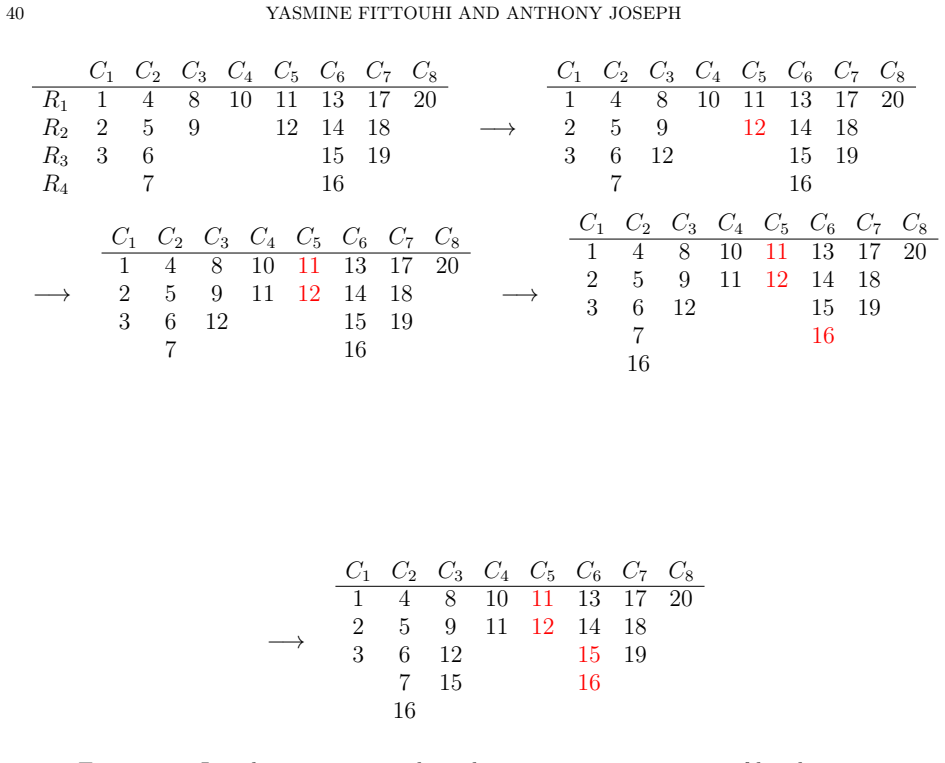
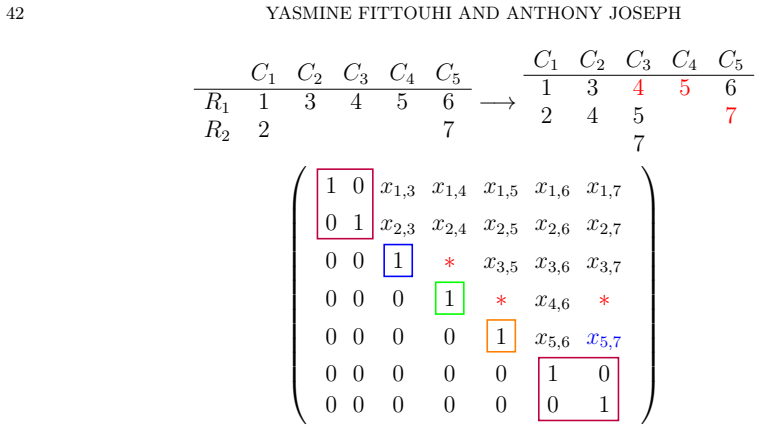
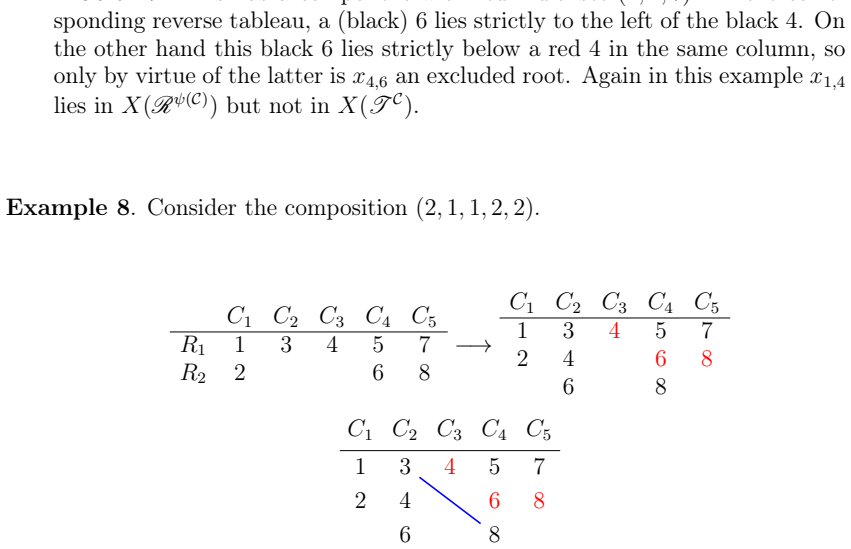
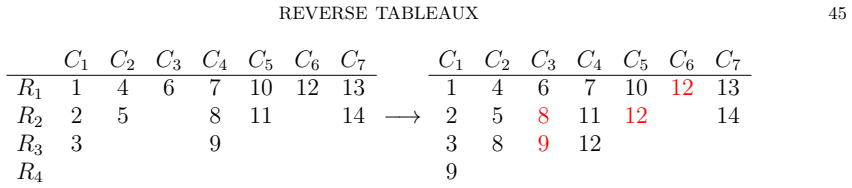
Reverse tableaux {R^{ψ(C)}} are constructed via an enabling proposition for each red set coming from combinatorial data C. They define exactly the same components C of the nilfibre N as the component tableaux do. In addition they supply a factorization of each new invariant in a chosen sequence by successive linearization of the preceding invariants. Krull's theorem applied to this factorization yields the surjectivity of the component map. Multiple reverse tableaux may exist for a single red set, yet each determines the same variety and the same component as the corresponding component tableau.
What carries the argument
The reverse tableaux associated to a red set, which enable factorization of invariants by successive linearization so that Krull's theorem applies directly to establish surjectivity.
If this is right
- The component map from tableaux to components is surjective, so combined with the earlier injectivity it is bijective.
- Several reverse tableaux may correspond to one red set while all still determine the identical variety and component.
- The extra flexibility in reverse tableaux, absent from the rigid component tableaux, is what makes the required factorizations possible.
- The method supplies a purely combinatorial-algebraic proof of surjectivity that does not rely on any geometric model of the nilcone.
- The Benlolo-Sanderson invariants continue to generate the semiinvariant algebra, and the new factorizations respect the polynomial structure given by Richardson's theorem.
Where Pith is reading between the lines
- If the enabling proposition extends beyond the present parabolic setting, similar factorizations could establish surjectivity for component maps in other nilpotent varieties.
- Red sets might function as a canonical, minimal combinatorial label for each component, simplifying classification tasks.
- The technique of successive linearization may expose algebraic relations among invariants that are invisible to geometric methods.
- This approach suggests that combinatorial objects can substitute for geometric data in other problems of invariant theory where direct geometry remains unavailable.
Load-bearing premise
The enabling proposition that guarantees a reverse tableau exists for every red set and that the successive linearizations produce a factorization to which Krull's theorem applies in this graded setting.
What would settle it
A red set for which no reverse tableau can be constructed, or a factorization obtained from linearization to which Krull's theorem does not imply surjectivity of the component map.
Figures





read the original abstract
Let $G$ be a simple algebraic group over $\mathbb C$, $B$ a fixed Borel subgroup, $P$ a parabolic subgroup, $P'$ its derived group acting on the Lie algebra $\mathfrak m$ of its nilradical. The nilfibre $\mathscr N$ is the zero locus of the augmentation $\mathcal I_+$ of the semiinvariant algebra $\mathcal I=\mathbb C[\mathfrak m]^{P'}$. Via Richardson's theorem, $\mathcal I$ is polynomial. Then the generators of $\mathcal I$ may be taken to be the Benlolo-Sanderson invariants \cite{BS}. In Y.Fittouhi and A.Joseph, The Magic and Mystery of Component Tableaux, Indag 2026, a set $\{\mathscr T^\mathcal C\}$ of component tableaux was constructed each encoding explicit combinatorial data $\mathcal C$. Each tableau $\{\mathscr T^\mathcal C\}$ defines a component $\mathscr C$ of $\mathscr N$ and the map $\{\mathscr T^\mathcal C\}\mapsto \mathscr C$ is injective. Here this data is simply encoded in a multiset called the Red Set. In the present work a set $\{\mathscr R^{\psi(\mathcal C)}\}$ of Reverse Tableaux is constructed through an Enabling Proposition. They define the same components as the component tableaux and furthermore give a factorisation of each new invariant in a chosen sequence via successive linearisation of preceding invariants. Via Krull's theorem this factorisation provides the required surjectivity. There can be several reverse tableaux for a given RedSet, yet each determine the same variety as the component tableaux with the given RedSet and define the same components. The flexibility of having several equivalent reverse tableaux absent from the more rigid component tableaux, is essential for factorisation This procedure is different from the classical approach to surjectivity requiring a \textit{geometric} description of the nilcone which seems unattainable. Nothing of this complexity has never been tackled before and the methods used here are entirely new
Editorial analysis
A structured set of objections, weighed in public.
Referee Report
Summary. The paper constructs a set of reverse tableaux {R^{ψ(C)}} via an Enabling Proposition for each Red Set associated to the component tableaux {T^C} from the authors' prior work. These reverse tableaux are claimed to define the same components of the nilfibre N as the component tableaux, while also providing a factorization of each new invariant in a chosen sequence through successive linearization of preceding invariants. The authors then invoke Krull's theorem on this factorization to establish surjectivity of the map from tableaux to components of N, noting the flexibility of multiple reverse tableaux per Red Set as essential for the factorization procedure.
Significance. If the Enabling Proposition and the factorization step are rigorously verified, the result would supply a combinatorial, algebraic route to surjectivity of the component map in the semiinvariant algebra I = C[m]^{P'} without requiring a geometric description of the nilcone. This builds directly on Richardson's theorem (that I is polynomial) and the Benlolo-Sanderson generators, offering a new perspective on the structure of nilfibre components that leverages the flexibility absent from the more rigid component tableaux.
major comments (2)
- Abstract (Enabling Proposition): The Enabling Proposition guaranteeing existence of reverse tableaux for every Red Set is referenced but neither stated explicitly nor exemplified; this proposition is load-bearing for the construction, the claim that reverse tableaux define the same components as component tableaux, and the subsequent factorization.
- Abstract (factorization and Krull step): The assertion that successive linearisation produces a factorization to which Krull's theorem applies directly is not supported by any verification that the linearised elements form a regular sequence in the graded semiinvariant algebra or that the height calculations in the successive quotients confirm the expected dimensions of the zero loci; this is required to ensure every component of the nilfibre is attained, especially given the graded setting and potential associated primes.
minor comments (2)
- Abstract, final sentence: The phrasing 'Nothing of this complexity has never been tackled before' contains a double negative and should be corrected to 'Nothing of this complexity has ever been tackled before'.
- Abstract: The heavy dependence on the prior paper for definitions of component tableaux, Red Sets, and Benlolo-Sanderson generators would benefit from brief self-contained reminders or a short preliminary section to improve readability.
Simulated Author's Rebuttal
We thank the referee for their thorough and constructive report. The comments identify important points where additional explicitness and verification will strengthen the manuscript. We address each major comment below and will incorporate the necessary revisions.
read point-by-point responses
-
Referee: Abstract (Enabling Proposition): The Enabling Proposition guaranteeing existence of reverse tableaux for every Red Set is referenced but neither stated explicitly nor exemplified; this proposition is load-bearing for the construction, the claim that reverse tableaux define the same components as component tableaux, and the subsequent factorization.
Authors: We agree that the Enabling Proposition requires explicit statement and an illustrative example to make its central role transparent. The proposition itself, together with its proof, appears in Section 3 of the full manuscript; however, the abstract only alludes to it. We will revise the abstract to include a concise formulation of the Enabling Proposition and add a short worked example in the introduction showing the construction of a reverse tableau from a given Red Set. This will also clarify why multiple reverse tableaux per Red Set are admissible while still determining the same component. revision: yes
-
Referee: Abstract (factorization and Krull step): The assertion that successive linearisation produces a factorization to which Krull's theorem applies directly is not supported by any verification that the linearised elements form a regular sequence in the graded semiinvariant algebra or that the height calculations in the successive quotients confirm the expected dimensions of the zero loci; this is required to ensure every component of the nilfibre is attained, especially given the graded setting and potential associated primes.
Authors: The referee correctly notes that an explicit check of the regular-sequence property and the resulting height computations is needed for a fully rigorous application of Krull's theorem in the graded setting. The combinatorial construction via reverse tableaux is designed so that each successive linearised invariant remains regular in the quotient by the preceding ones, with codimensions matching the expected dimensions of the components; this follows from the grading on the Benlolo-Sanderson generators and the structure of the Red Sets. To address the concern directly, we will insert a new subsection (immediately following the factorization construction) that proves the sequence is regular, computes the successive heights, and confirms that no extraneous associated primes arise that would prevent the zero loci from coinciding with the desired components of the nilfibre. revision: yes
Circularity Check
No significant circularity in derivation of surjectivity via reverse tableaux and Krull's theorem
full rationale
The paper's central claim establishes surjectivity of the component map by constructing reverse tableaux through a new Enabling Proposition, obtaining a factorization of invariants via successive linearisation, and invoking Krull's theorem on the resulting sequence in the graded semiinvariant algebra. While the abstract references the authors' prior work for the component tableaux, Red Set encoding, and injectivity of the map, this supplies setup and the injective direction rather than reducing the surjectivity result to an input by construction. External theorems (Richardson's polynomiality of I, Krull's height theorem) and the novel combinatorial objects provide independent content. No equations, definitions, or steps in the provided text exhibit self-definitional collapse, fitted inputs renamed as predictions, or load-bearing self-citations that force the conclusion. The derivation chain therefore remains self-contained against external benchmarks.
Axiom & Free-Parameter Ledger
axioms (2)
- standard math Richardson's theorem that the semiinvariant algebra I is polynomial
- standard math Krull's theorem that a factorization of invariants implies surjectivity of the component map
invented entities (2)
-
Reverse Tableaux
no independent evidence
-
Red Set
no independent evidence
Forward citations
Cited by 1 Pith paper
-
Reverse Tableaux and the Surjectivity of the Component Map in Type $A$
The component map φ from component tableaux to Irr(N) is surjective, established via factorization of the Benlolo-Sanderson invariants into products indexed by pseudo-neighbouring column pairs.
Reference graph
Works this paper leans on
-
[1]
M. F. Atiyah and I. G. Macdonald, Introduction to commutative algebra, Addison-Wesley Ser. Math. Westview Press, Boulder, CO, 2016
2016
-
[2]
Benlolo, and Y
E. Benlolo, and Y. B. Sanderson, On the hypersurface orbital varieties ofsl(N,C). J. Algebra 245 (2001), no. 1, 225—246
2001
-
[3]
Borho, P
W. Borho, P. Gabriel and R. Rentschler: Primideale in Einhüllenden auflösbarer Lie-algebren, LN 357, Springer-Verlag, Berlin-Heidelberg-New York, 1973
1973
-
[4]
Dixmier, Algèbres enveloppantes
J. Dixmier, Algèbres enveloppantes. (French) Cahiers Scientifiques, Fasc. XXXVII. Gauthier-Villars Éditeur, Paris-Brussels-Montreal, Que., 1974
1974
-
[5]
Fittouhi and A
Y. Fittouhi and A. Joseph, Weierstrass sections for Parabolic adjoint actions in typeA, J. Algebra 618 (2023), 1–41
2023
-
[6]
Fittouhi and A
Y. Fittouhi and A. Joseph, Parabolic adjoint action, Weierstrass sections and components of the nilfibre in typeA, Indag Math., online January 2026
2026
-
[7]
Fittouhi and A
Y. Fittouhi and A. Joseph, The canonical compoent of the nilfibre for parabolic adjoint action, Weier- strass sections in typeA, Journal of Algebraic Combinatorics, 59, (2024), 523-559
2024
-
[8]
Fittouhi and A
Y. Fittouhi and A. Joseph, The Composition Tableau and Reconstruction of the Canonical Weierstrass Section for Parabolic Adjoint Action in typeA, J. Algebra 632(2023), 1–30
2023
-
[9]
Fittouhi and A
Y. Fittouhi and A. Joseph, The Magic and Mystery of Component Tableaux, Indag. Math., online January 2026
2026
-
[10]
Fittouhi and A
Y. Fittouhi and A. Joseph, The Reverse Tableau. A Gateway to the Surjectivity of the Component Map - Redressing. Unpublished but available on
-
[11]
Fittouhi and A
Y. Fittouhi and A. Joseph, L’ensemble Rouge (In Preparation)
-
[12]
Joseph and A
A. Joseph and A. Melnikov, Quantization of hypersurface orbital varieties insl(n), Progr. Math., 213, Birkhäuser Boston, Inc., Boston, MA, 2003, 165–196
2003
-
[13]
Math., 34, 1979, no
B/ Kostant, The solution to a generalized Toda lattice and representation theory, Adv. Math., 34, 1979, no. 3, 195–338
1979
-
[14]
Perelman, Quantization of hypersurface orbital varieties in simple Lie algebras of classical types, Thesis, Weizmann Institute 2003
E. Perelman, Quantization of hypersurface orbital varieties in simple Lie algebras of classical types, Thesis, Weizmann Institute 2003
2003
-
[15]
Spaltenstein, On the fixed point set of a unipotent element on the variety of Borel subgroups
N. Spaltenstein, On the fixed point set of a unipotent element on the variety of Borel subgroups. Topology 16 (1977), no. 2, 203—204
1977
-
[16]
Steinberg, An occurrence of the Robinson-Schensted correspondence, J
R. Steinberg, An occurrence of the Robinson-Schensted correspondence, J. Algebra 113 (1988), no. 2, 523–528
1988
discussion (0)
Sign in with ORCID, Apple, or X to comment. Anyone can read and Pith papers without signing in.