Recognition: unknown
Tensor network surrogate models for variational quantum computation
Pith reviewed 2026-05-10 00:45 UTC · model grok-4.3
The pith
Tensor networks simulate deep QAOA circuits on large 2D lattices and train better variational parameters than small-to-large transfer.
A machine-rendered reading of the paper's core claim, the machinery that carries it, and where it could break.
Core claim
We adopt a two-dimensional tensor-network (TN) ansatz to simulate variational quantum algorithms on two-dimensional qubit architectures, demonstrating its capability to accurately simulate deep circuits through the Quantum Approximate Optimization Algorithm (QAOA) applied to Ising spin-glass problems on heavy-hexagonal and square lattices. For heavy-hexagonal problems with up to three-body interactions, parameters trained on small instances and transferred to systems an order of magnitude larger improve the sampled energy distribution only up to intermediate depths, indicating a fundamental limit of parameter concentration as a transfer strategy. By extending the training itself with TN simu
What carries the argument
The two-dimensional tensor-network ansatz with moderate bond dimension, which reproduces the entanglement structure and sampling statistics of QAOA circuits for the Ising problems.
If this is right
- Parameters transferred from small to large heavy-hexagonal instances improve sampled energies only up to intermediate circuit depths.
- Performing the variational training itself inside the TN simulation on larger sizes avoids local minima and yields lower energies.
- Entanglement growth and importance sampling remain controlled enough for classical feasibility at moderate bond dimension.
- Parameter concentration persists on square lattices, though reliable sampling becomes substantially more expensive.
Where Pith is reading between the lines
- The surrogate approach could support iterative hybrid loops in which classical TN optimization scales variational training beyond current quantum hardware sizes.
- Observed depth-dependent limits on parameter transfer imply that optimal circuit depths may need to be chosen with system size in mind.
- The framework could be applied to other variational algorithms or lattice connectivities to test how widely the surrogate training benefit holds.
Load-bearing premise
The two-dimensional tensor-network ansatz with moderate bond dimension accurately captures the entanglement structure and sampling statistics of the QAOA circuits for the Ising spin-glass problems considered.
What would settle it
Running the same TN simulations at substantially higher bond dimension on the largest lattices and checking whether the obtained energy distributions or trained parameters change would directly test whether the moderate-bond ansatz remains accurate.
Figures



read the original abstract
We adopt a two-dimensional tensor-network (TN) ansatz to simulate variational quantum algorithms on two-dimensional qubit architectures, demonstrating its capability to accurately simulate deep circuits through the Quantum Approximate Optimization Algorithm (QAOA) applied to Ising spin-glass problems on heavy-hexagonal and square lattices. For heavy-hexagonal problems with up to three-body interactions, parameters trained on small instances and transferred to systems an order of magnitude larger improve the sampled energy distribution only up to intermediate depths, indicating a fundamental limit of parameter concentration as a transfer strategy. By extending the training itself with TN simulations on larger system sizes, we avoid local minima and obtain lower-energy samples. Analyses of entanglement growth and importance sampling show that the simulation remains classically feasible with moderate bond dimension. We find that parameter concentration also persists on square lattices, albeit at substantially higher computational cost to perform reliable sampling. Overall, our TN framework not only provides an efficient and controlled framework for benchmarking variational quantum algorithms on two-dimensional lattices, but also serves as an effective surrogate model for training variational algorithms.
Editorial analysis
A structured set of objections, weighed in public.
Referee Report
Summary. The paper adopts a two-dimensional tensor-network (TN) ansatz to simulate variational quantum algorithms on 2D qubit lattices, focusing on QAOA applied to Ising spin-glass problems with up to three-body interactions on heavy-hexagonal and square lattices. It demonstrates that parameters trained on small instances can be transferred to systems an order of magnitude larger, improving sampled energy distributions up to intermediate circuit depths (limited by parameter concentration), while extending TN-based training to larger sizes avoids local minima and yields lower-energy samples. Entanglement growth and importance sampling analyses indicate that moderate bond dimensions keep the simulation classically feasible. The TN framework is positioned as both an efficient benchmarking tool for VQAs on 2D lattices and an effective surrogate model for training variational algorithms.
Significance. If the TN approximations are shown to faithfully reproduce the target QAOA statistics, the work would provide a valuable classical surrogate for studying and optimizing VQAs beyond exact simulability on 2D lattices, with direct implications for understanding parameter concentration and improving variational training. The entanglement and sampling analyses are a strength, as they explicitly tie computational cost to circuit properties and support the feasibility claim.
major comments (3)
- [Abstract] Abstract and results sections: The central claim that the 2D TN serves as an effective surrogate model for training variational algorithms requires that moderate bond dimension accurately captures the QAOA entanglement structure and output sampling statistics for the Ising instances considered, yet no quantitative validation metrics (fidelity, energy error, or distribution overlap) against exact statevector simulations are reported even on the smallest lattices where such comparisons are feasible.
- [Results] Heavy-hexagonal lattice results: The reported improvement in sampled energy distributions from transferred parameters (only up to intermediate depths) lacks explicit baselines (e.g., random initialization or direct large-system optimization) and error quantification, making it difficult to assess whether the gains are statistically significant or robust to the TN approximation.
- [Entanglement analysis] Entanglement growth analysis: While the paper uses entanglement growth to justify moderate bond dimension, specific values of bond dimension employed, convergence tests with increasing bond dimension, and the resulting approximation error on observables are not quantified, which is load-bearing for the feasibility and surrogate claims.
minor comments (2)
- [Methods] Clarify the precise TN contraction scheme and importance sampling procedure in the methods section to allow reproducibility.
- [Figures] Include error bars or statistical details on the sampled energy distributions in all relevant figures.
Simulated Author's Rebuttal
We thank the referee for their constructive and detailed comments, which highlight important aspects for strengthening the validation of our tensor-network surrogate approach. We have revised the manuscript to incorporate quantitative metrics, baselines, and convergence analyses as requested, thereby providing stronger support for the claims regarding accuracy and feasibility.
read point-by-point responses
-
Referee: [Abstract] Abstract and results sections: The central claim that the 2D TN serves as an effective surrogate model for training variational algorithms requires that moderate bond dimension accurately captures the QAOA entanglement structure and output sampling statistics for the Ising instances considered, yet no quantitative validation metrics (fidelity, energy error, or distribution overlap) against exact statevector simulations are reported even on the smallest lattices where such comparisons are feasible.
Authors: We agree that quantitative validation against exact simulations is necessary to substantiate the surrogate-model claim. In the revised manuscript we add direct comparisons on the smallest lattices (2x2 and 3x3 heavy-hexagonal) where exact state-vector simulation remains feasible. We report state fidelity, relative energy error, and distribution overlap (total-variation distance) between the TN and exact output statistics at representative depths. These metrics confirm that the moderate bond dimensions employed (D=4–6) reproduce the relevant entanglement structure and sampling statistics to high accuracy, thereby supporting the use of the TN as a faithful surrogate. revision: yes
-
Referee: [Results] Heavy-hexagonal lattice results: The reported improvement in sampled energy distributions from transferred parameters (only up to intermediate depths) lacks explicit baselines (e.g., random initialization or direct large-system optimization) and error quantification, making it difficult to assess whether the gains are statistically significant or robust to the TN approximation.
Authors: We have added the requested baselines and error quantification. The revised results section now includes (i) random-parameter initialization on the large instances and (ii) direct TN optimization performed on the same large systems. Statistical uncertainties are reported from multiple independent optimization runs (typically 10–20 seeds). The transferred-parameter improvements remain statistically significant up to intermediate depths; beyond this regime the gains saturate, consistent with the parameter-concentration phenomenon we analyze. The added baselines also demonstrate that the observed gains exceed the scale of the TN approximation error. revision: yes
-
Referee: [Entanglement analysis] Entanglement growth analysis: While the paper uses entanglement growth to justify moderate bond dimension, specific values of bond dimension employed, convergence tests with increasing bond dimension, and the resulting approximation error on observables are not quantified, which is load-bearing for the feasibility and surrogate claims.
Authors: We have expanded the entanglement and sampling section to provide the missing quantification. We now state the bond dimensions used for each depth and lattice size, include convergence plots of energy and magnetization versus increasing bond dimension (showing saturation at moderate D), and report the absolute approximation error on these observables for the small lattices where exact reference data exist (error <1 % at the D values employed). These additions directly link the entanglement-growth analysis to the computational cost and to the accuracy of the surrogate model. revision: yes
Circularity Check
No significant circularity in the TN surrogate model for QAOA
full rationale
The paper's claims rest on numerical simulations of QAOA circuits using a 2D tensor-network ansatz, with direct analyses of entanglement growth, importance sampling, and energy distributions on small-to-large lattices. No equations or steps reduce predictions by construction to fitted parameters, self-citations, or ansatzes imported from the authors' prior work. The surrogate training is performed explicitly via TN contraction on the target system sizes, and feasibility is justified by entanglement scaling rather than any self-referential definition. This is a standard application of TN methods to benchmark and extend variational algorithms, self-contained against external exact methods on small instances.
Axiom & Free-Parameter Ledger
free parameters (1)
- bond dimension
axioms (1)
- domain assumption Tensor networks with moderate bond dimension can faithfully represent the quantum states produced by QAOA circuits on 2D lattices for the spin-glass instances considered.
Forward citations
Cited by 1 Pith paper
-
Local tensor-train surrogates for quantum learning models
Local tensor-train surrogates approximate quantum machine learning models via Taylor polynomials and tensor networks, delivering polynomial parameter scaling and explicit generalization bounds controlled by patch radius.
Reference graph
Works this paper leans on
-
[1]
The data are obtained with bond dimensionχ= 32, amplitude-MPS rankR m =χ, and norm-MPS rankRM = 1
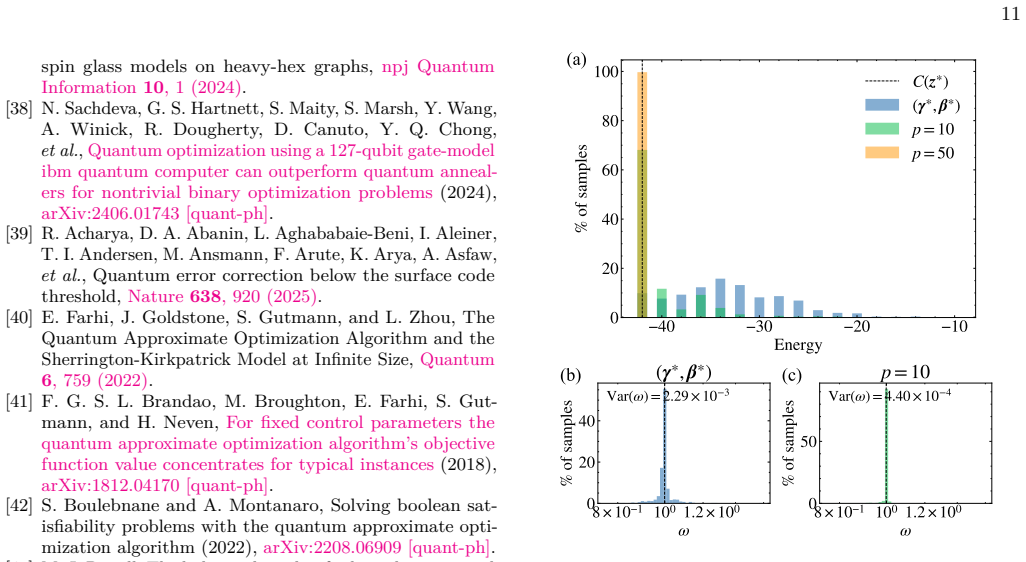
(b)–(e) Distributions of importance sampling weights ωfor( γ∗,β∗), p = 10,50, and100, respectively; the mean values of the weights are illustrated by vertical dashed lines, and the variances are indicated in the upper-left corner of each panel. The data are obtained with bond dimensionχ= 32, amplitude-MPS rankR m =χ, and norm-MPS rankRM = 1. contrast, Fig...
-
[2]
P. W. Shor, Polynomial-time algorithms for prime factor- ization and discrete logarithms on a quantum computer, SIAM Journal on Computing26, 1484 (1997)
1997
-
[3]
R. P. Feynman, Simulating physics with computers, Inter- national Journal of Theoretical Physics21, 467 (1982)
1982
-
[4]
Lloyd, Universal quantum simulators, Science273, 1073 (1996)
S. Lloyd, Universal quantum simulators, Science273, 1073 (1996)
1996
-
[5]
P. W. Shor, Scheme for reducing decoherence in quantum computer memory, Phys. Rev. A52, R2493 (1995)
1995
-
[6]
Y. Kim, A. Eddins, S. Anand, K. X. Wei, E. van den Berg, S. Rosenblatt, H. Nayfeh, Y. Wu, M. Zaletel,et al., Evidence for the utility of quantum computing before fault tolerance, Nature618, 500 (2023)
2023
-
[7]
A. D. King, J. Raymond, T. Lanting, R. Harris, A. Zucca, F. Altomare, A. J. Berkley, K. Boothby, S. Ejtemaee, et al., Quantum critical dynamics in a 5,000-qubit pro- grammable spin glass, Nature617, 61 (2023)
2023
-
[8]
A. D. King, A. Nocera, M. M. Rams, J. Dziarmaga, R. Wiersema, W. Bernoudy, J. Raymond, N. Kaushal, N. Heinsdorf,et al., Beyond-classical computation in quan- tum simulation, Science388, 199 (2025)
2025
-
[9]
Robledo-Moreno, M
J. Robledo-Moreno, M. Motta, H. Haas, A. Javadi-Abhari, P. Jurcevic, W. Kirby, S. Martiel, K. Sharma, S. Sharma, et al., Chemistry beyond the scale of exact diagonalization on a quantum-centric supercomputer, Science Advances 11, eadu9991 (2025)
2025
-
[10]
Tindall, M
J. Tindall, M. Fishman, E. M. Stoudenmire, and D. Sels, Efficient tensor network simulation of ibm’s eagle kicked ising experiment, PRX Quantum5, 010308 (2024)
2024
-
[11]
Patra, S
S. Patra, S. S. Jahromi, S. Singh, and R. Orús, Efficient tensor network simulation of ibm’s largest quantum pro- cessors, Phys. Rev. Res.6, 013326 (2024)
2024
-
[12]
Begušić, J
T. Begušić, J. Gray, and G. K.-L. Chan, Fast and con- verged classical simulations of evidence for the utility of quantum computing before fault tolerance, Science Advances10, eadk4321 (2024)
2024
-
[13]
J. Tindall, A. Mello, M. Fishman, M. Stoudenmire, and D. Sels, Dynamics of disordered quantum systems with two- and three-dimensional tensor networks (2025), arXiv:2503.05693 [quant-ph]
-
[14]
F. Hasselgren, M. O. Al-Hasso, A. Searle, J. Tindall, and M. von der Leyen, Probabilistic computing optimization of complex spin-glass topologies (2025), arXiv:2510.23419 [cond-mat.dis-nn]
-
[15]
D. A. Abanin, R. Acharya, L. Aghababaie-Beni, G. Aigeldinger, A. Ajoy, R. Alcaraz, I. Aleiner, T. I. An- dersen, M. Ansmann,et al., Observation of constructive interference at the edge of quantum ergodicity, Nature 646, 825 (2025)
2025
-
[16]
A Quantum Approximate Optimization Algorithm
E. Farhi, J. Goldstone, and S. Gutmann, A quantum ap- proximate optimization algorithm (2014), arXiv:1411.4028 [quant-ph]
work page internal anchor Pith review Pith/arXiv arXiv 2014
-
[17]
Cerezo, A
M. Cerezo, A. Arrasmith, R. Babbush, S. C. Benjamin, S. Endo, K. Fujii, J. R. McClean, K. Mitarai, X. Yuan, et al., Variational quantum algorithms, Nature Reviews Physics3, 625 (2021)
2021
-
[18]
Peruzzo, J
A. Peruzzo, J. McClean, P. Shadbolt, M.-H. Yung, X.-Q. Zhou, P. J. Love, A. Aspuru-Guzik, and J. L. O’Brien, A variational eigenvalue solver on a photonic quantum processor, Nature Communications5, 4213 (2014)
2014
-
[19]
Mitarai, M
K. Mitarai, M. Negoro, M. Kitagawa, and K. Fujii, Quan- tum circuit learning, Phys. Rev. A98, 032309 (2018)
2018
-
[20]
Farhi, J
E. Farhi, J. Goldstone, S. Gutmann, J. Lapan, A. Lund- gren, and D. Preda, A quantum adiabatic evolution al- gorithm applied to random instances of an np-complete problem, Science292, 472 (2001)
2001
-
[21]
Begušić, K
T. Begušić, K. Hejazi, and G. K.-L. Chan, Simulating quantum circuit expectation values by clifford perturba- tion theory, The Journal of Chemical Physics162, 154110 (2025)
2025
- [22]
-
[23]
Y. Shao, F. Wei, S. Cheng, and Z. Liu, Simulating noisy variational quantum algorithms: A polynomial approach, Phys. Rev. Lett.133, 120603 (2024)
2024
-
[24]
Quantum Convolutional Neural Networks are Effectively Classically Simulable
P. Bermejo, P. Braccia, M. S. Rudolph, Z. Holmes, L. Cincio, and M. Cerezo, Quantum convolutional neu- ral networks are effectively classically simulable (2026), arXiv:2408.12739 [quant-ph]
work page internal anchor Pith review Pith/arXiv arXiv 2026
-
[25]
S. Aaronson and A. Arkhipov, The computational com- plexity of linear optics (2010), arXiv:1011.3245 [quant-ph]
-
[26]
A. P. Lund, M. J. Bremner, and T. C. Ralph, Quan- tum sampling problems, bosonsampling and quantum supremacy, npj Quantum Information3, 15 (2017)
2017
-
[27]
Arute, K
F. Arute, K. Arya, R. Babbush, D. Bacon, J. C. Bardin, R. Barends, R. Biswas, S. Boixo, F. G. S. L. Brandao, et al., Quantum supremacy using a programmable super- conducting processor, Nature574, 505 (2019)
2019
-
[28]
Zlokapa, B
A. Zlokapa, B. Villalonga, S. Boixo, and D. A. Lidar, Boundaries of quantum supremacy via random circuit sampling, npj Quantum Information9, 36 (2023)
2023
-
[29]
A.Morvan, B.Villalonga, X.Mi, S.Mandrà, A.Bengtsson, P. V. Klimov, Z. Chen, S. Hong, C. Erickson,et al., Phase transitions in random circuit sampling, Nature634, 328 (2024)
2024
-
[30]
Pelofske, A
E. Pelofske, A. Bärtschi, and S. Eidenbenz, Quantum annealing vs. qaoa: 127 qubit higher-order ising prob- lems on nisq computers, inHigh Performance Computing (Springer Nature Switzerland, 2023) pp. 240–258
2023
-
[31]
Pelofske, A
E. Pelofske, A. Bärtschi, and S. Eidenbenz, Short-depth qaoa circuits and quantum annealing on higher-order ising models, npj Quantum Information10, 30 (2024)
2024
-
[32]
V. Akshay, D. Rabinovich, E. Campos, and J. Bia- monte, Parameter concentrations in quantum approxi- mate optimization, Physical Review A104, 10.1103/phys- reva.104.l010401 (2021)
-
[33]
A. Apte, S. H. Sureshbabu, R. Shaydulin, S. Boulebnane, Z. He, D. Herman, J. Sud, and M. Pistoia, Iterative inter- polation schedules for quantum approximate optimization algorithm (2025), arXiv:2504.01694 [quant-ph]
work page internal anchor Pith review Pith/arXiv arXiv 2025
-
[34]
Tindall and M
J. Tindall and M. Fishman, Gauging tensor networks with belief propagation, SciPost Phys.15, 222 (2023)
2023
-
[35]
Alkabetz and I
R. Alkabetz and I. Arad, Tensor networks contraction and the belief propagation algorithm, Phys. Rev. Res.3, 023073 (2021)
2021
-
[36]
Vieijra, J
T. Vieijra, J. Haegeman, F. Verstraete, and L. Van- derstraeten, Direct sampling of projected entangled-pair states, Phys. Rev. B104, 235141 (2021)
2021
- [37]
-
[38]
Pelofske, A
E. Pelofske, A. Bärtschi, L. Cincio, J. Golden, and S. Ei- denbenz, Scaling whole-chip qaoa for higher-order ising 11 spin glass models on heavy-hex graphs, npj Quantum Information10, 1 (2024)
2024
-
[39]
N. Sachdeva, G. S. Hartnett, S. Maity, S. Marsh, Y. Wang, A. Winick, R. Dougherty, D. Canuto, Y. Q. Chong, et al.,Quantumoptimizationusinga127-qubitgate-model ibm quantum computer can outperform quantum anneal- ers for nontrivial binary optimization problems (2024), arXiv:2406.01743 [quant-ph]
-
[40]
Acharya, D
R. Acharya, D. A. Abanin, L. Aghababaie-Beni, I. Aleiner, T. I. Andersen, M. Ansmann, F. Arute, K. Arya, A. Asfaw, et al., Quantum error correction below the surface code threshold, Nature638, 920 (2025)
2025
-
[41]
Farhi, J
E. Farhi, J. Goldstone, S. Gutmann, and L. Zhou, The Quantum Approximate Optimization Algorithm and the Sherrington-Kirkpatrick Model at Infinite Size, Quantum 6, 759 (2022)
2022
- [42]
-
[43]
S. Boulebnane and A. Montanaro, Solving boolean sat- isfiability problems with the quantum approximate opti- mization algorithm (2022), arXiv:2208.06909 [quant-ph]
-
[44]
M. J. Powell, The bobyqa algorithm for bound constrained optimization without derivatives, Cambridge NA Report NA2009/06, University of Cambridge, Cambridge26, 26 (2009)
2009
-
[45]
Leifer and D
M. Leifer and D. Poulin, Quantum graphical models and belief propagation, Annals of Physics323, 1899 (2008)
2008
-
[46]
S. Sahu and B. Swingle, Efficient tensor network simu- lation of quantum many-body physics on sparse graphs (2022), arXiv:2206.04701 [quant-ph]
-
[47]
C. Guo, D. Poletti, and I. Arad, Block belief propagation algorithm for two-dimensional tensor networks, Phys. Rev. B108, 125111 (2023)
2023
-
[48]
S. S. Jahromi and R. Orús, Universal tensor-network algorithm for any infinite lattice, Phys. Rev. B99, 195105 (2019)
2019
-
[49]
H. C. Jiang, Z. Y. Weng, and T. Xiang, Accurate determi- nation of tensor network state of quantum lattice models in two dimensions, Phys. Rev. Lett.101, 090603 (2008)
2008
-
[50]
S. T. Tokdar and R. E. Kass, Importance sampling: a review, WIREs Computational Statistics2, 54 (2010)
2010
-
[51]
E. Pelofske, M. Rams, A. Bärtschi, P. Czarnik, P. Brac- cia, L. Cincio, and S. Eidenbenz, Evaluating the lim- its of qaoa parameter transfer at high-rounds on sparse ising models with geometrically local cubic terms (2025), arXiv:2509.13528 [quant-ph]
work page internal anchor Pith review arXiv 2025
-
[52]
Rudolph, Armando Angrisani, Tyson Jones, M
S. Lerch, R. Puig, M. S. Rudolph, A. Angrisani, T. Jones, M. Cerezo, S. Thanasilp, and Z. Holmes, Efficient quantum-enhanced classical simulation for patches of quantum landscapes (2024), arXiv:2411.19896 [quant-ph]
-
[53]
R. Watanabe, J. Tindall, S. Miyakoshi, and H. Ueda, Quantum-inspired algorithm for classical spin hamil- tonians based on matrix product operators (2026), arXiv:2602.05224 [quant-ph]
-
[54]
C. Fan, M. Shen, Z. Nussinov, Z. Liu, Y. Sun, and Y.-Y. Liu, Searching for spin glass ground states through deep reinforcement learning, Nature Communications14, 725 (2023)
2023
-
[55]
opti- mal
M. Fishman, S. R. White, and E. M. Stoudenmire, The ITensor Software Library for Tensor Network Calculations, SciPost Phys. Codebases , 4 (2022). FIG. 8. (a)Histogram ofsampled energiesfor the27-qubit0th ibm_genevainstance in Ref. [29], where the minimum energy is C(z∗) =−42. The labels are the same as in Fig. 2(a). (b)-(c) Distributions of importance sam...
2022
discussion (0)
Sign in with ORCID, Apple, or X to comment. Anyone can read and Pith papers without signing in.