Recognition: unknown
An Analysis of Commutation-Based Trotter Ordering Strategies on Heisenberg-Style Hamiltonians
Pith reviewed 2026-05-08 08:27 UTC · model grok-4.3
The pith
Commutation graph coloring yields orderings that reduce true Trotter error for Heisenberg Hamiltonians.
A machine-rendered reading of the paper's core claim, the machinery that carries it, and where it could break.
Core claim
Commutation graphs of Heisenberg Hamiltonians possess exploitable structural properties that permit partitioning via graph coloring into sets of mutually commuting terms; when these partitions dictate the Trotter ordering, the measured approximation error on 1D and 2D Heisenberg systems is lower than that obtained from random or non-commutation-based orderings.
What carries the argument
The commutation graph, whose vertices are the individual Hamiltonian terms and whose edges connect pairs that fail to commute, with its proper colorings supplying the independent sets used to group and order Trotter steps.
If this is right
- For the studied Heisenberg classes the commutation graph admits colorings whose partitions can be used as Trotter orderings without further refinement.
- Empirical error measurements on 1D chains and 2D lattices confirm that these partitions outperform random and other baseline orderings.
- Structural theorems about the graphs supply a priori guarantees on the number and size of the commuting groups available for ordering.
- The method separates the combinatorial task of finding good orderings from the numerical task of estimating Trotter error.
Where Pith is reading between the lines
- The same graph-construction technique could be applied to other two-body or few-body spin models whose commutation relations are similarly local.
- Tighter a-priori error bounds might be derived by replacing generic Trotter formulas with ones that count only the non-commuting pairs remaining after coloring.
- The empirical gap between coloring-based and random orderings indicates that existing analytic Trotter bounds leave substantial room for improvement when commutation structure is taken into account.
Load-bearing premise
The commutation relations among the Hamiltonian terms are sufficient to determine orderings that minimize the actual Trotter error, so that graph-coloring partitions can be applied directly.
What would settle it
A concrete counter-example would be a 1D or 2D Heisenberg Hamiltonian for which some ordering not derived from a coloring of its commutation graph produces a strictly smaller measured Trotter error than every coloring-based ordering.
Figures


read the original abstract
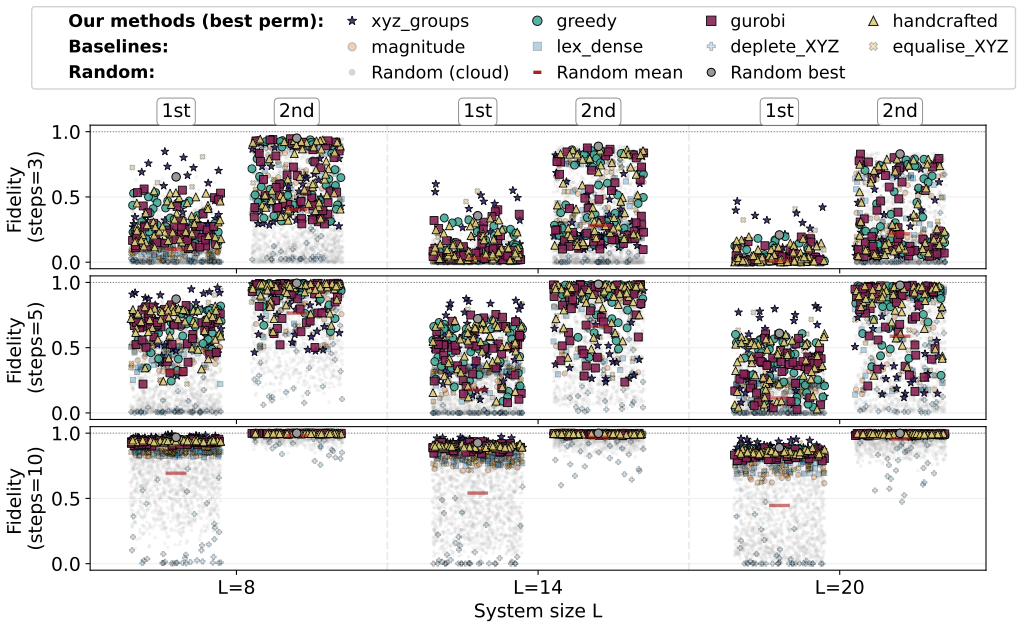
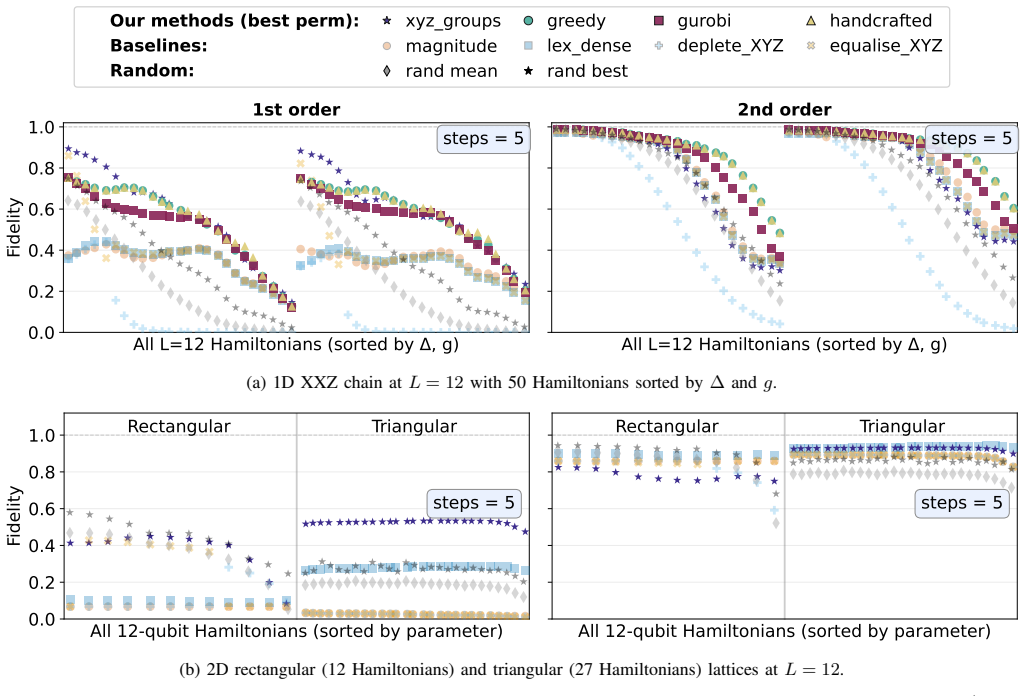
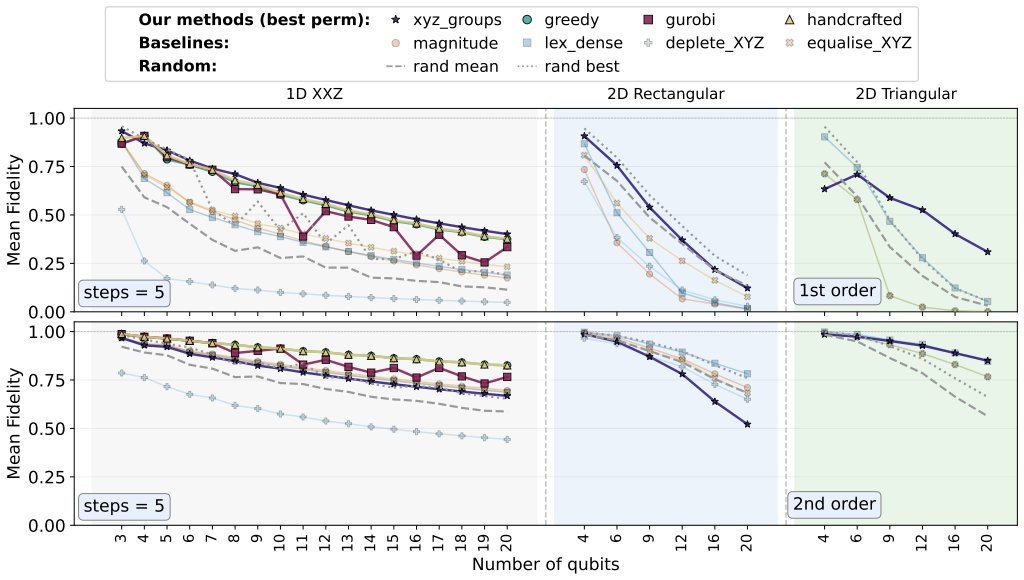
Trotterization is a technique that allows one to approximate a time evolution of a Hamiltonian by repeatedly evolving the individual terms of the Hamiltonian one-at-a-time for small time durations. Bounds on the error of this approximation exist; however, they are typically loose and moreover, it is known that the true error can be greatly influenced by the order in which the terms of the Hamiltonian are evolved. In this work, we consider various ordering strategies that exploit the commutation structure of the Hamiltonian, in addition to a few other baseline ordering strategies. These commutation-based strategies involve dividing the terms of the Hamiltonian into groups where all the terms within each group commute with one another. These groupings can be obtained by using graph coloring techniques on what we call the "commutation graph" of the Hamiltonian. We prove various results regarding the structure and properties of such commutation graphs for certain classes of Hamiltonians. We also empirically calculate the (true) Trotter error using these ordering strategies on various 1D and 2D Heisenberg-style systems.
Editorial analysis
A structured set of objections, weighed in public.
Referee Report
Summary. The manuscript analyzes commutation-based ordering strategies for Trotterization of Heisenberg-style Hamiltonians. It defines a commutation graph whose vertices are Hamiltonian terms and edges connect non-commuting pairs, applies graph coloring to partition the terms into commuting groups for simultaneous evolution, proves structural properties of these graphs for specific classes of 1D and 2D Heisenberg models, and reports direct numerical computations of the true Trotter error (as opposed to analytic bounds) for the resulting orderings versus several baseline strategies on small lattices.
Significance. If the numerical comparisons hold, the work supplies concrete guidance on ordering choices that can reduce Trotter error in quantum simulations of spin systems without increasing circuit depth. The structural proofs for commutation graphs on Heisenberg Hamiltonians constitute a modest but useful theoretical contribution that may generalize to other local Hamiltonians. Direct measurement of true error on concrete 1D/2D instances is a positive methodological choice that complements the usual loose bounds.
minor comments (3)
- The abstract states that proofs and empirical error calculations were performed but supplies neither the statements of the theorems nor any quantitative results, system sizes, or error-bar information. Adding one or two concrete findings (e.g., “the coloring-based ordering reduces error by a factor of X on the 4×4 lattice”) would improve readability.
- Section describing the numerical experiments: the method used to obtain the “true” Trotter error (exact diagonalization, Trotter with very small step, or another technique) and the precise lattice sizes (number of sites, boundary conditions) are not stated in the provided summary material. These details are necessary to reproduce the reported error curves.
- The construction of the commutation graph is described at a high level; a small worked example (e.g., a 3-site Heisenberg chain with explicit adjacency matrix) would clarify how the graph-coloring partitions are obtained and how they translate into a Trotter sequence.
Simulated Author's Rebuttal
We thank the referee for their careful summary of the manuscript, positive assessment of its significance, and recommendation for minor revision. No specific major comments were provided in the report, so we have no individual points to address.
Circularity Check
No significant circularity identified
full rationale
The paper constructs the commutation graph directly from the pairwise commutation relations of the Hamiltonian terms, applies standard graph-coloring algorithms to obtain partitions, proves structural properties of those graphs for Heisenberg-style models, and reports direct numerical evaluation of the true Trotter error on small 1-D and 2-D instances. None of these steps redefines a quantity in terms of itself, renames a fitted parameter as a prediction, or relies on a self-citation chain whose validity is presupposed by the present work. The empirical error measurements are independent of any internal fit and serve as external verification rather than tautological output.
Axiom & Free-Parameter Ledger
axioms (2)
- standard math The commutation graph of a Hamiltonian can be constructed by placing an edge between any pair of non-commuting terms.
- standard math Graph coloring yields a valid partition into mutually commuting sets.
Forward citations
Cited by 1 Pith paper
-
Structure-Aware Transformers for Learning Near-Optimal Trotter Orderings with System-Size Generalization in 1D Heisenberg Hamiltonians
A structure-aware transformer trained on 3-14 qubit systems predicts Trotter orderings for 16-20 qubit 1D Heisenberg Hamiltonians with a mean fidelity gap of 0.00115 to the best of 24 candidates.
Reference graph
Works this paper leans on
-
[1]
On the product of semi-groups of operators.Proceedings of the American Mathematical Society, 10(4):545–551, 1959
Hale F Trotter. On the product of semi-groups of operators.Proceedings of the American Mathematical Society, 10(4):545–551, 1959
1959
-
[2]
Fractal decomposition of exponential operators with applications to many-body theories and monte carlo simulations.Physics Letters A, 146(6):319–323, 1990
Masuo Suzuki. Fractal decomposition of exponential operators with applications to many-body theories and monte carlo simulations.Physics Letters A, 146(6):319–323, 1990
1990
-
[3]
General theory of higher-order decomposition of exponential operators and symplectic integrators.Physics Letters A, 165(5-6):387–395, 1992
Masuo Suzuki. General theory of higher-order decomposition of exponential operators and symplectic integrators.Physics Letters A, 165(5-6):387–395, 1992
1992
-
[4]
Universal quantum simulators.Science, 273(5278):1073– 1078, 1996
Seth Lloyd. Universal quantum simulators.Science, 273(5278):1073– 1078, 1996
1996
-
[5]
Theory of trotter error with commutator scaling.Physical Review X, 11(1):011020, 2021
Andrew M Childs, Yuan Su, Minh C Tran, Nathan Wiebe, and Shuchen Zhu. Theory of trotter error with commutator scaling.Physical Review X, 11(1):011020, 2021
2021
-
[6]
Chemical basis of trotter-suzuki errors in quantum chemistry simulation.Physical Review A, 91(2):022311, 2015
Ryan Babbush, Jarrod McClean, Dave Wecker, Al ´an Aspuru-Guzik, and Nathan Wiebe. Chemical basis of trotter-suzuki errors in quantum chemistry simulation.Physical Review A, 91(2):022311, 2015
2015
-
[7]
Elucidating reaction mechanisms on quantum comput- ers.Proceedings of the national academy of sciences, 114(29):7555– 7560, 2017
Markus Reiher, Nathan Wiebe, Krysta M Svore, Dave Wecker, and Matthias Troyer. Elucidating reaction mechanisms on quantum comput- ers.Proceedings of the national academy of sciences, 114(29):7555– 7560, 2017
2017
-
[8]
Ordering of trotterization: Impact on errors in quantum simulation of electronic structure.Entropy, 21(12):1218, 2019
Andrew Tranter, Peter J Love, Florian Mintert, Nathan Wiebe, and Peter V Coveney. Ordering of trotterization: Impact on errors in quantum simulation of electronic structure.Entropy, 21(12):1218, 2019
2019
-
[9]
Fidelity for mixed quantum states.Journal of modern optics, 41(12):2315–2323, 1994
Richard Jozsa. Fidelity for mixed quantum states.Journal of modern optics, 41(12):2315–2323, 1994
1994
-
[10]
Reducibility among combinatorial problems
Richard M Karp. Reducibility among combinatorial problems. In50 Years of Integer Programming 1958-2008: from the Early Years to the State-of-the-Art, pages 219–241. Springer, 2009
1958
-
[11]
Efficiently manip- ulating pauli strings with pauliarray.arXiv preprint arXiv:2405.19287, 2024
Maxime Dion, Tania Belabbas, and Nolan Bastien. Efficiently manip- ulating pauli strings with pauliarray.arXiv preprint arXiv:2405.19287, 2024
-
[12]
California Institute of Technology, 1997
Daniel Gottesman.Stabilizer codes and quantum error correction. California Institute of Technology, 1997
1997
-
[13]
Mukherjee, Michael M
Pontus Laurell, Allen Scheie, Chiron J. Mukherjee, Michael M. Koza, Mechtild Enderle, Zbigniew Tylczynski, Satoshi Okamoto, Radu Coldea, D. Alan Tennant, and Gonzalo Alvarez. Quantifying and controlling entanglement in the quantum magnet Cs 2CoCl4.Phys. Rev. Lett., 127:037201, Jul 2021
2021
-
[14]
AO Scheie, EA Ghioldi, J Xing, JAM Paddison, NE Sherman, M Dupont, LD Sanjeewa, S Lee, AJ Woods, D Abernathy, et al. Witnessing quantum criticality and entanglement in the triangular an- tiferromagnet KYbSe 2.arXiv preprint arXiv:2109.11527, 2021
-
[15]
Grad- uate Texts in Contemporary Physics
Assa Auerbach.Interacting Electrons and Quantum Magnetism. Grad- uate Texts in Contemporary Physics. Springer, 1994
1994
discussion (0)
Sign in with ORCID, Apple, or X to comment. Anyone can read and Pith papers without signing in.