Recognition: unknown
A sound-horizon-free measurement of the Hubble constant from DESI DR2 baryon acoustic oscillations using artificial neural networks
Pith reviewed 2026-05-08 02:00 UTC · model grok-4.3
The pith
Artificial neural networks reconstruct distances from DESI BAO data to measure H0 at 71.5 km/s/Mpc without the sound horizon scale.
A machine-rendered reading of the paper's core claim, the machinery that carries it, and where it could break.
Core claim
Artificial neural networks are trained to reconstruct the necessary distance functions directly from the data. These reconstructions are then combined via the distance duality relation across DESI DR2 baryon acoustic oscillations, supernovae, and cosmic chronometers to produce a model-independent Hubble constant of 71.5 plus or minus 2.2 km s^{-1} Mpc^{-1} at 68 percent . The value is consistent with local measurements within 0.6 sigma and with Planck within 2 sigma, thereby favoring a higher H0.
What carries the argument
Artificial neural network reconstruction of the distance-redshift relations, applied to the three probes and linked by the distance duality relation to remove dependence on the sound horizon scale r_d.
If this is right
- The method supplies an independent, late-universe-only anchor for H0 that does not rely on early-universe physics.
- It shows that DESI BAO data can constrain H0 once combined with supernovae and chronometers through duality.
- The higher central value adds support for the Hubble tension being present in the data rather than an artifact of modeling.
- Larger future BAO samples can be processed the same way to reduce the uncertainty without introducing new priors.
Where Pith is reading between the lines
- If the neural network outputs remain stable under changes in network size or training procedure, the technique could be applied to other cosmological parameters that currently depend on the sound horizon.
- Persistent tension after more data would shift attention toward possible breakdowns in the distance duality relation itself.
- The approach opens a path to test whether the tension appears in purely geometric, model-independent reconstructions at higher redshifts.
Load-bearing premise
The distance duality relation holds exactly between luminosity distances and angular diameter distances across the datasets.
What would settle it
A direct measurement showing that the product of reconstructed luminosity distance and angular diameter distance deviates from (1 plus z) squared by more than the reported uncertainty at overlapping redshifts would falsify the H0 result.
Figures


read the original abstract
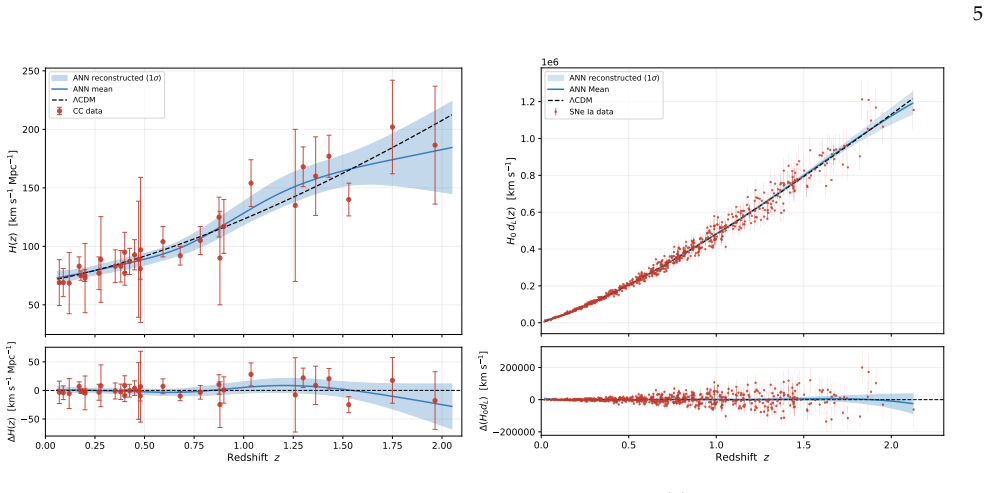
We present a model-independent, sound-horizon-free measurement of the Hubble constant $H_0$ using baryon acoustic oscillation tracers from the Dark Energy Spectroscopic Instrument Data Release 2. The function reconstructions are performed using the artificial neural network method, which is a completely data-driven approach that avoids the mild $\Lambda$CDM prior dependence. Our approach is based on the distance duality relation and combines three complementary observational probes, such as Type Ia supernovae, cosmic chronometer, and DESI DR2 BAO -- without requiring any knowledge of the sound horizon scale $r_d$ or any assumption about the absolute luminosity of SNe Ia. We obtain a joint constraint of $H_0 = 71.5\pm2.2$ km s$^{-1}$ Mpc$^{-1}$ at 68\% confidence for 1000 bootstrap realisations and 4096 neurons, which is consistent with the TRGB result and the SH0ES measurement within $0.6\sigma$, consistent with the Planck 2020 result within $2\sigma$. Our results favor a higher value of $H_0$ compared to the Planck CMB inference, adding independent support for the reality of the Hubble tension.
Editorial analysis
A structured set of objections, weighed in public.
Referee Report
Summary. The manuscript claims a model-independent, sound-horizon-free determination of the Hubble constant using artificial neural networks to reconstruct distance and expansion functions from DESI DR2 BAO data. These are combined with Type Ia supernovae and cosmic chronometers via the distance-duality relation, without input values for the sound horizon rd or SN absolute magnitudes. The reported result is H0 = 71.5 ± 2.2 km s^{-1} Mpc^{-1} (68% CL) from 1000 bootstrap realizations with a 4096-neuron network, stated to be consistent with SH0ES/TRGB within 0.6σ and Planck within 2σ.
Significance. If the result holds, the work supplies an independent H0 constraint that sidesteps the sound-horizon scale and SN luminosity assumptions common in other analyses. The data-driven ANN reconstruction with fixed hyperparameters and bootstrap uncertainty estimation is a clear methodological strength, providing a flexible, non-parametric route to combine the three probes and yielding a falsifiable numerical prediction that can be tested against future data releases.
major comments (2)
- [Methods / ANN reconstruction and error estimation] The central error budget (quoted ±2.2 km s^{-1} Mpc^{-1}) rests on 1000 bootstrap resamples of the combined dataset, yet the manuscript provides insufficient detail on how the joint DESI DR2 BAO + SNe + CC sample is constructed and resampled (e.g., whether probe-specific covariances are preserved). This directly affects the reliability of the final H0 uncertainty and must be expanded with explicit pseudocode or equations for the bootstrap procedure.
- [ANN architecture and training] The choice of 4096 neurons is presented as fixed, but no justification, hyperparameter scan, or validation against mocks is shown to demonstrate that reconstruction biases remain sub-dominant to the statistical error. Without such tests, it is difficult to confirm that the quoted H0 value is free of method-induced systematics at the claimed precision.
minor comments (2)
- [Abstract] The abstract states the final numerical result but omits the redshift range spanned by the DESI DR2 BAO measurements used in the joint fit; adding this would improve clarity.
- [Introduction / Methods] Notation for the reconstructed functions (e.g., DA(z), H(z)) should be defined once at first use with explicit reference to the distance-duality relation employed.
Simulated Author's Rebuttal
We thank the referee for the positive assessment of our work and the recommendation for minor revision. We address each major comment below and will update the manuscript accordingly to improve clarity and reproducibility.
read point-by-point responses
-
Referee: The central error budget (quoted ±2.2 km s^{-1} Mpc^{-1}) rests on 1000 bootstrap resamples of the combined dataset, yet the manuscript provides insufficient detail on how the joint DESI DR2 BAO + SNe + CC sample is constructed and resampled (e.g., whether probe-specific covariances are preserved). This directly affects the reliability of the final H0 uncertainty and must be expanded with explicit pseudocode or equations for the bootstrap procedure.
Authors: We agree that additional detail on the bootstrap procedure is required for full reproducibility and to confirm the robustness of the quoted uncertainty. In the revised manuscript we will expand the Methods section with an explicit description of how the joint DESI DR2 BAO + SNe Ia + cosmic chronometer dataset is assembled, including the treatment of probe-specific covariances. We will also insert pseudocode (or equivalent equations) that outlines the resampling steps, making clear that each probe's covariance structure is preserved during the bootstrap. revision: yes
-
Referee: The choice of 4096 neurons is presented as fixed, but no justification, hyperparameter scan, or validation against mocks is shown to demonstrate that reconstruction biases remain sub-dominant to the statistical error. Without such tests, it is difficult to confirm that the quoted H0 value is free of method-induced systematics at the claimed precision.
Authors: We acknowledge that the manuscript would benefit from a clearer justification of the fixed 4096-neuron architecture. While internal convergence checks guided our choice, these were not documented. In the revision we will add a concise rationale based on reconstruction stability and note that the bootstrap ensemble already samples reconstruction variability. A full hyperparameter scan and dedicated mock validation campaign, however, would require substantial new computational work beyond the scope of a minor revision; we therefore provide only the existing checks and a statement that any residual bias is expected to be sub-dominant to the reported statistical error. revision: partial
Circularity Check
No significant circularity
full rationale
The derivation reconstructs expansion and distance functions via ANN applied directly to DESI DR2 BAO data, then links the probes through the standard distance-duality relation to SNe Ia and cosmic chronometers without any input value for rd or SN absolute magnitude. H0 is obtained at z=0 from the absolute scale supplied by the chronometers. No equation reduces a fitted parameter to a renamed prediction, no load-bearing premise rests on a self-citation chain, and the ANN is treated as a non-parametric interpolator whose hyperparameters are fixed externally to the target result. The bootstrap procedure estimates uncertainties from the data itself, leaving the central claim self-contained against external benchmarks.
Axiom & Free-Parameter Ledger
free parameters (2)
- 4096 neurons
- 1000 bootstrap realizations
axioms (1)
- domain assumption The distance duality relation holds exactly
Reference graph
Works this paper leans on
-
[1]
The function reconstructions are performed using the artificial neural network method, which is a completely data-driven approach that avoids the mildΛCDM prior dependence. Our approach is based on the distance duality relation and combines three complementary observational probes, such as Type Ia supernovae, cosmic chronometer, and DESI DR2 BAO – without...
work page internal anchor Pith review Pith/arXiv arXiv 2020
-
[2]
• One hidden layer with 4096 neurons and an Expo- nential Linear Unit (ELU) activation function [31]: f(x) = ( x, forx>0 α(ex −1), forx≤0 (8) withα=1
Network Architecture and T raining Procedure The network consists of: 4 • An input layer accepting the scalar 2 redshiftz. • One hidden layer with 4096 neurons and an Expo- nential Linear Unit (ELU) activation function [31]: f(x) = ( x, forx>0 α(ex −1), forx≤0 (8) withα=1. • An output layer with 2 neurons returning the re- constructed function value and i...
-
[3]
Log-Space Reconstruction for SN Ia SinceΞ SNIa spans several orders of magnitude across the redshift rangez∈[0.01, 2.26], we perform the ANN 2 A scalar is a single numerical value. 3 Batch normalisation standardises the distribution of layer activa- tions within each training batch, stabilising the optimisation land- scape and reducing sensitivity to the ...
2020
-
[4]
Aghanimet al.(Planck Collaboration), Astron
N. Aghanimet al.(Planck Collaboration), Astron. Astro- phys.641, A6 (2020)
2020
-
[5]
A. G. Riesset al.(SH0ES Collaboration), Astrophys. J. Lett. 934, L7 (2022). 9
2022
-
[6]
W. L. Freedmanet al., Astrophys. J.891, 57 (2020)
2020
-
[7]
W. L. Freedman, Astrophys. J.919, 16 (2021)
2021
-
[8]
The DESI Experiment, a whitepaper for Snowmass 2013
M. Leviet al., 2013, arXiv:1308.0847
work page Pith review arXiv 2013
-
[9]
Abdul Karimet al.(DESI Collaboration), Phys
M. Abdul Karimet al.(DESI Collaboration), Phys. Rev. D 112, 083514 (2025)
2025
-
[10]
Abdul Karimet al.(DESI Collaboration), Phys
M. Abdul Karimet al.(DESI Collaboration), Phys. Rev. D 112, 083515 (2025)
2025
-
[11]
Renzi, and A
F. Renzi, and A. Silvestri, Phys. Rev. D107, 023520 (2023)
2023
-
[12]
Guoet al., Astrophys
W. Guoet al., Astrophys. J. Lett.978,L33 (2025)
2025
-
[13]
Jiang, D
J.Q. Jiang, D. Pedrotti, S.S. da Costa, and S. Vagnozzi, Phys. Rev. D110, 123519 (2024)
2024
-
[14]
Wang, X.-J
G.-J. Wang, X.-J. Ma, S.-Y. Li, and J.-Q. Xia, Astrophys. J. Suppl. Ser.246, 13 (2020)
2020
-
[15]
Fluriet al., Phys
J. Fluriet al., Phys. Rev. D100, 063514 (2019)
2019
-
[16]
George, and E.A
D. George, and E.A. Huerta, Phys. Rev. D 97, 044039 (2018)
2018
-
[17]
Escamilla-Rivera, M.A.C
C. Escamilla-Rivera, M.A.C. Quintero and S. Capozziello, JCAP03, 008 (2020)
2020
- [18]
-
[19]
Cao and N
S. Cao and N. Liang, Research in Astron. Astrophys. 11(10), 1199-1208 (2011)
2011
-
[20]
S. Cao, M. Biesiada, X. Zheng and Z.-H. Zhu, MNRAS 457, 281-287 (2016)
2016
-
[21]
Qiet al., Phys
J.-Z. Qiet al., Phys. Rev. D99, 063507 (2019)
2019
-
[22]
Zhenget al., Astrophys
X. Zhenget al., Astrophys. J.892, 103 (2020)
2020
-
[23]
Liu,et al., Phys
T. Liu,et al., Phys. Lett. B838, 137687 (2023)
2023
-
[24]
Broutet al., Astrophys
D. Broutet al., Astrophys. J.938, 110 (2022)
2022
-
[25]
Riess,et al.Astrophys
A.G. Riess,et al.Astrophys. J.826, 56 (2016)
2016
-
[26]
Jimenez and A
R. Jimenez and A. Loeb, Astrophys. J.573, 37 (2002)
2002
-
[27]
Zhang, Z
C. Zhang, Z. Han, Y. Shuo, L. Siqi, Z. Tong-Jie, and S. Yan- Chun, Res. Astron. Astrophys.14, 1221 (2014)
2014
-
[28]
Stern, R
D. Stern, R. Jimenez, L. Verde, M. Kamionkowski, and S.A. Stanford, J. Cosmol. Astropart. Phys.02, 008 (2010)
2010
-
[29]
Morescoet al., J
M. Morescoet al., J. Cosmol. Astropart. Phys.08, 006 (2012)
2012
-
[30]
Morescoet al., J
M. Morescoet al., J. Cosmol. Astropart. Phys.05, 014 (2016)
2016
-
[31]
A. L. Ratsimbazafyet al., Mon. Not. Roy. Astron. Soc.467, 3239 (2017)
2017
-
[32]
Moresco, Mon
M. Moresco, Mon. Not. Roy. Astron. Soc.450, L16 (2015)
2015
-
[33]
J.-Z. Qi, P . Meng, J.-F. Zhang, and X. Zhang, Phys. Rev. D. 108, 063522 (2023)
2023
-
[34]
Fast and Accurate Deep Network Learning by Exponential Linear Units (ELUs)
D.-A. Clevert, T. Unterthiner, and S. Hochreiter, 2015, arXiv:1511.07289
work page Pith review arXiv 2015
-
[35]
Batch Normalization: Accelerating Deep Network Training by Reducing Internal Covariate Shift
S. Ioffe, and C. Szegedy, 2015, arXiv:1502.03167
work page internal anchor Pith review arXiv 2015
-
[36]
Adam: A Method for Stochastic Optimization
D.P . Kingma, and J. Ba, 2014, arXiv:1412.6980
work page internal anchor Pith review arXiv 2014
-
[37]
Ivezi´cet al., Astrophys
ˇZ. Ivezi´cet al., Astrophys. J.873, 111 (2019)
2019
discussion (0)
Sign in with ORCID, Apple, or X to comment. Anyone can read and Pith papers without signing in.