REVIEW 2 major objections 2 minor 1 cited by
SUDP lets an untrusted agent trigger user-authorized secret operations without ever receiving reusable authority.
Reviewed by Pith at T0; open to challenge. T0 means a machine referee read the full paper against a public rubric. the ladder, T0–T4 →
T0 review · grok-4.3
2026-05-25 06:39 UTC pith:PHSJFORL
load-bearing objection SUDP formalizes the agent secret-use problem cleanly and offers a workable three-party protocol, but the security claims hinge on an unshown hardware assumption and missing proof details. the 2 major comments →
SUDP: Secret-Use Delegation Protocol for Agentic Systems
The pith
A machine-rendered reading of the paper's core claim, the machinery that carries it, and where it could break.
Core claim
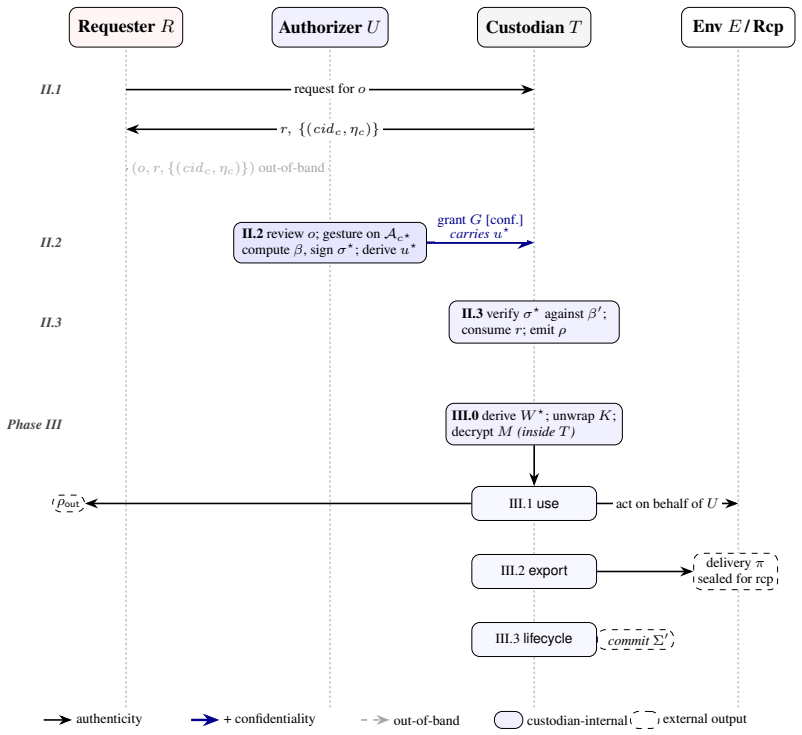
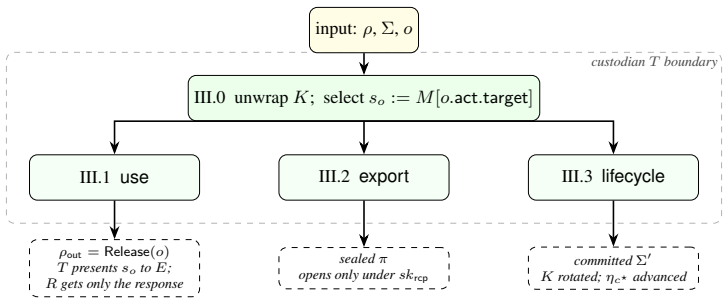
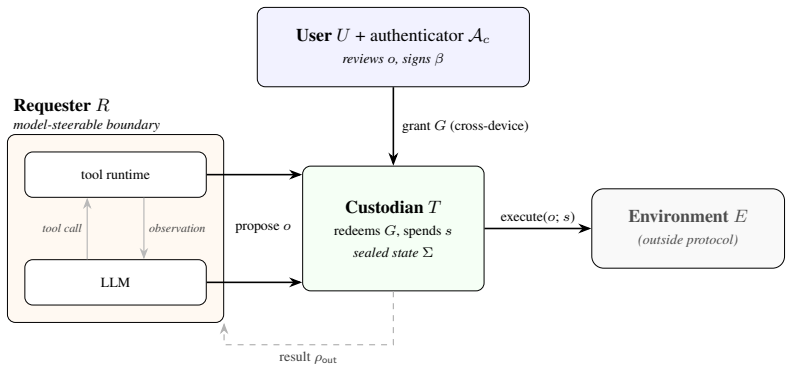
SUDP works by having a requester propose a canonical operation, the user authorize it with a fresh authenticator-backed grant, and a custodian redeem the grant to perform the bounded use. Reusable authority never crosses the requester boundary. Under standard cryptographic assumptions, SUDP satisfies all seven ASU properties when integrated with a hardware-rooted runtime.
What carries the argument
The Secret-Use Delegation Protocol (SUDP), which issues a fresh authenticator-backed grant redeemed only by a custodian to bound secret use.
Load-bearing premise
The security properties hold only when the protocol is integrated with a hardware-rooted runtime that prevents exposure of the grant or derived material to the requester.
What would settle it
An attack that succeeds in extracting reusable authority or derived material from the requester side despite the protocol and a hardware-rooted runtime would falsify the central claim.
If this is right
- Transient compromises such as prompt injection cannot produce durable account access.
- LLM-driven agents can safely call tools that require user-enrolled authority without holding reusable material.
- Authorization stays limited to the exact proposed operation rather than granting broad or reusable rights.
- The same pattern applies to any agentic workflow involving APIs, messaging platforms, or cloud services.
Where Pith is reading between the lines
- Hardware-rooted execution environments may become a baseline requirement for production agent deployments.
- The seven ASU properties could function as an evaluation checklist for other secret-handling designs in autonomous systems.
- Grant-based delegation patterns might extend to non-LLM autonomous agents such as scripts or robotic controllers.
Editorial analysis
A structured set of objections, weighed in public.
Referee Report
Summary. The paper formalizes the Agent Secret Use (ASU) problem for agentic systems, defining seven security properties spanning authorization integrity and secret confidentiality. It proposes the Secret-Use Delegation Protocol (SUDP) in which a requester proposes a canonical operation, the user issues a fresh authenticator-backed grant, and a custodian redeems the grant for bounded use, ensuring reusable authority never crosses the requester boundary. The central claim is that, under standard cryptographic assumptions and when integrated with a hardware-rooted runtime preventing exposure of the grant or derived material, SUDP satisfies all seven properties. A reference implementation is provided.
Significance. If the security reduction holds, the work supplies a clean specification and construction for a previously underspecified obligation in agentic runtimes, separating transient authorization from durable authority in a way that complements existing secret-storage and monitoring techniques. The explicit conditioning on hardware-rooted isolation is a strength rather than a hidden assumption.
major comments (2)
- [Abstract, §3–4] Abstract and §3–4: The manuscript asserts that SUDP satisfies the seven ASU properties under standard cryptographic assumptions, yet supplies neither formal game-based definitions of the properties, a security model, nor any reduction or proof sketch. This absence is load-bearing for the central claim.
- [§5] §5: The specialization to LLM-driven agents and the claim of applicability to any tool call exercising user-enrolled authority-bearing material is stated without a concrete mapping from the seven properties to the protocol steps or to the hardware-rooted runtime invariants.
minor comments (2)
- The GitHub reference implementation is a positive contribution for reproducibility; the manuscript would benefit from a brief description of which components are open-sourced versus assumed to be provided by the hardware root.
- Notation for the grant, authenticator, and redemption flow could be introduced earlier with a single diagram to aid readers unfamiliar with the custodian model.
Simulated Author's Rebuttal
We thank the referee for the constructive comments. We agree that the central claims would be strengthened by the addition of formal game-based definitions and explicit mappings, and we will revise the manuscript accordingly.
read point-by-point responses
-
Referee: [Abstract, §3–4] Abstract and §3–4: The manuscript asserts that SUDP satisfies the seven ASU properties under standard cryptographic assumptions, yet supplies neither formal game-based definitions of the properties, a security model, nor any reduction or proof sketch. This absence is load-bearing for the central claim.
Authors: The referee is correct that the manuscript defines the seven properties in Section 3 and asserts satisfaction under standard assumptions, but does not supply game-based definitions, a security model, or a reduction. In the revision we will add formal game-based definitions for each property, a security model, and a proof sketch establishing that SUDP meets the properties when the hardware-rooted runtime invariants are enforced. revision: yes
-
Referee: [§5] §5: The specialization to LLM-driven agents and the claim of applicability to any tool call exercising user-enrolled authority-bearing material is stated without a concrete mapping from the seven properties to the protocol steps or to the hardware-rooted runtime invariants.
Authors: We agree that an explicit mapping is needed to substantiate the specialization. The revised Section 5 will include a concrete mapping that associates each of the seven properties with the corresponding SUDP protocol steps and the invariants maintained by the hardware-rooted runtime, thereby clarifying applicability to LLM-driven agents and general tool calls. revision: yes
Circularity Check
No significant circularity identified
full rationale
The paper defines the ASU problem and seven required properties, then presents SUDP as a new protocol construction that satisfies them under standard cryptographic assumptions when integrated with a hardware-rooted runtime. No equations, fitted parameters, self-citations, or ansatzes appear in the abstract or described structure. The central claim is explicitly conditional on external hardware and crypto primitives rather than reducing to self-definition or internal fits. This is a standard protocol-design paper whose derivation chain is self-contained against external benchmarks.
Axiom & Free-Parameter Ledger
axioms (2)
- domain assumption Standard cryptographic assumptions (secure encryption, signatures, and authenticators) hold.
- domain assumption A hardware-rooted runtime can enforce isolation so that reusable authority never crosses the requester boundary.
read the original abstract
Agentic systems increasingly act with user secrets for APIs, messaging platforms, and cloud services. Today's agent runtimes typically implement authorization by exposure: enabling action often means placing a reusable secret, or a reusable artifact derived from it, inside the runtime, so a transient prompt-injection or tool-side compromise becomes durable account compromise. Existing defenses cover adjacent pieces such as secret storage, scoped delegation, sender-constrained tokens, and runtime monitoring, but leave the combined agentic obligation without a common specification: an untrusted autonomous requester should be able to cause a user-authorized secret-backed operation without gaining reusable authority over it. We formalize this as the Agent Secret Use (ASU) problem and identify seven security properties any solution must satisfy, spanning authorization integrity and secret confidentiality. We propose the Secret-Use Delegation Protocol (SUDP), in which a requester proposes a canonical operation, the user authorizes it with a fresh authenticator-backed grant, and a custodian redeems the grant to perform the bounded use; reusable authority never crosses the requester boundary. We specialize SUDP for LLM-driven agents, where it applies whenever a tool call would exercise user-enrolled authority-bearing material. Under standard cryptographic assumptions, SUDP satisfies all seven properties when integrated with a hardware-rooted runtime. A reference implementation is available at https://github.com/xhyumiracle/sudp.
Figures


Forward citations
Cited by 1 Pith paper
-
Protocol-Level Attacks on Agentic Commerce Platforms: A Cross-Platform Taxonomy, AIP-Bench, and Unified Defense
Protocol-level vulnerabilities in agentic commerce platforms are model-independent and can be measured with a deterministic benchmark and mitigated with a sidecar defense.
Reference graph
Works this paper leans on
-
[1]
URLhttps://arxiv.org/abs/2603.24414. Yi Liu, Gelei Deng, Yuekang Li, Kailong Wang, Tianwei Zhang, Yepang Liu, Haoyu Wang, Yan Zheng, and Yang Liu. Prompt injection attacks and defenses in LLM-integrated applications. In ACM Computing Surveys, 2024. Torsten Lodderstedt, Justin Richer, and Brian Campbell. OAuth 2.0 rich authorization requests. https://www.r...
-
[2]
URLhttps://arxiv.org/abs/2509.25974. OWASP Foundation. OWASP Top 10 for large language model applications.OWASP Project,
-
[3]
Agent Tools Orchestration Leaks More: Dataset, Benchmark, and Mitigation
URL https://owasp.org/www-project-top-10-for-large-language-model- applications/. Yuxuan Qiao, Dongqin Liu, Hongchang Yang, Wei Zhou, and Songlin Hu. Agent tools orchestration leaks more: Dataset, benchmark, and mitigation.arXiv preprint arXiv:2512.16310, 2025. doi: 10.48550/arXiv.2512.16310. URLhttps://arxiv.org/abs/2512.16310. Eric Rescorla. The transpo...
work page internal anchor Pith review doi:10.48550/arxiv.2512.16310 2025
-
[4]
Agent Security Bench (ASB): Formalizing and Benchmarking Attacks and Defenses in LLM-based Agents
URLhttps://arxiv.org/abs/2410.02644. Zhexin Zhang, Shiyao Cui, Yida Lu, Jingzhuo Zhou, Junxiao Yang, Hongning Wang, and Minlie Huang. Agent-safetybench: Evaluating the safety of LLM agents.arXiv preprint arXiv:2412.14470,
work page internal anchor Pith review Pith/arXiv arXiv
-
[5]
Agent-SafetyBench: Evaluating the Safety of LLM Agents
doi: 10.48550/arXiv.2412.14470. URLhttps://arxiv.org/abs/2412.14470. Xuhui Zhou, Hyunwoo Kim, Faeze Brahman, Liwei Jiang, Hao Zhu, Ximing Lu, Frank F. Xu, Bill Yuchen Lin, Yejin Choi, Niloofar Mireshghallah, Ronan Le Bras, and Maarten Sap. Haicosys- tem: An ecosystem for sandboxing safety risks in interactive AI agents. InConference on Language Modeling (...
work page internal anchor Pith review Pith/arXiv arXiv doi:10.48550/arxiv.2412.14470 2025
discussion (0)
Sign in with ORCID, Apple, or X to comment. Anyone can read and Pith papers without signing in.