Limitations of LTI Koopman Modeling for Nonlinear Control Systems
Pith reviewed 2026-07-01 09:10 UTC · model grok-4.3
The pith
Exact LTI Koopman representations require nonlinear control systems to have affine linear dynamics under controllability and coordinate inclusion.
A machine-rendered reading of the paper's core claim, the machinery that carries it, and where it could break.
Core claim
Assuming a mild controllability condition and the inclusion of the coordinate maps, the dynamics of the underlying control system must be affine linear.
What carries the argument
The combination of an LTI Koopman representation with a mild controllability condition on the control system and the requirement that coordinate maps belong to the set of observables.
If this is right
- Linear control techniques such as LQR and convex MPC apply exactly via Koopman lifting only when the original system is affine linear.
- Genuinely nonlinear systems cannot possess exact LTI Koopman models under the stated conditions.
- The modeling error incurred by forcing an LTI structure depends explicitly on the selection of observables.
- Approximate Koopman models become necessary whenever the system deviates from affine linearity.
Where Pith is reading between the lines
- Relaxing either the controllability assumption or the requirement to include coordinates may allow exact LTI representations for some nonlinear systems.
- Time-varying or bilinear Koopman structures could serve as alternatives that preserve more nonlinear behavior.
- The result indicates that observable selection strategies should prioritize deviation from affinity when the goal is faithful nonlinear modeling.
Load-bearing premise
The control system satisfies a mild controllability condition and the observables include the coordinate maps.
What would settle it
Exhibiting a nonlinear control system that satisfies the controllability condition, includes coordinates as observables, yet possesses an exact LTI Koopman representation.
Figures
read the original abstract
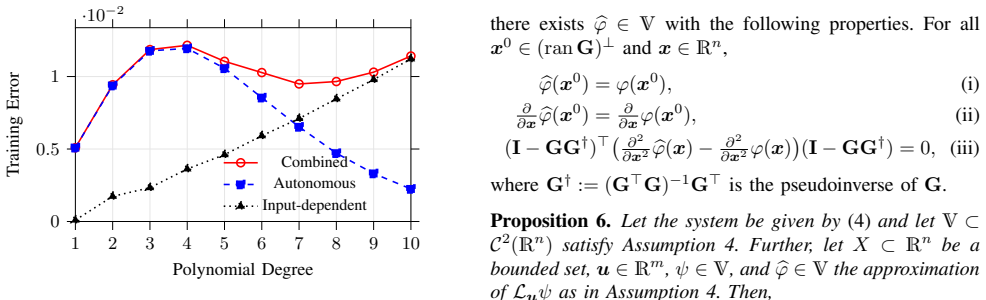
Koopman operator theory yields powerful tools for modeling, analysis, and control of nonlinear dynamical systems. Prominently, linear time-invariant (LTI) Koopman representations have been proposed to enable the application of linear control techniques, such as LQR and convex MPC. In this work, we investigate the implications of exact LTI Koopman representations for continuous-time nonlinear control systems. In particular, we show that, assuming a mild controllability condition and the inclusion of the coordinate maps, the dynamics of the underlying control system must be affine linear. Furthermore, we study the modeling bias introduced by the LTI structure and analyze its dependency on the choice of observables.
Editorial analysis
A structured set of objections, weighed in public.
Referee Report
Summary. The paper claims that, for continuous-time nonlinear control systems, the existence of an exact finite-dimensional LTI Koopman representation (under a mild controllability condition on the system together with the requirement that the coordinate maps are included among the observables) necessarily implies that the underlying dynamics are affine-linear. A secondary contribution examines the modeling bias that the LTI structure introduces and its dependence on the choice of observables.
Significance. If the central implication holds, the result supplies a precise theoretical boundary on the representational power of finite-dimensional LTI Koopman lifts for control systems. It shows that such lifts cannot exactly reproduce non-affine nonlinear dynamics once controllability and coordinate inclusion are granted, thereby clarifying when linear-control techniques applied to Koopman models remain faithful to the original plant. The accompanying bias analysis offers a practical complement by quantifying how observable selection modulates the approximation error.
minor comments (2)
- [Introduction / Abstract] The controllability assumption is described as 'mild' in the abstract and introduction; a short paragraph clarifying its precise statement (e.g., rank condition on the controllability matrix or Lie-algebraic rank) would help readers verify that it is indeed weaker than standard controllability.
- [Modeling-bias analysis] The modeling-bias section would benefit from an explicit statement of the norm or distance used to quantify bias (e.g., L2 on a compact set or supremum norm) and from a brief remark on whether the bias expression remains valid when the observable set is enlarged beyond the coordinate maps.
Simulated Author's Rebuttal
We thank the referee for the careful reading and positive assessment of our work. The recommendation for minor revision is noted, and we will prepare a revised manuscript accordingly. Since no specific major comments were raised, we address the overall report below.
Circularity Check
No significant circularity identified
full rationale
The paper establishes a conditional theorem: under a mild controllability assumption on the control system together with the requirement that coordinate maps are included in the observable set, any continuous-time system admitting an exact finite-dimensional LTI Koopman representation must have affine-linear dynamics. This is presented as a direct mathematical implication from the stated assumptions, with no fitted parameters renamed as predictions, no self-citation chains invoked as load-bearing uniqueness theorems, and no ansatz smuggled in via prior work. The modeling-bias analysis is treated as a separate secondary contribution. The derivation chain is self-contained and does not reduce to its inputs by construction.
Axiom & Free-Parameter Ledger
axioms (2)
- domain assumption Mild controllability condition on the nonlinear control system
- domain assumption Inclusion of coordinate maps among the observables
Forward citations
Cited by 1 Pith paper
-
Koopman meets input-output data: Data-driven output-feedback control of nonlinear systems with closed-loop guarantees
A method is proposed to design data-driven output-feedback controllers for nonlinear systems with provable exponential stability guarantees using only input-output measurements via Koopman-based bilinear surrogate mod...
Reference graph
Works this paper leans on
-
[1]
Qingyao Ai, Keping Bi, Jiafeng Guo, and W. Bruce Croft. 2018. Learning a Deep Listwise Context Model for Ranking Refinement. InThe 41st International ACM SIGIR Conference on Research & Development in Information Retrieval, SIGIR 2018, Ann Arbor, MI, USA, July 08-12, 2018, Kevyn Collins-Thompson, Qiaozhu Mei, Brian D. Davison, Yiqun Liu, and Emine Yilmaz (...
-
[2]
Keqin Bao, Jizhi Zhang, Yang Zhang, Wenjie Wang, Fuli Feng, and Xiangnan He. 2023. TALLRec: An Effective and Efficient Tuning Framework to Align Large Language Model with Recommendation. InProceedings of the 17th ACM Conference on Recommender Systems, RecSys 2023, Singapore, Singapore, September 18-22, 2023, Jie Zhang, Li Chen, Shlomo Berkovsky, Min Zhang...
-
[3]
Irwan Bello, Sayali Kulkarni, Sagar Jain, Craig Boutilier, Ed Huai-hsin Chi, Elad Eban, Xiyang Luo, Alan Mackey, and Ofer Meshi. 2018. Seq2Slate: Re-ranking and Slate Optimization with RNNs.CoRRabs/1810.02019 (2018). arXiv:1810.02019 http://arxiv.org/abs/1810.02019
work page internal anchor Pith review Pith/arXiv arXiv 2018
- [4]
-
[5]
Paul Covington, Jay Adams, and Emre Sargin. 2016. Deep Neural Networks for YouTube Recommendations. InProceedings of the 10th ACM Conference on Recommender Systems, Boston, MA, USA, September 15-19, 2016, Shilad Sen, Werner Geyer, Jill Freyne, and Pablo Castells (Eds.). ACM, 191–198. doi:10.1145/2959100. 2959190
- [6]
-
[7]
Marco Cuturi. 2013. Sinkhorn Distances: Lightspeed Computation of Opti- mal Transport. InAdvances in Neural Information Processing Systems 26: 27th Annual Conference on Neural Information Processing Systems 2013. Proceed- ings of a meeting held December 5-8, 2013, Lake Tahoe, Nevada, United States, Christopher J. C. Burges, Léon Bottou, Zoubin Ghahramani,...
2013
- [8]
-
[9]
Jiaxin Deng, Shiyao Wang, Kuo Cai, Lejian Ren, Qigen Hu, Weifeng Ding, Qiang Luo, and Guorui Zhou. 2025. Onerec: Unifying retrieve and rank with generative recommender and iterative preference alignment.arXiv preprint arXiv:2502.18965 (2025)
work page internal anchor Pith review Pith/arXiv arXiv 2025
- [10]
-
[11]
Kairui Fu, Tao Zhang, Shuwen Xiao, Ziyang Wang, Xinming Zhang, Chenchi Zhang, Yuliang Yan, Junjun Zheng, Yu Li, Zhihong Chen, Jian Wu, Xiangheng Kong, Shengyu Zhang, Kun Kuang, Yu-Gang Jiang, and Bo Zheng. 2025. FORGE: Forming Semantic Identifiers for Generative Retrieval in Industrial Datasets. CoRRabs/2509.20904 (2025). arXiv:2509.20904 doi:10.48550/ARX...
work page internal anchor Pith review Pith/arXiv arXiv doi:10.48550/arxiv.2509.20904 2025
-
[12]
Luke Gallagher, Ruey-Cheng Chen, Roi Blanco, and J. Shane Culpepper. 2019. Joint Optimization of Cascade Ranking Models. InProceedings of the Twelfth ACM International Conference on Web Search and Data Mining, WSDM 2019, Melbourne, VIC, Australia, February 11-15, 2019, J. Shane Culpepper, Alistair Moffat, Paul N. Bennett, and Kristina Lerman (Eds.). ACM, ...
-
[13]
Shijie Geng, Shuchang Liu, Zuohui Fu, Yingqiang Ge, and Yongfeng Zhang. 2022. Recommendation as Language Processing (RLP): A Unified Pretrain, Personalized Prompt & Predict Paradigm (P5). InRecSys ’22: Sixteenth ACM Conference on Recommender Systems, Seattle, W A, USA, September 18 - 23, 2022, Jennifer Golbeck, F. Maxwell Harper, Vanessa Murdock, Michael ...
-
[14]
F. Maxwell Harper and Joseph A. Konstan. 2016. The MovieLens Datasets: History and Context.ACM Trans. Interact. Intell. Syst.5, 4 (2016), 19:1–19:19. doi:10.1145/2827872
-
[15]
Jingcheng Hu, Yinmin Zhang, Qi Han, Daxin Jiang, Xiangyu Zhang, and Heung- Yeung Shum. 2025. Open-reasoner-zero: An open source approach to scaling up reinforcement learning on the base model.arXiv preprint arXiv:2503.24290 (2025)
work page internal anchor Pith review Pith/arXiv arXiv 2025
- [16]
-
[17]
Guangda Huzhang, Zhen-Jia Pang, Yongqing Gao, Yawen Liu, Weijie Shen, Wen-Ji Zhou, Qianying Lin, Qing Da, Anxiang Zeng, Han Yu, Yang Yu, and Zhi-Hua Zhou
-
[18]
AliExpress Learning-to-Rank: Maximizing Online Model Performance Without Going Online.IEEE Trans. Knowl. Data Eng.35, 2 (2023), 1214–1226. doi:10.1109/TKDE.2021.3098898
-
[19]
Clark Mingxuan Ju, Liam Collins, Leonardo Neves, Bhuvesh Kumar, Louis Yufeng Wang, Tong Zhao, and Neil Shah. 2025. Generative Recommendation with Seman- tic IDs: A Practitioner’s Handbook. InProceedings of the 34th ACM International Conference on Information and Knowledge Management, CIKM 2025, Seoul, Repub- lic of Korea, November 10-14, 2025, Meeyoung Ch...
-
[20]
Xiaoyu Kong, Leheng Sheng, Junfei Tan, Yuxin Chen, Jiancan Wu, An Zhang, Xiang Wang, and Xiangnan He. 2025. MiniOneRec: An Open-Source Frame- work for Scaling Generative Recommendation.CoRRabs/2510.24431 (2025). arXiv:2510.24431 doi:10.48550/ARXIV.2510.24431
-
[21]
Xiaopeng Li, Bo Chen, Junda She, Shiteng Cao, You Wang, Qinlin Jia, Haiying He, Zheli Zhou, Zhao Liu, Ji Liu, et al. 2025. A Survey of Generative Recommendation from a Tri-Decoupled Perspective: Tokenization, Architecture, and Optimization. (2025)
2025
-
[22]
Jiayi Liao, Sihang Li, Zhengyi Yang, Jiancan Wu, Yancheng Yuan, Xiang Wang, and Xiangnan He. 2024. LLaRA: Large Language-Recommendation Assistant. InProceedings of the 47th International ACM SIGIR Conference on Research and Development in Information Retrieval, SIGIR 2024, Washington DC, USA, July 14-18, 2024, Grace Hui Yang, Hongning Wang, Sam Han, Claud...
-
[23]
Xiao Lin, Xiaokai Chen, Chenyang Wang, Hantao Shu, Linfeng Song, Biao Li, and Peng Jiang. 2024. Discrete Conditional Diffusion for Reranking in Rec- ommendation. InCompanion Proceedings of the ACM on Web Conference 2024, WWW 2024, Singapore, Singapore, May 13-17, 2024, Tat-Seng Chua, Chong-Wah Ngo, Roy Ka-Wei Lee, Ravi Kumar, and Hady W. Lauw (Eds.). ACM,...
-
[24]
Zhijie Lin, Zhuofeng Li, Chenglei Dai, Wentian Bao, Shuai Lin, Enyun Yu, Haox- iang Zhang, and Liang Zhao. 2025. GReF: A Unified Generative Framework for Efficient Reranking via Ordered Multi-token Prediction. InProceedings of the 34th ACM International Conference on Information and Knowledge Manage- ment, CIKM 2025, Seoul, Republic of Korea, November 10-...
-
[25]
Qi Liu, Kai Zheng, Rui Huang, Wuchao Li, Kuo Cai, Yuan Chai, Yanan Niu, Yiqun Hui, Bing Han, Na Mou, Hongning Wang, Wentian Bao, Yunen Yu, Guorui Zhou, Han Li, Yang Song, Defu Lian, and Kun Gai. 2025. RecFlow: An Industrial Full Flow Recommendation Dataset. InThe Thirteenth International Conference on Learning Representations, ICLR 2025, Singapore, April ...
2025
-
[26]
McAuley, Dong Zheng, Peng Jiang, and Kun Gai
Shuchang Liu, Qingpeng Cai, Zhankui He, Bowen Sun, Julian J. McAuley, Dong Zheng, Peng Jiang, and Kun Gai. 2023. Generative Flow Network for Listwise Recommendation. InProceedings of the 29th ACM SIGKDD Conference on Knowl- edge Discovery and Data Mining, KDD 2023, Long Beach, CA, USA, August 6- 10, 2023, Ambuj K. Singh, Yizhou Sun, Leman Akoglu, Dimitrio...
-
[27]
Weiwen Liu, Yunjia Xi, Jiarui Qin, Fei Sun, Bo Chen, Weinan Zhang, Rui Zhang, and Ruiming Tang. 2022. Neural Re-ranking in Multi-stage Recommender Sys- tems: A Review. InProceedings of the Thirty-First International Joint Conference on Artificial Intelligence, IJCAI 2022, Vienna, Austria, 23-29 July 2022, Luc De Raedt (Ed.). ijcai.org, 5512–5520. doi:10.2...
-
[28]
Zichen Liu, Changyu Chen, Wenjun Li, Penghui Qi, Tianyu Pang, Chao Du, Wee Sun Lee, and Min Lin. 2025. Understanding r1-zero-like training: A critical perspective.arXiv preprint arXiv:2503.20783(2025)
work page internal anchor Pith review Pith/arXiv arXiv 2025
-
[29]
Ilya Loshchilov and Frank Hutter. 2019. Decoupled Weight Decay Regularization. In7th International Conference on Learning Representations, ICLR 2019, New Or- leans, LA, USA, May 6-9, 2019. OpenReview.net. https://openreview.net/forum? id=Bkg6RiCqY7
2019
-
[30]
Wenyu Mao, Shuchang Liu, Hailan Yang, Xiaobei Wang, Xiaoyu Yang, Xu Gao, Xiang Li, Lantao Hu, Han Li, Kun Gai, et al. 2025. Denoising Neural Reranker for Recommender Systems.arXiv preprint arXiv:2509.18736(2025)
work page internal anchor Pith review Pith/arXiv arXiv 2025
-
[31]
McAuley, Christopher Targett, Qinfeng Shi, and Anton van den Hengel
Julian J. McAuley, Christopher Targett, Qinfeng Shi, and Anton van den Hengel
-
[32]
Image-Based Recommendations on Styles and Substitutes. InProceedings of the 38th International ACM SIGIR Conference on Research and Development in Information Retrieval, Santiago, Chile, August 9-13, 2015, Ricardo Baeza-Yates, Mounia Lalmas, Alistair Moffat, and Berthier A. Ribeiro-Neto (Eds.). ACM, 43–52. doi:10.1145/2766462.2767755
-
[33]
Yue Meng, Cheng Guo, Yi Cao, Tong Liu, and Bo Zheng. 2025. A Generative Re-ranking Model for List-level Multi-objective Optimization at Taobao. InPro- ceedings of the 48th International ACM SIGIR Conference on Research and Develop- ment in Information Retrieval, SIGIR 2025, Padua, Italy, July 13-18, 2025, Nicola Ferro, Maria Maistro, Gabriella Pasi, Omar ...
-
[34]
Hall, Daniel Cer, and Yinfei Yang
Jianmo Ni, Gustavo Hernández Ábrego, Noah Constant, Ji Ma, Keith B. Hall, Daniel Cer, and Yinfei Yang. 2022. Sentence-T5: Scalable Sentence Encoders from ���������� ������� ���� ���� ������ ����� ���������� �� ��� �� ��� Pre-trained Text-to-Text Models. InFindings of the Association for Computational Linguistics: ACL 2022, Dublin, Ireland, May 22-27, 2022...
-
[35]
Changhua Pei, Yi Zhang, Yongfeng Zhang, Fei Sun, Xiao Lin, Hanxiao Sun, Jian Wu, Peng Jiang, Junfeng Ge, Wenwu Ou, and Dan Pei. 2019. Personalized re-ranking for recommendation. InProceedings of the 13th ACM Conference on Recommender Systems, RecSys 2019, Copenhagen, Denmark, September 16-20, 2019, Toine Bogers, Alan Said, Peter Brusilovsky, and Domonkos ...
-
[36]
Colin Raffel, Noam Shazeer, Adam Roberts, Katherine Lee, Sharan Narang, Michael Matena, Yanqi Zhou, Wei Li, and Peter J. Liu. 2020. Exploring the Limits of Transfer Learning with a Unified Text-to-Text Transformer.J. Mach. Learn. Res.21 (2020), 140:1–140:67. https://jmlr.org/papers/v21/20-074.html
2020
-
[37]
Tran, Jonah Samost, Maciej Kula, Ed H
Shashank Rajput, Nikhil Mehta, Anima Singh, Raghunandan Hulikal Kesha- van, Trung Vu, Lukasz Heldt, Lichan Hong, Yi Tay, Vinh Q. Tran, Jonah Samost, Maciej Kula, Ed H. Chi, and Mahesh Sathiamoorthy. 2023. Rec- ommender Systems with Generative Retrieval. InAdvances in Neural Infor- mation Processing Systems 36: Annual Conference on Neural Information Pro- ...
2023
-
[38]
Yuxin Ren, Qiya Yang, Yichun Wu, Wei Xu, Yalong Wang, and Zhiqiang Zhang
-
[39]
Non-autoregressive Generative Models for Reranking Recommendation. InProceedings of the 30th ACM SIGKDD Conference on Knowledge Discovery and Data Mining, KDD 2024, Barcelona, Spain, August 25-29, 2024, Ricardo Baeza-Yates and Francesco Bonchi (Eds.). ACM, 5625–5634. doi:10.1145/3637528.3671645
-
[40]
Zhihong Shao, Peiyi Wang, Qihao Zhu, Runxin Xu, Junxiao Song, Xiao Bi, Haowei Zhang, Mingchuan Zhang, YK Li, Yang Wu, et al. 2024. Deepseekmath: Pushing the limits of mathematical reasoning in open language models.arXiv preprint arXiv:2402.03300(2024)
work page internal anchor Pith review Pith/arXiv arXiv 2024
-
[41]
Xiaowen Shi, Fan Yang, Ze Wang, Xiaoxu Wu, Muzhi Guan, Guogang Liao, Yongkang Wang, Xingxing Wang, and Dong Wang. 2023. PIER: Permutation-Level Interest-Based End-to-End Re-ranking Framework in E-commerce. InProceedings of the 29th ACM SIGKDD Conference on Knowledge Discovery and Data Mining, KDD 2023, Long Beach, CA, USA, August 6-10, 2023, Ambuj K. Sing...
-
[42]
Shuli Wang, Xue Wei, Senjie Kou, Chi Wang, Wenshuai Chen, Qi Tang, Yinhua Zhu, Xiong Xiao, and Xingxing Wang. 2025. NLGR: Utilizing Neighbor Lists for Generative Rerank in Personalized Recommendation Systems. InCompanion Proceedings of the ACM on Web Conference 2025, WWW 2025, Sydney, NSW, Aus- tralia, 28 April 2025 - 2 May 2025, Guodong Long, Michale Blu...
-
[43]
Wenjie Wang, Honghui Bao, Xinyu Lin, Jizhi Zhang, Yongqi Li, Fuli Feng, See- Kiong Ng, and Tat-Seng Chua. 2024. Learnable Item Tokenization for Generative Recommendation. InProceedings of the 33rd ACM International Conference on Information and Knowledge Management, CIKM 2024, Boise, ID, USA, October 21-25, 2024, Edoardo Serra and Francesca Spezzano (Eds....
-
[44]
Yunjia Xi, Weiwen Liu, Jieming Zhu, Xilong Zhao, Xinyi Dai, Ruiming Tang, Weinan Zhang, Rui Zhang, and Yong Yu. 2022. Multi-Level Interaction Reranking with User Behavior History. InSIGIR ’22: The 45th International ACM SIGIR Conference on Research and Development in Information Retrieval, Madrid, Spain, July 11 - 15, 2022, Enrique Amigó, Pablo Castells, ...
-
[45]
Hailan Yang, Zhenyu Qi, Shuchang Liu, Xiaoyu Yang, Xiaobei Wang, Xiang Li, Lantao Hu, Han Li, and Kun Gai. 2025. Comprehensive List Generation for Multi-Generator Reranking. InProceedings of the 48th International ACM SIGIR Conference on Research and Development in Information Retrieval, SIGIR 2025, Padua, Italy, July 13-18, 2025, Nicola Ferro, Maria Mais...
-
[46]
Qiying Yu, Zheng Zhang, Ruofei Zhu, Yufeng Yuan, Xiaochen Zuo, Yu Yue, Weinan Dai, Tiantian Fan, Gaohong Liu, Lingjun Liu, et al. 2025. Dapo: An open- source llm reinforcement learning system at scale.arXiv preprint arXiv:2503.14476 (2025)
work page internal anchor Pith review Pith/arXiv arXiv 2025
-
[47]
Jiaqi Zhai, Lucy Liao, Xing Liu, Yueming Wang, Rui Li, Xuan Cao, Leon Gao, Zhaojie Gong, Fangda Gu, Jiayuan He, Yinghai Lu, and Yu Shi. 2024. Actions Speak Louder than Words: Trillion-Parameter Sequential Transducers for Generative Recommendations. InForty-first International Conference on Machine Learning, ICML 2024, Vienna, Austria, July 21-27, 2024. Op...
2024
-
[48]
Kaike Zhang, Xiaobei Wang, Shuchang Liu, Hailan Yang, Xiang Li, Lantao Hu, Han Li, Qi Cao, Fei Sun, and Kun Gai. 2025. GoalRank: Group-Relative Optimiza- tion for a Large Ranking Model.CoRRabs/2509.22046 (2025). arXiv:2509.22046 doi:10.48550/ARXIV.2509.22046
-
[49]
Yanzhao Zhang, Mingxin Li, Dingkun Long, Xin Zhang, Huan Lin, Baosong Yang, Pengjun Xie, An Yang, Dayiheng Liu, Junyang Lin, Fei Huang, and Jingren Zhou
-
[50]
Qwen3 Embedding: Advancing Text Embedding and Reranking Through Foundation Models.arXiv preprint arXiv:2506.05176(2025)
work page internal anchor Pith review Pith/arXiv arXiv 2025
-
[51]
Kesen Zhao, Shuchang Liu, Qingpeng Cai, Xiangyu Zhao, Ziru Liu, Dong Zheng, Peng Jiang, and Kun Gai. 2023. KuaiSim: A Comprehensive Sim- ulator for Recommender Systems. InAdvances in Neural Information Pro- cessing Systems 36: Annual Conference on Neural Information Processing Sys- tems 2023, NeurIPS 2023, New Orleans, LA, USA, December 10 - 16, 2023, Ali...
2023
-
[52]
Bowen Zheng, Yupeng Hou, Hongyu Lu, Yu Chen, Wayne Xin Zhao, Ming Chen, and Ji-Rong Wen. 2024. Adapting Large Language Models by Integrating Col- laborative Semantics for Recommendation. In40th IEEE International Conference on Data Engineering, ICDE 2024, Utrecht, The Netherlands, May 13-16, 2024. IEEE, 1435–1448. doi:10.1109/ICDE60146.2024.00118
- [53]
-
[54]
Guorui Zhou, Hengrui Hu, Hongtao Cheng, Huanjie Wang, Jiaxin Deng, Jinghao Zhang, Kuo Cai, Lejian Ren, Lu Ren, Liao Yu, Pengfei Zheng, Qiang Luo, Qianqian Wang, Qigen Hu, Rui Huang, Ruiming Tang, Shiyao Wang, Shujie Yang, Tao Wu, Wuchao Li, Xinchen Luo, Xingmei Wang, Yi Su, Yunfan Wu, Zexuan Cheng, Zhanyu Liu, Zixing Zhang, Bin Zhang, Boxuan Wang, Chaoyi ...
work page internal anchor Pith review Pith/arXiv arXiv doi:10.48550/arxiv.2508.20900 2025
discussion (0)
Sign in with ORCID, Apple, or X to comment. Anyone can read and Pith papers without signing in.