Recognition: unknown
Continuous Reset-Induced Phase Transition in Measurement-Free Random Quantum Circuits
Pith reviewed 2026-05-07 16:48 UTC · model grok-4.3
The pith
Reset channels in random quantum circuits produce a continuous second-order entanglement phase transition for qubits.
A machine-rendered reading of the paper's core claim, the machinery that carries it, and where it could break.
Core claim
In a measurement-free random quantum circuit composed of unitary gates and reset channels, the reset-induced entanglement phase transition for d=2 is continuous: large fluctuations appear near the critical point and data collapses are obtained that are consistent with second-order scaling, in disagreement with the expectations of the classical statistical mapping that applies in the large-d limit.
What carries the argument
The reset channel inserted into an otherwise random unitary circuit, whose impact on entanglement entropy is extracted from efficient stabilizer simulations to expose fluctuations and finite-size scaling.
If this is right
- The nature of the reset-induced transition changes markedly with the local dimension d.
- Large fluctuations in entanglement appear in the vicinity of the critical reset probability.
- Finite-size data collapses are consistent with second-order scaling.
- The observed behavior differs from the classical large-d picture.
Where Pith is reading between the lines
- Practical qubit hardware may therefore host continuously tunable entanglement transitions that large-d approximations miss.
- Similar reset-driven protocols in measurement-free error correction could display analogous scaling.
- Testing the transition with non-Clifford gates would check whether the continuous character survives beyond the stabilizer regime.
Load-bearing premise
Stabilizer-circuit numerics performed at d=2 faithfully reproduce the continuous character of the reset-induced transition and provide a valid benchmark against the large-d classical mapping.
What would settle it
Exact diagonalization or non-stabilizer simulations on systems of size 10-20 that show either a discontinuous jump in entanglement or the absence of data collapse at the same critical reset probability would falsify the continuous-transition claim.
Figures


read the original abstract
We study a random unitary quantum circuit with only reset channels, which has high feasibility for real quantum devices. In particular, we investigate the many-body statistical physics properties, "reset-induced" entanglement phase transitions comparing the classical statistical picture in the large "$d$" limit of qudits. In the property of the reset-induced phase transition the parameter of qudit $d$ is essential. That is, the transition properties induced by the reset channel significantly depend on $d$. We numerically elucidate this statement employing efficient stabilizer circuit simulations for $d=2$. Specifically, large fluctuations are observed near the critical point, indicating that the reset-induced phase transition is continuous. We obtain clear data collapses, consistent with a second-order mixed phase transition. This behavior differs from expectations based on the classical statistical mapping in the large-$d$ limit.
Editorial analysis
A structured set of objections, weighed in public.
Referee Report
Summary. The paper studies reset-induced entanglement phase transitions in measurement-free random quantum circuits with reset channels. For d=2 qudits, using stabilizer circuit simulations, they report large fluctuations near the critical point and clear data collapses supporting a continuous second-order mixed phase transition. This differs from the behavior expected from the classical statistical mapping in the large-d limit, emphasizing the role of finite d.
Significance. If the central claim holds, this work would be significant for demonstrating a continuous phase transition in a hardware-friendly, measurement-free setup. The numerical evidence of data collapses and large fluctuations provides a concrete basis for the second-order classification at d=2, contrasting with large-d expectations. This could inform experimental studies on quantum devices and deepen understanding of entanglement transitions in open systems. The efficient use of stabilizer simulations is a strength for accessing relevant system sizes.
major comments (2)
- [Numerical Simulations] The results are obtained exclusively from stabilizer simulations, which restrict the random unitaries to the Clifford group. As highlighted in related literature on measurement-induced transitions, Clifford circuits can exhibit different critical properties, including possibly altered transition orders, compared to generic Haar-random circuits. The manuscript provides no cross-validation, argument for universality preservation under the reset channel, or finite-size scaling to isolate this effect. This is a load-bearing concern for the claim that the observed continuous transition is a generic d=2 feature differing from the large-d limit.
- [Data Collapse Analysis] The data collapses are presented as evidence for the second-order nature, but the text lacks detailed description of the scaling ansatz, the quantities collapsed (e.g., entanglement entropy or other order parameters), the determination of critical parameters, error bars, or goodness-of-fit metrics. Without these, the support for the continuous transition classification remains provisional, consistent with the limited methods details.
minor comments (2)
- [Abstract] The phrase 'second-order mixed phase transition' is introduced without prior definition; a short clarification in the introduction or abstract would improve accessibility.
- Ensure all figure captions fully describe the plotted quantities, parameters, and any scaling used to facilitate interpretation of the data collapses.
Simulated Author's Rebuttal
We thank the referee for their careful reading of our manuscript and for the constructive comments, which have helped us clarify several aspects of our work. We address each major comment in detail below.
read point-by-point responses
-
Referee: [Numerical Simulations] The results are obtained exclusively from stabilizer simulations, which restrict the random unitaries to the Clifford group. As highlighted in related literature on measurement-induced transitions, Clifford circuits can exhibit different critical properties, including possibly altered transition orders, compared to generic Haar-random circuits. The manuscript provides no cross-validation, argument for universality preservation under the reset channel, or finite-size scaling to isolate this effect. This is a load-bearing concern for the claim that the observed continuous transition is a generic d=2 feature differing from the large-d limit.
Authors: We acknowledge that the restriction to Clifford circuits is a valid and important consideration, as differences in critical properties between Clifford and Haar-random circuits have been observed in measurement-induced transitions. Our transition, however, is induced by reset channels rather than measurements; the reset operation is a fixed non-unitary map to a computational basis state, which may render the critical behavior less sensitive to the details of the unitary ensemble. In the revised manuscript we have added a dedicated paragraph in the Discussion section that provides a physical argument for why the reset-induced transition at d=2 is expected to lie in a universality class accessible to Clifford circuits: the entanglement dynamics are dominated by the probabilistic reset events, whose statistics are independent of the specific unitary gates. We also note that the finite-size scaling collapses we report remain consistent across the range of system sizes accessible to us. While we agree that explicit cross-validation with Haar-random circuits would be desirable, such simulations are computationally prohibitive at the sizes required to resolve the scaling; we therefore view the stabilizer results as a controlled and relevant first step for this hardware-friendly model. revision: partial
-
Referee: [Data Collapse Analysis] The data collapses are presented as evidence for the second-order nature, but the text lacks detailed description of the scaling ansatz, the quantities collapsed (e.g., entanglement entropy or other order parameters), the determination of critical parameters, error bars, or goodness-of-fit metrics. Without these, the support for the continuous transition classification remains provisional, consistent with the limited methods details.
Authors: We agree that the original manuscript did not provide sufficient technical detail on the data-collapse procedure. In the revised version we have expanded the Methods and Results sections to include: (i) the explicit finite-size scaling ansatz employed, S(L,p) = f[(p−p_c)L^{1/ν}] together with the sub-leading corrections considered; (ii) the primary observable collapsed (bipartite entanglement entropy) as well as the auxiliary quantities (entanglement fluctuations and the reset-density order parameter); (iii) the numerical procedure used to locate p_c and the exponent ν (optimization of collapse quality by minimizing the variance of the scaling function across system sizes); (iv) error bars obtained from 100 independent circuit realizations; and (v) goodness-of-fit quantified by the reduced χ² statistic (values ≈1 for the reported collapses). These additions make the evidence for a continuous second-order transition substantially more transparent and reproducible. revision: yes
Circularity Check
No circularity: results from direct stabilizer-circuit numerics benchmarked against external large-d analytic limit
full rationale
The paper's central claim rests on numerical simulation of reset-induced entanglement transitions in d=2 stabilizer circuits, with observed data collapses and large fluctuations near criticality indicating a continuous second-order transition. This is directly contrasted with expectations from the classical statistical mapping in the large-d limit. No load-bearing step reduces by construction to a fitted parameter, self-definition, or self-citation chain; the derivation chain consists of independent simulation output compared to an external benchmark. The Clifford restriction is a methodological choice whose impact on universality is not addressed, but that is a question of correctness rather than circularity.
Axiom & Free-Parameter Ledger
axioms (1)
- domain assumption Classical statistical mapping in the large-d limit accurately describes the expected transition behavior for comparison
Forward citations
Cited by 1 Pith paper
-
Chaos Emerge with Exceptional Points in Reset-Driven Floquet Dynamics
Tuning a chaos parameter drives an exceptional-point transition in reset-driven Floquet channel spectra from real eigenvalues in an ergodic regime to complex pairs in a chaotic regime, distinguishing multiple dynamica...
Reference graph
Works this paper leans on
-
[1]
If(n x, ny, nz)is(1,0,0),(0,1,0),(0,0,1),(1,1,0), (1,0,1),(0,1,1), we delete the stabilizer generator(s)
-
[2]
#$!(&)−!
If(n x, ny, nz)is(1,1,1), we multiply all the gen- erators together and add them to the stabilizer group such thatS={g x 1 , gy 1 , gz 1}+{g I 1,· · ·, g I nI } → {Zi, gx 1 gy 1 gz 1, gI 1,· · ·, g I nI }. In these rules, including the standard transformation, we essentially remove any stabilizers that containX i, Yi, Zi by multiplication of stabilizer ge...
-
[3]
This means that we have a state of|0⟩ ⟨0|(product state) in the first qubit and a maximally mixed state in the second qubit
Therefore, the state changes as ρ′ =R i=1(ρ) =|0⟩ ⟨0| 1 ⊗ρ 2,=|0⟩ ⟨0| 1 ⊗ I 2 . This means that we have a state of|0⟩ ⟨0|(product state) in the first qubit and a maximally mixed state in the second qubit. The stateρ ′ is mixed. We next apply the channel on the second qubit. As a result, we obtaine the product state,R 2(ρ′) = |00⟩ ⟨00|. This indicates that...
-
[4]
We consider the following assumptions:
Small-pregime In the small-pregimep≪1, we qualitatively estimateS p. We consider the following assumptions:
-
[5]
Indeed, we only pick up the leading contribution ofZ (n=2,k) up(0)
We focus only on the spin configuration{σ}giving a dominant contribution to the partition function. Indeed, we only pick up the leading contribution ofZ (n=2,k) up(0)
-
[6]
We assume that the action of the Haar random gates effectively aligns the spinsσon the triangular lattice depending on the fixed spins at the upper boundary, so that the dominant spin configuration is uniform
-
[7]
We further assume that adjacent diagonal lines do not simultaneously host reset channels
We assume that reset channels are dilute on the tri- angular lattice and primarily affect the diagonal lines as in [6]. We further assume that adjacent diagonal lines do not simultaneously host reset channels. In this picture, the reset-channel contribution effectively re- duces to a single diagonal line to the triangular-weight W αℓ ▽ℓ . The correspondin...
-
[8]
Thus, we estimate the free energy as F (n=2,k) up ∼ −log 2[Z l up] =−log 2[(d)−kT Lq].(A11) where we used|C|=k
The two triangular weights are known to become [6]: W R ▽ (σ, σ;σ)∼d −|σ|,(A8) where|σ|is the number of transpositionsσfrom the identity permutation spinIand W 0 ▽(σ, σ;σ)∼d 0 = 1.(A9) By using these weights, the leading of the configuration of Z(n=2,k) up denoted byZ l up is the all-spin-Cconfiguration due to the spinCon the upper boundary shown in Fig.A...
-
[9]
This regime has been mainly discussed in [6]
Large-pregime We next discuss the large-pregime. This regime has been mainly discussed in [6]. Even for the upper boundary with the spinCfixed, the spin Iproliferates due to the large-pin the backgroundC. Asp increases, domainIincreases. As a result, two large domains appear forIandCas shown in Fig. A2(c), where the domain Cattaches to the upper boundary....
-
[10]
(7) in the intermediate regime wherep∼p c
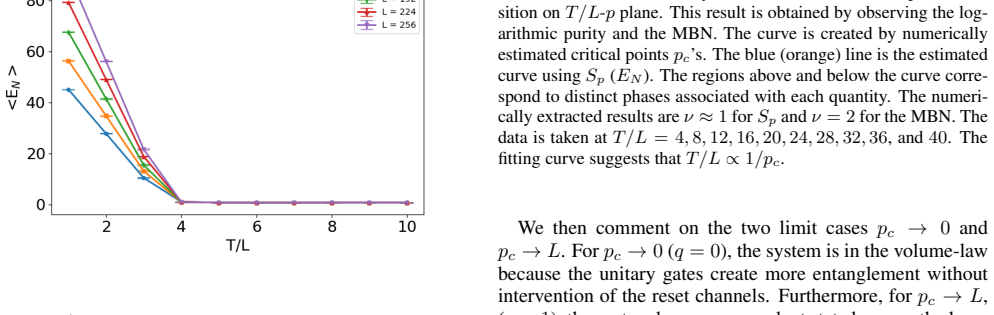
Intermediatepregime We additionally comment on the form ofS p in Eq. (7) in the intermediate regime wherep∼p c. In the small-Tregime, the numerical results in the main text show strong agreement with the analytical expression ofS p given in Eq. (7) as shown in Fig. 6 (a). However, around the transition value ofT, a discrepancy between the analytical and n...
-
[11]
T. D. Ladd, F. Jelezko, R. Laflamme, C. Monroe, Y . Nakamura, and J. L. O’Brien, Quantum computers, Nature464, 45 (2010)
2010
-
[12]
J. M. Martinis, Qubit metrology for building a fault-tolerant quantum computer, npj Quantum Information1, 1 (2015)
2015
-
[13]
RIKEN, Joining the dots for quantum computing, RIKEN Research Highlight (2014), arrays of electrons trapped in nanoscale circuitry could form the basis for future scalable quantum computers
2014
-
[14]
R. Babbush, R. King, S. Boixo, W. Huggins, T. Khattar, G. H. Low, J. R. McClean, T. O’Brien, and N. C. Rubin, The grand challenge of quantum applications (2025), arXiv:2511.09124 [quant-ph]
-
[15]
Preskill, Quantum Computing in the NISQ era and beyond, Quantum2, 79 (2018)
J. Preskill, Quantum Computing in the NISQ era and beyond, Quantum2, 79 (2018)
2018
-
[16]
S. Liu, M.-R. Li, S.-X. Zhang, S.-K. Jian, and H. Yao, Noise- induced phase transitions in hybrid quantum circuits, Physical Review B110, 10.1103/physrevb.110.064323 (2024)
-
[17]
Y . Kuno, T. Orito, and I. Ichinose, Strong-to-weak symmetry breaking states in stochastic dephasing stabilizer circuits, Phys. Rev. B110, 094106 (2024)
2024
-
[18]
L. A. Lessa, R. Ma, J.-H. Zhang, Z. Bi, M. Cheng, and C. Wang, Strong-to-weak spontaneous symmetry breaking in mixed quantum states, PRX Quantum6, 010344 (2025)
2025
-
[19]
Weinstein, Y
Z. Weinstein, Y . Bao, and E. Altman, Measurement-induced power-law negativity in an open monitored quantum circuit, Phys. Rev. Lett.129, 080501 (2022)
2022
-
[20]
B. C. Dias, D. Perkovi ´c, M. Haque, P. Ribeiro, and P. A. McClarty, Quantum noise as a symmetry-breaking field, Phys. Rev. B108, L060302 (2023)
2023
-
[21]
Geerlings, Z
K. Geerlings, Z. Leghtas, I. M. Pop, S. Shankar, L. Frunzio, R. J. Schoelkopf, M. Mirrahimi, and M. H. Devoret, Demon- strating a driven reset protocol for a superconducting qubit, Phys. Rev. Lett.110, 120501 (2013)
2013
-
[22]
Y . Zhou, Z. Zhang, Z. Yin, S. Huai, X. Gu, X. Xu, J. Allcock, F. Liu, G. Xi, Q. Yu, H. Zhang, M. Zhang, H. Li, X. Song, Z. Wang, D. Zheng, S. An, Y . Zheng, and S. Zhang, Rapid and unconditional parametric reset protocol for tunable supercon- ducting qubits, Nature Communications12, 10.1038/s41467- 13 021-26205-y (2021)
-
[23]
Lovas, U
I. Lovas, U. Agrawal, and S. Vijay, Quantum coding transi- tions in the presence of boundary dissipation, PRX Quantum 5, 030327 (2024)
2024
-
[24]
M. A. Nielsen and I. L. Chuang, Quantum Computation and Quantum Information, 10th ed. (Cambridge University Press, USA, 2011)
2011
-
[25]
Koenig and J
R. Koenig and J. A. Smolin, How to efficiently select an arbi- trary clifford group element, Journal of Mathematical Physics 55, 122202 (2014)
2014
-
[26]
Richter, O
J. Richter, O. Lunt, and A. Pal, Transport and entanglement growth in long-range random clifford circuits, Phys. Rev. Res. 5, L012031 (2023)
2023
-
[27]
Liu, M.-R
S. Liu, M.-R. Li, S.-X. Zhang, and S.-K. Jian, Entanglement structure and information protection in noisy hybrid quantum circuits, Phys. Rev. Lett.132, 240402 (2024)
2024
- [28]
-
[29]
D. P. DiVincenzo, The physical implementation of quantum computation, Fortschritte der Physik48, 771–783 (2000)
2000
-
[30]
M. J. Gullans and D. A. Huse, Dynamical purification phase transition induced by quantum measurements, Phys. Rev. X10, 041020 (2020)
2020
-
[31]
The Heisenberg Representation of Quantum Computers
D. Gottesman, The heisenberg representation of quantum com- puters (1998), arXiv:quant-ph/9807006 [quant-ph]
work page internal anchor Pith review arXiv 1998
-
[32]
Aaronson and D
S. Aaronson and D. Gottesman, Improved simulation of stabi- lizer circuits, Phys. Rev. A70, 052328 (2004)
2004
-
[33]
Ashida, S
Y . Ashida, S. Furukawa, and M. Oshikawa, System- environment entanglement phase transitions, Phys. Rev. B110, 094404 (2024)
2024
-
[34]
Peres, Separability criterion for density matrices, Phys
A. Peres, Separability criterion for density matrices, Phys. Rev. Lett.77, 1413 (1996)
1996
-
[35]
Horodecki, P
R. Horodecki, P. Horodecki, M. Horodecki, and K. Horodecki, Quantum entanglement, Rev. Mod. Phys.81, 865 (2009)
2009
-
[36]
M. B. Plenio, Logarithmic negativity: A full entanglement monotone that is not convex, Phys. Rev. Lett.95, 090503 (2005)
2005
-
[37]
S. Sang, Y . Li, T. Zhou, X. Chen, T. H. Hsieh, and M. P. Fisher, Entanglement negativity at measurement-induced crit- icality, PRX Quantum2, 030313 (2021)
2021
-
[38]
Sharma, X
S. Sharma, X. Turkeshi, R. Fazio, and M. Dalmonte, Measurement-induced criticality in extended and long-range unitary circuits, SciPost Phys. Core5, 023 (2022)
2022
-
[39]
Anzai, H
K. Anzai, H. Matsueda, and Y . Kuno, Disordered purification phase transition in hybrid random circuits, Phys. Rev. B113, 014111 (2026)
2026
- [40]
-
[41]
O. Melchert, autoscale.py - a program for automatic finite- size scaling analyses: A user’s guide (2009), arXiv:0910.5403 [physics.comp-ph]
-
[42]
Skinner, J
B. Skinner, J. Ruhman, and A. Nahum, Measurement-induced phase transitions in the dynamics of entanglement, Phys. Rev. X9, 031009 (2019)
2019
-
[43]
Y . Li, X. Chen, and M. P. A. Fisher, Quantum zeno effect and the many-body entanglement transition, Phys. Rev. B98, 205136 (2018)
2018
-
[44]
Zabalo, M
A. Zabalo, M. J. Gullans, J. H. Wilson, S. Gopalakrish- nan, D. A. Huse, and J. H. Pixley, Critical properties of the measurement-induced transition in random quantum circuits, Phys. Rev. B101, 060301 (2020)
2020
-
[46]
Y . Bao, S. Choi, and E. Altman, Theory of the phase transi- tion in random unitary circuits with measurements, Phys. Rev. B101, 104301 (2020)
2020
-
[47]
M. P. Fisher, V . Khemani, A. Nahum, and S. Vijay, Random quantum circuits, Annual Review of Condensed Matter Physics 14, 335–379 (2023)
2023
-
[48]
R. Vasseur, Les houches lectures on random quantum circuits and monitored quantum dynamics (2026), arXiv:2602.17258 [quant-ph]
-
[49]
Y . Zou, S. Sang, and T. H. Hsieh, Channeling quantum critical- ity, Phys. Rev. Lett.130, 250403 (2023)
2023
-
[50]
Jian, Y .-Z
C.-M. Jian, Y .-Z. You, R. Vasseur, and A. W. W. Ludwig, Measurement-induced criticality in random quantum circuits, Phys. Rev. B101, 104302 (2020)
2020
discussion (0)
Sign in with ORCID, Apple, or X to comment. Anyone can read and Pith papers without signing in.