Recognition: 2 theorem links
· Lean TheoremChaos Emerge with Exceptional Points in Reset-Driven Floquet Dynamics
Pith reviewed 2026-05-13 06:00 UTC · model grok-4.3
The pith
Tuning a chaos parameter in reset-driven Floquet channels triggers exceptional-point transitions that break symmetry and produce full chaos.
A machine-rendered reading of the paper's core claim, the machinery that carries it, and where it could break.
Core claim
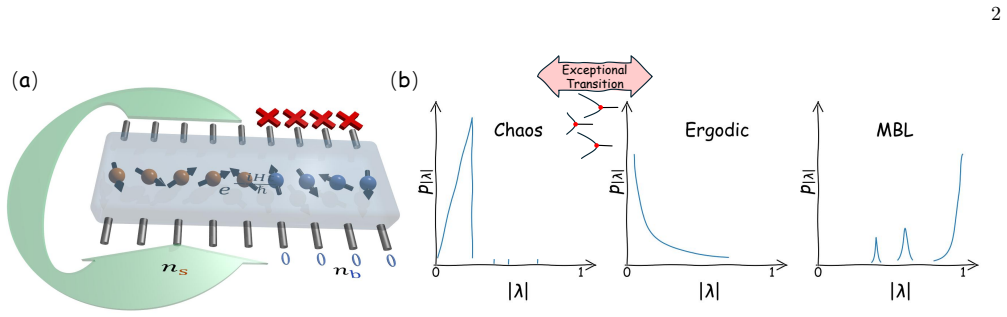
Increasing the chaos-controlling parameter causes the real eigenvalues of the reset-driven Floquet channel to coalesce at exceptional points and bifurcate into complex-conjugate pairs. This spectral change marks the progressive breaking of symmetry constraints in operator space and drives the system from a symmetry-constrained ergodic regime into a fully chaotic regime. The channel spectrum thereby distinguishes chaotic, ergodic, many-body localized, and scarred dynamical regimes, with its leading eigenvalues directly tied to experimentally measurable quantum mutual information.
What carries the argument
The spectrum of the reset-driven Floquet quantum channel, in which exceptional points cause real eigenvalues to coalesce and bifurcate into complex pairs, thereby lifting symmetry constraints on the operator dynamics.
If this is right
- The channel spectrum provides a single diagnostic that separates chaotic, ergodic, many-body localized, and scarred regimes.
- The leading eigenvalues of the channel correspond to the decay rates of quantum mutual information, supplying concrete experimental observables.
- The transition occurs through eigenvalue coalescence at exceptional points and does not require model-specific details of the bath reset.
Where Pith is reading between the lines
- The same spectral diagnostic could be applied to other periodically driven open systems to detect the onset of chaos.
- Tracking eigenvalue bifurcation might offer a practical way to identify symmetry-breaking transitions in larger many-body systems.
- Because the leading eigenvalues link to mutual information, the approach could be used to monitor chaos in quantum simulation platforms without full tomography.
Load-bearing premise
The periodic bath reset produces a quantum channel whose eigenvalue spectrum directly registers the symmetry-breaking transition without further assumptions on bath coupling strength or the precise form of the reset.
What would settle it
An experiment or numerical diagonalization that tracks the channel eigenvalues while the chaos parameter is swept and checks whether they stay real past the predicted transition point or fail to match the decay of measured quantum mutual information.
Figures


read the original abstract
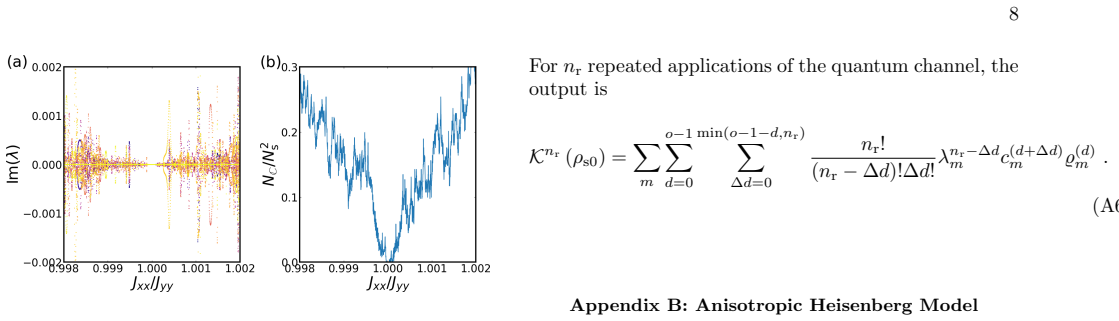
We investigate the spectral structure of reset-driven Floquet quantum channels generated by the Hamiltonian evolution of a many-body system followed by periodic resetting of a bath. By tuning a chaos-controlling parameter in the underlying Hamiltonian, we uncover an exceptional-point-induced spectral transition from a symmetry-constrained ergodic regime to a fully chaotic regime. Across this transition, increasing the chaos parameter causes the real eigenvalues of the channel to drift, coalesce at exceptional points, and bifurcate into complex-conjugate pairs, signaling the progressive breaking of symmetry constraints in operator space. We further show that the channel spectrum sharply distinguishes chaotic, ergodic, many-body localized, and scarred dynamical regimes. Finally, we connect the leading channel eigenvalues to experimentally accessible probes based on quantum mutual information, establishing a link between the spectral organization of reset-driven quantum channels and observable relaxation dynamics.
Editorial analysis
A structured set of objections, weighed in public.
Referee Report
Summary. The paper examines reset-driven Floquet quantum channels formed by Hamiltonian evolution of a many-body system followed by periodic bath resets. By varying a chaos-controlling parameter in the Hamiltonian, it reports an exceptional-point-induced transition in the channel spectrum from a symmetry-constrained ergodic regime to a fully chaotic regime, with real eigenvalues drifting, coalescing at EPs, and bifurcating into complex-conjugate pairs. The spectrum is claimed to distinguish chaotic, ergodic, many-body localized, and scarred regimes, and leading eigenvalues are linked to quantum mutual information as experimental probes.
Significance. If substantiated, the work offers a spectral diagnostic for dynamical regimes in open quantum systems that ties Hamiltonian chaos directly to non-unitary channel properties and observable relaxation dynamics. The explicit connection to quantum mutual information provides a potential experimental bridge. Strengths include the attempt to unify chaos indicators across closed and open settings via exceptional points, though verification of the central mapping requires detailed methods.
major comments (2)
- [Abstract / central claim] Abstract and main claim: the assertion that the channel spectrum directly encodes the Hamiltonian chaos-induced symmetry-breaking transition rests on the assumption that the reset map does not independently generate or shift exceptional points. The non-Hermitian channel superoperator is the composition of unitary evolution and the reset operation; without explicit checks (e.g., varying reset form or bath coupling strength while holding the chaos parameter fixed), it is unclear whether the reported EP coalescence and bifurcation are robust signatures of the underlying many-body chaos or artifacts of the specific reset protocol.
- [Methods / numerical implementation] No derivation details, numerical methods, or error analysis are provided for the eigenvalue computations or the identification of exceptional points. The transition is described qualitatively, but load-bearing steps such as how the Floquet channel is constructed, how eigenvalues are extracted, and how the chaos parameter is defined quantitatively are absent, making it impossible to assess reproducibility or sensitivity to discretization.
minor comments (2)
- [Introduction] Clarify notation for the reset operation and the precise definition of the chaos-controlling parameter early in the text.
- [Results] Add error bars or convergence checks for the reported eigenvalue drifts and bifurcation points.
Simulated Author's Rebuttal
We thank the referee for the constructive comments, which have helped us strengthen the manuscript. We address each major point below and have revised the paper to incorporate additional checks, expanded methods, and clarifications. All changes are highlighted in the revised version.
read point-by-point responses
-
Referee: Abstract and main claim: the assertion that the channel spectrum directly encodes the Hamiltonian chaos-induced symmetry-breaking transition rests on the assumption that the reset map does not independently generate or shift exceptional points. Without explicit checks (e.g., varying reset form or bath coupling strength while holding the chaos parameter fixed), it is unclear whether the reported EP coalescence and bifurcation are robust signatures of the underlying many-body chaos or artifacts of the specific reset protocol.
Authors: We agree that robustness against reset variations strengthens the central claim. In the revised manuscript we have added a dedicated subsection (now Section IV.C) that fixes the chaos parameter at representative values in both the ergodic and chaotic regimes and systematically varies the reset protocol: (i) bath coupling strength over two orders of magnitude, (ii) different reset operators (projective vs. partial trace with thermal bath), and (iii) reset frequency. The exceptional-point coalescence and subsequent bifurcation into complex-conjugate pairs remain tied to the chaos parameter; only the precise locations of the EPs shift mildly with reset strength, while the qualitative spectral transition persists. These results are summarized in new Figures 4 and 5. We have also revised the abstract and introduction to explicitly state that the reset map is held fixed while the Hamiltonian chaos parameter is tuned, and we now emphasize that the observed transition is a joint property of the driven Hamiltonian and the reset channel. revision: yes
-
Referee: No derivation details, numerical methods, or error analysis are provided for the eigenvalue computations or the identification of exceptional points. The transition is described qualitatively, but load-bearing steps such as how the Floquet channel is constructed, how eigenvalues are extracted, and how the chaos parameter is defined quantitatively are absent, making it impossible to assess reproducibility or sensitivity to discretization.
Authors: We acknowledge that the original Methods section lacked sufficient detail. The revised manuscript now contains an expanded Methods section (Section II) that provides: (1) the explicit superoperator construction of the reset-driven Floquet channel as the composition of the unitary evolution operator U(τ) followed by the reset map R, (2) the quantitative definition of the chaos parameter (the kicking strength λ in the Floquet Hamiltonian H = H0 + λ V(t)), (3) the numerical procedure—exact diagonalization for system sizes up to L=10 and matrix-product-operator techniques for larger systems—together with the software libraries and convergence criteria used, and (4) a dedicated error-analysis subsection that reports eigenvalue sensitivity to time-step discretization, truncation thresholds, and system-size extrapolation. We have also added pseudocode and supplementary material containing the raw eigenvalue spectra for representative parameter values to facilitate reproducibility. revision: yes
Circularity Check
No circularity: spectral transition obtained from direct channel diagonalization
full rationale
The derivation proceeds by explicitly constructing the reset-driven Floquet channel as the composition of Hamiltonian unitary evolution followed by the bath reset map, then computing its eigenvalues numerically or analytically as the chaos-controlling parameter is varied. The exceptional-point coalescence and bifurcation are direct consequences of this superoperator's spectrum; no parameters are fitted to a data subset and then relabeled as predictions, no self-citation supplies a uniqueness theorem or ansatz that the present work merely renames, and the link to mutual information follows from separate explicit calculation rather than by construction. The analysis is therefore self-contained against external benchmarks.
Axiom & Free-Parameter Ledger
free parameters (1)
- chaos-controlling parameter
axioms (1)
- domain assumption The reset operation produces a completely positive trace-preserving quantum channel whose spectrum faithfully reflects the underlying Hamiltonian dynamics.
Lean theorems connected to this paper
-
IndisputableMonolith/Cost/FunctionalEquation.leanwashburn_uniqueness_aczel unclearBy tuning a chaos-controlling parameter in the underlying Hamiltonian, we uncover an exceptional-point-induced spectral transition from a symmetry-constrained ergodic regime to a fully chaotic regime.
-
IndisputableMonolith/Foundation/RealityFromDistinction.leanreality_from_one_distinction unclearthe channel spectrum sharply distinguishes chaotic, ergodic, many-body localized, and scarred dynamical regimes
Reference graph
Works this paper leans on
-
[1]
Y. Choi, C. Hahn, J. W. Yoon, and S. H. Song, Ob- servation of an anti-pt-symmetric exceptional point and energy-difference conserving dynamics in electrical cir- cuit resonators, Nature communications9, 2182 (2018)
work page 2018
-
[2]
D. J. Luitz and F. Piazza, Exceptional points and the topology of quantum many-body spectra, Phys. Rev. Res.1, 033051 (2019)
work page 2019
-
[3]
R. El-Ganainy, K. G. Makris, M. Khajavikhan, Z. H. Musslimani, S. Rotter, and D. N. Christodoulides, Non- hermitian physics and pt symmetry, Nature Physics14, 11 (2018)
work page 2018
-
[4]
Huang, Exceptional topology in non-hermitian twisted bilayer graphene, Phys
Y. Huang, Exceptional topology in non-hermitian twisted bilayer graphene, Phys. Rev. B111, 085120 (2025)
work page 2025
- [5]
-
[6]
Xue, Essay: Topological phases and exceptional points in non-hermitian systems, Phys
P. Xue, Essay: Topological phases and exceptional points in non-hermitian systems, Phys. Rev. Lett.136, 170001 (2026)
work page 2026
-
[7]
Y. Xu, Z. Chai, and X. Su, Exceptional point-driven multi-channel electron spin po- larization, ACS Photonics13, 1084 (2026), https://doi.org/10.1021/acsphotonics.5c02577
-
[8]
M.-A. Miri and A. Al` u, Exceptional points in op- tics and photonics, Science363, eaar7709 (2019), https://www.science.org/doi/pdf/10.1126/science.aar7709
-
[9]
F. Minganti, A. Miranowicz, R. W. Chhajlany, and F. Nori, Quantum exceptional points of non-hermitian hamiltonians and liouvillians: The effects of quantum jumps, Phys. Rev. A100, 062131 (2019)
work page 2019
- [10]
-
[11]
Z.-Z. Wu, P.-D. Li, T.-H. Cui, J.-W. Wang, Y.-Z. Dong, S.-Q. Dai, J. Li, Y.-Q. Wei, Q. Yuan, X.-M. Cai,et al., Experimental witness of quantum jump induced high- order liouvillian exceptional points, Nature Communica- tions 10.1038/s41467-026-68705-9 (2026)
-
[12]
R. Hanai and P. B. Littlewood, Critical fluctuations at a many-body exceptional point, Phys. Rev. Res.2, 033018 (2020)
work page 2020
-
[13]
J.-L. Ma, Z. Guo, Y. Gao, Z. Papi´ c, and L. Ying, Liou- villian spectral transition in noisy quantum many-body scars, Phys. Rev. Lett.135, 180401 (2025)
work page 2025
- [14]
-
[15]
A. Chaduteau, D. K. K. Lee, and F. Schindler, Lindbla- dian versus postselected non-hermitian topology, Phys. Rev. Lett.136, 016603 (2026)
work page 2026
- [16]
-
[17]
W. C. Wong, B. Zeng, and J. Li, Non-markovian ex- ceptional points by interpolating quantum channels, npj Quantum Information12, 63 (2026)
work page 2026
-
[18]
K. Chen, F. Girardi, A. Oufkir, N. Yu, and Z. Zhang, Quantum channel tomography: optimal 9 bounds and a heisenberg-to-classical phase transition (2026), arXiv:2604.17369 [quant-ph]
work page internal anchor Pith review Pith/arXiv arXiv 2026
-
[19]
F. Hu, S. A. Khan, N. T. Bronn, G. Angelatos, G. E. Rowlands, G. J. Ribeill, and H. E. T¨ ureci, Overcoming the coherence time barrier in quantum machine learning on temporal data, Nat. Commun.15, 7491 (2024)
work page 2024
- [20]
-
[21]
E. B¨ aumer, V. Tripathi, D. S. Wang, P. Rall, E. H. Chen, S. Majumder, A. Seif, and Z. K. Minev, Efficient long- range entanglement using dynamic circuits, PRX Quan- tum5, 030339 (2024)
work page 2024
-
[22]
J. Langbehn, K. Snizhko, I. Gornyi, G. Morigi, Y. Gefen, and C. P. Koch, Dilute measurement-induced cooling into many-body ground states, PRX Quantum5, 030301 (2024)
work page 2024
-
[23]
J. Langbehn, G. Mouloudakis, E. King, R. Menu, I. Gornyi, G. Morigi, Y. Gefen, and C. P. Koch, Uni- versal cooling of quantum systems via randomized mea- surements (2025), arXiv:2506.11964 [quant-ph]
- [24]
-
[25]
Moiseyev,Non-Hermitian Quantum Mechanics(Cam- bridge University Press, 2011)
N. Moiseyev,Non-Hermitian Quantum Mechanics(Cam- bridge University Press, 2011)
work page 2011
-
[26]
Continuous Reset-Induced Phase Transition in Measurement-Free Random Quantum Circuits
H. Yokoyama, K. Anzai, D. Syverud-Lindland, Y. Kuno, and H. Matsueda, Continuous reset-induced phase tran- sition in measurement-free random quantum circuits (2026), arXiv:2604.25640 [quant-ph]
work page internal anchor Pith review Pith/arXiv arXiv 2026
- [27]
- [28]
-
[29]
L. Kong, Z. Gong, and B. Wu, Quantum dynamical tun- neling breaks classical conserved quantities, Phys. Rev. E109, 054113 (2024)
work page 2024
-
[30]
S. F. E. Oliviero, L. Leone, F. Caravelli, and A. Hamma, Random matrix theory of the isospectral twirling, Sci- Post Phys.10, 076 (2021)
work page 2021
-
[31]
F. U. J. Klauck, M. Heinrich, A. Szameit, and T. A. W. Wolterink, Crossing exceptional points in non-hermitian quantum systems, Science Advances11, eadr8275 (2025), https://www.science.org/doi/pdf/10.1126/sciadv.adr8275
- [32]
-
[33]
J. Wang, M. H. Lamann, J. Richter, R. Steinigeweg, A. Dymarsky, and J. Gemmer, Eigenstate thermaliza- tion hypothesis and its deviations from random-matrix theory beyond the thermalization time, Phys. Rev. Lett. 128, 180601 (2022)
work page 2022
-
[34]
M. Schecter and T. Iadecola, Weak ergodicity breaking and quantum many-body scars in spin-1xymagnets, Phys. Rev. Lett.123, 147201 (2019)
work page 2019
- [35]
-
[36]
J.-J. Feng and Q. Zhuang, Many-body anti-zeno thermal- ization and zeno determinism in monitored hamiltonian dynamics, Phys. Rev. Lett.136, 080602 (2026)
work page 2026
- [37]
- [38]
-
[39]
M. ˇZnidariˇ c and M. Ljubotina, Interaction instability of localization in quasiperiodic systems, Proceedings of the National Academy of Sciences115, 4595 (2018), https://www.pnas.org/doi/pdf/10.1073/pnas.1800589115
-
[40]
Y. Yoo, J. Lee, and B. Swingle, Nonequilibrium steady state phases of the interacting aubry-andr´ e-harper model, Phys. Rev. B102, 195142 (2020)
work page 2020
-
[41]
X. Chen and R. Yu, Realization of fractal aubry-andr´ e- harper models in electronic circuits, Phys. Rev. B111, 235104 (2025)
work page 2025
-
[42]
P. Sierant, M. Lewenstein, A. Scardicchio, L. Vidmar, and J. Zakrzewski, Many-body localization in the age of classical computing*, Reports on Progress in Physics88, 026502 (2025)
work page 2025
-
[43]
E. Br´ ezin and J. Zinn-Justin, Finite size effects in phase transitions, Nuclear Physics B257, 867 (1985)
work page 1985
-
[44]
J. K. Jiang, F. M. Surace, and O. I. Motrunich, Charge transport capacity as a probe of resonances in models of many-body localization (2026), arXiv:2604.18710 [cond- mat.dis-nn]
work page internal anchor Pith review Pith/arXiv arXiv 2026
-
[45]
A. Morningstar, L. Colmenarez, V. Khemani, D. J. Luitz, and D. A. Huse, Avalanches and many-body res- onances in many-body localized systems, Phys. Rev. B 105, 174205 (2022)
work page 2022
-
[46]
T. Kuwahara and K. Saito, Area law of noncritical ground states in 1d long-range interacting systems, Na- ture communications11, 4478 (2020)
work page 2020
-
[47]
T. Brydges, A. Elben, P. Jurcevic, B. Vermersch, C. Maier, B. P. Lanyon, P. Zoller, R. Blatt, and C. F. Roos, Probing r´ enyi entanglement entropy via randomized measurements, Science364, 260 (2019), https://www.science.org/doi/pdf/10.1126/science.aau4963
-
[48]
Z. Li, R. Cai, X. Wang, K. Shimomura, C. Lu, Z. Yang, M. Sato, and G. Ma, Exceptional deficiency of non- hermitian systems, Nature Physics 10.1038/s41567-026- 03259-7 (2026)
-
[49]
R. K¨ uhn, Spectra of sparse random matrices, Journal of Physics A: Mathematical and Theoretical41, 295002 (2008)
work page 2008
-
[50]
F. Lucas Metz, I. Neri, and T. Rogers, Spectral the- ory of sparse non-hermitian random matrices, Journal of Physics A: Mathematical and Theoretical52, 434003 (2019)
work page 2019
-
[51]
L. Xiao, T. Deng, K. Wang, Z. Wang, W. Yi, and P. Xue, Observation of non-bloch parity-time symmetry and ex- ceptional points, Phys. Rev. Lett.126, 230402 (2021)
work page 2021
- [52]
- [53]
-
[54]
Y. Zhao and B. Wu, Quantum-classical correspondence in integrable systems, Science China Physics, Mechanics 10 & Astronomy62, 997011 (2019)
work page 2019
- [55]
- [56]
-
[57]
J. Randall, C. E. Bradley, F. V. van der Gron- den, A. Galicia, M. H. Abobeih, M. Markham, D. J. Twitchen, F. Machado, N. Y. Yao, and T. H. Taminiau, Many-body–localized discrete time crystal with a programmable spin-based quantum simulator, Science374, 1474 (2021), https://www.science.org/doi/pdf/10.1126/science.abk0603
-
[58]
H. Kim, T. N. Ikeda, and D. A. Huse, Testing whether all eigenstates obey the eigenstate thermalization hypothe- sis, Phys. Rev. E90, 052105 (2014)
work page 2014
-
[59]
S. Pilatowsky-Cameo and S. Choi, Quantum thermaliza- tion must occur in translation-invariant systems at high temperature, Nature Communications (2025)
work page 2025
- [60]
-
[61]
P. Sierant and J. Zakrzewski, Challenges to observation of many-body localization, Phys. Rev. B105, 224203 (2022)
work page 2022
-
[62]
Z.-H. Liu, Y. Liu, G.-H. Liang, C.-L. Deng, K. Chen, Y.-H. Shi, T.-M. Li, L. Zhang, B.-J. Chen, C.-P. Fang, et al., Prethermalization by random multipolar driving on a 78-qubit processor, Nature , 1 (2026)
work page 2026
discussion (0)
Sign in with ORCID, Apple, or X to comment. Anyone can read and Pith papers without signing in.