REVIEW 4 major objections 4 minor 3 cited by
Variational Neural Belief Parameterizations for Robust Dexterous Grasping under Multimodal Uncertainty
T0 review · 4 major / 4 minor · reviewed 2026-08-02 · deepseek-v4-flash
Pith's one-line read The paper's central claim is that a differentiable Gaussian-mixture belief, updated by learned neural dynamics, lets a grasp planner optimize Conditional Value-at-Risk directly, improving robust success and risk calibration under variable f
desk verdict New piece: differentiable GMM belief with pathwise CVaR gradients for grasp MPC; solid math, honest reporting, but the neural belief training is unspecified, so the headline calibration gains are not yet trustworthy. read the letter →
The pith
A machine-rendered reading of the paper's core claim, the machinery that carries it, and where it could break.
The reading
What carries the argument
The load-bearing object is the reparameterized Gaussian mixture belief p(θ|ϕ) = Σ π_k N(µ_k, diag(σ_k²)), with samples built as θ = Σ ζ_k(µ_k + σ_k ⊙ ε_k), where ζ comes from a Gumbel-Softmax draw over component logits. This makes every sample a smooth function of the belief parameters. Learned transition and correction networks plus a decoder update the mixture online, and a softplus-smoothed CVaR estimator propagates pathwise gradients through both the action and the belief. Per-component action optimization with multi-start avoids optimizing against an averaged belief, letting the controller hedge across distinct contact hypotheses.
What would settle it
Hold out one friction regime (e.g., a µ_o range outside [0.15, 1.2] or a new material surface), freeze the trained belief networks, and rerun the 28-perturbation stress test. If mean absolute calibration error exceeds 0.14 or robust-success margins over CEM disappear, the learned belief has not generalized. A complementary check is to rerun simulation with the real fingertip friction µ_f = 0.35, which the paper says was replaced by the simulator default µ_f = 1.0.
Extended reading notes
Core claim
Variational neural beliefs close the gradient gap that particle-filter belief-space MPC leaves open. Because each Gaussian-mixture sample is a differentiable function of the mixture logits, means, and scales, the planner can backpropagate through a smooth CVaR surrogate and directly optimize actions that hedge against the worst β-fraction of contact and pose realizations. The paper reports that this VNB-MPC achieves higher robust grasp success and perturbation survival than sampling-based baselines in simulation, cuts planning time by roughly an order of magnitude relative to particle-filter MPC (about 5–7x in the reported tables), and yields markedly better risk calibration, with mean absol
Load-bearing premise
The learned neural belief dynamics are trained on data the paper does not describe; if that training distribution does not cover the friction and pose regimes used for evaluation, the reported calibration and robustness gains may reflect memorization rather than generalization.
Editorial extensions
If this is right
- Risk-sensitive grasp planning no longer needs particle resampling: tail-risk gradients can be computed through the belief, so MPC can hedge against rare contact and force outcomes in gradient steps.
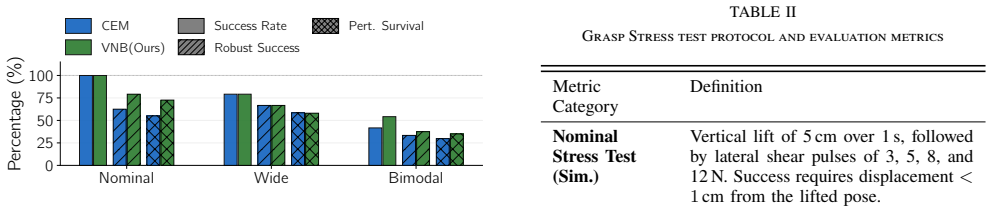
- Belief calibration improves enough that predicted failure probability can serve as an online stop/go signal; reported |P̂_bel_fail − P̂_emp_fail| ≤ 0.14 across regimes, versus 0.58 for CEM.
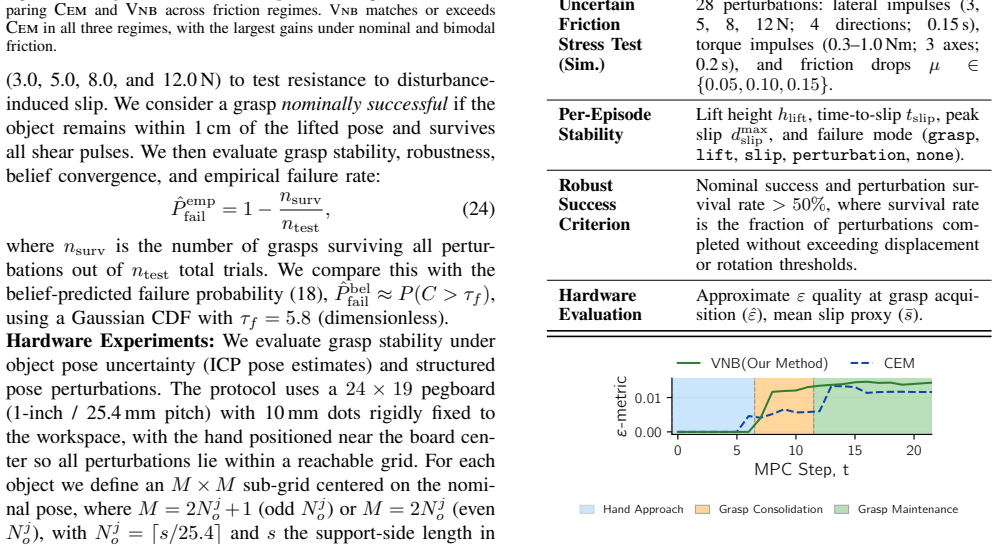
- The same differentiable belief pipeline transfers from simulation to hardware under pose uncertainty, terminating in fewer steps and less wall-clock time than a Gaussian baseline while achieving a higher tactile quality proxy (median 1.6×10⁻³ vs 0.9×10⁻³).
- Multimodality is represented explicitly: each mixture component is optimized separately and the best risk-aware action is selected, so the planner hedges across distinct contact hypotheses instead of averaging them.
- Planning speed improves to roughly an order of magnitude below particle-filter MPC (episode times about 4–6 s vs 65–72 s), making risk-aware dexterous grasping feasible for repeated online use.
Reading between the lines
- The differentiable belief mechanism is not grasp-specific; in principle it transfers to other belief-space manipulation problems where contact uncertainty and tail outcomes dominate, such as assembly, insertion, or in-hand regrasping. This extension is not tested in the paper.
- The SIREN/Langevin variant in Appendix B points toward high-capacity non-Gaussian beliefs, but the discretization bias bound in (30) is only a guarantee of sampling quality, not of planning performance; whether that bias matters for grasping is untested.
- Because hardware trials are 12 per method with 100% success for both, the meaningful hardware claims are convergence speed and tactile-quality proxy, not success-rate superiority; readers should not take the hardware comparison as evidence of robustness gains.
- A practical downstream use of the calibration result would be to treat the belief-predicted failure probability as an online abort or retry signal during grasp execution, using the reported |ΔP̂| ≤ 0.14 as a trust bound. The paper does not evaluate this use.
Editorial analysis
A structured set of objections, weighed in public.
Referee Report
Summary. The paper proposes a variational neural belief (VNB) parameterization for risk-sensitive dexterous grasping. The belief is a Gaussian mixture over latent contact parameters and object pose, with learned transition/observation models (f_trans, f_obs, DecodeBelief), Gumbel-Softmax component selection, and location-scale reparameterization. These choices make belief samples differentiable with respect to the belief parameters, enabling pathwise gradients through a smooth CVaR surrogate. Grasping is formulated as a belief-space MPC problem with a composite objective of CVaR cost, expected cost, perception cost, and belief entropy. Experiments in MuJoCo compare VNB-MPC against particle-filter MPC, Gaussian MPC, Gaussian-CVaR MPC, and CEM across nominal, wide, and bimodal friction regimes, reporting robust success, perturbation survival, calibration error, and wall-clock time. Hardware trials on a serial arm with a multi-fingered hand evaluate grasp-and-lift success under object-pose uncertainty against a Gaussian baseline. The central claim is that VNB improves robust grasp success and calibration while reducing planning time by roughly an order of magnitude relative to particle-filter MPC.
Significance. If the reported results are reproducible and generalizable, the paper makes a useful contribution: it replaces particle-filter beliefs with a continuous differentiable mixture belief, enabling gradient-based CVaR optimization in belief-space grasping and offering a practical speed advantage. The authors provide code, simulation assets, and a dataset of force-closed grasps, which is a concrete reproducibility asset. The reparameterized CVaR gradient derivation in Section IV and Appendix A is standard and clean, and the perturbation stress-test protocol is more detailed than is typical. However, the central empirical claims rest on the learned belief dynamics and on the calibration threshold, and both are under-specified in ways that currently prevent verification of generalization.
major comments (4)
- [Section III-B, Algorithm 2, Table V] The training protocol for the neural belief dynamics is not given. f_trans, f_obs, and DecodeBelief are defined only by architecture and optimizer (Table V); the loss function, training-data generation procedure, validation split, and any separation between training and evaluation regimes are absent. The abstract's 'dataset of 243 force-closed grasps' is never connected to this training. Since Table III reports calibration and robust-success gains computed with beliefs produced by these networks, the results could reflect in-sample fitting rather than generalization. Please specify the dataset, loss, and train/evaluation split, ideally with held-out objects or friction regimes.
- [Section V-D, Eq. (17), Table III] The failure threshold tau_f = 5.8 is asserted without a stated selection procedure. The calibration error |Delta P| in Table III is computed as |P^bel_fail - P^emp_fail|, and P^bel_fail is defined through the threshold tau_f in Eq. (18)-(19). If tau_f was chosen after observing empirical failure rates, the calibration comparison is not a predictive test. Please report how tau_f was selected, show that it was fixed before the evaluation, and provide a sensitivity analysis over tau_f. Without this, the 'better-calibrated risk' claim is not load-bearing.
- [Algorithm 1, Section IV-E] The per-component action optimization with selection of the lowest risk-aware cost is an optimistic rule, not a risk-averse one. Each component's action is optimized using samples from that component only (line 4), and k* is chosen as arg min_k J^(k) subject to P_fail^(k) <= delta. A dangerous mode with high failure probability is therefore not required to influence the executed action as long as its own J^(k) is not the minimum or its P_fail^(k) is below delta. This conflicts with the claimed robustness under multimodal uncertainty. Moreover, the failure bound delta is never given in Table V. Please either justify this selection rule, modify it to optimize a joint CVaR over the full mixture or a worst-component objective, and report delta.
- [Table III, Section VI-A] The rows for Gauss and Gauss-Cvar are numerically identical across all regimes. The paper states that 'the CVaR weighting did not change the selected actions after multi-start optimization.' This means the simulation comparison does not isolate the effect of the CVaR objective: the robust-success advantage attributed to VNB could come from the GMM belief, the learned belief dynamics, or the multi-start rule rather than from risk-sensitive optimization. A direct ablation (e.g., VNB with lambda_c = 0 versus lambda_c = 1, and a GMM belief without CVaR) is needed to support the risk-sensitivity claim.
minor comments (4)
- [Section IV-E and Table V] The text states 'multi-start optimization with three initial action magnitudes,' while Table V lists '20 action candidates, close in {0.05, 0.10, 0.15, 0.20}.' Please reconcile the number of initializations and the set of closure magnitudes.
- [Appendix A, Eq. (26)] The envelope-theorem sentence says the gradient contribution through eta vanishes at the optimal quantile. For a finite sample softplus approximation, the empirical quantile is not generally the minimizer of the smoothed objective. The estimator is valid if eta is treated as fixed, but the statement should be qualified to avoid implying an exact unbiased gradient.
- [Figure 3] The notation 'Cctc(theta_i)' in the figure is not defined in the caption. It should be tied to the cost decomposition in Eq. (14)-(15).
- [Footnote 2, Section V-A] The simulation uses mu_f = 1.0 while the real hand's PEEK fingertips have mu_f = 0.35. This means the simulated friction regimes do not match the hardware conditions. The discrepancy should be discussed as a limitation when interpreting the simulation-to-hardware transfer.
Circularity Check
No significant circularity: the central gradient derivation is self-contained; the main concerns are missing training/threshold details, not construction-level circularity.
full rationale
The paper's central derivation chain starts from a reparameterized GMM belief (Eqs. 7-9) and a differentiable CVaR surrogate (Eq. 12). Theorem 1 (Eq. 26) is a chain-rule application of the reparameterization trick and does not assume the paper's empirical conclusions. The grasp cost (Eqs. 14-15) and the MPC objective (Eq. 20) are defined independently of the success metrics (Eq. 24, Table III), so the robust-success and planning-time results are measurements rather than identities. I checked the candidate circularity sources. (1) The calibration claim depends on a failure threshold tau_f = 5.8 that is stated without derivation (Sec. V-D), and the neural belief dynamics (Sec. III-B, Algorithm 2) are described without training data or loss; these are genuine reproducibility/generalization omissions and could in principle conceal in-sample fitting, but the paper does not exhibit an equation that makes the reported calibration error equal to a chosen parameter, so this is not a demonstrated circular step. (2) The only self-citation ([26], Enwerem et al. 2025) appears in related work to support the statement that distributional RL does not capture physical contact uncertainty; it is not load-bearing for the main claim. (3) The Gumbel-Softmax and location-scale reparameterizations are cited to external works [15,16], not to the authors' prior results. I therefore find no step where a prediction reduces by construction to its inputs.
Assumptions & free parameters
free parameters (5)
- failure threshold tau_f =
5.8 (dimensionless)
- cost weights alpha_s, alpha_g, alpha_r, alpha_n =
1.0, 0.5, 2.0, 0.1
- risk/softness hyperparameters kappa_rho, kappa_f, lambda_c, lambda_v, gamma =
5.0, 100.0, 1.0, 0.3, not reported
- mixture components K and sample count N =
K=8, N=256/512
- MPC horizon H
assumptions (6)
- standard math Reparameterization and Gumbel-Softmax yield pathwise gradients through Gaussian mixture samples
- standard math CVaR dual representation and envelope theorem justify the gradient formula
- domain assumption Latent state is object pose plus per-contact friction, stiffness, damping, and slip; only fingers move; obstacle-free tabletop; initial belief is known
- domain assumption MuJoCo's effective friction model mu_eff = sqrt(mu_f * mu_o) adequately represents contact uncertainty
- ad hoc to paper Neural belief dynamics f_trans, f_obs, DecodeBelief approximate the true posterior update
- ad hoc to paper Per-component action optimization with selection of the lowest risk-aware cost is a sound planning rule
invented entities (1)
-
latent belief embedding h_t
Cite this review
Pith. "Pith review of Variational Neural Belief Parameterizations for Robust Dexterous Grasping under Multimodal Uncertainty." pith.science (2026). https://pith.science/paper/A5CUGUDO
@misc{pith2026260425897,
  author       = {Pith},
  title        = {Pith review of: Variational Neural Belief Parameterizations for Robust Dexterous Grasping under Multimodal Uncertainty},
  year         = {2026},
  howpublished = {\url{https://pith.science/paper/A5CUGUDO}},
  note         = {Machine review of arXiv:2604.25897}
}
read the original abstract
Contact variability, sensing uncertainty, and external disturbances make grasp execution stochastic. Expected-quality objectives ignore tail outcomes and often select grasps that fail under adverse contact realizations. Risk-sensitive POMDPs address this failure mode, but many use particle-filter beliefs that scale poorly, obstruct gradient-based optimization, and estimate Conditional Value-at-Risk (CVaR) with high-variance approximations. We instead formulate grasp acquisition as variational inference over latent contact parameters and object pose, representing the belief with a differentiable Gaussian mixture. We use Gumbel-Softmax component selection and location-scale reparameterization to express samples as smooth functions of the belief parameters, enabling pathwise gradients through a differentiable CVaR surrogate for direct optimization of tail robustness. In simulation, our variational neural belief improves robust grasp success under contact-parameter uncertainty and exogenous force perturbations while reducing planning time by roughly an order of magnitude relative to particle-filter model-predictive control. On a serial-chain robot arm with a multifingered hand, we validate grasp-and-lift success under object-pose uncertainty against a Gaussian baseline. Both methods succeed on the tested perturbations, but our controller terminates in fewer steps and less wall-clock time while achieving a higher tactile grasp-quality proxy. Our learned belief also calibrates risk more accurately, keeping mean absolute calibration error below 0.14 across tested simulation regimes, compared with 0.58 for a Cross-Entropy Method planner. We provide code, simulation assets, and a dataset of 243 force-closed grasps at the following link: www.github.com/coenwerem/vnb-grasp.
Figures


Figures from the paper (5 more)


Forward citations
Cited by 3 Pith papers
-
Grasp Execution Without a Planner: Configuration-Space Grasp Distance Fields with Certified Safety & Guaranteed Quality
Grasp execution via a softmin field over grasp configurations with CBF-QP safety filtering, eliminating trajectory replanning, with a force-closure margin guarantee that fails in one reported trial.
-
FIRMGrasp: A Friction-Informed Risk Margin for Robust Grasp Synthesis
A CVaR-based risk-adjusted Ferrari-Canny margin certifies force closure with probability at least β and better ranks adverse-friction grasp success than nominal epsilon.
-
EquiDexFlow: Contact-Grounded SE(3)-Equivariant Dexterous Grasp Generative Flows
EquiDexFlow is an SE(3)-equivariant flow-matching model for generating contact-grounded dexterous grasps that enforces surface contact and friction-cone compliance by architectural construction.
Reference graph
Works this paper leans on
-
[1]
Pose Error Robust Grasping From Contact Wrench Space Metrics,
J. Weisz and P. K. Allen, “Pose Error Robust Grasping From Contact Wrench Space Metrics,” in2012 IEEE International Conference On Robotics and Automation, pp. 557–562, 2012. ISSN: 1050-4729
2012
-
[2]
Toward An Analytic Theory of Intrinsic Robustness for Dexterous Grasping,
A. H. Li, P. Culbertson, and A. D. Ames, “Toward An Analytic Theory of Intrinsic Robustness for Dexterous Grasping,” in2024 IEEE/RSJ International Conference on Intelligent Robots and Systems (IROS), pp. 2992–2999, 2024. ISSN: 2153-0866
2024
-
[3]
GraspIt! A Versatile Simulator for Robotic Grasping,
A. T. Miller and P. K. Allen, “GraspIt! A Versatile Simulator for Robotic Grasping,”IEEE Robotics & Automation Magazine, vol. 11, no. 4, pp. 110–122, 2004
2004
-
[4]
TPGP: Temporal-Parametric Optimization with Deep Grasp Prior for Dexterous Motion Planning,
H. Li, Q. Ye, Y. Huo, Q. Liu, S. Jiang, T. Zhou, X. Li, Y. Zhou, and J. Chen, “TPGP: Temporal-Parametric Optimization with Deep Grasp Prior for Dexterous Motion Planning,” in2024 IEEE International Conference on Robotics and Automation (ICRA), pp. 18106–18112, 2024
2024
-
[5]
Synthesizing Diverse and Physically Stable Grasps With Arbitrary Hand Structures Using Differentiable Force Closure Estimator,
T. Liu, Z. Liu, Z. Jiao, Y. Zhu, and S.-C. Zhu, “Synthesizing Diverse and Physically Stable Grasps With Arbitrary Hand Structures Using Differentiable Force Closure Estimator,”IEEE Robotics and Automa- tion Letters, vol. 7, no. 1, pp. 470–477, 2022
2022
-
[6]
Deep Learning Approaches to Grasp Synthesis: A Review,
R. Newbury, M. Gu, L. Chumbley, A. Mousavian, C. Eppner, J. Leit- ner, J. Bohg, A. Morales, T. Asfour, D. Kragic, D. Fox, and A. Cosgun, “Deep Learning Approaches to Grasp Synthesis: A Review,”IEEE Transactions on Robotics, vol. 39, no. 5, pp. 3994–4015, 2023
2023
-
[7]
Neu- ralGrasps: Learning Implicit Representations for Grasps of Multiple Robotic Hands,
N. Khargonkar, N. Song, Z. Xu, B. Prabhakaran, and Y. Xiang, “Neu- ralGrasps: Learning Implicit Representations for Grasps of Multiple Robotic Hands,” 2022
2022
-
[8]
Dex- GraspNet: A Large-Scale Robotic Dexterous Grasp Dataset for General Objects Based on Simulation,
R. Wang, J. Zhang, J. Chen, Y. Xu, P. Li, T. Liu, and H. Wang, “Dex- GraspNet: A Large-Scale Robotic Dexterous Grasp Dataset for General Objects Based on Simulation,” 2023
2023
Show all 40 references
-
[9]
Deep Varia- tional Bayes Filters: Unsupervised Learning of State Space Models from Raw Data,
M. Karl, M. Soelch, J. Bayer, and P. van der Smagt, “Deep Varia- tional Bayes Filters: Unsupervised Learning of State Space Models from Raw Data,” inInternational Conference on Learning Represen- tations (ICLR), 2017
2017
-
[10]
Dex-Net 2.0: Deep Learning to Plan Robust Grasps with Synthetic Point Clouds and Analytic Grasp Metrics,
J. Mahler, J. Liang, S. Niyaz, M. Laskey, R. Doan, X. Liu, J. A. Ojea, and K. Goldberg, “Dex-Net 2.0: Deep Learning to Plan Robust Grasps with Synthetic Point Clouds and Analytic Grasp Metrics,”Robotics: Science and Systems (RSS), 2017
2017
-
[11]
Planning and Acting in Partially Observable Stochastic Domains,
L. P. Kaelbling, M. L. Littman, and A. R. Cassandra, “Planning and Acting in Partially Observable Stochastic Domains,”Artificial Intelli- gence, vol. 101, no. 1, pp. 99–134, 1998
1998
-
[12]
Thrun, W
S. Thrun, W. Burgard, and D. Fox,Probabilistic Robotics. MIT Press, 2005
2005
-
[13]
Improved Particle Filter Al- gorithm for Multi-Target Detection and Tracking,
Y. Cheng, W. Ren, C. Xiu, and Y. Li, “Improved Particle Filter Al- gorithm for Multi-Target Detection and Tracking,”Sensors (Basel, Switzerland), vol. 24, no. 14, p. 4708, 2024
2024
-
[14]
Maintaining Multimodality through Mixture Tracking,
J. Vermaak, A. Doucet, and P. P ´erez, “Maintaining Multimodality through Mixture Tracking,” inProceedings Ninth IEEE International Conference on Computer Vision, pp. 1110–1116 vol.2, 2003
2003
-
[15]
Categorical Reparameterization with Gumbel-Softmax,
E. Jang, S. Gu, and B. Poole, “Categorical Reparameterization with Gumbel-Softmax,” 2017
2017
-
[16]
Auto-Encoding Variational Bayes,
D. P. Kingma and M. Welling, “Auto-Encoding Variational Bayes,” arXiv preprint arXiv:1312.6114, 2013
2013 arXiv
-
[17]
Monte Carlo Methods for Value-at- Risk and Conditional Value-at-Risk: A Review,
L. J. Hong, Z. Hu, and G. Liu, “Monte Carlo Methods for Value-at- Risk and Conditional Value-at-Risk: A Review,”ACM Transactions on Modeling and Computer Simulation, vol. 24, no. 4, pp. 22:1–22:37, 2014
2014
-
[18]
Belief- Space Planning Assuming Maximum Likelihood Observations,
R. Platt Jr, L. P. Kaelbling, T. Lozano-Perez, and R. Tedrake, “Belief- Space Planning Assuming Maximum Likelihood Observations,” in Robotics: Science and Systems, vol. 6, pp. 37–44, 2010
2010
-
[19]
Global Localization of Objects via Touch,
A. Petrovskaya and O. Khatib, “Global Localization of Objects via Touch,”IEEE Transactions on Robotics, vol. 27, no. 3, pp. 569–585, 2011
2011
-
[20]
Particle MPC for Uncertain and Learning-Based Control,
R. Dyro, J. Harrison, A. Sharma, and M. Pavone, “Particle MPC for Uncertain and Learning-Based Control,” in2021 IEEE/RSJ Interna- tional Conference on Intelligent Robots and Systems (IROS), pp. 7127– 7134, 2021. ISSN: 2153-0866
2021
-
[21]
LQG-MP: Optimized Path Planning for Robots with Motion Uncertainty and Imperfect State Information,
J. van den Berg, P. Abbeel, and K. Goldberg, “LQG-MP: Optimized Path Planning for Robots with Motion Uncertainty and Imperfect State Information,”The International Journal of Robotics Research, vol. 30, no. 7, pp. 895–913, 2011
2011
-
[22]
Risk-Aware Motion Planning and Control Using CVaR-Constrained Optimization,
A. Hakobyan, G. C. Kim, and I. Yang, “Risk-Aware Motion Planning and Control Using CVaR-Constrained Optimization,”IEEE Robotics and Automation Letters, vol. 4, no. 4, pp. 4538–4545, 2019
2019
-
[23]
Variational Infer- ence: A Review for Statisticians,
D. M. Blei, A. Kucukelbir, and J. D. McAuliffe, “Variational Infer- ence: A Review for Statisticians,”Journal of the American Statistical Association, vol. 112, no. 518, pp. 859–877, 2017
2017
-
[24]
Learning and Policy Search in Stochastic Dynamical Systems with Bayesian Neural Networks,
S. Depeweg, J. M. Hern ´andez-Lobato, F. Doshi-Velez, and S. Udluft, “Learning and Policy Search in Stochastic Dynamical Systems with Bayesian Neural Networks,” inInternational Conference on Learning Representations (ICLR), 2017
2017
-
[25]
Deep Rein- forcement Learning in a Handful of Trials Using Probabilistic Dynam- ics Models,
K. Chua, R. Calandra, R. McAllister, and S. Levine, “Deep Rein- forcement Learning in a Handful of Trials Using Probabilistic Dynam- ics Models,” inAdvances in Neural Information Processing Systems (NeurIPS), pp. 4754–4765, 2018
2018
-
[26]
Safety-Aware Reinforcement Learning for Control via Risk-Sensitive Action-Value Iteration and Quantile Regression,
C. Enwerem, A. G. Puranic, J. S. Baras, and C. Belta, “Safety-Aware Reinforcement Learning for Control via Risk-Sensitive Action-Value Iteration and Quantile Regression,” in2025 IEEE 64th Conference on Decision and Control (CDC), pp. 4890–4895, IEEE, 2025
2025
-
[27]
Distri- butional Reinforcement Learning with Quantile Regression,
W. Dabney, M. Rowland, M. G. Bellemare, and R. Munos, “Distri- butional Reinforcement Learning with Quantile Regression,” inPro- ceedings of the AAAI Conference on Artificial Intelligence, vol. 32, 2018
2018
-
[28]
Probabilistic Differential Dynamic Pro- gramming,
Y. Pan and E. A. Theodorou, “Probabilistic Differential Dynamic Pro- gramming,” inAdvances in Neural Information Processing Systems, vol. 27, Curran Associates, Inc., 2014
2014
-
[29]
R. M. Murray, Z. Li, and S. S. Sastry,A Mathematical Introduction to Robotic Manipulation. CRC Press, 1 ed., 2017
2017
-
[30]
Grasping,
D. Prattichizzo and J. C. Trinkle, “Grasping,” inSpringer Handbook of Robotics(B. Siciliano and O. Khatib, eds.), pp. 671–700, Springer Berlin Heidelberg, 2008
2008
-
[31]
Optimization of Conditional Value- at-Risk,
R. T. Rockafellar and S. Uryasev, “Optimization of Conditional Value- at-Risk,”Journal of Risk, vol. 2, no. 3, pp. 21–42, 2000
2000
-
[32]
Implicit Neural Representations with Periodic Activa- tion Functions,
V. Sitzmann, J. N. Martel, A. W. Bergman, D. B. Lindell, and G. Wetzstein, “Implicit Neural Representations with Periodic Activa- tion Functions,”Advances in Neural Information Processing Systems (NeurIPS), vol. 33, pp. 7462–7473, 2020
2020
-
[33]
Global Convergence of Langevin Dynamics Based Algorithms for Nonconvex Optimization,
P. Xu, J. Chen, D. Zou, and Q. Gu, “Global Convergence of Langevin Dynamics Based Algorithms for Nonconvex Optimization,” inAd- vances in Neural Information Processing Systems, vol. 31, Curran As- sociates, Inc., 2018
2018
-
[34]
Planning Optimal Grasps,
C. Ferrari and J. Canny, “Planning Optimal Grasps,”IEEE Inter- national Conference on Robotics and Automation (ICRA), vol. 3, pp. 2290–2295, 1992
1992
-
[35]
Sample-Efficient Cross-Entropy Method for Real-time Planning,
C. Pinneri, S. Sawant, S. Blaes, J. Achterhold, J. Stueckler, M. Ro- linek, and G. Martius, “Sample-Efficient Cross-Entropy Method for Real-time Planning,” inProceedings of the 2020 Conference on Robot Learning, pp. 1049–1065, PMLR, 2021
2020
-
[36]
Coefficient of Friction Reference Chart,
Schneider & Company, “Coefficient of Friction Reference Chart,”
-
[37]
The YCB Object and Model Set: Towards Common Bench- marks for Manipulation Research,
B. Calli, A. Walsman, A. Singh, S. Srinivasa, P. Abbeel, and A. M. Dollar, “The YCB Object and Model Set: Towards Common Bench- marks for Manipulation Research,” in2015 International Conference on Advanced Robotics (ICAR), pp. 510–517, 2015
2015
-
[38]
Envelope Quantile Regression,
S. Ding, Z. Su, G. Zhu, and L. Wang, “Envelope Quantile Regression,” Statistica Sinica, 2019
2019
-
[39]
The Envelope Theorem in Dynamic Optimization,
J. T. LaFrance and L. D. Barney, “The Envelope Theorem in Dynamic Optimization,”Journal of Economic Dynamics and Control, vol. 15, no. 2, pp. 355–385, 1991. Appendix A. Pathwise Risk Gradients via Action Optimization Theorem 1(Reparameterized CVaR Gradient).Letb(ϕ)be a reparam...
1991
-
[2026]
25, 2026
Accessed: Feb. 25, 2026
2026
Reviewed August 2, 2026 · model on record in the stance chip above.
Discussion (0). Continue with ORCID to comment.