Recognition: unknown
Towards A Universal Analytical Model of Population III Star Formation: A Bridge Between Cosmological Scales and Protostars
Pith reviewed 2026-05-07 15:22 UTC · model grok-4.3
The pith
An analytical model connects cosmological radiation backgrounds to sub-AU protostellar disk fragmentation for Population III star formation.
A machine-rendered reading of the paper's core claim, the machinery that carries it, and where it could break.
Core claim
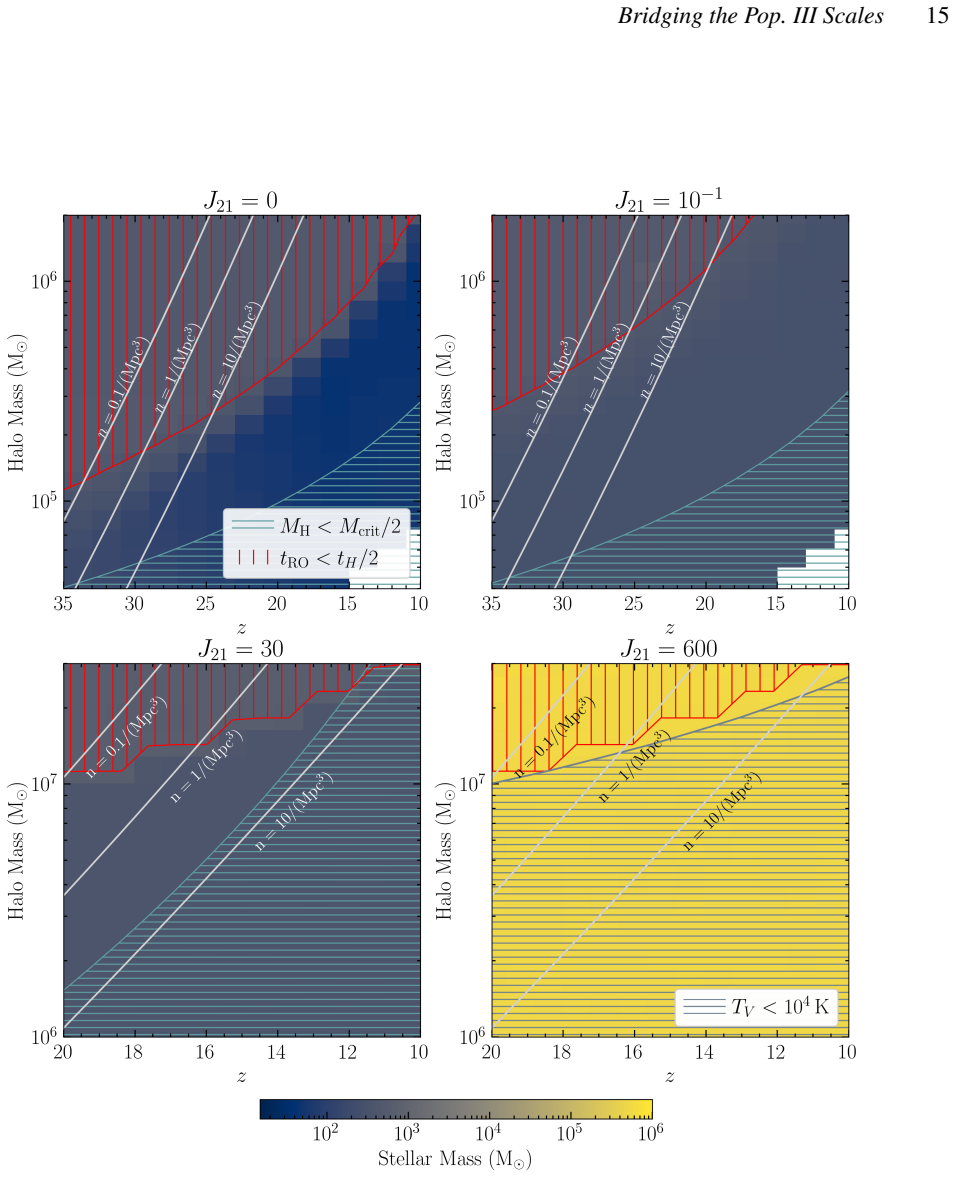
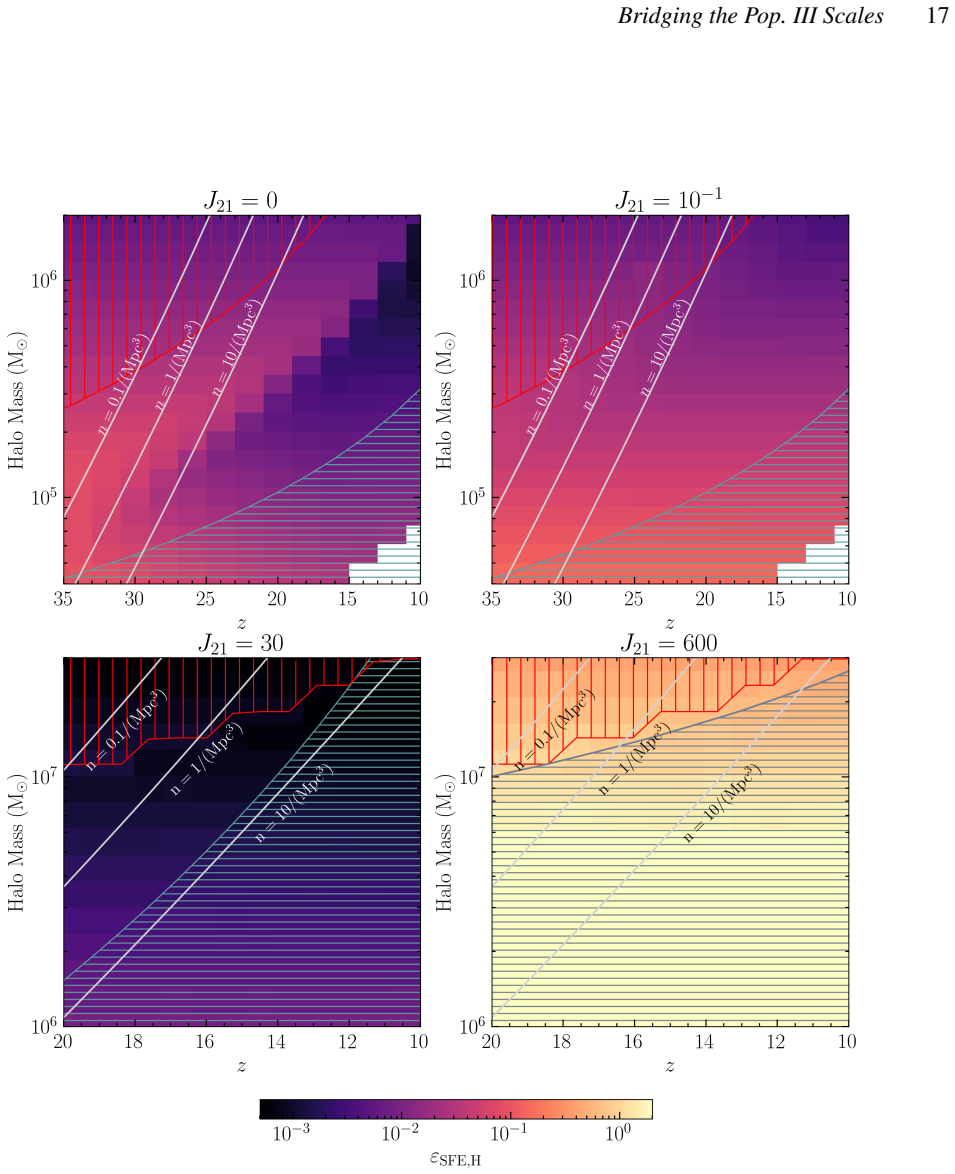
By stitching together scale-specific analytical prescriptions, the authors obtain a computationally inexpensive model that reproduces simulation results across the full dynamic range from cosmological backgrounds to sub-AU disks. The model predicts halo-scale star-formation efficiencies ranging from roughly 0.001 to 0.5, set by the transitions among HD cooling, molecular-hydrogen cooling, and atomic cooling, while the efficiency inside individual unstable clouds remains high, above 0.2.
What carries the argument
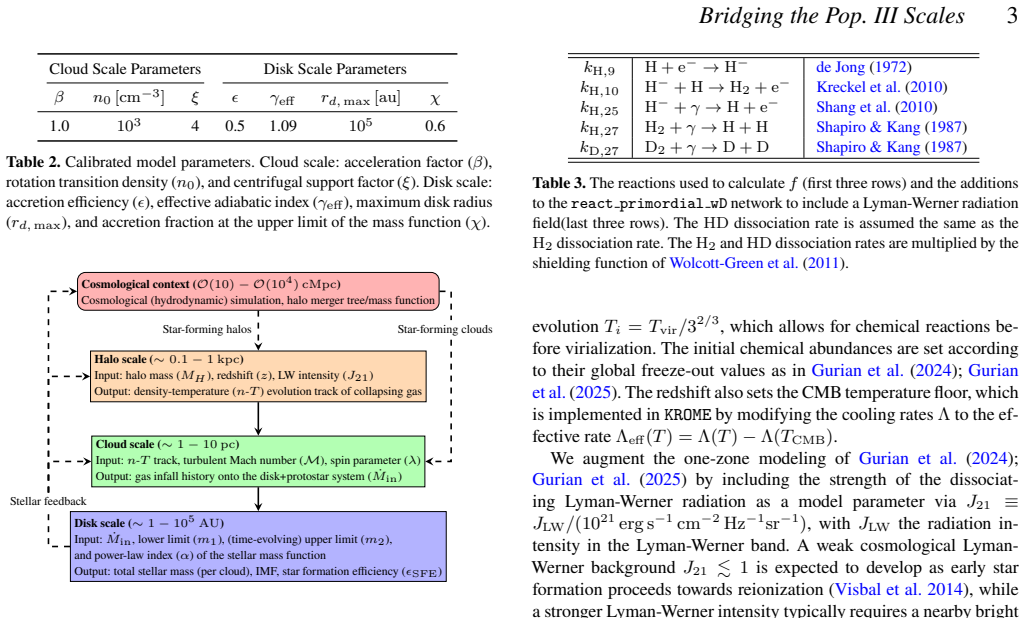
A linked chain of three analytical modules: (1) cosmological radiation background to halo properties, (2) halo to star-forming cloud, and (3) cloud to fragmenting protostellar disk, each validated separately against simulations before being joined.
If this is right
- Halo-scale Pop III star-formation efficiency changes by more than two orders of magnitude with Lyman-Werner intensity and virial temperature.
- Sharp efficiency jumps appear exactly where cooling mechanisms switch from HD to H2 to atomic lines.
- Cloud-scale conversion of unstable gas into stars remains efficient (greater than or equal to 0.2) across the explored conditions.
- The full model remains inexpensive enough to scan wide ranges of radiation background and halo properties.
Where Pith is reading between the lines
- The framework could be used to generate large statistical samples of Pop III formation sites for input into reionization or chemical-enrichment calculations without running new simulations for every parameter combination.
- If the model holds, the sharp efficiency transitions may imprint observable features on the spatial distribution or metallicity patterns of the earliest stars.
- Extending the same modular approach to include later metal-line cooling or different initial mass functions would test whether the same linking logic remains valid once the first supernovae enrich the gas.
Load-bearing premise
That interactions between the different scales can be ignored and that agreement of each piece with its own simulations is enough to trust the combined prediction under all conditions.
What would settle it
A single high-resolution simulation that evolves one halo from cosmological scales through disk fragmentation and reports a star-formation efficiency differing by more than a factor of a few from the model's output for the same Lyman-Werner flux and halo mass.
Figures



read the original abstract
We construct an analytical model of Population III star formation that connects the cosmological radiation background to sub-AU protostellar disk fragmentation, a dynamic range inaccessible to any single simulation. Our approach is based on combining separate models of the disparate relevant scales: from the cosmological environment to the host-halo scale, from the halo scale to the scale of the star-forming cloud, and from the cloud scale to the fragmenting, accreting protostellar disk. Individually and collectively, the models agree well with the predictions of state of the art simulations, while remaining computationally inexpensive and physically transparent. As an example of the applicability of the model, we study the effects of varying the Lyman-Werner flux on the Pop. III star formation efficiency. We show that depending on the halo properties and the strength of the dissociating radiation field, the halo-scale Pop. III star formation efficiency varies by more than two orders of magnitude from $\varepsilon_{\rm SFE,H} \approx 10^{-3}$ to $\varepsilon_{\rm SFE, H} \approx 0.5$. The abrupt transitions between hydrogen-deuteride cooling (in low virial temperature mini-halos subjected to low radiation backgrounds), molecular hydrogen cooling (at intermediate temperatures and radiation intensities), and atomic cooling (in higher temperature halos exposed to strong radiation fields) produces sharp features in the halo-scale star formation efficiency as a function of the halo properties. Meanwhile, at the scale of individual star-forming clouds, the star formation efficiency is $\varepsilon_{\rm SFE,c} \gtrsim 0.2$. That is, pristine gas in a halo is converted into unstable clouds at a wide range of efficiencies, and these unstable clouds are efficiently converted into Pop. III stars.
Editorial analysis
A structured set of objections, weighed in public.
Referee Report
Summary. The manuscript constructs an analytical model of Population III star formation by combining separate scale-specific models (cosmological radiation background to halo virial temperature and cooling, halo to star-forming cloud, and cloud to sub-AU protostellar disk fragmentation). It reports good agreement with state-of-the-art simulations individually and collectively, and as an application shows that halo-scale star formation efficiency ε_SFE,H varies by more than two orders of magnitude (from ~10^{-3} to ~0.5) with Lyman-Werner flux and halo properties, with sharp transitions at HD/H2/atomic cooling boundaries, while cloud-scale efficiency ε_SFE,c ≳ 0.2.
Significance. If the chained model holds, it supplies a computationally inexpensive and physically transparent framework for predicting Pop III efficiencies over a dynamic range inaccessible to single simulations, which could be incorporated into semi-analytic models or large-volume cosmological runs. The reported efficiency variations and sharp cooling-regime features are concrete, falsifiable outputs that highlight the role of the dissociating background. The approach of linking calibrated modules is a strength when interfaces are shown to be robust.
major comments (2)
- [model construction and example application sections] The central claim that the linked model bridges scales without missing interactions rests on the untested premise that outputs from one module (e.g., halo-scale SFE and cloud mass function) are statistically compatible with inputs to the next (e.g., disk initial conditions). No re-validation against any integrated multi-scale simulation is reported, so mismatches in angular momentum or density PDF could propagate and alter the final efficiencies or stellar masses. This directly affects the 'universal' and 'bridge' assertions.
- [results on efficiency variation] The abrupt jumps in ε_SFE,H at the HD/H2/atomic cooling boundaries are presented as physical features, but they inherit directly from the separate cooling-regime models; without explicit propagation of uncertainties or interface consistency checks, it is unclear whether these discontinuities survive in the full chain.
minor comments (1)
- Notation for efficiencies (ε_SFE,H vs ε_SFE,c) is clear in the abstract but should be defined explicitly at first use in the main text with reference to the relevant equations.
Simulated Author's Rebuttal
We thank the referee for the constructive and insightful comments, which have helped us improve the clarity and robustness of the manuscript. We address each major comment point by point below, with revisions made where appropriate to strengthen the presentation of the model interfaces and the physical nature of the efficiency features.
read point-by-point responses
-
Referee: [model construction and example application sections] The central claim that the linked model bridges scales without missing interactions rests on the untested premise that outputs from one module (e.g., halo-scale SFE and cloud mass function) are statistically compatible with inputs to the next (e.g., disk initial conditions). No re-validation against any integrated multi-scale simulation is reported, so mismatches in angular momentum or density PDF could propagate and alter the final efficiencies or stellar masses. This directly affects the 'universal' and 'bridge' assertions.
Authors: We agree that a direct end-to-end validation against a single integrated simulation spanning all scales would provide the strongest test of interface compatibility. However, no such simulation exists or is feasible at present due to the prohibitive computational cost of resolving the full dynamic range from cosmological to sub-AU scales. Our model instead validates each module individually against dedicated simulations at its respective scale and ensures that the statistical outputs (e.g., cloud mass functions, densities, and angular momenta) from one module lie within the validated input ranges of the next. In the revised manuscript, we have added a new subsection explicitly discussing the interface assumptions, including quantitative checks on angular momentum and density PDF consistency between modules. We have also moderated the language around the 'universal' and 'bridge' claims to emphasize that the model is a chained framework with validated components rather than a fully self-consistent multi-scale simulation. These changes constitute a partial revision. revision: partial
-
Referee: [results on efficiency variation] The abrupt jumps in ε_SFE,H at the HD/H2/atomic cooling boundaries are presented as physical features, but they inherit directly from the separate cooling-regime models; without explicit propagation of uncertainties or interface consistency checks, it is unclear whether these discontinuities survive in the full chain.
Authors: The sharp transitions originate from the distinct and well-validated cooling physics (HD, H2, and atomic) that define each regime, as confirmed by the individual module comparisons to simulations. To demonstrate that these features persist in the chained model, the revised manuscript now includes an explicit uncertainty propagation analysis: we vary key inputs (Lyman-Werner flux, halo virial temperature, and radiation background) within their plausible ranges and show that the discontinuities remain robust features rather than artifacts. This analysis is supported by the interface consistency checks added in response to the first comment. We have updated the results section and added a supplementary figure illustrating the sensitivity of ε_SFE,H to input variations. revision: yes
Circularity Check
No circularity: composite model chains externally validated scale-specific components
full rationale
The derivation chains independent analytical models across cosmological, halo, cloud, and disk scales, each reported to match separate simulation suites. No equation or claim reduces an output (such as ε_SFE,H or ε_SFE,c) to a fitted input by construction, nor does any load-bearing step rely on a self-citation whose content is itself unverified or defined circularly. The reported variations with Lyman-Werner flux and cooling regime boundaries follow from the explicit combination of the modules rather than from renaming or self-definition. The interfaces are presented as direct mappings whose validity is asserted via per-module simulation agreement, leaving the overall construction self-contained against external benchmarks.
Axiom & Free-Parameter Ledger
axioms (1)
- domain assumption Separate analytical models for cosmological, halo, cloud, and disk scales can be linked without significant missing cross-scale physics.
Forward citations
Cited by 1 Pith paper
-
Metal Enrichment by the First Stars Exploding at the Lower Energy Limit of Pair-Instability Supernovae
Low-energy PISNe from 140 solar-mass Pop III stars produce second-generation stars at median [Fe/H] ~ -5.5 with odd-even patterns, but their absence from EMP observations disfavors PISNe as the main early enrichment channel.
Reference graph
Works this paper leans on
-
[1]
E., 2018, ApJ, 857, 138 Beers T
Becerra F., Marinacci F., Inayoshi K., Bromm V., Hernquist L. E., 2018, ApJ, 857, 138 Beers T. C., Christlieb N., 2005, ARA&A, 43, 531 Bonnor W. B., 1956, MNRAS, 116, 351 Brauer K., et al., 2025a, The Astrophysical Journal, 980, 41 Brauer K., et al., 2025b, The Astrophysical Journal, 993, 2 Bromm V., 2013, Reports on Progress in Physics, 76, 112901 Bromm ...
-
[2]
L., Bromm V., 2009, MNRAS, 392, L50 Fujimoto S., et al., 2025a, arXiv e-prints, p
pp 533–557, doi:10.1016/B978-0-443-21439-4.00052-3 Frebel A., Johnson J. L., Bromm V., 2009, MNRAS, 392, L50 Fujimoto S., et al., 2025a, arXiv e-prints, p. arXiv:2512.11790 Fujimoto S., et al., 2025b, ApJ, 989, 46 Gessey-Jones T., et al., 2022, Monthly Notices of the Royal Astronomical Society, 516, 841–860 Grassi T., Bovino S., Schleicher D. R. G., Priet...
-
[3]
(A13) in the left hand side, and substituting Eq
By writing ˙m2mαc(t)−˙m1mαc(t) = ˙m2mαc(t)−˙N,(A17) expanding the accretion law Eq. (A13) in the left hand side, and substituting Eq. (2.20), one can show that ˙m2 dN dm ⏐⏐⏐⏐ m− 2 = ˙M∗−¯m˙N m2−¯m,(A18) where ¯m= ∫m2 m1 dmm dN dm∫m2 m1 dm dN dm .(A19) This paper has been typeset from a TEX/LATEX file prepared by the author. MNRAS000, 1–21 (2026)
2026
discussion (0)
Sign in with ORCID, Apple, or X to comment. Anyone can read and Pith papers without signing in.