Interlayer Five-Spin Polaron in Superconducting Bilayer Nickelates
Pith reviewed 2026-07-01 00:01 UTC · model grok-4.3
The pith
A ligand hole at the inter-bilayer apical oxygen forms an interlayer five-spin polaron that is the ground state for superconducting bilayer nickelates.
A machine-rendered reading of the paper's core claim, the machinery that carries it, and where it could break.
Core claim
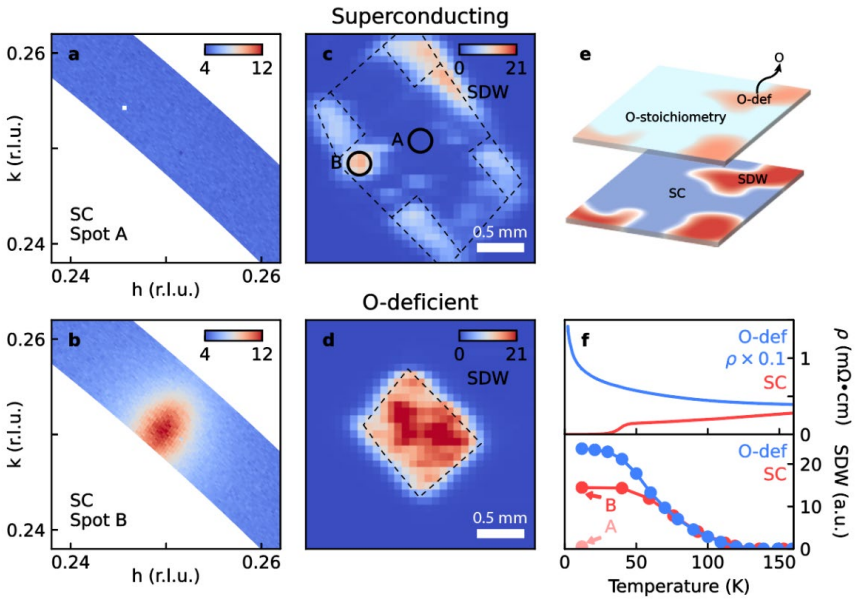
In bilayer nickelates, superconductivity occurs in SDW-free, oxygen-stoichiometric regions. Spectroscopy indicates that a ligand hole resides mainly at the inter-bilayer apical oxygen, forming a robust interlayer five-spin polaron state that serves as the ground state, while oxygen deficiency favors SDW order instead.
What carries the argument
The interlayer five-spin polaron, formed when a ligand hole at the inter-bilayer apical oxygen couples five Ni spins across the bilayer.
If this is right
- Oxygen stoichiometry is the control parameter that switches between SDW order and the polaron ground state.
- Superconductivity and SDW order occupy separate spatial regions rather than coexisting.
- Interlayer coupling is set by the apical oxygen occupancy and determines the electronic structure along the c-axis.
- The five-spin polaron replaces the conventional d9 picture as the starting point for pairing in these materials.
Where Pith is reading between the lines
- If the polaron picture holds, models of pairing in bilayer nickelates must start from five-spin clusters rather than single-site d9 moments.
- The same oxygen-stoichiometry control may apply to other Ruddlesden-Popper nickelates and could be tested by targeted annealing experiments.
- The phase segregation implies that local probes averaged over mixed regions may have masked the true ground state in earlier studies.
Load-bearing premise
The distinct c-axis electronic structures measured by Ni-L3 and O-K spectroscopy between superconducting and oxygen-deficient regions directly locate the ligand hole at the inter-bilayer apical oxygen and establish the five-spin polaron as the ground state.
What would settle it
A direct probe such as site-selective x-ray absorption or scanning tunneling spectroscopy that finds the ligand hole on a different oxygen site, or a calculation showing another magnetic configuration lower in energy than the five-spin polaron.
Figures

read the original abstract
The discovery of high-$T_c$ superconductivity in Ruddlesden-Popper nickelates has sparked substantial effort towards understanding unconventional electronic states beyond a traditional cuprate-like $d^9$ configurational ground state. An understanding of the interplay between magnetic ground states and multi-orbital physics is key for establishing a microscopic mechanism for superconductivity. In the bilayer nickelates, spin density wave (SDW) order is a prominent feature in the non-superconducting regime, yet its relation to superconducting pairing remains an open question. Here, we use resonant x-ray scattering to examine the existence of SDW order in superconducting bilayer nickelate thin films La$_2$PrNi$_2$O$_7$ (LPNO). Comparing superconducting and oxygen-deficient LPNO thin films, we find that superconductivity occurs in SDW-free, oxygen-stoichiometric regions, whereas oxygen-deficiency promotes SDW order, indicating phase segregation of SDW and superconductivity. Furthermore, Ni-$L_3$ and O-$K$ edge spectroscopy reveals distinct electronic structures - particularly along the $c$-axis - between the two regions. Our results identify oxygen stoichiometry as a key parameter controlling interlayer coupling and thus the electronic structure of bilayer nickelates. In concert with theory, we propose that a ligand hole primarily resides at the inter-bilayer apical oxygen, forming a robust interlayer five-spin polaron state, which serves as the ground state for superconducting bilayer nickelates.
Editorial analysis
A structured set of objections, weighed in public.
Referee Report
Summary. The manuscript uses resonant x-ray scattering on La2PrNi2O7 thin films to show that superconductivity occurs in SDW-free, oxygen-stoichiometric regions while oxygen deficiency promotes SDW order, indicating phase segregation. Ni-L3 and O-K edge spectroscopy reveals c-axis electronic-structure differences between the regions. Oxygen stoichiometry is identified as controlling interlayer coupling. In concert with theory, the authors propose that a ligand hole resides primarily at the inter-bilayer apical oxygen, forming an interlayer five-spin polaron as the ground state for superconducting bilayer nickelates.
Significance. If the site-specific assignment and five-spin polaron identification are rigorously established, the work would connect oxygen stoichiometry to the suppression of SDW order and the emergence of a multi-orbital polaronic ground state, providing a concrete microscopic framework for superconductivity in bilayer nickelates that goes beyond simple cuprate analogies.
major comments (2)
- [Abstract / spectroscopy discussion] Abstract (final sentence) and the interpretive section following the spectroscopy results: the claim that c-axis spectral contrasts between superconducting and oxygen-deficient regions uniquely locate the ligand hole on the inter-bilayer apical oxygen and establish the five-spin polaron configuration as the ground state is presented as a proposal 'in concert with theory,' yet the manuscript provides no explicit derivation, parameter fitting, or model calculation demonstrating that this assignment is the only one consistent with the measured Ni-L3 and O-K edge differences.
- [Results and discussion of polaron proposal] The phase-segregation conclusion is supported by the resonant x-ray data, but the load-bearing step converting those data into the specific interlayer five-spin polaron ground state lacks the intermediate modeling steps (e.g., cluster calculations or DFT+DMFT spectra) needed to make the mapping falsifiable from the reported measurements alone.
minor comments (2)
- [Methods / experimental section] Experimental details such as film thickness, oxygen annealing protocols, error bars on resonance energies, and quantitative fitting of the spectral contrasts are not described in sufficient detail to allow independent assessment of the c-axis differences.
- [Discussion of polaron state] Notation for the five-spin polaron (spin configuration, ligand-hole orbital character) should be defined explicitly with a diagram or Hamiltonian term when first introduced.
Simulated Author's Rebuttal
We thank the referee for their careful reading of the manuscript and for the constructive comments. We address each major comment below.
read point-by-point responses
-
Referee: [Abstract / spectroscopy discussion] Abstract (final sentence) and the interpretive section following the spectroscopy results: the claim that c-axis spectral contrasts between superconducting and oxygen-deficient regions uniquely locate the ligand hole on the inter-bilayer apical oxygen and establish the five-spin polaron configuration as the ground state is presented as a proposal 'in concert with theory,' yet the manuscript provides no explicit derivation, parameter fitting, or model calculation demonstrating that this assignment is the only one consistent with the measured Ni-L3 and O-K edge differences.
Authors: We agree that the manuscript presents the interlayer five-spin polaron as a proposal informed by the c-axis spectral contrasts and existing theoretical literature rather than as a result derived from new model calculations within this work. The experimental focus is on resonant x-ray scattering and edge spectroscopy demonstrating phase segregation and oxygen-stoichiometry control of interlayer coupling. To address the concern, we will revise the abstract and discussion to explicitly qualify the proposal as a physically motivated interpretation consistent with the data and prior theory, without claiming uniqueness or providing a full derivation from the measurements alone. Additional citations to relevant theoretical studies on nickelate polaron states will be included. revision: yes
-
Referee: [Results and discussion of polaron proposal] The phase-segregation conclusion is supported by the resonant x-ray data, but the load-bearing step converting those data into the specific interlayer five-spin polaron ground state lacks the intermediate modeling steps (e.g., cluster calculations or DFT+DMFT spectra) needed to make the mapping falsifiable from the reported measurements alone.
Authors: The referee is correct that the specific five-spin polaron assignment is an interpretive step that would be strengthened by explicit intermediate modeling (e.g., cluster or DFT+DMFT spectra) to enable direct falsifiability. The phase-segregation result itself is directly supported by the resonant scattering and spectroscopy data. The polaron proposal is offered as a candidate ground state that accounts for the observed c-axis electronic-structure differences and the role of inter-bilayer apical oxygen. Because the present study is primarily experimental, we will add clarifying language in the discussion noting that the reported measurements supply key experimental constraints for future quantitative modeling of the polaron configuration, while the current text does not contain such calculations. revision: partial
Circularity Check
No circularity; experimental mapping presented as interpretive proposal
full rationale
The manuscript reports resonant x-ray scattering and edge spectroscopy results that establish phase segregation between SDW order and superconductivity as a function of oxygen stoichiometry, with c-axis spectral differences between regions. The interlayer five-spin polaron is introduced only as a proposal 'in concert with theory' without any derivation, equations, fitted parameters, or self-citation chain that reduces the claim to its own inputs by construction. No load-bearing step equates a prediction to a fit or imports uniqueness via prior author work; the central claim remains an interpretation of independent measurements rather than a self-referential reduction.
Axiom & Free-Parameter Ledger
axioms (1)
- domain assumption Resonant x-ray scattering at Ni L3 and O K edges can reliably distinguish SDW order and c-axis electronic structure differences in nickelate thin films
invented entities (1)
-
interlayer five-spin polaron
no independent evidence
Forward citations
Cited by 1 Pith paper
-
Atomically resolved intrinsic superconducting gap in (La,Pr)3Ni2O7 films
STM spectroscopy on bilayer nickelate ultrathin films reveals reproducible U-shaped spectra with nodeless gaps of ~14 and ~20 meV and flat zero-conductance regions.
Reference graph
Works this paper leans on
-
[1]
Li, D. et al. Superconductivity in an infinite-layer nickelate. Nature 572, 624–627 (2019)
2019
-
[2]
Chow, S. L. E., Luo, Z. & Ariando, A. Bulk superconductivity near 40 K in hole-doped SmNiO2 at ambient pressure. Nature 642, 58–63 (2025)
2025
-
[3]
Pan, G. A. et al. Superconductivity in a quintuple-layer square-planar nickelate. Nat. Mater. 21, 160–164 (2022)
2022
-
[4]
Sun, H. et al. Signatures of superconductivity near 80 K in a nickelate under high pressure. Nature 621, 493–498 (2023)
2023
-
[5]
Zhu, Y . et al. Superconductivity in pressurized trilayer La4Ni3O10−δ single crystals. Nature 631, 531–536 (2024)
2024
-
[6]
Ko, E. K. et al. Signatures of ambient pressure superconductivity in thin film La3Ni2O7. Nature 638, 935–940 (2025)
2025
- [7]
-
[8]
Li, F. et al. Bulk superconductivity up to 96 K in pressurized nickelate single crystals. Nature 649, 871–878 (2026)
2026
-
[9]
Le Tacon, M. et al. Intense paramagnon excitations in a large family of high-temperature superconductors. Nat. Phys. 7, 725–730 (2011)
2011
-
[10]
Lu, H. et al. Magnetic excitations in infinite-layer nickelates. Science 373, 213–216 (2021)
2021
- [11]
-
[12]
M., Buttrey, D
Tranquada, J. M., Buttrey, D. J., Sachan, V . & Lorenzo, J. E. Simultaneous Ordering of Holes and Spins in La2NiO4.125. Phys. Rev. Lett. 73, 1003–1006 (1994). 16
1994
-
[13]
J., Tranquada, J
Sachan, V ., Buttrey, D. J., Tranquada, J. M., Lorenzo, J. E. & Shirane, G. Charge and spin ordering in La2−xSrxNiO4.00 with x = 0.135 and 0.20. Phys. Rev. B 51, 12742–12746 (1995)
1995
-
[15]
Gupta, N. K. et al. Anisotropic spin stripe domains in bilayer La3Ni2O7. Nat Commun 16, 6560 (2025)
2025
-
[16]
Ren, X. et al. Resolving the electronic ground state of La3Ni2O7-δ films. Commun Phys 8, 52 (2025)
2025
-
[17]
Zhang, J. et al. Intertwined density waves in a metallic nickelate. Nat Commun 11, 6003 (2020)
2020
-
[18]
Samarakoon, A. M. et al. Bootstrapped dimensional crossover of a spin density wave. Phys. Rev. X 13, 041018 (2023)
2023
-
[19]
Shi, M. et al. Spin density wave rather than tetragonal structure is prerequisite for superconductivity in La3Ni2O7-δ. Nat Commun 16, 9141 (2025)
2025
-
[20]
Wang, G. et al. Pressure-induced superconductivity in polycrystalline La3Ni2O7−δ. Phys. Rev. X 14, 011040 (2024)
2024
-
[21]
Khasanov, R. et al. Pressure-enhanced splitting of density wave transitions in La3Ni2O7–δ. Nat. Phys. 21, 430–436 (2025)
2025
-
[22]
Xu, S. et al. Collapse of density wave and emergence of superconductivity in pressurized- La4Ni3O10 evidenced by ultrafast spectroscopy. Nat Commun 16, 7039 (2025)
2025
-
[23]
Liu, Y . et al. Superconductivity and normal-state transport in compressively strained La2PrNi2O7 thin films. Nat. Mater. 24, 1221–1227 (2025). 17
2025
-
[24]
Zhou, G. et al. Ambient-pressure superconductivity onset above 40 K in (La,Pr)3Ni2O7 films. Nature 640, 641–646 (2025)
2025
-
[25]
Hao, B. et al. Superconductivity in Sr-doped La3Ni2O7 thin films. Nat. Mater. 24, 1756–1762 (2025)
2025
-
[26]
Wang, H. et al. Electronic structures across the superconductor-insulator transition at La2.85Pr0.15Ni2O7/SrLaAlO4 interfaces. arXiv.2502.18068 (2025)
work page internal anchor Pith review Pith/arXiv arXiv 2025
-
[27]
Dong, Z. et al. Visualization of oxygen vacancies and self-doped ligand holes in La3Ni2O7−δ. Nature 630, 847–852 (2024)
2024
-
[28]
Zhou, Y . et al. Investigations of key issues on the reproducibility of high-Tc superconductivity emerging from compressed La3Ni2O7. Matter and Radiation at Extremes 10, 027801 (2025)
2025
- [29]
-
[30]
Zhong, H. et al. Epitaxial strain tuning of electronic and spin excitations in La3Ni2O7 thin films. arXiv.2502.03178 (2025)
work page internal anchor Pith review Pith/arXiv arXiv 2025
-
[31]
Chen, X. et al. Electronic and magnetic excitations in La3Ni2O7. Nat Commun 15, 9597 (2024)
2024
-
[32]
Zhong, H. et al. Doping evolution of spin excitations in La3-xSrxNi2O7/SrLaAlO4 superconducting thin films. arXiv.2603.01120 (2026)
work page internal anchor Pith review Pith/arXiv arXiv 2026
-
[33]
Bisogni, V . et al. Ground-state oxygen holes and the metal–insulator transition in the negative charge-transfer rare-earth nickelates. Nat Commun 7, 13017 (2016)
2016
-
[34]
Nag, A. et al. Many-body physics of single and double spin-flip excitations in NiO. Phys. Rev. Lett. 124, 067202 (2020). 18
2020
-
[35]
Fabbris, G. et al. Doping dependence of collective spin and orbital excitations in the spin-1 quantum antiferromagnet La2−xSrxNiO4 observed by X-rays. Phys. Rev. Lett. 118, 156402 (2017)
2017
-
[36]
Zaanen, J., Sawatzky, G. A. & Allen, J. W. Band gaps and electronic structure of transition- metal compounds. Phys. Rev. Lett. 55, 418–421 (1985)
1985
-
[37]
Zhang, F. C. & Rice, T. M. Effective Hamiltonian for the superconducting Cu oxides. Phys. Rev. B 37, 3759–3761 (1988)
1988
-
[38]
Chen, C. T. et al. Out-of-plane orbital characters of intrinsic and doped holes in La 2−xSrxCuO4. Phys. Rev. Lett. 68, 2543–2546 (1992)
1992
-
[39]
Chen, C. T. et al. Electronic states in La2−xSrxCuO4+δ probed by soft-x-ray absorption. Phys. Rev. Lett. 66, 104–107 (1991)
1991
-
[40]
Advances in the OCEAN-3 spectroscopy package
Vinson, J. Advances in the OCEAN-3 spectroscopy package. Phys. Chem. Chem. Phys. 24, 12787–12803 (2022)
2022
-
[41]
Giannozzi, P. et al. Advanced capabilities for materials modelling with Quantum ESPRESSO. J. Phys.: Condens. Matter 29, 465901 (2017)
2017
-
[42]
A., Norman, M
Keimer, B., Kivelson, S. A., Norman, M. R., Uchida, S. & Zaanen, J. From quantum matter to high-temperature superconductivity in copper oxides. Nature 518, 179–186 (2015)
2015
-
[43]
Zhang, S. et al. Interlayer hybridization enables superconductivity in bilayer nickelates. arXiv.2604.14701 (2026)
work page internal anchor Pith review Pith/arXiv arXiv 2026
-
[44]
Chen, X. et al. 3dz2 orbital delocalization and magnetic collapse in superconducting (La,Pr)3Ni2O7-δ films. arXiv.2604.21899 (2026)
work page internal anchor Pith review Pith/arXiv arXiv 2026
-
[45]
J., Kas, J
Vinson, J., Rehr, J. J., Kas, J. J. & Shirley, E. L. Bethe-Salpeter equation calculations of core excitation spectra. Phys. Rev. B 83, 115106 (2011). 19
2011
-
[46]
& Perdew, J
Sun, J., Ruzsinszky, A. & Perdew, J. P. Strongly Constrained and Appropriately Normed Semilocal Density Functional. Phys. Rev. Lett. 115, 036402 (2015)
2015
-
[47]
Hamann, D. R. Optimized norm-conserving Vanderbilt pseudopotentials. Phys. Rev. B 88, 085117 (2013). Acknowledgements: We thank S. Kivelson, S. Raghu, Y . Wu, H. Oh, B. Wang, Z.X. Shen, E. Zhang for fruitful discussions. This work was supported by the US Department of Energy (DOE), Office of Science, Basic Energy Sciences, Materials Sciences and Engineeri...
2013
discussion (0)
Sign in with ORCID, Apple, or X to comment. Anyone can read and Pith papers without signing in.