REVIEW 2 major objections 4 minor 1 cited by
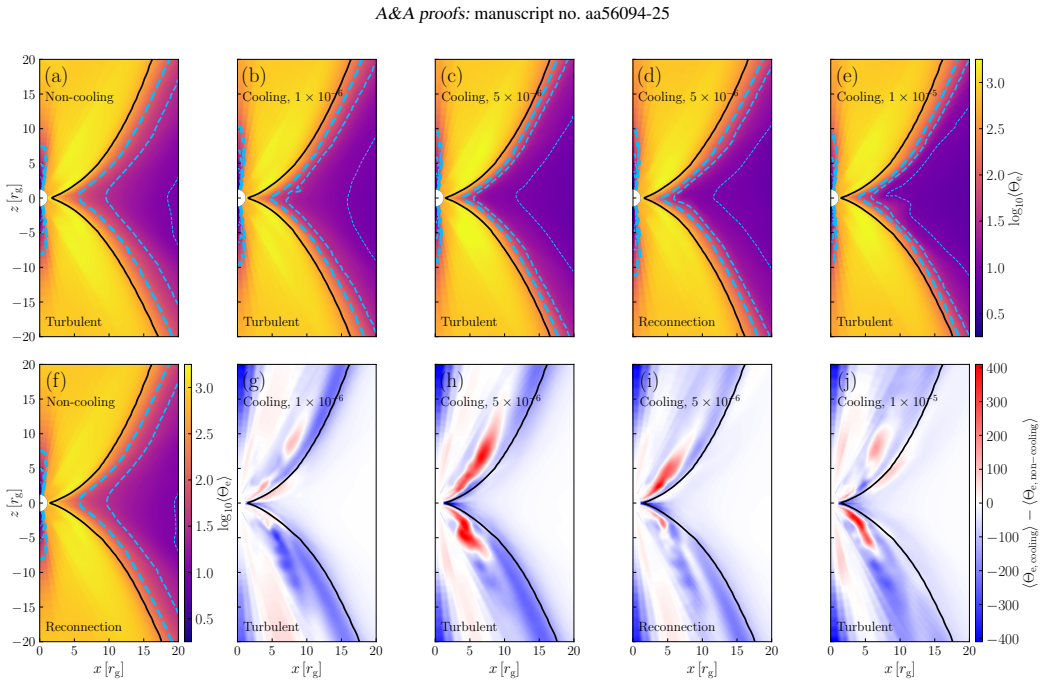
Radiative cooling cools the dense black-hole disk far more than the jet sheath, dimming the ring, brightening extended jets, and cutting 230 GHz flux at fixed accretion rate.
Reviewed by Pith at T0; open to challenge. T0 means a machine referee read the full paper against a public rubric. the ladder, T0–T4 →
T0 review · grok-4.5
2026-07-12 16:44 UTC pith:RXOUPILJ
load-bearing objection Solid, useful cooling-vs-noncooling comparison for MAD M87* with hybrid κ imaging; the midplane Te drop is robust, the relative jet brightening is the part that needs the nonthermal-cooling caveat the authors already flag. the 2 major comments →
Impacts of radiative cooling on the images of a black hole shadow and extended jets in two-temperature GRMHD simulations
The pith
A machine-rendered reading of the paper's core claim, the machinery that carries it, and where it could break.
Core claim
Radiative cooling sharply lowers electron temperature in the dense equatorial disk (r ≲ 10 rg) while only slightly cooling the jet sheath; consequently the 230 GHz image becomes a dimmer disk with more extended, brighter jets and reduced total flux, and the high-frequency SED is suppressed at fixed mass accretion rate.
What carries the argument
Two-temperature GRMHD simulations that evolve electron entropy with Coulomb coupling plus radiative cooling (bremsstrahlung, cyclo-synchrotron, Compton), followed by GRRT with a hybrid thermal-plus-variable-κ electron distribution, allow direct before/after comparison of density, temperature, images, SEDs and light curves.
Load-bearing premise
Cooling by nonthermal electrons is omitted from the fluid evolution even though nonthermal electrons are used later to compute the images; if those electrons cool efficiently the jet-brightening result could reverse.
What would settle it
A simultaneous 230 GHz image of the M87* ring and jet base with dynamic range high enough to measure the jet-to-disk flux ratio and turnover frequency; if the jet remains faint relative to the ring at the accretion rates required by the total flux, the cooling-induced jet brightening is ruled out.
Editorial analysis
A structured set of objections, weighed in public.
Referee Report
Summary. The paper compares two-temperature MAD GRMHD simulations (BHAC) of a spinning black hole (a=0.9375) without and with radiative cooling plus Coulomb coupling, for mass accretion rates ṁ=(1–10)×10^{-6} Ṁ_Edd and two electron heating prescriptions (turbulent Kawazura and reconnection Rowan). Cooling is implemented as a local source term (thermal bremsstrahlung, cyclo-synchrotron, multiple Compton). GRRT (BHOSS) at 230 GHz and i=163° for M87* uses a hybrid thermal+variable-κ eDF (PIC-based κ matched to heating, ε=0.5, σ_cut=1). The central claims, supported by density/Θ_e maps, decomposed images, SEDs and light curves (§§3.1–3.6, Appendices A–C), are that cooling sharply lowers electron temperature in the dense midplane (r≲10 r_g) while only slightly cooling the jet sheath, producing a dimmer disk, relatively more extended/brighter jets, lower total 230 GHz flux, reduced high-frequency SED flux at fixed ṁ, and midplane-dominated variability that decreases with rising ṁ.
Significance. If the differential cooling and resulting morphology hold, the work is significant for EHT/ngEHT modeling of M87* and other MAD LLAGNs: it shows that the observed high radiative efficiency requires cooling in electron thermodynamics, that fixed-ṁ comparisons already alter ring/jet contrast and SEDs, and that horizon-scale jet emission (currently below EHT dynamic range) is a concrete ngEHT target. Strengths include the systematic multi-rate, multi-heating design, self-consistent two-temperature evolution, decomposed GRRT images that isolate midplane vs. jet contributions, matched PIC κ prescriptions, and explicit appendices on σ_cut and heating differences. The limitations (no nonthermal cooling, models not flux-matched) are stated, making the results usable as controlled experiments rather than direct fits.
major comments (2)
- [§2.1, §2.2 Eqs. (7)–(8), §3.4] §2.1 explicitly omits radiative cooling from nonthermal electrons (“ignored for simplicity”) while §2.2 and Eqs. (7)–(8) still inject a hybrid thermal+κ eDF with nonthermal efficiency η→0.5 (and PIC-based κ) that dominates jet-sheath emission. Midplane emission is thermal-dominated (η→0), so the sharp Θ_e drop at r≲10 r_g is robust; jet-sheath emission is not. Nonthermal electrons cool more efficiently via synchrotron and inverse-Compton, so the selective under-cooling of the sheath relative to the midplane is load-bearing for the paper’s main imaging claim (Abstract; §3.4; Summary points 1–2) of a dimmer disk plus relatively brighter/more extended jets. §4 correctly flags this as future work, but the present morphology and fractional-jet results require a stronger quantitative caveat or an order-of-magnitude estimate of the missing sink before the claim can be taken at face value.
- [§3.4–3.5, Figs. 5–7] All image and SED comparisons are performed at fixed ṁ rather than fixed 230 GHz flux. Resulting total fluxes (Figs. 5–6, 8–9) range from ~0.4 Jy (lowest cooling) to tens of Jy (non-cooling), far above the observed ~0.5 Jy for most models. Consequently the optical-depth regime, self-absorption turnover locations (§3.5), and the relative jet contribution that underpins the “brighter jets” morphology are not guaranteed to map onto M87*. The paper notes that models are “not precisely tuned,” yet the Abstract and Summary still present the morphology change as directly relevant to EHT/ngEHT. Either a flux-matched rescaling discussion or an explicit statement that the reported jet fractions apply only at the simulated (higher) optical depths is needed.
minor comments (4)
- [Fig. 1 caption] Figure 1 and several captions contain residual box characters (□) in place of minus signs or subscripts; these should be cleaned for production.
- [§2.2] The free parameters ε=0.5, σ_min=0.01, r_inj=10 r_g and the precise polar-angle cuts used for image decomposition (57.3°/122.7°) are stated but not varied; a short sensitivity sentence or pointer to Appendix A would help readers assess robustness.
- [§3.3, Fig. 4] In §3.3 the angular-thickness definition of the disk is given; it would be clearer to mark the corresponding θ boundaries consistently on all panels of Fig. 4 rather than only for the non-cooling case.
- [Table 1] Table 1 reports modulation indices; adding the absolute mean fluxes (already in Fig. 9) in the same table would make the relative contributions easier to read without cross-referencing.
Circularity Check
No significant circularity: cooling-on vs cooling-off morphology and SED differences are independent GRMHD+GRRT outputs, not forced by definition or fit.
full rationale
The paper's load-bearing claims (sharp Te drop in the dense midplane r≲10 rg, milder drop in the jet sheath, consequent dimmer disk + relatively brighter/more extended jets, reduced total 230 GHz flux and high-frequency SED at fixed Ṁ) are obtained by running otherwise identical two-temperature MAD GRMHD simulations with and without the radiative-cooling + Coulomb source terms, then performing GRRT with a hybrid thermal+variable-κ eDF. Density, Θe maps, decomposed images, SEDs and modulation indices are direct numerical outputs of those runs (Sects. 3.2–3.6, Figs. 2–9, Table 1); they are not algebraically identical to any input parameter. Accretion rates are chosen a priori from EHT estimates rather than fitted to the 0.5 Jy flux, and the authors explicitly note that none of the models is tuned to the data. Self-citations (Zhang et al. 2024 for the prior non-cooling setup, Dihingia et al. 2023 / Mizuno et al. 2021 for the two-temperature + cooling modules, Ball/Meringolo/Cruz-Osorio for the κ prescriptions) supply standard numerical methods and context; they do not constitute a uniqueness theorem or ansatz that forces the reported temperature contrast or jet-fraction increase. The deliberate omission of nonthermal cooling is an explicit modeling assumption, not a circular reduction of the claimed result to its inputs. Hence the derivation chain is self-contained.
Axiom & Free-Parameter Ledger
free parameters (6)
- ε (κ width magnetic contribution)
- σ_cut (magnetization ceiling for emission)
- η nonthermal efficiency parameters (ϵ=0.5, σ_min=0.01)
- r_inj injection radius
- mass accretion rates ṁ
- black hole spin a and inclination i
axioms (5)
- domain assumption Electron thermodynamics evolve via a two-temperature entropy equation with grid-scale heating (turbulent Kawazura or reconnection Rowan) plus Spitzer Coulomb coupling when cooling is on.
- ad hoc to paper Radiative cooling is applied as a local source term (bremsstrahlung, thermal cyclo-synchrotron, multiple Compton) without solving radiation fields or cooling nonthermal electrons.
- domain assumption Hybrid Maxwell–Jüttner plus variable-κ eDF with PIC-based κ(σ,β) (PIC-TURB or PIC-CS) and emission mix Eq. (7)–(8).
- domain assumption Single-loop MAD torus (Fishbone–Moncrief, rin=20 rg, rmax=40 rg, γ=4/3) reaches quasi-steady MAD by t≳10 000 tg.
- domain assumption Synchrotron GRRT at 230 GHz with FoV 760 µas, M_BH=6.5e9 M_⊙, D=16.8 Mpc, and emission cut at σ>σ_cut.
read the original abstract
The recent 230 GHz observations from the Event Horizon Telescope collaboration have successfully imaged the supermassive black hole shadow of the M87 galaxy. However, the relatively high radiative efficiency observed in the hot accretion flow suggests that radiative cooling is non-negligible and should be considered when calculating the electron temperature. In this study, we compare accretion models without and with radiative cooling across a range of mass accretion rates, $\dot{M}_{\mathrm{BH}} = (1.0 - 10) \times 10^{-6}\,\dot{M}_{\mathrm{Edd}}$, aiming to assess the impact of cooling on the disk structure, electron temperature distribution (eDF), black hole shadow morphology, broadband spectral energy distributions (SEDs), and flux variability. We performed general relativistic radiative transfer (GRRT) calculations on two-temperature, radiative, general relativistic magnetohydrodynamic (GRMHD) simulations, employing different electron heating prescriptions and nonthermal eDFs, analyzing the radiation transfer due to synchrotron emission at 230 GHz with inclination angle of $163^\circ$. These simulations are targeted toward M87$^{*}$. By comparing density profiles, eDFs, GRRT images, SEDs, and time variability between models, we find that the radiative cooling sharply decreases the electron temperature in the dense inner disk around the equatorial plane ($r\lesssim 10\,r_\mathrm{g}$), while slightly reducing jet sheath temperature. Cooling leads to a dimmer disk, more extended and brighter jets, and reduced total flux. For a given accretion rate, cooling reduces the high-frequency flux. Time variability originates primarily from the midplane in both non-cooling and cooling cases and decreases as accretion rates rise. Although currently below the dynamic range of EHT observations, the features identified in this study could be resolved by next-generation arrays such as the ngEHT.
Figures




Forward citations
Cited by 1 Pith paper
-
Probing radiation micro-physics in M 87 I. Total intensity and broad-band spectra
Future VLBI with dynamic range 10^4 from 86–345 GHz can distinguish turbulent vs reconnection electron heating and thermal vs kappa distributions in M87 via spectral indices and jet structure.
Reference graph
Works this paper leans on
-
[1]
2025, Living Reviews in Relativity, 28, 4
Ayzenberg, D., Blackburn, L., Brito, R., et al. 2025, Living Reviews in Relativity, 28, 4
2025
-
[2]
2018, ApJ, 862, 80
Ball, D., Sironi, L., & Özel, F. 2018, ApJ, 862, 80
2018
-
[3]
2019, ARA&A, 57, 467
Blandford, R., Meier, D., & Readhead, A. 2019, ARA&A, 57, 467
2019
-
[4]
2025, MNRAS, 537, 2496
Chael, A. 2025, MNRAS, 537, 2496
2025
-
[5]
Chael, A., Narayan, R., & Johnson, M. D. 2019, MNRAS, 486, 2873
2019
-
[6]
2018, MNRAS, 478, 5209
Chael, A., Rowan, M., Narayan, R., Johnson, M., & Sironi, L. 2018, MNRAS, 478, 5209
2018
-
[7]
1984, ApJ, 280, 319
Colpi, M., Maraschi, L., & Treves, A. 1984, ApJ, 280, 319
1984
-
[8]
M., Mizuno, Y ., et al
Cruz-Osorio, A., Fromm, C. M., Mizuno, Y ., et al. 2022, Nature Astronomy, 6, 103
2022
-
[9]
M., et al
Cruz-Osorio, A., Meringolo, C., Fromm, C. M., et al. 2026, ApJ, 1001, 227
2026
-
[10]
2018, A&A, 612, A34
Davelaar, J., Mo´scibrodzka, M., Bronzwaer, T., & Falcke, H. 2018, A&A, 612, A34
2018
-
[11]
2019, A&A, 632, A2
Davelaar, J., Olivares, H., Porth, O., et al. 2019, A&A, 632, A2
2019
-
[12]
2023, ApJ, 959, L3 De Villiers, J.-P
Davelaar, J., Ripperda, B., Sironi, L., et al. 2023, ApJ, 959, L3 De Villiers, J.-P. & Hawley, J. F. 2003, ApJ, 589, 458
2023
-
[13]
C., & McKinney, J
Dexter, J., Agol, E., Fragile, P. C., & McKinney, J. C. 2010, ApJ, 717, 1092
2010
-
[14]
M., et al
Dexter, J., Jiménez-Rosales, A., Ressler, S. M., et al. 2020, MNRAS, 494, 4168
2020
-
[15]
C., Markoff, S., & Dexter, J
Dibi, S., Drappeau, S., Fragile, P. C., Markoff, S., & Dexter, J. 2012, MNRAS, 426, 1928
2012
-
[16]
Dihingia, I. K. & Fendt, C. 2025, in New Frontiers in GRMHD Simulations, ed. C. Bambi, Y . Mizuno, S. Shashank, & F. Yuan, 327–360
2025
-
[17]
K., Mizuno, Y ., Fromm, C
Dihingia, I. K., Mizuno, Y ., Fromm, C. M., & Rezzolla, L. 2023, MNRAS, 518, 405
2023
-
[18]
K., Mizuno, Y ., Fromm, C
Dihingia, I. K., Mizuno, Y ., Fromm, C. M., & Younsi, Z. 2025, J. Cosmology Astropart. Phys., 2025, 152
2025
-
[19]
K., Vaidya, B., & Fendt, C
Dihingia, I. K., Vaidya, B., & Fendt, C. 2021, MNRAS, 505, 3596
2021
-
[20]
2010, ApJ, 708, 1545
Ding, J., Yuan, F., & Liang, E. 2010, ApJ, 708, 1545
2010
-
[21]
A., Narayan, R., Ostriker, E., & Yi, I
Esin, A. A., Narayan, R., Ostriker, E., & Yi, I. 1996, ApJ, 465, 312 Event Horizon Telescope Collaboration, Akiyama, K., Albentosa-Ruíz, E., et al. 2025, A&A, 693, A265 Event Horizon Telescope Collaboration, Akiyama, K., Alberdi, A., et al. 2024, A&A, 681, A79 Event Horizon Telescope Collaboration, Akiyama, K., Alberdi, A., et al. 2022, ApJ, 930, L16 Even...
1996
-
[22]
Fishbone, L. G. & Moncrief, V . 1976, ApJ, 207, 962
1976
-
[23]
M., Cruz-Osorio, A., Mizuno, Y ., et al
Fromm, C. M., Cruz-Osorio, A., Mizuno, Y ., et al. 2022, A&A, 660, A107
2022
-
[24]
Gammie, C. F. 2025, ApJ, 980, 193
2025
-
[25]
F., McKinney, J
Gammie, C. F., McKinney, J. C., & Tóth, G. 2003, ApJ, 589, 444
2003
-
[26]
2013, ApJ, 773, 118
Hoshino, M. 2013, ApJ, 773, 118
2013
-
[27]
1977, ApJ, 214, 840
Ichimaru, S. 1977, ApJ, 214, 840
1977
-
[28]
2025, ApJ, 990, L33
Imbrogno, M., Meringolo, C., Cruz-Osorio, A., et al. 2025, ApJ, 990, L33
2025
-
[29]
2024, Astrophys
Imbrogno, M., Meringolo, C., Servidio, S., et al. 2024, Astrophys. J. Lett., 972, L5
2024
-
[30]
D., Akiyama, K., Blackburn, L., et al
Johnson, M. D., Akiyama, K., Blackburn, L., et al. 2023, Galaxies, 11, 61
2023
-
[31]
Kawazura, Y ., Barnes, M., & Schekochihin, A. A. 2019, Proceedings of the Na- tional Academy of Science, 116, 771
2019
-
[32]
K., Gammie, C
Leung, P. K., Gammie, C. F., & Noble, S. C. 2011, ApJ, 737, 21
2011
-
[33]
C., Tchekhovskoy, A., & Blandford, R
McKinney, J. C., Tchekhovskoy, A., & Blandford, R. D. 2012, MNRAS, 423, 3083
2012
-
[34]
2023, Astrophys
Meringolo, C., Cruz-Osorio, A., Rezzolla, L., & Servidio, S. 2023, Astrophys. J., 944, 122
2023
-
[35]
M., Younsi, Z., et al
Mizuno, Y ., Fromm, C. M., Younsi, Z., et al. 2021, MNRAS, 506, 741
2021
-
[36]
M., et al
Mizuno, Y ., Younsi, Z., Fromm, C. M., et al. 2018, Nature Astronomy, 2, 585 Mo´scibrodzka, M. 2025, ApJ, 981, 145 Mo´scibrodzka, M., Falcke, H., & Shiokawa, H. 2016, A&A, 586, A38 Mo´scibrodzka, M., Falcke, H., Shiokawa, H., & Gammie, C. F. 2014, A&A, 570, A7 Mo´scibrodzka, M., Gammie, C. F., Dolence, J. C., & Shiokawa, H. 2011, ApJ, 735, 9 Mo´scibrodzka...
2018
-
[37]
2018, ApJ, 868, 146
Nakamura, M., Asada, K., Hada, K., et al. 2018, ApJ, 868, 146
2018
-
[38]
V ., & Abramowicz, M
Narayan, R., Igumenshchev, I. V ., & Abramowicz, M. A. 2003, PASJ, 55, L69
2003
-
[39]
F., & Kulkarni, A
Narayan, R., SÄ dowski, A., Penna, R. F., & Kulkarni, A. K. 2012, MNRAS, 426, 3241
2012
-
[40]
Narayan, R. & Yi, I. 1994, ApJ, 428, L13
1994
-
[41]
C., Leung, P
Noble, S. C., Leung, P. K., Gammie, C. F., & Book, L. G. 2007, Classical and Quantum Gravity, 24, S259
2007
-
[42]
2019, A&A, 629, A61
Olivares, H., Porth, O., Davelaar, J., et al. 2019, A&A, 629, A61
2019
-
[43]
Pandya, A., Zhang, Z., Chandra, M., & Gammie, C. F. 2016, ApJ, 822, 34
2016
-
[44]
2019, ApJS, 243, 26
Porth, O., Chatterjee, K., Narayan, R., et al. 2019, ApJS, 243, 26
2019
-
[45]
2017, Computational Astrophysics and Cosmology, 4, 1
Porth, O., Olivares, H., Mizuno, Y ., et al. 2017, Computational Astrophysics and Cosmology, 4, 1
2017
-
[46]
A., Fernández-Ontiveros, J
Prieto, M. A., Fernández-Ontiveros, J. A., Markoff, S., Espada, D., & González- Martín, O. 2016, MNRAS, 457, 3801
2016
-
[47]
2026, MNRAS, 546, stag148
Raha, R., Mukhopadhyay, B., & Chatterjee, K. 2026, MNRAS, 546, stag148
2026
-
[48]
M., Tchekhovskoy, A., Quataert, E., Chandra, M., & Gammie, C
Ressler, S. M., Tchekhovskoy, A., Quataert, E., Chandra, M., & Gammie, C. F. 2015, MNRAS, 454, 1848
2015
-
[49]
M., Tchekhovskoy, A., Quataert, E., & Gammie, C
Ressler, S. M., Tchekhovskoy, A., Quataert, E., & Gammie, C. F. 2017, MNRAS, 467, 3604
2017
-
[50]
& Zanotti, O
Rezzolla, L. & Zanotti, O. 2013, Relativistic Hydrodynamics
2013
-
[51]
D., Kovalev, Y
Ricarte, A., Johnson, M. D., Kovalev, Y . Y ., Palumbo, D. C. M., & Emami, R. 2023, Galaxies, 11, 5
2023
-
[52]
E., Sironi, L., & Narayan, R
Rowan, M. E., Sironi, L., & Narayan, R. 2017, ApJ, 850, 29
2017
-
[53]
R., Ressler, S
Ryan, B. R., Ressler, S. M., Dolence, J. C., Gammie, C., & Quataert, E. 2018, ApJ, 864, 126
2018
-
[54]
Salas, L. D. S., Liska, M. T. P., Markoff, S. B., et al. 2025, MNRAS, 538, 698
2025
-
[55]
V ., Penna, R
Shcherbakov, R. V ., Penna, R. F., & McKinney, J. C. 2012, ApJ, 755, 133
2012
-
[56]
2025, ApJ, 981, L11
Singh, A., Bégué, D., & Pe’er, A. 2025, ApJ, 981, L11
2025
-
[57]
2026, ApJ, submitted, arXiv:2605.09326 S˛ adowski, A., Narayan, R., McKinney, J
Singh, A., Begue, D., & Pe’er, A. 2026, ApJ, submitted, arXiv:2605.09326 S˛ adowski, A., Narayan, R., McKinney, J. C., & Tchekhovskoy, A. 2014, MN- RAS, 439, 503 S˛ adowski, A., Narayan, R., Penna, R., & Zhu, Y . 2013, MNRAS, 436, 3856 S˛ adowski, A., Wielgus, M., Narayan, R., et al. 2017, MNRAS, 466, 705
Pith/arXiv arXiv 2026
-
[58]
1965, Physics of fully ionized gases
Spitzer, L. 1965, Physics of fully ionized gases
1965
-
[59]
& McKinney, J
Tchekhovskoy, A. & McKinney, J. C. 2012, MNRAS, 423, L55
2012
-
[60]
Tchekhovskoy, A., Narayan, R., & McKinney, J. C. 2011, MNRAS, 418, L79
2011
-
[61]
W., Narayan, R., et al
Tsunetoe, Y ., Pesce, D. W., Narayan, R., et al. 2025, ApJ, 984, 35 V ourellis, C., Fendt, C., Qian, Q., & Noble, S. C. 2019, ApJ, 882, 2
2025
-
[62]
2006, Plasma Physics and Controlled Fusion, 48, 203
Xiao, F. 2006, Plasma Physics and Controlled Fusion, 48, 203
2006
-
[63]
B., et al
Yoon, D., Chatterjee, K., Markoff, S. B., et al. 2020, MNRAS, 499, 3178
2020
-
[64]
M., & Olivares, H
Younsi, Z., Porth, O., Mizuno, Y ., Fromm, C. M., & Olivares, H. 2020, in Perseus in Sicily: From Black Hole to Cluster Outskirts, ed. K. Asada, E. de Gouveia Dal Pino, M. Giroletti, H. Nagai, & R. Nemmen, V ol. 342, 9–12
2020
-
[65]
2023, ApJ, 942, 47
Younsi, Z., Psaltis, D., & Özel, F. 2023, ApJ, 942, 47
2023
-
[66]
Younsi, Z., Wu, K., & Fuerst, S. V . 2012, A&A, 545, A13
2012
-
[67]
& Narayan, R
Yuan, F. & Narayan, R. 2014, ARA&A, 52, 529
2014
-
[68]
A., Poutanen, J., Mikolajewska, J., et al
Zdziarski, A. A., Poutanen, J., Mikolajewska, J., et al. 1998, MNRAS, 301, 435
1998
-
[69]
M., Younsi, Z., & Cruz-Osorio, A
Zhang, M., Mizuno, Y ., Fromm, C. M., Younsi, Z., & Cruz-Osorio, A. 2024, A&A, 687, A88 Article number, page 12 of 15 Zhang et al.: Impacts of radiative cooling on the images of black hole shadow and jets Appendix A: Exclusion of magnetized region Due to the density, pressure, and internal energy in simulations may reach the floor value in highly magnetiz...
2024
discussion (0)
Sign in with ORCID, Apple, or X to comment. Anyone can read and Pith papers without signing in.