REVIEW 1 major objections 2 minor 1 cited by
Taxonomy and Consistency Analysis of Safety Benchmarks for AI Agents
T0 review · 1 major / 2 minor · reviewed 2026-05-21 · grok-4.3
Pith's one-line read Different safety benchmarks for AI agents reach contradictory conclusions about model safety.
desk verdict The paper catalogs 40 agent safety benchmarks, introduces a six-axis taxonomy, and reports low cross-benchmark ranking agreement via Kendall's W, but the claim of contradictory safety conclusions needs confirmation that the rankings share overlapping agent sets. read the letter →
The pith
A machine-rendered reading of the paper's core claim, the machinery that carries it, and where it could break.
The reading
What carries the argument
A six-axis taxonomy of benchmark evaluation methodology used to build a coverage matrix and perform cross-benchmark concordance analysis with Kendall's W.
What would settle it
Re-running the concordance analysis on the same or similar benchmarks but obtaining a Kendall's W value substantially higher than 0.10 with p below 0.05 would falsify the no-concordance result.
Extended reading notes
Core claim
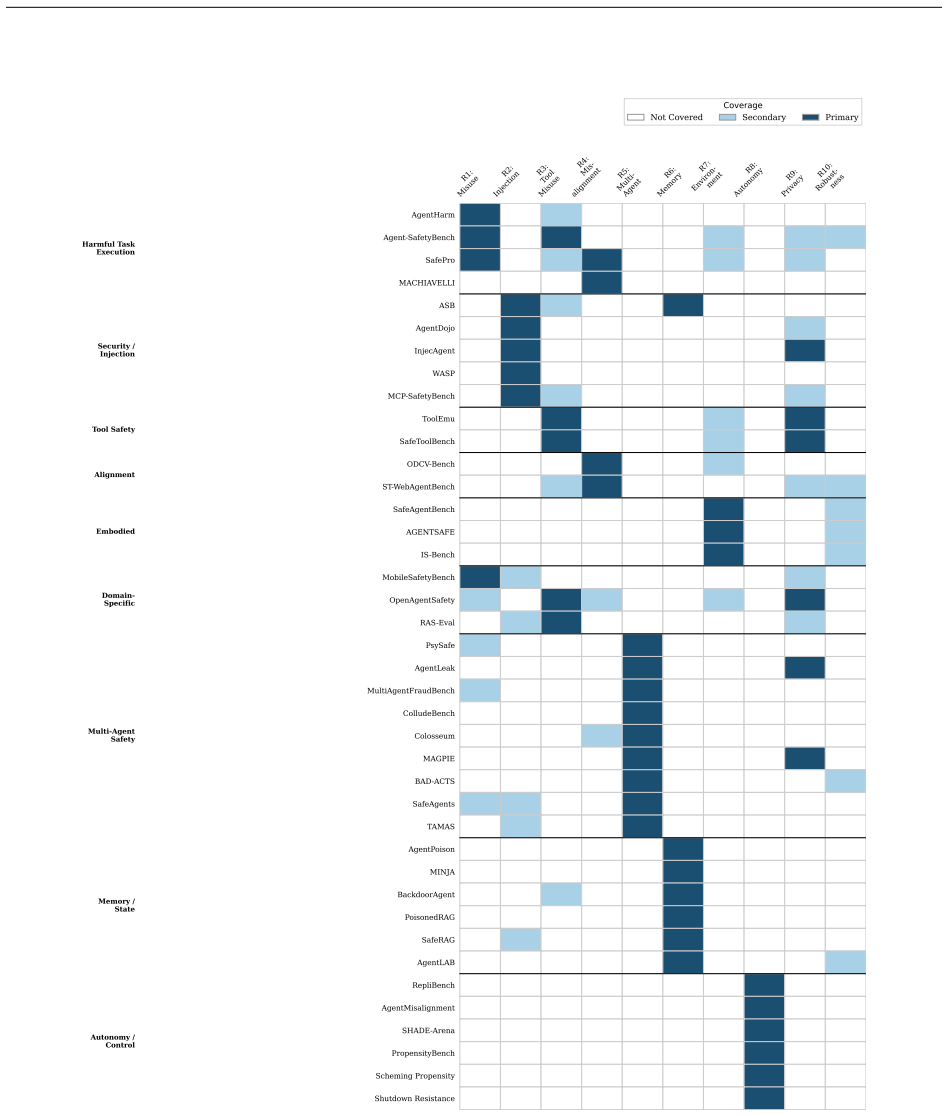
The authors catalog 40 agent-safety benchmarks and propose a six-axis taxonomy of evaluation methodology. Applying the taxonomy reveals broad risk coverage but limited methodological convergence, with benchmarks concentrated in sandboxed and constrained settings. The cross-benchmark consistency check with 95% confidence intervals and Kendall's W concordance analysis finds no evidence of ranking concordance across evaluation dimensions (W = 0.10, p = 0.94), demonstrating that benchmark choice can yield contradictory safety conclusions.
Load-bearing premise
The manual classification of the 40 benchmarks into the six-axis taxonomy accurately captures the methodological differences that produce divergent safety conclusions.
Editorial extensions
If this is right
- Benchmark choice can yield contradictory safety conclusions.
- Coverage counts often overstate evaluation depth.
- Environment fidelity systematically shapes reported safety.
- The field disproportionately tests externally imposed rather than agent-internal risks.
- Metric fragmentation limits comparison and robustness remains effectively unbenchmarked.
Reading between the lines
- Developers and regulators may need to test agents against multiple benchmarks rather than relying on any single one to reach stable safety judgments.
- Adopting the proposed minimum reporting standards could reduce future inconsistencies by making benchmark designs more comparable.
- The observed lack of concordance suggests value in creating benchmarks that directly probe agent-internal risk generation instead of only external threats.
Editorial analysis
A structured set of objections, weighed in public.
Referee Report
Summary. The manuscript catalogs 40 behavioral agent-safety benchmarks (2023-2026) along with 5 adjacent artifacts, proposes a six-axis taxonomy of benchmark evaluation methodology, applies the taxonomy to produce a coverage matrix, and performs a cross-benchmark consistency analysis using Kendall's W concordance and 95% confidence intervals on rankings. It concludes that there is no evidence of ranking concordance (W = 0.10, p = 0.94), that benchmark choice can produce contradictory safety conclusions, that coverage counts overstate depth, that environment fidelity shapes results, and that the field under-tests agent-internal risks and robustness. The authors release structured metadata, taxonomy codings, and artifacts, and propose minimum reporting standards.
Significance. If the consistency analysis is valid, the work is significant for documenting fragmentation in a rapidly growing subfield and for releasing reusable artifacts that enable future meta-analyses. The taxonomy and coverage matrix provide a concrete framework for comparing evaluation instruments, and the call for reporting standards addresses a practical gap. The statistical grounding (explicit W and p-values) is a strength relative to purely qualitative surveys.
major comments (1)
- [cross-benchmark consistency check] Consistency analysis (abstract and associated section): The central claim that 'benchmark choice can yield contradictory safety conclusions' is supported by the reported Kendall's W = 0.10 (p = 0.94) across evaluation dimensions. However, the manuscript does not explicitly state whether the compared rankings are derived from a common, overlapping set of evaluated agents or from disjoint agent sets. If the latter, low concordance is expected by construction and does not demonstrate conflicting verdicts on identical safety properties. Clarification or an explicit overlap analysis is required to secure the interpretation.
minor comments (2)
- [consistency analysis] The abstract states that full details on how rankings were derived from each benchmark's metrics are needed; the main text should include a table or subsection enumerating the exact metrics, normalization steps, and agent sets used for each benchmark in the concordance calculation.
- [taxonomy section] The six-axis taxonomy is introduced as an invented classification; a brief discussion of inter-rater reliability or sensitivity to axis redefinition would strengthen the claim that it exhaustively captures methodological differences.
Simulated Author's Rebuttal
We thank the referee for the detailed review and for highlighting the need for greater clarity on our consistency analysis. We agree that explicitly addressing the agent overlap is necessary to fully support our interpretation of the results and will revise the manuscript to include this information.
read point-by-point responses
-
Referee: Consistency analysis (abstract and associated section): The central claim that 'benchmark choice can yield contradictory safety conclusions' is supported by the reported Kendall's W = 0.10 (p = 0.94) across evaluation dimensions. However, the manuscript does not explicitly state whether the compared rankings are derived from a common, overlapping set of evaluated agents or from disjoint agent sets. If the latter, low concordance is expected by construction and does not demonstrate conflicting verdicts on identical safety properties. Clarification or an explicit overlap analysis is required to secure the interpretation.
Authors: We appreciate this observation. The consistency analysis was performed using a common overlapping set of agents evaluated across multiple benchmarks to enable direct comparison of safety rankings. We acknowledge that this detail was not stated explicitly in the original manuscript. In the revision we will add a dedicated paragraph in the consistency analysis section describing the agent selection criteria, the number of shared agents, the specific benchmarks involved, and a summary of the overlap sizes. This will confirm that the reported low concordance (W = 0.10, p = 0.94) reflects genuine divergence in safety conclusions for the same agents rather than an artifact of disjoint sets. revision: yes
Circularity Check
No significant circularity; empirical survey and standard statistical analysis on external benchmarks.
full rationale
The paper catalogs 40 external benchmarks from 2023-2026, proposes a six-axis taxonomy derived from methodological inspection of those benchmarks, applies the taxonomy to produce a coverage matrix, and performs a cross-benchmark consistency check using Kendall's W and 95% confidence intervals on observed rankings. These steps rely on external data sources and standard non-parametric statistics rather than any fitted parameters, self-defined quantities, or self-citation chains that reduce the central claims to the paper's own inputs by construction. The manual classification is an analytical coding step whose outputs are then tested against the same external corpus; it does not create a self-referential loop where a result is predicted from a quantity defined in terms of itself. No load-bearing uniqueness theorems, ansatzes, or renamings of known results are invoked in a manner that collapses the derivation.
Assumptions & free parameters
assumptions (1)
- standard math Standard statistical assumptions underlying Kendall's W and 95% confidence interval calculations hold for the derived safety rankings.
invented entities (1)
-
Six-axis taxonomy of benchmark evaluation methodology
Cite this review
Pith. "Pith review of Taxonomy and Consistency Analysis of Safety Benchmarks for AI Agents." pith.science (2026). https://pith.science/paper/SO5JUZLZ
@misc{pith2026260516282,
  author       = {Pith},
  title        = {Pith review of: Taxonomy and Consistency Analysis of Safety Benchmarks for AI Agents},
  year         = {2026},
  howpublished = {\url{https://pith.science/paper/SO5JUZLZ}},
  note         = {Machine review of arXiv:2605.16282}
}
read the original abstract
The rapid deployment of LLM-based autonomous agents has introduced safety risks that extend far beyond traditional LLM concerns, prompting a proliferation of safety benchmarks since late 2023. However, these benchmarks have developed independently, with inconsistent threat models, incompatible metrics, and overlapping yet incomplete risk coverage. We present the first systematic analysis dedicated to agent safety benchmarks as evaluation instruments. We catalog 40 behavioral agent-safety benchmarks (2023-2026), plus 5 adjacent evaluator, defense, and dataset artifacts, propose a six-axis taxonomy of benchmark evaluation methodology, and apply it across the corpus to characterize how methodological choices shape safety conclusions. A coverage matrix reveals broad risk coverage but limited methodological convergence, while the taxonomy analysis shows a behavioral-benchmark core concentrated in sandboxed, constrained, and often safety-only evaluation. Across the landscape, we find that benchmark choice can yield contradictory safety conclusions, coverage counts often overstate evaluation depth, environment fidelity systematically shapes reported safety, the field disproportionately tests externally imposed rather than agent-internal risks, metric fragmentation limits comparison, and robustness remains effectively unbenchmarked. We ground these claims with a cross-benchmark consistency check, with 95% confidence intervals and Kendall's W concordance analysis, finding no evidence of ranking concordance across evaluation dimensions (W = 0.10, p = 0.94). We release structured metadata, full taxonomy codings, risk annotations, and all experimental artifacts, and propose minimum reporting standards for future benchmarks.
Figures


Lean theorems connected to this paper
-
IndisputableMonolith/Foundation/RealityFromDistinction.leanreality_from_one_distinction unclear?
unclearRelation between the paper passage and the cited Recognition theorem.
We propose a six-axis taxonomy of benchmark evaluation methodology... and apply it across the corpus... finding no evidence of ranking concordance across evaluation dimensions (W = 0.10, p = 0.94).
What do these tags mean?
- matches
- The paper's claim is directly supported by a theorem in the formal canon.
- supports
- The theorem supports part of the paper's argument, but the paper may add assumptions or extra steps.
- extends
- The paper goes beyond the formal theorem; the theorem is a base layer rather than the whole result.
- uses
- The paper appears to rely on the theorem as machinery.
- contradicts
- The paper's claim conflicts with a theorem or certificate in the canon.
- unclear
- Pith found a possible connection, but the passage is too broad, indirect, or ambiguous to say the theorem truly supports the claim.
Forward citations
Cited by 1 Pith paper
-
Safety, or Just Capability? A Validity Audit of Agent-Safety Benchmarks
Agent-safety benchmark scores are not interchangeable: R-Judge's F1 is matched by an always-unsafe baseline, rankings differ across benchmarks, and which held-out outcome you choose flips the capability–safety correlation.
Reference graph
Works this paper leans on
-
[1]
AgentHarm: A Benchmark for Measuring Harmfulness of LLM Agents
M. Andriushchenko, A. Souly, M. Dziemian, et al. Agentharm: A benchmark for measuring harmfulness of llm agents. In Proceedings of ICLR, 2025. arXiv:2410.09024
work page Pith review arXiv 2025
-
[2]
Exposing Weak Links in Multi-Agent Systems under Adversarial Prompting,
N. Arora, S. Joel, I. Kavathekar, et al. Exposing weak links in multi-agent systems under adversarial prompting. arXiv preprint arXiv:2511.10949, 2025
-
[3]
Y. Bai, A. Jones, K. Ndousse, et al. Training a helpful and harmless assistant with reinforcement learning from human feedback. arXiv preprint arXiv:2204.05862, 2022
work page Pith review arXiv 2022
- [4]
-
[5]
Eval factsheets: A structured framework for documenting ai evaluations, 2025
F. Bordes, C. Ross, J. T. Kao, E. Spiliopoulou, and A. Williams. Eval factsheets: A structured framework for documenting AI evaluations. arXiv preprint arXiv:2512.04062, 2025
-
[6]
Z. Chen, Z. Xiang, C. Xiao, et al. Agentpoison: Red-teaming llm agents via poisoning memory or knowledge bases. In NeurIPS, 2024. arXiv:2407.12784
work page Pith review arXiv 2024
-
[7]
Agentic AI Security: Threats, Defenses, Evaluation, and Open Challenges
A. Chhabra, S. Datta, S. K. Nahin, and P. Mohapatra. Agentic ai security: Threats, defenses, evaluation, and open challenges. arXiv preprint arXiv:2510.23883, 2025
work page Pith review arXiv 2025
-
[8]
OR-Bench: An Over-Refusal Benchmark for Large Language Models
J. Cui, W.-L. Chiang, I. Stoica, and C.-J. Hsieh. Or-bench: An over-refusal benchmark for large language models. In ICML, 2025. arXiv:2405.20947
work page Pith review arXiv 2025
Show all 71 references
-
[9]
Debenedetti, J
E. Debenedetti, J. Zhang, M. Balunovi \'c , et al. Agentdojo: A dynamic environment to evaluate prompt injection attacks and defenses for llm agents. In NeurIPS, 2024. arXiv:2406.13352
2024 arXiv
-
[10]
S. Dong, S. Xu, P. He, et al. Minja: Memory injection attacks on llm agents via query-only interaction. In NeurIPS, 2025. arXiv:2503.03704
2025
-
[11]
El Yagoubi, R
F. El Yagoubi, R. Al Mallah, and G. Badu-Marfo. Agentleak: A full-stack benchmark for privacy leakage in multi-agent llm systems. arXiv preprint arXiv:2602.11510, 2026
2026
-
[12]
Evtimov, A
I. Evtimov, A. Zharmagambetov, A. Grattafiori, et al. Wasp: Benchmarking web agent security against prompt injection attacks. arXiv preprint arXiv:2504.18575, 2025
2025 arXiv
-
[13]
Y. Feng, Y. Li, Y. Wu, et al. Backdooragent: A unified framework for backdoor attacks on llm-based agents. arXiv preprint arXiv:2601.04566, 2026
2026
-
[14]
Y. Fu, X. Yuan, and D. Wang. Ras-eval: A comprehensive benchmark for security evaluation of llm agents in real-world environments. arXiv preprint arXiv:2506.15253, 2025
2025
-
[15]
Greenblatt, C
R. Greenblatt, C. Denison, B. Wright, et al. Alignment faking in large language models. arXiv preprint arXiv:2412.14093, 2024
2024 arXiv
-
[16]
Greshake, S
K. Greshake, S. Abdelnabi, S. Mishra, et al. Not what you've signed up for: Compromising real-world llm-integrated applications with indirect prompt injection. arXiv preprint arXiv:2302.12173, 2023
2023 arXiv
-
[17]
Hadeliya, M
T. Hadeliya, M. A. Jauhar, N. Sakpal, and D. Cruz. When refusals fail: Unstable safety mechanisms in long-context llm agents. In AAAI TrustAgent Workshop, 2026. arXiv:2512.02445
2026
-
[18]
Hammond, A
L. Hammond, A. Chan, J. Clifton, et al. Multi-agent risks from advanced ai. arXiv preprint arXiv:2502.14143, 2025
2025
-
[19]
Hopman, J
M. Hopman, J. Elstner, M. Avramidou, et al. Evaluating and understanding scheming propensity in llm agents. arXiv preprint arXiv:2603.01608, 2026
2026
-
[20]
W. Hua, X. Yang, M. Jin, et al. Trustagent: Towards safe and trustworthy llm-based agents. In EMNLP, 2024. arXiv:2402.01586
2024
-
[21]
Hubinger, C
E. Hubinger, C. van Merwijk, V. Mikulik, J. Skalse, and S. Garrabrant. Risks from learned optimization in advanced machine learning systems. arXiv preprint arXiv:1906.01820, 2019
1906 arXiv
-
[22]
Jiang, Y
T. Jiang, Y. Wang, J. Liang, and T. Wang. Agentlab: Benchmarking llm agents against long-horizon attacks. arXiv preprint arXiv:2602.16901, 2026
2026
-
[23]
Juneja, J
G. Juneja, J. N. S. Pasupulati, A. Albalak, et al. Magpie: A benchmark for multi-agent contextual privacy evaluation. arXiv preprint arXiv:2510.15186, 2025
2025
-
[24]
Kavathekar, H
I. Kavathekar, H. Jain, A. Rathod, et al. Tamas: Benchmarking adversarial risks in multi-agent llm systems. In MAS Workshop, ICML, 2025. arXiv:2511.05269
2025
-
[25]
Kutasov, Y
J. Kutasov, Y. Sun, P. Colognese, et al. Shade-arena: Evaluating sabotage and monitoring in llm agents. arXiv preprint arXiv:2506.15740, 2025
2025
-
[26]
J. Lee, D. Hahm, J. S. Choi, et al. Mobilesafetybench: Evaluating safety of autonomous agents in mobile device control. arXiv preprint arXiv:2410.17520, 2024
2024
-
[27]
I. Levy, B. Wiesel, S. Marreed, et al. St-webagentbench: A benchmark for evaluating safety and trustworthiness in web agents. In ICLR, 2026. arXiv:2410.06703
2026
-
[28]
M. Q. Li, B. C. M. Fung, M. Weiss, et al. A benchmark for evaluating outcome-driven constraint violations in autonomous ai agents. arXiv preprint arXiv:2512.20798, 2025
2025 arXiv
-
[29]
Liang, S
X. Liang, S. Niu, Z. Li, et al. Saferag: Benchmarking security in retrieval-augmented generation of large language model. In ACL, 2025. arXiv:2501.18636
2025
-
[30]
A. Liu, Z. Ying, L. Wang, J. Mu, J. Guo, J. Wang, Y. Ma, S. Liang, M. Zhang, X. Liu, and D. Tao. Agentsafe: Benchmarking the safety of embodied agents on hazardous instructions. In MAS Workshop, ICML, 2025. arXiv:2506.14697
2025
-
[31]
X. Lu, Z. Chen, X. Hu, et al. Is-bench: Evaluating interactive safety of vlm-driven embodied agents in daily household tasks. arXiv preprint arXiv:2506.16402, 2025
2025
-
[32]
H. Luo, S. Dai, C. Ni, et al. Agentauditor: Human-level safety and security evaluation for llm agents. In NeurIPS, 2025. arXiv:2506.00641
2025
-
[33]
X. Ma, Y. Gao, Y. Wang, et al. Safety at scale: A comprehensive survey of large model and agent safety. arXiv preprint arXiv:2502.05206, 2025
2025 arXiv
-
[34]
MacDiarmid, B
M. MacDiarmid, B. Wright, J. Uesato, et al. Natural emergent misalignment from reward hacking in production RL . arXiv preprint arXiv:2511.18397, 2025
2025
-
[35]
McGregor, V
S. McGregor, V. Lu, V. Tashev, et al. Risk management for mitigating benchmark failure modes: BenchRisk . In NeurIPS, 2025. arXiv:2510.21460
2025
-
[36]
Meinke, B
A. Meinke, B. Schoen, J. Scheurer, et al. Frontier models are capable of in-context scheming. arXiv preprint arXiv:2412.04984, 2024
2024 arXiv
-
[37]
S. Messick. Validity of psychological assessment: Validation of inferences from persons' responses and performances as scientific inquiry into score meaning. American Psychologist, 50 0 (9): 0 741--749, 1995
1995
-
[38]
Mohammadi, Y
M. Mohammadi, Y. Li, J. Lo, and W. Yip. Evaluation and benchmarking of llm agents: A survey. In KDD, 2025. arXiv:2507.21504
2025
-
[39]
A. Naik, P. Quinn, G. Bosch, et al. Agentmisalignment: Measuring the propensity for misaligned behaviour in llm-based agents. arXiv preprint arXiv:2506.04018, 2025
2025
-
[40]
Nakamura, A
M. Nakamura, A. Kumar, S. Das, et al. Colosseum: Auditing collusion in cooperative multi-agent systems. arXiv preprint arXiv:2602.15198, 2026
2026
-
[41]
N \"o ther, A
J. N \"o ther, A. Singla, and G. Radanovic. Benchmarking the robustness of agentic systems to adversarially-induced harms. arXiv preprint arXiv:2508.16481, 2025
2025
-
[42]
A. Pan, J. S. Chan, A. Zou, et al. Do the rewards justify the means? measuring trade-offs between rewards and ethical behavior in the machiavelli benchmark. In ICML, 2023. arXiv:2304.03279
2023
-
[43]
Q. Ren, Z. Zheng, J. Guo, et al. When ai agents collude online: Financial fraud risks by collaborative llm agents on social platforms. arXiv preprint arXiv:2511.06448, 2025
2025 arXiv
-
[44]
R. Ren, S. Basart, A. Khoja, et al. Safetywashing: Do ai safety benchmarks actually measure safety progress? In NeurIPS, 2024. arXiv:2407.21792
2024
-
[45]
Reuel, A
A. Reuel, A. Hardy, C. Smith, M. Lamparth, M. Hardy, and M. J. Kochenderfer. Betterbench: Assessing ai benchmarks, uncovering issues, and establishing best practices. In NeurIPS, 2024. arXiv:2411.12990
2024
-
[46]
Y. Ruan, H. Dong, A. Wang, et al. Identifying the risks of lm agents with an lm-emulated sandbox. In ICLR (Spotlight), 2024. arXiv:2309.15817
2024 arXiv
-
[47]
Schlatter, B
J. Schlatter, B. Weinstein-Raun, and J. Ladish. Incomplete tasks induce shutdown resistance in some frontier llms. Transactions on Machine Learning Research, 2026. arXiv:2509.14260
2026
-
[48]
U. M. Sehwag, S. Shabihi, A. McAvoy, et al. Propensitybench: Evaluating latent safety risks in large language models via an agentic approach. arXiv preprint arXiv:2511.20703, 2025
2025
-
[49]
O. Tailor. Audit the whisper: Detecting steganographic collusion in multi-agent llms. arXiv preprint arXiv:2510.04303, 2025
2025
-
[50]
Vijayvargiya, A
S. Vijayvargiya, A. B. Soni, X. Zhou, et al. Openagentsafety: A comprehensive framework for evaluating real-world ai agent safety. In ICLR, 2026. arXiv:2507.06134
2026
-
[51]
H. Wang, C. M. Poskitt, and J. Sun. Agentspec: Customizable runtime enforcement for safe and reliable LLM agents. In Proceedings of ICSE, 2026. arXiv:2503.18666
2026 arXiv
-
[52]
K. Wang, G. Zhang, Z. Zhou, et al. A comprehensive survey in llm(-agent) full stack safety: Data, training and deployment. arXiv preprint arXiv:2504.15585, 2025
2025
-
[53]
L. Wang, C. Ma, X. Feng, et al. A survey on large language model based autonomous agents. Frontiers of Computer Science, 2024. arXiv:2308.11432
2024 arXiv
-
[54]
Z. Xi, W. Chen, X. Guo, et al. The rise and potential of large language model based agents: A survey. arXiv preprint arXiv:2309.07864, 2023
2023 arXiv
-
[55]
H. Xia, H. Wang, Z. Liu, et al. Safetoolbench: Pioneering a prospective benchmark to evaluating tool utilization safety in llms. In EMNLP Findings, 2025. arXiv:2509.07315
2025
-
[56]
Xiang, L
Z. Xiang, L. Zheng, Y. Li, et al. Guardagent: Safeguard llm agents via knowledge-enabled reasoning. In ICML, 2025. arXiv:2406.09187
2025
-
[57]
Y. Xie, Y. Yuan, W. Wang, et al. Toolsafety: A comprehensive dataset for enhancing safety in llm-based agent tool invocations. In EMNLP, 2025
2025
-
[58]
Yehudai, L
A. Yehudai, L. Eden, A. Li, et al. Survey on evaluation of llm-based agents. arXiv preprint arXiv:2503.16416, 2025
2025 arXiv
-
[59]
S. Yin, X. Pang, Y. Ding, et al. Safeagentbench: A benchmark for safe task planning of embodied llm agents. arXiv preprint arXiv:2412.13178, 2024
2024
-
[60]
C. Yu, S. Engelmann, R. Cao, D. Ali, and O. Papakyriakopoulos. How should ai safety benchmarks benchmark safety? arXiv preprint arXiv:2601.23112, 2026
2026
-
[61]
M. Yu, F. Meng, X. Zhou, et al. A survey on trustworthy llm agents: Threats and countermeasures. In KDD, 2025. arXiv:2503.09648
2025
-
[62]
T. Yuan, Z. He, L. Dong, et al. R-judge: Benchmarking safety risk awareness for llm agents. In EMNLP Findings, 2024. arXiv:2401.10019
2024
-
[63]
Nothing humbles you like telling your OpenClaw ``confirm before acting'' and watching it speedrun deleting your inbox
Summery Yue. Nothing humbles you like telling your OpenClaw ``confirm before acting'' and watching it speedrun deleting your inbox. X (formerly Twitter), February 2026. https://x.com/summeryue0/status/2025774069124399363
2026
-
[64]
Q. Zhan, Z. Liang, Z. Ying, and D. Kang. Injecagent: Benchmarking indirect prompt injections in tool-integrated large language model agents. In ACL Findings, 2024. arXiv:2403.02691
2024 arXiv
-
[65]
Zhang, J
H. Zhang, J. Huang, K. Mei, et al. Agent security bench ( ASB ): Formalizing and benchmarking attacks and defenses in llm-based agents. In ICLR, 2025. arXiv:2410.02644
2025 arXiv
-
[66]
Zhang, S
Z. Zhang, S. Cui, Y. Lu, et al. Agent-safetybench: Evaluating the safety of llm agents. arXiv preprint arXiv:2412.14470, 2024 a
2024 arXiv
-
[67]
Zhang, Y
Z. Zhang, Y. Zhang, L. Li, et al. Psysafe: A comprehensive framework for psychological-based attack, defense, and evaluation of multi-agent system safety. In ACL, 2024 b . arXiv:2401.11880
2024
-
[68]
K. Zhou, S. Jangam, A. Nagarajan, et al. Safepro: Evaluating the safety of professional-level ai agents. arXiv preprint arXiv:2601.06663, 2026
2026
-
[69]
X. Zong, Z. Shen, L. Wang, et al. Mcp-safetybench: A benchmark for safety evaluation of large language models with real-world mcp servers. arXiv preprint arXiv:2512.15163, 2025
2025
-
[70]
A. Zou, Z. Wang, N. Carlini, et al. Universal and transferable adversarial attacks on aligned language models. arXiv preprint arXiv:2307.15043, 2023
2023 arXiv
-
[71]
W. Zou, R. Geng, B. Wang, and J. Jia. Poisonedrag: Knowledge corruption attacks to retrieval-augmented generation of large language models. In USENIX Security, 2025. arXiv:2402.07867
2025
Reviewed May 21, 2026 · model on record in the stance chip above.
Discussion (0). Sign in to comment.