REVIEW 4 major objections 4 minor 1 cited by
LLM agents can improve at test time by retrieving a few training trajectories and synthesizing them into a temporary task-specific skill, without changing model weights.
Reviewed by Pith at T0; open to challenge. T0 means a machine referee read the full paper against a public rubric. the ladder, T0–T4 →
T0 review · deepseek-v4-flash
2026-08-02 13:49 UTC pith:H5FEKJ65
load-bearing objection Useful test-time skill synthesis method with a plausible mechanism, but the no-copy constraint is unverified and the abstract overstates the results. the 4 major comments →
Skills on the Fly: Test-Time Adaptive Skill Synthesis for LLM Agents
The pith
A machine-rendered reading of the paper's core claim, the machinery that carries it, and where it could break.
Core claim
The paper claims that dynamic, task-specific skills improve LLM agents compared with static skill and memory baselines. Concretely, retrieving the top-3 training trajectories by semantic and structural task metadata and synthesizing them into a task-conditioned SKILL.md raises SpreadsheetBench Pass@1 from 0.397 (Trace2Skill with GPT-5.5 synthesis) to 0.505 and BigCodeBench Pass@1 from 0.517 to 0.651, with ALFWorld success at 0.872–0.879 and the shortest successful trajectories among reported methods. The discovery is that the adaptation unit matters: a temporary skill synthesized after seeing the target task reconciles the compression of a static skill with the specificity of a per-task exam
What carries the argument
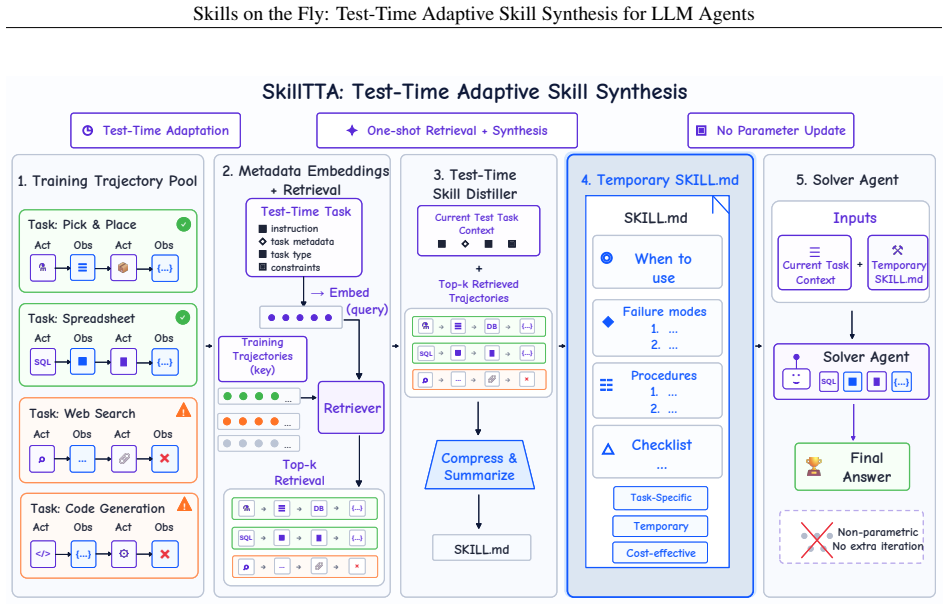
The central object is the temporary task-specific SKILL.md, generated at test time by a synthesis model (GPT-5.5 or GPT-5.4-mini) from the target task context and a small set of retrieved trajectories (top-k=3). Retrieval is driven by embeddings over stable task metadata—instruction, task type, function signature, output range, action grammar—rather than over trajectory details, to avoid leaking answers or one-off constants. The synthesis prompt treats the target context as the binding contract and retrieved trajectories as non-binding evidence, and explicitly forbids copying concrete answers; the resulting skill carries procedures, pitfalls, and checks. The fixed solver (GPT-5.4-mini) condi
Load-bearing premise
The gains rest on the unmeasured premise that the hand-designed metadata embeddings retrieve trajectories whose lessons transfer to the target contract, and that the synthesis model obeys the no-copy, target-authoritative constraint in the prompt template.
What would settle it
Audit the retrieval stage: for each test task, check whether the top-3 retrieved trajectories actually share the target's output contract (e.g., same answer range for SpreadsheetBench). If the gain over random retrieval persists even when the top-3 are contract-mismatched, then the paper's stated retrieval principle is not the active ingredient; if it collapses when the output position is masked from the embedding, the principle is confirmed.
If this is right
- On SpreadsheetBench, dynamic skills reach 0.505 Pass@1 versus 0.397 for static Trace2Skill synthesis with the same GPT-5.5 writer; even with the smaller writer (GPT-5.4-mini), dynamic skills beat the static baseline (0.443 vs 0.420).
- On BigCodeBench, SkillTTA lifts Pass@1 from 0.517 to 0.651 and Pass@3 from 0.582 to 0.673 relative to Trace2Skill.
- On ALFWorld, SkillTTA reaches 0.872–0.879 success without iterative learning, close to MemRL's 0.907 but with shorter successful episodes (8.88–9.03 steps vs 11.85), showing the method converts test-time compute into capability more cheaply.
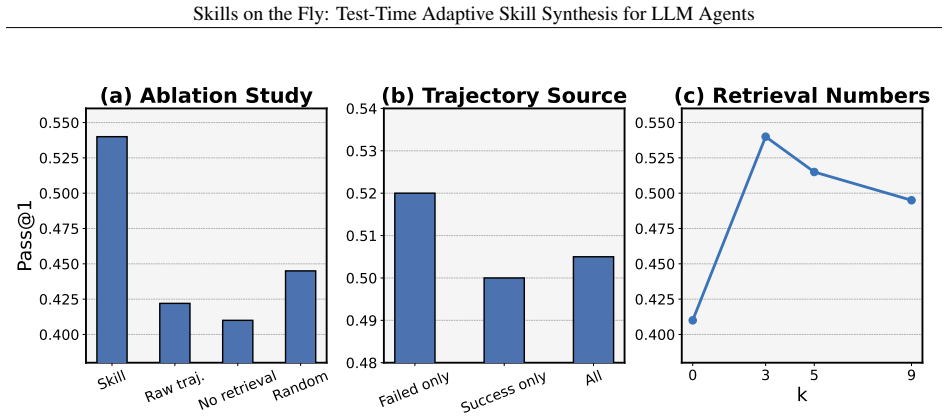
- Ablations show the gain comes from skill compression: synthesized skills (0.540) outperform raw trajectory prompting (0.422), random retrieval (0.445), and no retrieval (0.410); top-3 retrieval beats top-5 and top-9.
- Failed trajectories are the most informative retrieval source, because they expose recurring evaluator-facing mistakes that translate directly into corrective skill rules.
Where Pith is reading between the lines
- The one-shot synthesis interface could generalize to other adaptation signals—live environment feedback, user corrections, or changing tool availability—by adding them as evidence in the retrieval pool, without altering the pipeline.
- Retrieval quality is directly testable: measuring whether top-3 retrieved trajectories actually share the target task's contract (output range, action grammar, return type) would separate the contribution of retrieval from that of synthesis.
- The cost comparison suggests the dominant expense shifts from repeated rollouts (as in MemRL) or hierarchical skill consolidation (as in Trace2Skill) to a single retrieval plus one synthesis call per task; for large pools, the retrieval step becomes the scaling bottleneck and could be approximated with clustering or hashing.
- Because the no-copy constraint is enforced by a prompt instruction rather than by verification, a natural strengthening is to add a check that the synthesized SKILL.md does not leak answer-adjacent constants before it reaches the solver; this would also make the method safer to deploy with closed API solvers.
Editorial analysis
A structured set of objections, weighed in public.
Referee Report
Summary. The paper proposes SkillTTA, a test-time adaptive skill synthesis method for LLM agents. For each test task, SkillTTA retrieves a small set of training trajectories using embeddings computed from task metadata, synthesizes those trajectories into a temporary, task-specific SKILL.md with a fixed-solver prompt, and injects this skill into the solver. The solver parameters are never updated. The method is evaluated on SpreadsheetBench, ALFWorld, and BigCodeBench. The main table (Table 1) reports that SkillTTA with GPT-5.5 synthesis improves SpreadsheetBench Pass@1 from 0.397 (Trace2Skill) to 0.505, BigCodeBench Pass@1 from 0.517 to 0.651, and achieves ALFWorld success of 0.872–0.879 with shorter successful trajectories than baselines. Ablations (Section 4.3) indicate that synthesized skills outperform raw trajectory prompting, that failed trajectories are informative, and that small retrieval sets (top-3) are better than larger ones. The paper claims that dynamic task-specific skill synthesis is a lightweight, closed-API-compatible alternative to raw trajectory prompting, static skill libraries, and runtime parameter or memory-utility learning.
Significance. If the central claim holds, the paper is a useful empirical contribution: it shows that one-shot, text-only adaptation can improve fixed LLM solvers across three diverse agentic task families, without parameter updates or iterative rollouts. The design is simple and the isolation ablations are informative: the gap between synthesized skills (0.540) and raw trajectory prompting (0.422), random retrieval (0.445), and no retrieval (0.410) in Figure 3 suggests that compression of retrieved evidence is doing real work. The paper also reports the shortest ALFWorld successful trajectories among compared methods, and the cost-accuracy analysis in Figure 4 is a useful practical comparison. However, the load-bearing claims currently rest on two unverified premises: that the synthesized skills do not copy concrete answers from retrieved trajectories, and that the reported configurations were not selected on the evaluation split. Both are testable and within the scope of a revision. No derivation is claimed, and I see no definitional circularity in the evaluation.
major comments (4)
- [Sections 3.4 and A.2; Figure 3(a)] The paper repeatedly asserts that the synthesis prompt forbids copying concrete answers, file paths, local constants, and benchmark-only values, but it provides no audit of the generated SKILL.md files. For SpreadsheetBench, retrieved trajectories contain solution excerpts; for BigCodeBench, they may contain code that directly implements the target function. If the synthesizer emits such concrete content, the Pass@1 gains would reflect retrieval-and-copy rather than skill abstraction. The ablation in Figure 3(a) does not rule this out: a compact copied answer could beat raw trajectory prompting because it is more directly applicable. The authors should report an overlap analysis between synthesized skills and retrieved trajectories, plus manual or LLM-based checks of no-copy compliance, or otherwise rule out answer leakage.
- [Sections 4.1.3 and 4.3; Table 1; Figure 3] The main table reports SkillTTA with 'all retrieved trajectories' (SpreadsheetBench 0.505), while the ablation studies select failed-only retrieval, top-k=3, and other defaults on the same 200-task test split. The best ablation configuration reaches 0.540, but there is no separate validation split or pre-registered configuration. This selection-on-the-evaluation-split means the headline effect size and even the reported 'strongest' configuration may be optimistic. The authors should either fix all hyperparameters before evaluation, use a held-out validation split, or report the distribution over validation splits.
- [Paper metadata abstract vs full text] The metadata abstract claims that SkillTTA 'further uses meta prompt optimization (MPO) to adapt the policy that writes these skills' and that it is evaluated 'Across ALFWorld, SpreadsheetBench, BigCodeBench, and WebShop.' Neither MPO nor WebShop appears anywhere in the full text: the abstract, method, experiments, and conclusion describe only three benchmarks and a single-shot skill-synthesis pipeline. This is a major consistency issue: a reader cannot tell which contribution is being claimed, and the MPO component, if real, is a substantial missing technical section. The authors must reconcile the abstract with the actual manuscript.
- [Section 3.3; Figure 3] The retrieval design is asserted, not measured. The paper says retrieval should be driven by semantic and structural task similarity, but it reports no retrieval precision, recall, or qualitative analysis of retrieved trajectory–target pairs. The ablation shows retrieval matters (0.540 vs 0.445 random vs 0.410 none), but it does not show that the metadata embeddings retrieve trajectories whose lessons actually transfer, as opposed to trajectories that happen to share surface metadata. A minimal retrieval-quality audit, or a few case studies, would substantiate the claimed mechanism.
minor comments (4)
- [Section 1 and abstract] The paper calls the pipeline 'parameter-free,' but it has several free design choices: top-k, trajectory source filter, per-benchmark embedding schema, prompt template, and temperatures. These are hyperparameters rather than learned parameters; the wording should be 'no learned parameters' or 'solver-parameter-free' to avoid overclaiming.
- [Table 1, ALFWorld rows] On ALFWorld, MemRL achieves the highest success rate (0.907) and SkillTTA is lower (0.872–0.879). The text acknowledges this, but the abstract's phrase 'outperforms state-of-the-art reuse and optimization baselines' is too broad and should be qualified to reflect the ALFWorld comparison.
- [Figure 4 and Section 4.4] The cost comparison reports decoded tokens only and excludes input-token cost and retrieval cost. The authors justify this choice, but the discussion should also state that SkillTTA's input includes retrieved trajectories and the synthesized skill, which may make input-token comparisons relevant under different pricing schemes.
- [Section 4.1.1] The split descriptions are terse. For ALFWorld, '1000 training tasks from the original training set with seed 42' should state whether these are unique task instances and whether the valid-seen set overlaps with training task families, since this affects the difficulty of the retrieval task.
Circularity Check
No circularity found: the paper is an empirical evaluation whose claimed gains are measured directly against external baselines rather than derived from fitted inputs or self-citations.
full rationale
SkillTTA is an empirical adaptation pipeline. Its central claim—that task-specific synthesized skills improve a fixed solver over static, raw-trajectory, and memory baselines—is established by direct evaluation on ALFWorld, SpreadsheetBench, and BigCodeBench, and by ablations that isolate synthesis from raw trajectory prompting, retrieval source, and retrieval count. No predicted quantity is defined in terms of a fitted constant, and no equation reduces an output to its own input. Retrieval uses stable task metadata (Section 3.3), synthesis uses the target context plus retrieved trajectories under an explicit no-copy instruction (Appendix A.2), and the solver is a fixed GPT-5.4-mini, so every stage is measured rather than definitionally forced. The self-citations in Related Work are contextual surveys and are not load-bearing: the comparisons and ablations stand on public benchmark results. Two genuine empirical risks exist but are not circularity under the stated rules: (1) the paper does not audit whether generated SKILL.md files actually obey the no-copy constraint, so answer leakage into the skill is an unmeasured threat to validity; and (2) top-k=3 and the preference for failed trajectories were selected using ablations on the same 200-task SpreadsheetBench test split used for the reported main results. These are evaluation/selection concerns, not cases where a result reduces by construction to its inputs, so they do not raise the circularity score.
Axiom & Free-Parameter Ledger
free parameters (5)
- top-k retrieval size =
3
- trajectory source filter =
Failed-only (ablations); all trajectories (main results)
- per-benchmark metadata embedding schema
- split seeds and sizes =
0/42/123; 200/1000/798 train tasks
- synthesis prompt template and temperatures =
temp 0 (0.7 for BigCodeBench Pass@3)
axioms (4)
- domain assumption Training and test tasks come from the same task family with transferable procedure-level knowledge
- domain assumption Graded trajectory labels y_i in {T+, T-} are available for the whole training pool at no extra cost
- domain assumption The synthesis model faithfully obeys the no-copy, target-authoritative prompt and produces skills that do not leak answers or override the visible contract
- domain assumption Cosine similarity over the hand-built metadata text is a valid proxy for lesson transferability
read the original abstract
Additional test-time compute can give LLM agents access to more past experience, yet expanding the context or adding rollouts does not necessarily yield greater agent capability. We call this challenge test-time compute-to-capability conversion and propose SkillTTA, which retrieves task-relevant training trajectories and synthesizes a temporary skill conditioned on the visible target context for a solver with fixed parameters. To pursue a higher performance ceiling, SkillTTA further uses meta prompt optimization (MPO) to adapt the policy that writes these skills. MPO evaluates candidate prompts on paired tasks and emphasizes informative transitions. It also confines updates to benchmark-specific atomic slots, reducing the variance caused by observing each edit only indirectly through skill synthesis and solver rollout. Across ALFWorld, SpreadsheetBench, BigCodeBench, and WebShop, SkillTTA outperforms state-of-the-art reuse and optimization baselines. It attains a higher performance ceiling at lower compute cost than baseline reuse and sampling strategies.
Figures


Forward citations
Cited by 1 Pith paper
-
Agent Skills Matter: Inferring Proprietary Skills from Execution Trajectories
A black-box attacker can recover a functional approximation of a hidden agent skill from paired skill-enabled and skill-disabled execution trajectories elicited by benign queries.
Reference graph
Works this paper leans on
-
[2]
Junda Wang, Zonghai Tao, Hansi Zeng, Zhichao Yang, Hamed Zamani, and Hong Yu
URLhttps://arxiv.org/abs/2601.03192. Junda Wang, Zonghai Tao, Hansi Zeng, Zhichao Yang, Hamed Zamani, and Hong Yu. Tarse: Test-time adaptation via retrieval of skills and experience for reasoning agents.arXiv preprint arXiv:2603.01241, 2026. URL https: //arxiv.org/abs/2603.01241. Guanzhi Wang, Yuqi Xie, Yunfan Jiang, Ajay Mandlekar, Chaowei Xiao, Yuke Zhu...
Pith/arXiv arXiv 2026
-
[2024]
URLhttps://arxiv.org/abs/2406.14991. Mohit Shridhar, Xingdi Yuan, Marc-Alexandre Cote, Yonatan Bisk, Adam Trischler, and Matthew Hausknecht. ALFWorld: Aligning text and embodied environments for interactive learning. InInternational Conference on Learning Representations, 2021. URLhttps://arxiv.org/abs/2010.03768. Terry Yue Zhuo, Minh Chien Vu, Jenny Chim...
Pith/arXiv arXiv 2021
-
[2026]
Zora Zhiruo Wang, Jiayuan Mao, Daniel Fried, and Graham Neubig
URLhttps://arxiv.org/abs/2603.25158. Zora Zhiruo Wang, Jiayuan Mao, Daniel Fried, and Graham Neubig. Agent workflow memory.arXiv preprint arXiv:2409.07429, 2024. URLhttps://arxiv.org/abs/2409.07429. Shengtao Zhang, Jiaqian Wang, Ruiwen Zhou, Junwei Liao, Yuchen Feng, Weinan Zhang, Muning Wen, et al. Memrl: Self-evolving agents via runtime reinforcement le...
Pith/arXiv arXiv 2024
discussion (0)
Sign in with ORCID, Apple, or X to comment. Anyone can read and Pith papers without signing in.