Quantum magic of strongly correlated fermions - the Hubbard dimer
Pith reviewed 2026-06-30 18:23 UTC · model grok-4.3
The pith
Non-stabilizerness acts as a distinct quantum resource in the Hubbard dimer that captures complexity missed by entanglement and non-Gaussianity.
A machine-rendered reading of the paper's core claim, the machinery that carries it, and where it could break.
Core claim
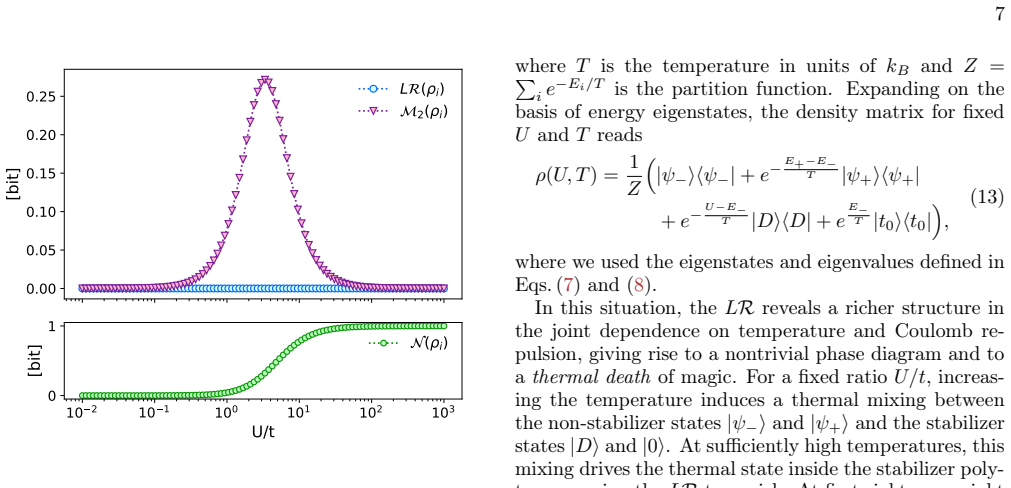
In the Hubbard dimer the robustness of magic remains nonzero across a range of interaction strengths and temperatures while the stabilizer Rényi entropy often returns zero for mixed states; when compared with fermionic non-Gaussianity and superselected entanglement, non-stabilizerness therefore supplies an independent diagnostic of quantum complexity in a tunable fermionic model.
What carries the argument
Robustness of magic and stabilizer Rényi entropy applied to the eigenstates and time-evolved states of the Hubbard dimer Hamiltonian.
If this is right
- Non-stabilizerness supplies information about quantum complexity that is independent of entanglement and non-Gaussianity in interacting fermion systems.
- The stabilizer Rényi entropy is unreliable for mixed states that commonly appear at finite temperature or after quenches.
- Interaction strength directly controls the amount of non-stabilizerness generated in the dimer.
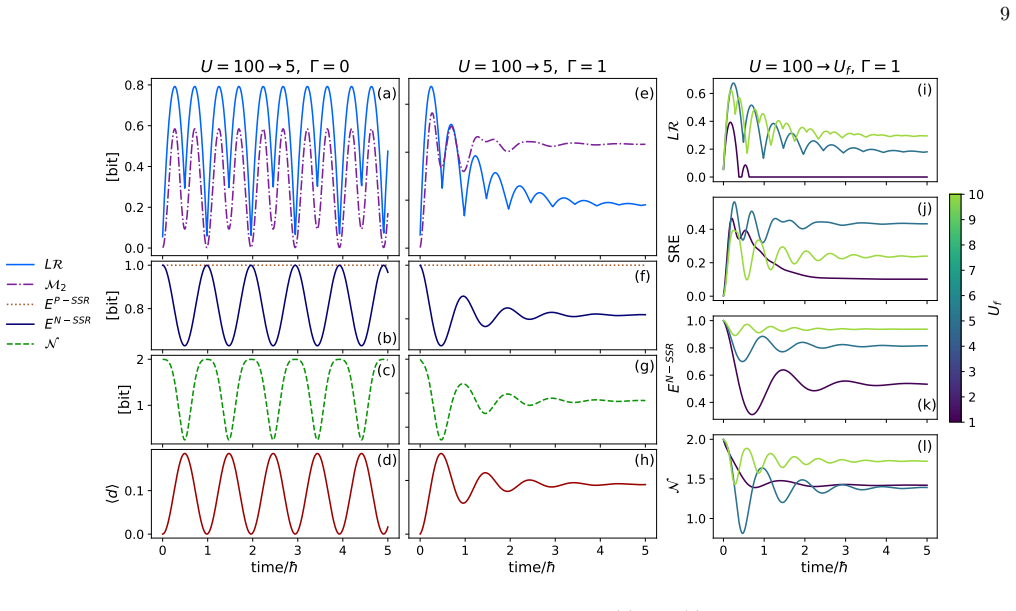
- Temperature and quench protocols produce distinct signatures in non-stabilizerness that are not reproduced by other resource measures.
Where Pith is reading between the lines
- The same measures could be applied to larger Hubbard lattices to test whether the dimer already captures the essential scaling of magic with system size.
- Non-stabilizerness may serve as a diagnostic for the onset of strongly correlated regimes that are difficult to characterize with conventional entanglement witnesses.
- If the dimer results hold more broadly, magic could become a practical figure of merit when designing fermionic quantum simulators or variational circuits.
Load-bearing premise
Results obtained for the two-site Hubbard dimer are representative of non-stabilizerness behavior in strongly correlated fermions more generally.
What would settle it
A direct computation of the robustness of magic in a three-site or four-site Hubbard chain that yields zero magic wherever the dimer predicts nonzero magic would falsify the representativeness claim.
Figures




read the original abstract
We study the non-stabilizerness (quantum magic) content of the Hubbard dimer, an analytically solvable, yet completely non-trivial, model of strongly correlated fermions. We consider zero- and finite-temperature properties as well as the time evolution after a quantum quench drives the system out of equilibrium. We evaluate local and nonlocal non-stabilizerness using both the robustness of magic and the stabilizer Renyi entropy, demonstrating how the latter often fails in detecting the mixed stabilizer states that are typically found in this kind of systems. Finally, we compare the non-stabilizerness with other genuine resources of quantum-state complexity, i.e., the fermionic non-Gaussianity and the superselected two-site entanglement. Our findings corroborate the role of non-stabilizerness as a fundamental quantum resource, capturing aspects of quantum complexity that elude traditional information-theoretic measures and providing a novel perspective on fermionic systems with tunable interactions.
Editorial analysis
A structured set of objections, weighed in public.
Referee Report
Summary. The paper studies non-stabilizerness (quantum magic) in the Hubbard dimer, an exactly solvable two-site, two-electron model of interacting fermions. It computes local and nonlocal measures using robustness of magic and stabilizer Rényi entropy at zero and finite temperature as well as after quantum quenches, shows that the stabilizer Rényi entropy frequently fails to detect magic in the mixed states arising in this system, and compares these quantities to fermionic non-Gaussianity and superselected entanglement. The authors conclude that non-stabilizerness captures distinct aspects of quantum complexity in fermionic systems with tunable interactions.
Significance. If the explicit calculations and comparisons hold, the work supplies a clean, analytically tractable benchmark that isolates distinctions among magic, non-Gaussianity, and entanglement measures. Credit is due for the exact treatment of both equilibrium and quench dynamics on a model whose Hilbert space is only four-dimensional, allowing unambiguous identification of mixed stabilizer states.
major comments (2)
- [Abstract, §1] Abstract and §1: the framing of the Hubbard dimer as a 'completely non-trivial' model that 'faithfully represents' the non-stabilizerness properties of strongly correlated fermions is load-bearing for the broader claim, yet the manuscript provides no scaling argument, comparison to larger lattices, or discussion of the absence of emergent many-body phenomena (Mott gap, doping-driven transitions) that define strong correlations in extended systems.
- [Results (SRE comparison)] Results section on SRE vs. robustness of magic: the claim that stabilizer Rényi entropy 'often fails in detecting the mixed stabilizer states' requires an explicit counter-example with numerical values (e.g., a thermal or post-quench state whose SRE is zero while robustness of magic is positive) together with the precise definition of the SRE used for mixed states; without this the distinction remains qualitative.
minor comments (2)
- Notation for local vs. nonlocal magic should be introduced once and used consistently; the current alternation between 'local non-stabilizerness' and 'on-site magic' is unclear.
- Figure captions for quench dynamics should state the initial state, quench parameter, and time interval explicitly rather than referring only to the main text.
Simulated Author's Rebuttal
We thank the referee for the careful reading and constructive comments on our manuscript. We respond point-by-point to the major comments below.
read point-by-point responses
-
Referee: [Abstract, §1] Abstract and §1: the framing of the Hubbard dimer as a 'completely non-trivial' model that 'faithfully represents' the non-stabilizerness properties of strongly correlated fermions is load-bearing for the broader claim, yet the manuscript provides no scaling argument, comparison to larger lattices, or discussion of the absence of emergent many-body phenomena (Mott gap, doping-driven transitions) that define strong correlations in extended systems.
Authors: We agree that the Hubbard dimer does not capture emergent many-body phenomena such as the Mott gap or doping-driven transitions that appear in extended systems, and the manuscript contains no scaling arguments or comparisons to larger lattices. The model was selected because its four-dimensional Hilbert space permits fully analytic, approximation-free computation of all quantities at zero and finite temperature and after quenches. We will revise the abstract and §1 to replace 'completely non-trivial' and 'faithfully represents' with 'minimal yet non-trivial benchmark model' that isolates distinctions among non-stabilizerness, non-Gaussianity, and superselected entanglement. This change removes the load-bearing claim while preserving the paper's scope. revision: yes
-
Referee: [Results (SRE comparison)] Results section on SRE vs. robustness of magic: the claim that stabilizer Rényi entropy 'often fails in detecting the mixed stabilizer states' requires an explicit counter-example with numerical values (e.g., a thermal or post-quench state whose SRE is zero while robustness of magic is positive) together with the precise definition of the SRE used for mixed states; without this the distinction remains qualitative.
Authors: We accept that the distinction would be stronger with an explicit numerical example. The stabilizer Rényi entropy for mixed states is evaluated via the convex-roof extension of the pure-state definition (we will state the precise formula and reference). In the revised manuscript we will insert a concrete counter-example, for instance a thermal state at a specific inverse temperature or a post-quench state at a given time, reporting numerical values where SRE = 0 while robustness of magic remains strictly positive. This will render the failure quantitative. revision: yes
Circularity Check
No circularity in derivation chain
full rationale
The paper performs direct numerical evaluation of non-stabilizerness measures (robustness of magic, stabilizer Rényi entropy) on the exactly solvable Hubbard dimer at zero/finite temperature and after quenches, then compares them to fermionic non-Gaussianity and superselected entanglement. All reported quantities are obtained from the model's four-dimensional Hilbert space via exact diagonalization and matrix exponentiation; no parameter is fitted to a subset of data and then relabeled as a prediction, no ansatz is smuggled via self-citation, and no uniqueness theorem or self-definitional loop is invoked. The central claim that non-stabilizerness captures distinct complexity aspects is a comparative observation on computed values, not a reduction to the inputs by construction. The derivation chain is therefore self-contained against external benchmarks.
Axiom & Free-Parameter Ledger
axioms (1)
- domain assumption The Hubbard dimer is an analytically solvable yet completely non-trivial model of strongly correlated fermions.
Forward citations
Cited by 2 Pith papers
-
Unitary Designs from Doped Matchgate Circuits
Doped matchgate circuits achieve approximate parity-preserving 2-designs in polylogarithmic depth using a sparse number of non-Gaussian gates, with the design formation mapped exactly to a birth-death Markov chain.
-
Practical Tests and Witnesses of Fermionic non-Gaussianity
Introduces practical witnesses of fermionic non-Gaussianity via antiflatness from covariance matrices, with two efficient measurement protocols, a purity-corrected version for mixed states, and experimental results on...
Reference graph
Works this paper leans on
-
[1]
GB further acknowledges support through the SFB Q- M&S project of the FWF, DOI 10.55776/F86
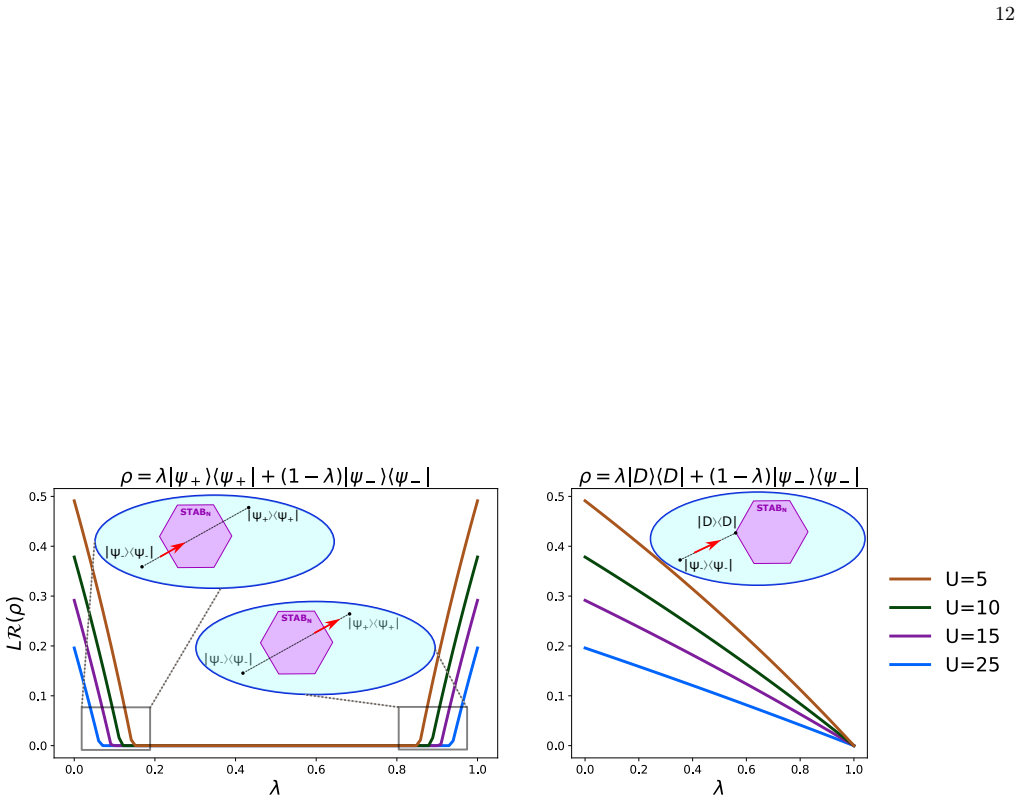
and PRIN 2022 (Prot.20228YCYY7) programmes. GB further acknowledges support through the SFB Q- M&S project of the FWF, DOI 10.55776/F86. Appendix A: Mixing and the vanishing of magic In this appendix, we highlight more explicitly the mechanisms behind both thethermaland thedynami- caldeath of magic, shown respectively in Secs.V and VI. As temperature incr...
-
[2]
M. B. Plenio and S. Virmani, An introduction to en- tanglement measures, Quantum Info. Comput.7, 1–51 (2007)
2007
-
[3]
Horodecki, P
R. Horodecki, P. Horodecki, M. Horodecki, and K. Horodecki, Quantum entanglement, Reviews of mod- ern physics81, 865 (2009)
2009
-
[4]
Preskill, Quantum computing in the nisq era and be- yond, Quantum2, 79 (2018)
J. Preskill, Quantum computing in the nisq era and be- yond, Quantum2, 79 (2018)
2018
-
[5]
Jozsa and N
R. Jozsa and N. Linden, On the role of entanglement in quantum-computational speed-up, Proceedings of the Royal Society of London. Series A: Mathematical, Phys- ical and Engineering Sciences459, 2011 (2003)
2011
-
[7]
Gottesman, Theory of fault-tolerant quantum com- putation, Physical Review A57, 127 (1998)
D. Gottesman, Theory of fault-tolerant quantum com- putation, Physical Review A57, 127 (1998)
1998
-
[8]
D. Gottesman, The heisenberg representation of quan- tum computers, arXiv preprint quant-ph/9807006 (1998)
Pith/arXiv arXiv 1998
-
[9]
M. A. Nielsen and I. L. Chuang,Quantum computation and quantum information(Cambridge university press, 2010)
2010
-
[10]
Gottesman,Stabilizer codes and quantum error cor- rection(California Institute of Technology, 1997)
D. Gottesman,Stabilizer codes and quantum error cor- rection(California Institute of Technology, 1997)
1997
-
[11]
B. Zeng, A. Cross, and I. L. Chuang, Transversality versus universality for additive quantum codes, IEEE Transactions on Information Theory57, 6272 (2011)
2011
-
[12]
Veitch, S
V. Veitch, S. H. Mousavian, D. Gottesman, and J. Emerson, The resource theory of stabilizer quantum computation,NewJournalofPhysics16,013009(2014)
2014
-
[13]
Howard and E
M. Howard and E. Campbell, Application of a resource theory for magic states to fault-tolerant quantum com- puting, Physical review letters118, 090501 (2017)
2017
-
[14]
Bravyi and A
S. Bravyi and A. Kitaev, Universal quantum computa- tion with ideal clifford gates and noisy ancillas, Physical Review A—Atomic, Molecular, and Optical Physics71, 022316 (2005)
2005
-
[15]
A. Paviglianiti, M. Seclì, E. Tirrito, and V. Savona, The true cost of factoring: Linking magic and number-theoretic complexity in shor’s algorithm (2026), arXiv:2605.05347 [quant-ph]
Pith/arXiv arXiv 2026
-
[16]
Liu and A
Z.-W. Liu and A. Winter, Many-body quantum magic, PRX Quantum3, 020333 (2022)
2022
-
[17]
S. F. Oliviero, L. Leone, and A. Hamma, Magic-state re- source theory for the ground state of the transverse-field ising model, Physical Review A106, 042426 (2022)
2022
-
[18]
P. S. Tarabunga, Critical behaviors of non-stabilizerness in quantum spin chains, Quantum8, 1413 (2024)
2024
-
[19]
Passarelli, R
G. Passarelli, R. Fazio, and P. Lucignano, Nonstabilizer- ness of permutationally invariant systems, Physical Re- view A110, 022436 (2024)
2024
-
[20]
Smith, Z
R. Smith, Z. Papić, and A. Hallam, Nonstabilizerness in kinetically constrained rydberg atom arrays, Physical Review B111, 245148 (2025)
2025
-
[21]
P. S. Tarabunga and C. Castelnovo, Magic in general- ized rokhsar-kivelson wavefunctions, Quantum8, 1347 (2024)
2024
-
[22]
M. Viscardi, M. Dalmonte, A. Hamma, and E. Tirrito, Interplay of entanglement structures and stabilizer en- tropy in spin models, arXiv preprint arXiv:2503.08620 (2025)
arXiv 2025
-
[23]
C. Cao, G. Cheng, A. Hamma, L. Leone, W. Munizzi, and S. Oliviero, Gravitational back-reaction is magical (2024), arXiv preprint arXiv:2403.07056
arXiv 2024
-
[24]
P. S. Tarabunga, E. Tirrito, T. Chanda, and M. Dalmonte, Many-body magic via pauli-markov chains—from criticality to gauge theories, PRX Quan- tum4, 040317 (2023)
2023
-
[25]
Haug and L
T. Haug and L. Piroli, Quantifying nonstabilizerness of matrix product states, Physical Review B107, 035148 (2023)
2023
-
[26]
Lami and M
G. Lami and M. Collura, Unveiling the stabilizer group of a matrix product state, Physical Review Letters133, 010602 (2024)
2024
-
[27]
P. S. Tarabunga and T. Haug, Efficient mutual magic and magic capacity with matrix product states, arXiv preprint arXiv:2504.07230 (2025)
arXiv 2025
-
[28]
M. Collura, J. De Nardis, V. Alba, and G. Lami, The quantum magic of fermionic gaussian states, arXiv preprint arXiv:2412.05367 (2024)
arXiv 2024
-
[29]
M. Sarkis and A. Tkatchenko, Are molecules magical? non-stabilizerness in molecular bonding, arXiv preprint arXiv:2504.06673 (2025)
Pith/arXiv arXiv 2025
-
[30]
H. Timsina, Y.-M. Ding, E. Tirrito, P. S. Tarabunga, B.-B. Mao, M. Collura, Z. Yan, and M. Dalmonte, Robustness of magic in the quantum ising chain via quantum monte carlo tomography, arXiv preprint arXiv:2507.12902 (2025)
arXiv 2025
-
[31]
Marian and T
P. Marian and T. A. Marian, Relative entropy is an exact measure of non-gaussianity, Physical Review A—Atomic, Molecular, and Optical Physics88, 012322 (2013)
2013
-
[32]
L. Lami, B. Regula, X. Wang, R. Nichols, A. Winter, and G. Adesso, Gaussian quantum resource theories, Physical Review A98, 022335 (2018)
2018
-
[33]
Lumia, E
L. Lumia, E. Tirrito, R. Fazio, and M. Collura, Measurement-induced transitions beyond gaussianity: A single particle description, Physical Review Research 6, 023176 (2024)
2024
- [34]
-
[35]
A. A. Mele and Y. Herasymenko, Efficient learning of quantum states prepared with few fermionic non- gaussian gates, PRX Quantum6, 010319 (2025)
2025
-
[36]
P. Sierant, P. Stornati, and X. Turkeshi, Fermionic magic resources of quantum many-body systems (2025), arXiv:2506.00116 [quant-ph]
arXiv 2025
-
[37]
Hebenstreit, R
M. Hebenstreit, R. Jozsa, B. Kraus, S. Strelchuk, and M. Yoganathan, All pure fermionic non-gaussian states are magic states for matchgate computations, Physical review letters123, 080503 (2019)
2019
-
[38]
Oszmaniec, N
M. Oszmaniec, N. Dangniam, M. E. Morales, and Z. Zimborás, Fermion sampling: a robust quantum com- putational advantage scheme using fermionic linear op- tics and magic input states, PRX Quantum3, 020328 (2022)
2022
-
[39]
Reardon-Smith, M
O. Reardon-Smith, M. Oszmaniec, and K. Korzekwa, Improved simulation of quantum circuits dominated by free fermionic operations, Quantum8, 1549 (2024)
2024
-
[40]
Dias and R
B. Dias and R. Koenig, Classical simulation of non- gaussian fermionic circuits, Quantum8, 1350 (2024). 14
2024
- [41]
-
[42]
A. D. Gottlieb and N. J. Mauser, New measure of electron correlation, Physical Review Letters95, 10.1103/physrevlett.95.123003 (2005)
-
[43]
A. D. Gottlieb and N. J. Mauser, Properties of non- freeness: An entropy measure of electron correlation, International Journal of Quantum Information5, 815 (2007)
2007
-
[44]
A. D. Gottlieb and N. J. Mauser, Correlation in fermion or boson systems as the minimum of entropy relative to all free states, arXiv preprint arXiv:1403.7640 (2014)
Pith/arXiv arXiv 2014
-
[45]
Byczuk, J
K. Byczuk, J. Kuneš, W. Hofstetter, and D. Vollhardt, Quantification of correlations in quantum many-particle systems, Physical Review Letters108, 087004 (2012)
2012
-
[46]
K. Held and N. J. Mauser, Physics behind the mini- mum of relative entropy measures for correlations, The European Physical Journal B86, 10.1140/epjb/e2013- 40424-5 (2013)
-
[47]
Aliverti-Piuri, K
D. Aliverti-Piuri, K. Chatterjee, L. Ding, K. Liao, J. Liebert, and C. Schilling, What can quantum in- formation theory offer to quantum chemistry?, Faraday Discussions254, 76 (2024)
2024
-
[48]
M. G. Genoni and M. G. A. Paris, Quantifying non- gaussianity for quantum information, Physical Review A82, 10.1103/physreva.82.052341 (2010)
-
[49]
Eisert, S
J. Eisert, S. Scheel, and M. B. Plenio, Distilling gaussian states with gaussian operations is impossible, Physical review letters89, 137903 (2002)
2002
-
[50]
Giedke and J
G. Giedke and J. I. Cirac, Characterization of gaussian operations and distillation of gaussian states, Physical Review A66, 032316 (2002)
2002
-
[51]
Fiurášek, Gaussian transformations and distillation of entangled gaussian states, Physical review letters89, 137904 (2002)
J. Fiurášek, Gaussian transformations and distillation of entangled gaussian states, Physical review letters89, 137904 (2002)
2002
-
[52]
Niset, J
J. Niset, J. Fiurášek, and N. J. Cerf, No-go theorem for gaussian quantum error correction, Physical review letters102, 120501 (2009)
2009
-
[53]
T. C. Ralph, A. Gilchrist, G. J. Milburn, W. J. Munro, and S. Glancy, Quantum computation with optical co- herent states, Physical Review A68, 042319 (2003)
2003
-
[54]
A. P. Lund, T. C. Ralph, and H. L. Haselgrove, Fault- tolerant linear optical quantum computing with small- amplitude coherent states, Physical review letters100, 030503 (2008)
2008
-
[55]
Chitambar and G
E. Chitambar and G. Gour, Quantum resource theories, Rev. Mod. Phys.91, 025001 (2019)
2019
-
[56]
A. Paviglianiti, L. Lumia, E. Tirrito, A. Silva, M. Col- lura, X. Turkeshi, and G. Lami, Emergence of generic entanglement structure in doped matchgate circuits (2025), arXiv:2507.12526 [quant-ph]
arXiv 2025
-
[57]
Ding and C
L. Ding and C. Schilling, Correlation paradox of the dissociation limit: A quantum information perspective, Journal of Chemical Theory and Computation16, 4159 (2020)
2020
-
[58]
L. Ding, Z. Zimboras, and C. Schilling, Quantify- ing electron entanglement faithfully, arXiv preprint arXiv:2207.03377 (2022)
arXiv 2022
-
[59]
L. Ding, S. Mardazad, S. Das, S. Szalay, U. Schollwöck, Z. Zimborás, and C. Schilling, Concept of orbital entan- glement and correlation in quantum chemistry, Journal of Chemical Theory and Computation17, 79 (2020)
2020
-
[60]
L. Ding, G. Dünnweber, and C. Schilling, Physical en- tanglement between localized orbitals, Quantum Sci- ence and Technology9, 015005 (2024)
2024
-
[61]
Bellomia, C
G. Bellomia, C. Mejuto-Zaera, M. Capone, and A. Amaricci, Quasilocal entanglement across the mott- hubbard transition, Physical Review B109, 115104 (2024)
2024
-
[62]
Bippus, A
F. Bippus, A. Kauch, G. Roósz, C. Mayrhofer, F. As- saad, and K. Held, Two-site entanglement in the two- dimensional hubbard model, Physical Review B113, 035152 (2026)
2026
- [63]
-
[64]
Bellomiaet al., Quantum information insights into strongly correlated electrons, (2024)
G. Bellomiaet al., Quantum information insights into strongly correlated electrons, (2024)
2024
-
[65]
Bellomia, A
G. Bellomia, A. Amaricci, and M. Capone, Local clas- sical correlations between physical electrons in hubbard systems, Phys. Rev. B113, 155158 (2026)
2026
-
[66]
E. Zavatti, G. Bellomia, S. Giuli, M. Ferraretto, and M. Capone, More is uncorrelated: Tuning the local cor- relations of su(n) fermi-hubbard systems via controlled symmetry breaking, arXiv preprint arXiv:2512.03689 (2025)
arXiv 2025
-
[67]
D. J. Carrascal, J. Ferrer, J. C. Smith, and K. Burke, The hubbard dimer: a density functional case study of a many-body problem, Journal of Physics: Condensed Matter27, 393001 (2015)
2015
-
[68]
Giarrusso and P.-F
S. Giarrusso and P.-F. Loos, Exact excited-state func- tionals of the asymmetric hubbard dimer, The Journal of Physical Chemistry Letters14, 8780 (2023)
2023
-
[69]
Avella, F
A. Avella, F. Mancini, and T. Saikawa, The 2-site hub- bard and $\mathsf{t}$-$\mathsf{j}$models, The Euro- pean Physical Journal B - Condensed Matter and Com- plex Systems36, 445 (2003)
2003
-
[70]
Capone and S
M. Capone and S. Ciuchi, Interplay between spin and phonon fluctuations in the double-exchange model for the manganites, Phys. Rev. B65, 104409 (2002)
2002
-
[71]
Sacchetti, P
A. Sacchetti, P. Postorino, and M. Capone, High- pressure phase diagram in the manganites: a two-site model study, New Journal of Physics8, 3 (2006)
2006
-
[72]
Andreadakis and P
F. Andreadakis and P. Zanardi, An exact link between nonlocal magic and operator entanglement, arXiv e- prints , arXiv (2025)
2025
-
[73]
D. Iannotti, B. Magni, R. Cioli, A. Hamma, and X. Turkeshi, Non-local magic resources for fermionic gaussian states, arXiv preprint arXiv:2604.27049 (2026)
Pith/arXiv arXiv 2026
-
[74]
M. Collura, B. Béri, and E. Tirrito, Nonlocal non- stabilizerness in free fermion models, arXiv preprint arXiv:2604.27055 (2026)
Pith/arXiv arXiv 2026
-
[75]
Leone, S
L. Leone, S. F. Oliviero, and A. Hamma, Stabilizer rényi entropy, Physical Review Letters128, 050402 (2022)
2022
-
[76]
V. Bettaque and B. Swingle, The structure of the ma- jorana clifford group, arXiv preprint arXiv:2407.11319 (2024)
arXiv 2024
-
[77]
Aaronson and D
S. Aaronson and D. Gottesman, Improved simulation of stabilizer circuits, Physical Review A—Atomic, Molec- ular, and Optical Physics70, 052328 (2004)
2004
-
[78]
H. J. García, I. L. Markov, and A. W. Cross, On the geometry of stabilizer states, arXiv preprint arXiv:1711.07848 (2017). 15
Pith/arXiv arXiv 2017
-
[79]
Heinrich and D
M. Heinrich and D. Gross, Robustness of magic and symmetries of the stabiliser polytope, Quantum3, 132 (2019)
2019
-
[80]
J. R. Seddon and E. T. Campbell, Quantifying magic for multi-qubit operations, Proceedings of the Royal Soci- ety A475, 20190251 (2019)
2019
-
[81]
Vidal and R
G. Vidal and R. Tarrach, Robustness of entanglement, Physical Review A59, 141 (1999)
1999
discussion (0)
Sign in with ORCID, Apple, or X to comment. Anyone can read and Pith papers without signing in.