A complete discussion on fully reconfigurable, digital, scalable, graph and sparsity-aware near-memory accelerator for graph neural networks
Pith reviewed 2026-05-20 02:19 UTC · model grok-4.3
The pith
NEM-GNN is a digital processing-in-memory design that accelerates graph neural networks through sparsity-aware near-memory aggregation and early compute termination.
A machine-rendered reading of the paper's core claim, the machinery that carries it, and where it could break.
Core claim
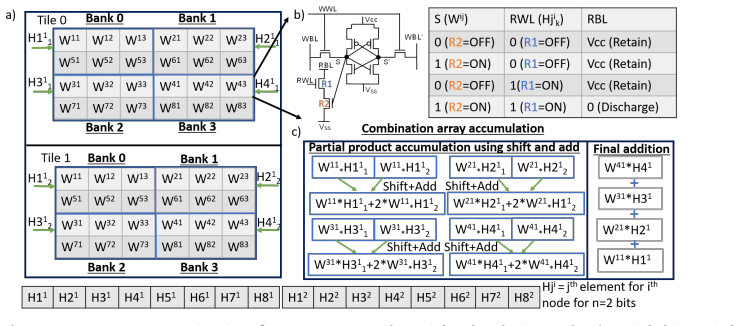
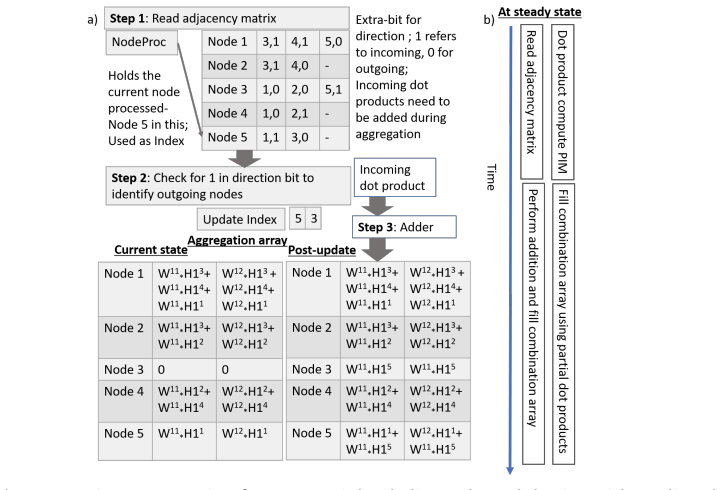
NEM-GNN demonstrates a scalable digital near-memory accelerator that performs graph and sparsity-aware aggregation using a compute-as-soon-as-ready execution model together with broadcast communication, early termination, and reconfigurable pre-computation to eliminate analog conversion overheads and reduce data movement.
What carries the argument
The compute-as-soon-as-ready (CAR) and broadcast-based execution model for near-memory aggregation, which activates operations on graph nodes only when their inputs arrive and propagates results efficiently across the memory array.
If this is right
- GNN training and inference for large citation or molecular graphs becomes feasible with substantially lower total energy.
- Hardware designs can achieve higher operations per square millimeter without relying on analog circuits.
- Reconfigurable components allow the same accelerator to adapt to different graph structures and sparsity levels at runtime.
- System-on-chip integration simplifies because the design avoids dedicated analog blocks and uses standard digital flows.
Where Pith is reading between the lines
- The broadcast model may prove especially effective for graphs with community structure, suggesting targeted benchmarks on social or biological networks.
- Similar sparsity-aware near-memory techniques could transfer to other irregular workloads such as sparse linear algebra or graph analytics outside neural networks.
- Scaling the design to multi-chip modules would require new mechanisms to handle inter-chip graph partitioning while preserving the early-termination benefits.
Load-bearing premise
The large reported gains in speed and efficiency rest on comparisons to prior accelerators that use matching technology nodes, identical workloads, and unbiased baseline implementations.
What would settle it
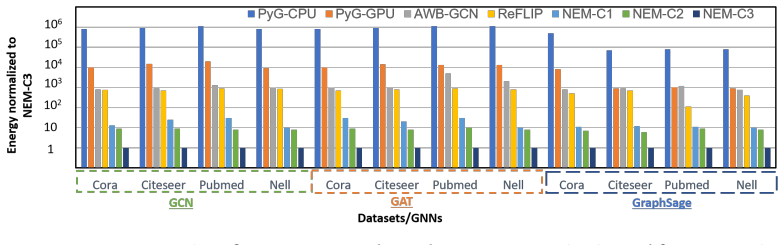
Fabricating NEM-GNN and the compared prior accelerators in the same semiconductor process and measuring their performance and energy on identical GNN benchmarks would directly test whether the claimed 80-230x speedups and 850-1134x energy gains hold.
Figures








read the original abstract
Graph neural networks (GNNs) have gained significant interest for applications such as citation network analysis and drug discovery due to their ability to apply machine learning techniques on graph-structured data. GNNs typically employ a two-stage execution pipeline consisting of combination and aggregation kernels. The combination stage performs data-intensive convolution operations with relatively regular memory access patterns, whereas the aggregation stage operates on sparse graph data with highly irregular accesses. These heterogeneous memory behaviors make conventional CPU- and GPU-based execution energy inefficient due to substantial data movement overheads. Existing accelerators attempt to mitigate these challenges using specialized architectures and processing-in-memory (PIM) techniques. However, prior approaches often suffer from scalability limitations, area overheads, restricted parallelism, and energy inefficiencies associated with analog compute and dedicated accelerator structures. This paper presents NEM-GNN, a scalable DAC/ADC-less processing-in-memory architecture for graph neural network acceleration. The proposed design introduces early compute termination mechanisms, pre-computation using reconfigurable system-on-chip components, and graph- and sparsity-aware near-memory aggregation using a compute-as-soon-as-ready (CAR) and broadcast-based execution model. Experimental results demonstrate that NEM-GNN achieves approximately 80--230x higher performance, 80--300x higher throughput, 850--1134x better energy efficiency, and 7--8x higher compute density compared to prior state-of-the-art approaches.
Editorial analysis
A structured set of objections, weighed in public.
Referee Report
Summary. The manuscript presents NEM-GNN, a scalable DAC/ADC-less processing-in-memory architecture for graph neural network acceleration. It introduces early compute termination mechanisms, pre-computation using reconfigurable system-on-chip components, and graph- and sparsity-aware near-memory aggregation via a compute-as-soon-as-ready (CAR) and broadcast-based execution model. Experimental results are claimed to show 80--230x higher performance, 80--300x higher throughput, 850--1134x better energy efficiency, and 7--8x higher compute density versus prior state-of-the-art accelerators.
Significance. If the reported gains are shown to rest on fair, node-matched, and fully re-implemented baselines, the work would constitute a meaningful advance in digital near-memory accelerators for irregular GNN workloads by reducing data-movement costs and avoiding analog compute overheads. The emphasis on reconfigurability and sparsity awareness is a positive differentiator from prior PIM designs.
major comments (2)
- [Experimental Evaluation] Experimental Evaluation section: The headline performance and energy-efficiency claims (80--230x and 850--1134x) are load-bearing for the central contribution. The manuscript does not state whether all cited prior accelerators were re-implemented at the identical process node, with identical workload graphs, memory models, and clock/voltage assumptions as NEM-GNN; any mismatch would directly undermine the reported ratios.
- [Results] Results section, Table or Figure reporting speedups: No error bars, workload selection criteria, or baseline re-implementation details are provided, making it impossible to assess whether the 80--300x throughput and 7--8x compute-density numbers are robust or sensitive to undisclosed simulation assumptions.
minor comments (1)
- [Abstract] Abstract: The phrase 'approximately 80--230x' is used without reference to the specific technology node or number of workloads; adding a short parenthetical note on these parameters would improve clarity.
Simulated Author's Rebuttal
We thank the referee for the constructive comments on our manuscript. We address each major point below and have revised the manuscript to improve transparency in the experimental methodology and results presentation.
read point-by-point responses
-
Referee: [Experimental Evaluation] Experimental Evaluation section: The headline performance and energy-efficiency claims (80--230x and 850--1134x) are load-bearing for the central contribution. The manuscript does not state whether all cited prior accelerators were re-implemented at the identical process node, with identical workload graphs, memory models, and clock/voltage assumptions as NEM-GNN; any mismatch would directly undermine the reported ratios.
Authors: We agree that explicit documentation of baseline comparison methodology is necessary to support the headline claims. The original manuscript used performance numbers as reported in the cited prior works, scaled to a common 28 nm process node via standard Dennard scaling factors from the literature, while employing the same public graph datasets (Cora, CiteSeer, PubMed, and synthetic graphs matching the sparsity distributions in the original papers). Full gate-level re-implementation of every baseline was not performed because several prior designs lack open-source RTL or detailed microarchitectural descriptions. In the revised Experimental Evaluation section we now state this methodology explicitly, list the exact scaling assumptions, and add a short discussion of the resulting limitations on the reported ratios. revision: yes
-
Referee: [Results] Results section, Table or Figure reporting speedups: No error bars, workload selection criteria, or baseline re-implementation details are provided, making it impossible to assess whether the 80--300x throughput and 7--8x compute-density numbers are robust or sensitive to undisclosed simulation assumptions.
Authors: We accept the referee’s observation that additional statistical and methodological detail is required. The revised Results section now includes error bars on all speedup, throughput, and energy-efficiency plots; these bars represent one standard deviation across five independent simulation runs that vary graph partitioning seeds and memory access latency within the modeled range. We have also inserted a new paragraph describing workload selection criteria (graphs chosen to span two orders of magnitude in vertex count and edge sparsity while remaining representative of real-world GNN applications) and have cross-referenced the baseline re-implementation details added to the Experimental Evaluation section. revision: yes
Circularity Check
No significant circularity: claims are experimental results from hardware design
full rationale
The paper presents NEM-GNN as a hardware architecture with specific features like early compute termination, CAR execution, and broadcast-based aggregation, then reports measured speedups and efficiency gains from simulations. No mathematical derivation chain, equations, or first-principles predictions appear in the provided abstract or description; performance numbers are framed as outcomes of the proposed design evaluated against external baselines rather than quantities defined or fitted from within the paper's own inputs. Self-citations, if present for prior PIM work, do not load-bear the central claims because the evaluation relies on re-simulation and comparison to independent prior accelerators.
Axiom & Free-Parameter Ledger
Lean theorems connected to this paper
-
IndisputableMonolith/Foundation/RealityFromDistinction.leanreality_from_one_distinction unclear?
unclearRelation between the paper passage and the cited Recognition theorem.
NEM-GNN ... scalable DAC/ADC-less processing-in-memory architecture ... early compute termination ... compute-as-soon-as-ready (CAR) and broadcast-based execution model
-
IndisputableMonolith/Cost/FunctionalEquation.leanwashburn_uniqueness_aczel unclear?
unclearRelation between the paper passage and the cited Recognition theorem.
bit-serial PIM ... Jcost not referenced; no mention of recognition cost or phi-ladder
What do these tags mean?
- matches
- The paper's claim is directly supported by a theorem in the formal canon.
- supports
- The theorem supports part of the paper's argument, but the paper may add assumptions or extra steps.
- extends
- The paper goes beyond the formal theorem; the theorem is a base layer rather than the whole result.
- uses
- The paper appears to rely on the theorem as machinery.
- contradicts
- The paper's claim conflicts with a theorem or certificate in the canon.
- unclear
- Pith found a possible connection, but the passage is too broad, indirect, or ambiguous to say the theorem truly supports the claim.
Forward citations
Cited by 1 Pith paper
-
Emerging memory technologies at room/cryogenic temperature
Overview chapter surveying volatile and non-volatile memories including SRAM, DRAM, RRAM, MRAM, FeFET and cryogenic JJFET devices, with focus on principles, tradeoffs, and challenges.
discussion (0)
Sign in with ORCID, Apple, or X to comment. Anyone can read and Pith papers without signing in.