Beyond Rational Illusion: Behaviorally Realistic Strategic Classification
Pith reviewed 2026-06-30 18:25 UTC · model grok-4.3
The pith
Strategic classification must model agents' feature manipulations with prospect theory biases rather than assuming full rationality.
A machine-rendered reading of the paper's core claim, the machinery that carries it, and where it could break.
Core claim
By incorporating asymmetry between benefits and costs, different subjective reference points, and non-rational probability distortion into the Stackelberg-style interaction, the Prospect-Guided Strategic Framework (Pro-SF) enables modeling and learning under behaviorally realistic strategic responses, overcoming the idealized rationality assumption in prior strategic classification work.
What carries the argument
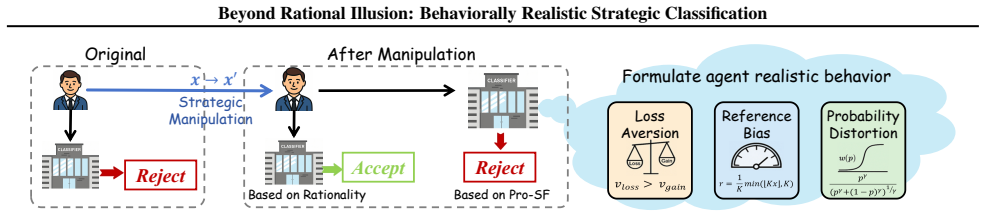
Prospect-Guided Strategic Framework (Pro-SF) that reformulates agent-decision maker interactions by adding three prospect theory mechanisms to capture deviations from rationality.
If this is right
- Models trained with Pro-SF will better predict agent responses in biased scenarios.
- Improved accuracy in applications involving human strategic behavior.
- Facilitates integration of behavioral economics insights into ML systems.
- Experiments validate effectiveness on both synthetic and real-world data.
Where Pith is reading between the lines
- The framework could be extended to other game-theoretic ML problems with human agents.
- Validation requires direct comparison with observed human manipulation data.
- May influence design of transparent decision systems to reduce biased manipulations.
Load-bearing premise
The three mechanisms from prospect theory accurately represent how real people deviate from rational strategic manipulations.
What would settle it
Observing actual agents' feature manipulation choices in a controlled setting and checking whether their decisions align more closely with Pro-SF predictions than with rational models.
Figures

read the original abstract
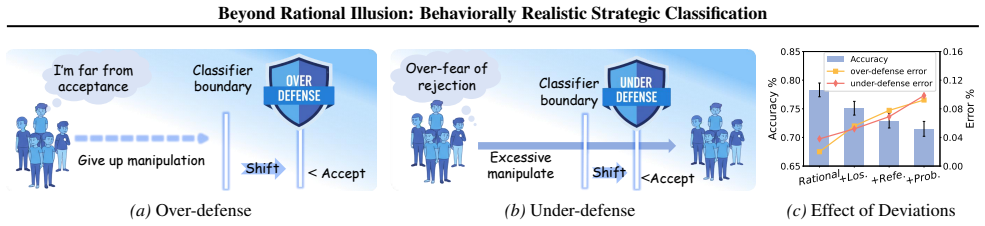
Strategic classification(SC) studies the interaction between decision models and agents who strategically manipulate their features for favorable outcomes. Existing SC frameworks typically rely on the idealized assumption that agents are strictly rational. However, evidence from behavioral economics and psychology consistently shows that real-world decision-making is often shaped by cognitive biases, deviating from pure rationality. To formalize this limitation, we identify and define a new problem setting, termed the behaviorally realistic strategic classification problem, where agents' strategic manipulations deviate from full rationality due to psychological biases. Motivated by the identified limitation, we propose the Prospect-Guided Strategic Framework (Pro-SF) to address the problem, a principled framework grounded in prospect theory to model and learn under behaviorally realistic strategic responses. Specifically, to capture behaviorally realistic strategic manipulations, our framework reformulates the Stackelberg-style interaction between agents and the decision-maker by incorporating three key mechanisms inspired by prospect theory, including the asymmetry between benefits and costs, different subjective reference points, and non-rational probability distortion. Experiments on synthetic and real-world datasets establish Pro-SF as a behaviorally grounded approach to strategic classification, bridging machine learning and behavioral economics for more reliable deployment in the real world.
Editorial analysis
A structured set of objections, weighed in public.
Referee Report
Summary. The manuscript defines a new 'behaviorally realistic strategic classification' problem in which agents deviate from rationality due to cognitive biases. It proposes the Prospect-Guided Strategic Framework (Pro-SF) that augments the standard Stackelberg interaction with three prospect-theory mechanisms (asymmetry between benefits and costs, subjective reference points, and non-rational probability distortion) and reports that experiments on synthetic and real-world datasets establish the framework as behaviorally grounded.
Significance. A sound formalization of prospect-theoretic strategic responses would usefully connect behavioral economics and strategic classification. The explicit identification of the three mechanisms and the new problem setting are constructive contributions; however, the manuscript provides no independent human-subject data on feature manipulation, so the behavioral-realism claim rests on modeling assumptions rather than external validation.
major comments (1)
- [Experiments] Experiments section (and the abstract claim that 'experiments ... establish Pro-SF as a behaviorally grounded approach'): the reported synthetic and real-world datasets contain no independent human-subject observations of strategic feature manipulation under cognitive bias. Without such data the three prospect-theory mechanisms remain modeling choices rather than empirically supported descriptions of real agents, which is load-bearing for the central claim.
minor comments (1)
- [Model] Notation for the three prospect-theory parameters (reference point, loss-aversion coefficient, probability-weighting function) should be introduced with explicit equations in the model section rather than only in prose.
Simulated Author's Rebuttal
We thank the referee for highlighting the distinction between modeling assumptions drawn from behavioral economics and direct empirical validation via human-subject experiments. We agree this distinction is important for the central claim and will revise the manuscript accordingly.
read point-by-point responses
-
Referee: [Experiments] Experiments section (and the abstract claim that 'experiments ... establish Pro-SF as a behaviorally grounded approach'): the reported synthetic and real-world datasets contain no independent human-subject observations of strategic feature manipulation under cognitive bias. Without such data the three prospect-theory mechanisms remain modeling choices rather than empirically supported descriptions of real agents, which is load-bearing for the central claim.
Authors: We agree that the synthetic and real-world datasets used in the experiments do not constitute new human-subject observations of strategic feature manipulation under cognitive bias. The behavioral grounding of Pro-SF derives from incorporating three mechanisms (asymmetry between benefits and costs, subjective reference points, and probability distortion) that are directly taken from prospect theory, whose empirical support is established in the behavioral economics literature. The experiments demonstrate the consequences of these mechanisms for classification performance and robustness, rather than providing independent validation of the mechanisms themselves. To address the concern, we will revise the abstract, introduction, and experiments section to replace the phrasing 'establish Pro-SF as a behaviorally grounded approach' with more precise language such as 'provide a prospect-theory-based framework for behaviorally realistic strategic classification' and 'illustrate the impact of prospect-theoretic mechanisms on strategic classification outcomes.' This change will make the scope of the behavioral claim explicit without overstating the role of the reported experiments. revision: yes
Circularity Check
No significant circularity; framework proposal is self-contained
full rationale
The paper proposes Pro-SF as a new modeling framework that incorporates three prospect-theory mechanisms into a Stackelberg interaction. No equations or claims in the provided text reduce a derived result to a fitted parameter, self-citation, or definitional renaming. The central construction is presented as an extension motivated by external behavioral economics literature, with experiments described on synthetic and real-world datasets. This is a standard modeling contribution whose validity rests on external assumptions rather than internal self-reference, warranting a score of 0.
Axiom & Free-Parameter Ledger
Forward citations
Cited by 2 Pith papers
-
Beyond Independent Manipulation: Individual Fairness-aware Strategic Classification with Peer Imitation
Introduces IFSC framework modeling peer imitation in individual fairness-aware strategic classification to improve fairness consistency under interdependent manipulations.
-
Partial Fairness Awareness: Belief-Guided Strategic Mechanism for Strategic Agents
Introduces partial fairness awareness (PFA) and a belief-guided mechanism allowing strategic agents to align beliefs with a hidden grounding fairness constraint via iterative interaction.
Reference graph
Works this paper leans on
-
[1]
Dong, J., Roth, A., Schutzman, Z., Waggoner, B., and Wu, Z
URL https://openreview.net/forum? id=W98AEKQ38Y. Dong, J., Roth, A., Schutzman, Z., Waggoner, B., and Wu, Z. S. Strategic classification from revealed preferences. In Proceedings of the 2018 ACM Conference on Economics and Computation, pp. 55–70, 2018. Dwyer, A. A., Uveges, M. K., Dockray, S., and Smith, N. Exploring rare disease patient attitudes and bel...
-
[2]
cc/paper_files/paper/2021/file/ f1404c2624fa7f2507ba04fd9dfc5fb1-Paper
URL https://proceedings.neurips. cc/paper_files/paper/2021/file/ f1404c2624fa7f2507ba04fd9dfc5fb1-Paper. pdf. Harris, K., Ngo, D. D. T., Stapleton, L., Heidari, H., and Wu, S. Strategic instrumental variable regression: Recovering causal relationships from strategic responses. InInterna- tional Conference on Machine Learning, pp. 8502–8522. PMLR, 2022. Ho...
-
[3]
DOI: https://doi.org/10.24432/C53G6X. 10 Beyond Rational Illusion: Behaviorally Realistic Strategic Classification Horowitz, G. and Rosenfeld, N. Causal strategic classifica- tion: A tale of two shifts. InInternational Conference on Machine Learning, pp. 13233–13253. PMLR, 2023. Hossain, S., Micha, E., Chen, Y ., and Procaccia, A. Strate- gic classificati...
-
[4]
Levanon, S
URL https://www.sciencedirect.com/ science/article/pii/S0377221721002812. Levanon, S. and Rosenfeld, N. Strategic classification made practical. InInternational Conference on Machine Learn- ing, pp. 6243–6253. PMLR, 2021. Li, T. and Sethi, S. P. A review of dynamic stackelberg game models.Discrete & Continuous Dynamical Systems- Series B, 22(1), 2017. Liu...
2021
-
[5]
Association for Computing Machinery. ISBN 9781450363242. doi: 10.1145/3287560.3287576. Mofakhami, M., Mitliagkas, I., and Gidel, G. Performa- tive prediction with neural networks. InInternational Conference on Artificial Intelligence and Statistics, pp. 11079–11093. PMLR, 2023. Mullainathan, S. and Thaler, R. H. Behavioral economics. Working Paper w7948, ...
-
[6]
extra disagreement region
URL https://proceedings.mlr.press/ v162/zhang22l.html. Zrnic, T., Mazumdar, E., Sastry, S., and Jordan, M. Who leads and who follows in strategic classification?Ad- vances in Neural Information Processing Systems, 34: 15257–15269, 2021. 13 Beyond Rational Illusion: Behaviorally Realistic Strategic Classification Appendix Contents •Additional Related Work ...
2021
discussion (0)
Sign in with ORCID, Apple, or X to comment. Anyone can read and Pith papers without signing in.