Matrix structure and convergence behaviour of the matched eigenfunction method for computing heave wave forces on generalized concentric bodies
Pith reviewed 2026-06-30 17:48 UTC · model grok-4.3
The pith
The matched eigenfunction expansion method computes hydrodynamic coefficients for generalized concentric bodies much faster than boundary element methods.
A machine-rendered reading of the paper's core claim, the machinery that carries it, and where it could break.
Core claim
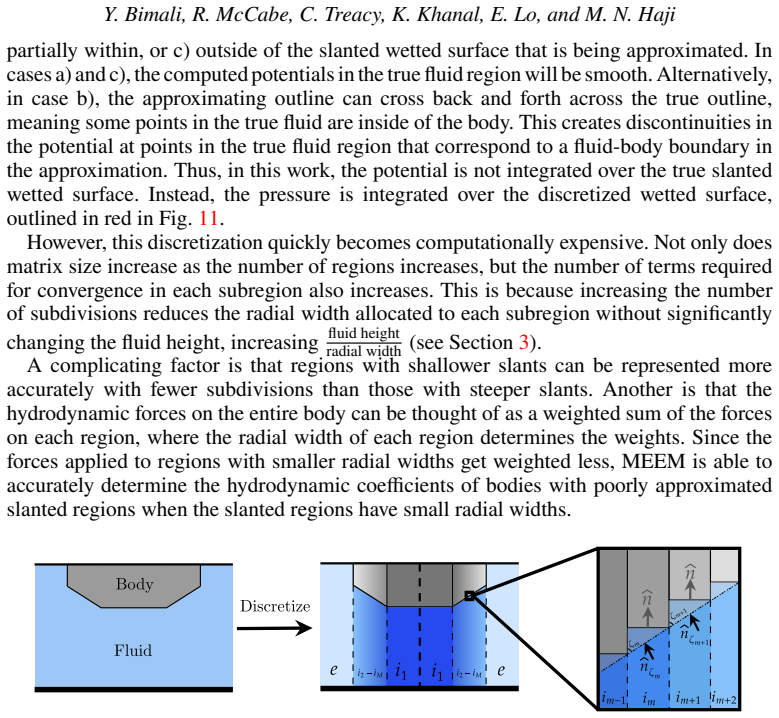
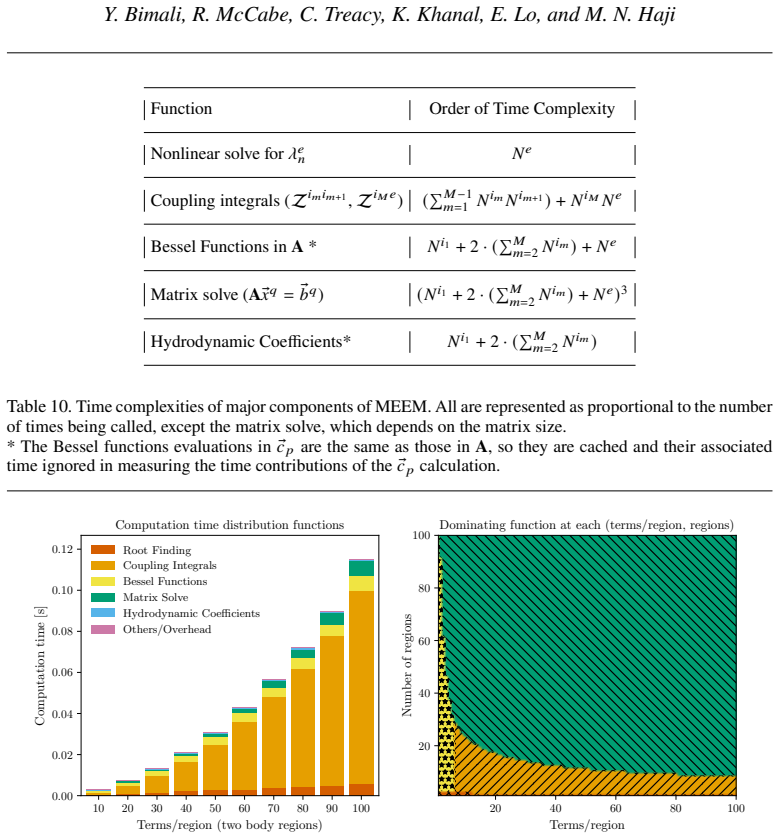
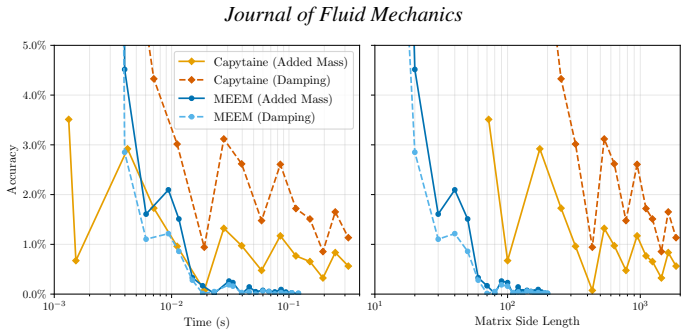
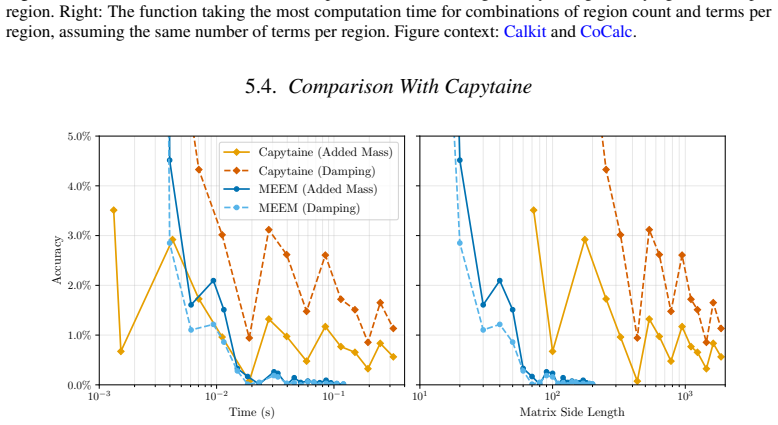
MEEM can compute hydrodynamic coefficients of slanted geometries within 5% of Capytaine even for angles as steep as 15 degrees from vertical, and can achieve 2% convergence an order of magnitude faster with a matrix size two orders of magnitude smaller.
What carries the argument
The block matrix structure arising from matching eigenfunction expansions in annular regions for arbitrary numbers of concentric bodies.
If this is right
- MEEM provides a computationally effective alternative to BEM for hydrodynamic analysis of a broad range of shapes.
- The framework supports modeling of slanted geometries with good accuracy.
- Increased speed allows for future optimization studies to yield improved offshore designs.
- Convergence behavior is documented for cylindrical and slanted cases.
Where Pith is reading between the lines
- MEEM might support iterative design loops where many geometries need evaluation quickly.
- Extensions could include other degrees of freedom beyond heave if the profile conditions are met.
- The semi-analytical nature may offer insights into parameter sensitivities not easily obtained from BEM.
Load-bearing premise
Body profiles are continuous and radially monotonic to allow exact matching of eigenfunction expansions at region interfaces.
What would settle it
A test case with a non-monotonic or discontinuous body profile where MEEM matching fails to produce consistent results compared to BEM.
Figures


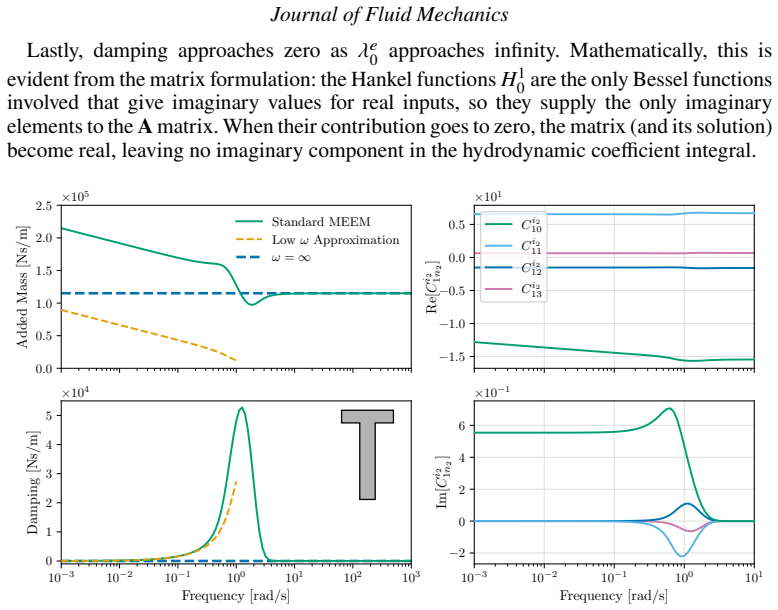
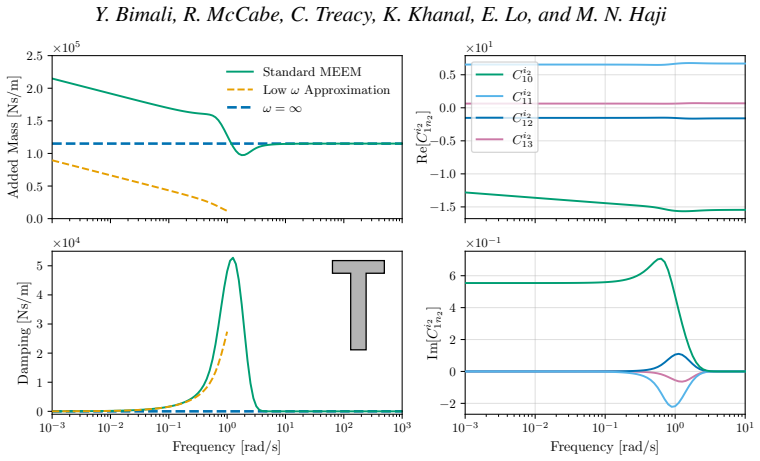

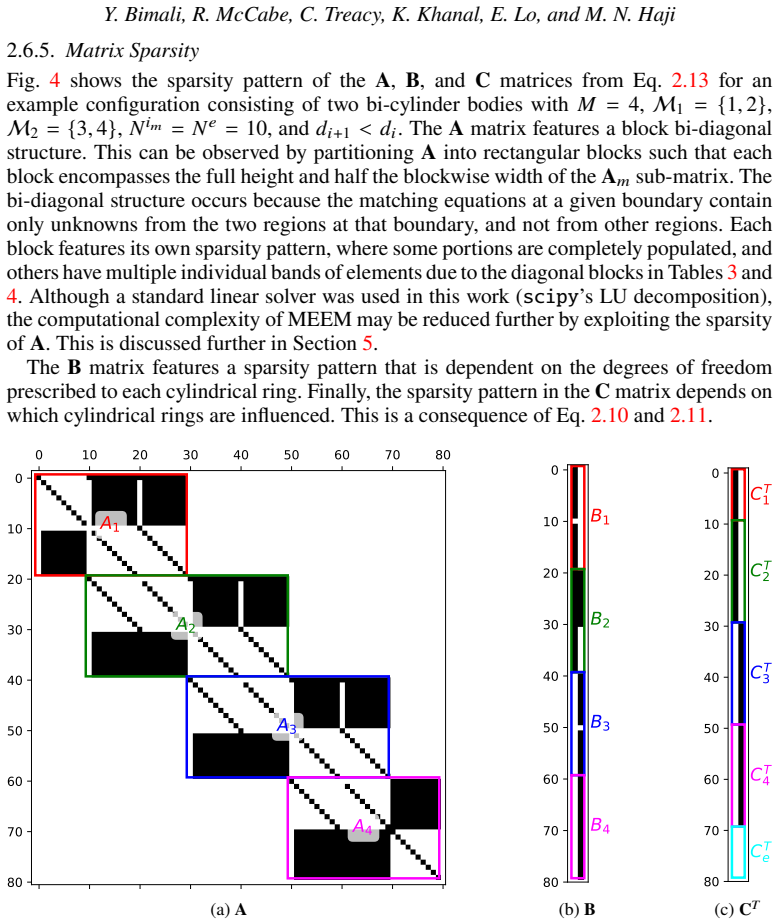


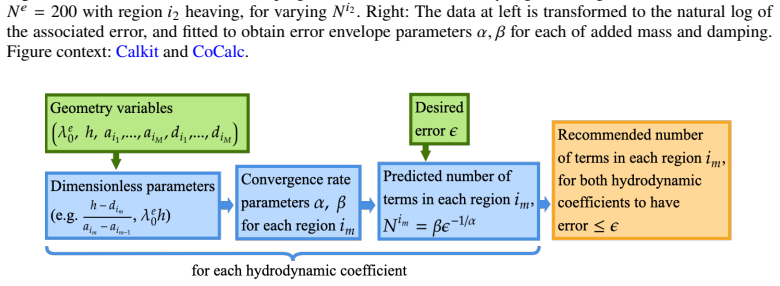






read the original abstract
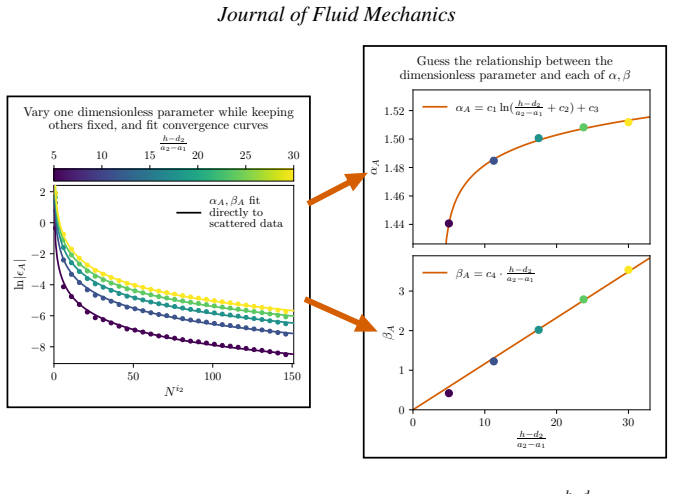
Structural survival of offshore structures is crucial for the growing marine economy. Calculating the added mass, radiation damping, and excitation coefficients to quantify wave loads with the traditional boundary element method (BEM) presents a computational bottleneck. The matched eigenfunction expansion method (MEEM), a long-known but rarely-used alternative, offers computational benefits due to its semi-analytical nature. However, previous work fails to directly compare its accuracy and computational performance with BEM, leaving the extent of its utility unknown. Furthermore, the geometry-dependent convergence for cylindrical and slanted geometries has not yet been documented, making the method's practicality for general geometries unclear. This paper presents a unifying MEEM framework for modeling an arbitrary number of fixed or heaving surface-piercing annular cylinders with continuous and radially-monotonic body profiles, and explores the method's block matrix structure, convergence behavior, ability to accurately approximate slanted geometries, and computational advantages over the BEM solver Capytaine. The numerical experiments show that MEEM can compute hydrodynamic coefficients of slanted geometries within 5% of Capytaine, even for angles as steep as 15 degrees from vertical. Finally, MEEM can achieve 2% convergence of its hydrodynamic coefficients an order of magnitude faster than Capytaine with a matrix size two orders of magnitude smaller, making it a computationally effective alternative to traditional BEM solvers. These contributions enable hydrodynamic analysis of a broad range of shapes with increased speed and confidence, paving the way for future optimization studies to yield improved designs.
Editorial analysis
A structured set of objections, weighed in public.
Referee Report
Summary. The paper introduces a unifying matched eigenfunction expansion method (MEEM) framework for computing heave wave forces on an arbitrary number of fixed or heaving surface-piercing annular cylinders with continuous and radially-monotonic body profiles. It analyzes the block matrix structure and convergence behavior, demonstrates approximation of slanted geometries, and reports computational advantages over the BEM solver Capytaine, including 2% convergence of hydrodynamic coefficients an order of magnitude faster with a matrix two orders of magnitude smaller, and agreement within 5% of Capytaine for slants up to 15 degrees from vertical.
Significance. If the central claims hold, the work supplies a semi-analytical alternative that could reduce computational cost for hydrodynamic coefficient calculations on generalized concentric bodies, supporting optimization studies for offshore structures. Direct benchmarking against an independent solver (Capytaine) and explicit documentation of convergence for cylindrical and slanted cases add value.
major comments (2)
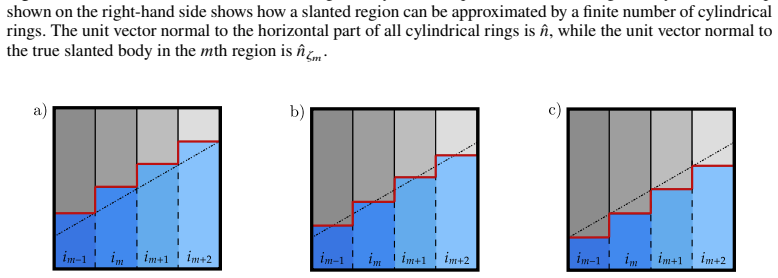
- [Numerical experiments on slanted geometries] The 5% agreement for slanted geometries up to 15° from vertical depends on discretizing the slant into monotonic segments to enable eigenfunction matching at vertical interfaces. The manuscript must quantify sensitivity of this error bound to segment count and radial spacing, as the continuous radially-monotonic assumption may be violated by the discretization step.
- [Convergence behavior and comparisons to Capytaine] The performance claims (order-of-magnitude faster convergence at 2% with matrix size two orders smaller) require explicit reporting of error bars, exact matrix dimensions used in each comparison, and the precise metric for convergence across all tested cases to be load-bearing.
minor comments (2)
- Clarify the precise definition of 'radially-monotonic' and how it is enforced for the generalized profiles in the framework setup.
- Add labels to figures showing matrix sizes and convergence metrics to improve reproducibility of the timing and accuracy results.
Simulated Author's Rebuttal
We thank the referee for their constructive feedback and recommendation for major revision. We agree that additional quantification is needed for the slanted geometry approximations and more explicit documentation for the convergence comparisons. The revised manuscript will incorporate these elements to strengthen the claims.
read point-by-point responses
-
Referee: [Numerical experiments on slanted geometries] The 5% agreement for slanted geometries up to 15° from vertical depends on discretizing the slant into monotonic segments to enable eigenfunction matching at vertical interfaces. The manuscript must quantify sensitivity of this error bound to segment count and radial spacing, as the continuous radially-monotonic assumption may be violated by the discretization step.
Authors: We agree that the discretization step requires explicit sensitivity analysis to confirm the robustness of the 5% agreement. In the revised manuscript, we will add numerical results (new table or figure) demonstrating how the hydrodynamic coefficient error varies with segment count (e.g., 5, 10, 20 segments) and radial spacing for the 15° case. These will show that the error bound holds for discretizations that maintain radial monotonicity at the interfaces. revision: yes
-
Referee: [Convergence behavior and comparisons to Capytaine] The performance claims (order-of-magnitude faster convergence at 2% with matrix size two orders smaller) require explicit reporting of error bars, exact matrix dimensions used in each comparison, and the precise metric for convergence across all tested cases to be load-bearing.
Authors: We acknowledge the need for greater precision in reporting the performance metrics. The revised manuscript will include: exact matrix dimensions (e.g., MEEM truncation parameter N and resulting matrix size versus Capytaine panel count), the precise convergence metric (relative change in coefficients below 2%), and error bars from truncation sensitivity. Updated tables and text will present these for all cylindrical and slanted cases. revision: yes
Circularity Check
No circularity: MEEM derivations and validations rely on external benchmarks
full rationale
The paper develops a unifying MEEM framework for annular cylinders with continuous radially-monotonic profiles, using standard eigenfunction matching at vertical interfaces. All performance claims (convergence rates, 5% agreement on slanted geometries, matrix-size advantages) are established via direct numerical comparison to the independent external solver Capytaine. No equations reduce a claimed prediction to a fitted parameter defined inside the paper, no self-citation supplies a load-bearing uniqueness theorem, and the method is not presented as a renaming of a known empirical pattern. The derivation chain is therefore self-contained against external benchmarks.
Axiom & Free-Parameter Ledger
axioms (1)
- domain assumption Eigenfunctions in each annular region are orthogonal and can be matched at radial interfaces for continuous radially-monotonic profiles.
Forward citations
Cited by 1 Pith paper
-
Development, Validation, and Benchmarking of a Multidisciplinary Semi-Analytical Model for Wave Energy Converters
MDOcean is a multidisciplinary semi-analytical model for wave energy converters that runs in 151 ms with near-numerical accuracy for techno-economic analysis.
Reference graph
Works this paper leans on
-
[1]
International Marine Energy Journal 8 (1), 29--35
Beringer, Courtney , Bosma, Bret & Robertson, Bryson 2025 Degrees of freedom effects on a laboratory scale wec point absorber . International Marine Energy Journal 8 (1), 29--35
2025
-
[2]
In review
Best, Hope , Khanal, Kapil , McCabe, Rebecca , Jiang, Ruiyang , Treacy, Collin & Haji, Maha 2026 a\/ OpenFLASH : An open-source flexible library for analytical and semi-analytical hydrodynamics calculations. In review. https://joss.theoj.org/papers/842d9827ef856fd88af7128f707f265b
2026
-
[3]
https://doi.org/10.5281/zenodo.17453418
Best, Hope , McCabe, Rebecca , Khanal, Kapil , Bimali, Yinghui , Lo, En , Jiang, Ruiyang , Fernandez, John & Treacy, Collin 2026 b\/ OpenFLASH . https://doi.org/10.5281/zenodo.17453418
-
[4]
2018 Analytical Methods in Marine Hydrodynamics \/
Chatjigeorgiou, Ioannis K. 2018 Analytical Methods in Marine Hydrodynamics \/ . Cambridge: Cambridge University Press
2018
-
[5]
Cambridge University Press
Chatzigeorgiou, Ioannis 2018 Analytical methods in marine hydrodynamics\/ . Cambridge University Press
2018
-
[6]
In International Conference on Offshore Mechanics and Arctic Engineering\/ , OMAE\/ , pp
Chau, Fun Pang & Yeung, Ronald W 2012 Inertia, damping, and wave excitation of heaving coaxial cylinders. In International Conference on Offshore Mechanics and Arctic Engineering\/ , OMAE\/ , pp. 803--813 . American Society of Mechanical Engineers
2012
-
[7]
Sustainability 8 (11), 1109
De Andres, Adrian , Maillet, J \'e romine , Hals Todalshaug, J rgen , M \"o ller, Patrik , Bould, David & Jeffrey, Henry 2016 Techno-economic related metrics for a wave energy converters feasibility assessment . Sustainability 8 (11), 1109
2016
-
[8]
IET Renewable Power Generation 15 (14), 3395--3408
Faedo, Nicol \'a s , Scarciotti, Giordano , Astolfi, Alessandro & Ringwood, John V 2021 Energy-maximising moment-based constrained optimal control of ocean wave energy farms . IET Renewable Power Generation 15 (14), 3395--3408
2021
-
[9]
Fuchs, R. A. & MacCamy, R. C. 1954 Wave forces on piles: a diffraction theory . Technical Memorandum 69. United States Department of the Army Corps of Engineers
1954
-
[10]
Proceedings of the Royal Society of London
Havelock, Thomas Henry 1936 The forces on a circular cylinder submerged in a uniform stream . Proceedings of the Royal Society of London. A. Mathematical and Physical Sciences 157 (892), 526--534
1936
-
[11]
In Building bridges: connections and challenges in modern approaches to numerical PDEs \/ , Lecture Notes in Computational Science and Engineering , vol
Hiptmair, Ralf , Moiola, Andrea & Perugia, Ilaria 2016 A survey of Trefftz methods for the Helmholtz equation . In Building bridges: connections and challenges in modern approaches to numerical PDEs \/ , Lecture Notes in Computational Science and Engineering , vol. 1 . Springer
2016
-
[12]
Michelén , Ancellin, Matthieu & Haji, Maha N
Khanal, Kapil , Ströfer, Carlos A. Michelén , Ancellin, Matthieu & Haji, Maha N. 2025 Fully differentiable boundary element solver for hydrodynamic sensitivity analysis of wave-structure interactions . Applied Ocean Research 163 , 104707
2025
-
[13]
Advances in Engineering Software 24 (1), 3--12
Kita, Eisuke & Kamiya, Norio 1995 Trefftz method: an overview . Advances in Engineering Software 24 (1), 3--12
1995
-
[14]
Ocean Engineering 13 (6), 505--538
Kokkinowrachos, Konstantin , Mavrakos, Spyridon & Asorakos, Sampson 1986 Behaviour of vertical bodies of revolution in waves . Ocean Engineering 13 (6), 505--538
1986
-
[15]
Ocean engineering 24 (4), 381--399
Mavrakos, SA 1997 Hydrodynamic characteristics of floating toroidal bodies . Ocean engineering 24 (4), 381--399
1997
-
[16]
2004 Hydrodynamic coefficients in heave of two concentric surface-piercing truncated circular cylinders
Mavrakos, Spyros A. 2004 Hydrodynamic coefficients in heave of two concentric surface-piercing truncated circular cylinders . Applied Ocean Research 26 (3), 84--97
2004
-
[17]
Mavrakos, Spyros A. & Konispoliatis, Dimitrios N. 2012 Hydrodynamic Analysis of a Vertical Axisymmetric Oscillating Water Column Device Floating in Finite Depth Waters . In ASME 2012 31st International Conference on Ocean , Offshore and Arctic Engineering \/ , OMAE , vol. 7: Ocean Space Utilization; Ocean Renewable Energy , pp. 577--586 . Rio de Janeiro, ...
-
[18]
McCabe, Rebecca , Dietrich, Madison & Haji, Maha 2026 Development, Validation , and Benchmarking of a Multidisciplinary Semi - Analytical Model for Wave Energy Converters . In prep. https://calkit.io/symbiotic-engineering/mdocean/publications?path=pubs
2026
-
[19]
In UMERC ( University Marine Energy Research Consortium ) Conference 2024\/ , p
McCabe, Rebecca , Khanal, Kapil & Haji, Maha 2024 Open-source toolbox for semi-analytical hydrodynamic coefficients via the matched eigenfunction expansion method. In UMERC ( University Marine Energy Research Consortium ) Conference 2024\/ , p. 6 . Duluth, MN: Zenodo . https://zenodo.org/records/14504017
-
[20]
World Scientific
Mei, Chiang C , Stiassnie, Michael Aharon & Yue, Dick K-P 2005 Theory and applications of ocean surface waves: Part 1: linear aspects\/ . World Scientific
2005
-
[21]
Proceedings of the Royal Society A: Mathematical, Physical and Engineering Sciences 472 (2192), 20160174
Michele, Simone , Sammarco, Paolo & d’Errico, Michele 2016 Theory of the synchronous motion of an array of floating flap gates oscillating wave surge converter . Proceedings of the Royal Society A: Mathematical, Physical and Engineering Sciences 472 (2192), 20160174
2016
-
[22]
Neary, Vincent S , Previsic, Mirko , Jepsen, Richard A , Lawson, Michael J , Yu, Yi-Hsiang , Copping, Andrea E , Fontaine, Arnold A , Hallett, Kathleen C & Murray, Dianne K 2014 Methodology for Design and Economic Analysis of Marine Energy Conversion ( MEC ) Technologies . Tech. Rep.\/ SAND2014-9040. Sandia National Laboratories , Albuquerque, New Mexico
2014
-
[23]
The MIT press
Newman, John Nicholas 2018 Marine hydrodynamics\/ . The MIT press
2018
-
[24]
Nguyen, Nhu 2024 Theoretical Modeling Toolbox for Diffraction Problems of Common Shaped Bodies . In ASME 2024 43rd International Conference on Ocean , Offshore and Arctic Engineering \/ , OMAE , vol. 7: ocean renewable energy . Singapore, Singapore: ASME . https://dx.doi.org/10.1115/OMAE2024-128018
-
[25]
Applied Ocean Research 149 , 104031
Nguyen, Nhu , Davis, Jacob , Tom, Nathan & Thiagarajan, Krish 2024 Theoretical modeling of a bottom-raised oscillating surge wave energy converter structural loadings and power performances . Applied Ocean Research 149 , 104031
2024
-
[26]
IEEE Journal of Oceanic Engineering 40 (3), 522--535 , conference Name: IEEE Journal of Oceanic Engineering
Olaya, Sébastien , Bourgeot, Jean-Matthieu & Benbouzid, Mohamed El Hachemi 2015 Hydrodynamic Coefficient Computation for a Partially Submerged Wave Energy Converter . IEEE Journal of Oceanic Engineering 40 (3), 522--535 , conference Name: IEEE Journal of Oceanic Engineering
2015
-
[27]
2022 A novel two-objective optimization computational framework for a two-body heaving wave energy converter
Pavlidou, Lamprini & Angelides, Demos C. 2022 A novel two-objective optimization computational framework for a two-body heaving wave energy converter . Renewable Energy 191 , 510--534
2022
-
[28]
Springer Science & Business Media , google-Books-ID: 31m4ahn\_KfkC
Quarteroni, Alfio , Sacco, Riccardo & Saleri, Fausto 2006 Numerical Mathematics \/ . Springer Science & Business Media , google-Books-ID: 31m4ahn\_KfkC
2006
-
[29]
& Dias, F
Renzi, E. & Dias, F. 2013 Hydrodynamics of the oscillating wave surge converter in the open ocean . European Journal of Mechanics - B/Fluids 41 , 1--10
2013
-
[30]
Seah, Robert K. M. & Yeung, Ronald W. 2006 Symmetric Resonant Modes Between Twin Bodies . In 21st International Workshop on Water Waves and Floating Bodies \/ , p. 4 . http://iwwwfb.org/Abstracts/iwwwfb21/iwwwfb21_44.pdf
2006
-
[31]
IEEE Transactions on Sustainable Energy 14 (4), 2157--2167
Str \"o fer, Carlos A Michel \'e n , Gaebele, Daniel T , Coe, Ryan G & Bacelli, Giorgio 2023 Control co-design of power take-off systems for wave energy converters using wecopttool . IEEE Transactions on Sustainable Energy 14 (4), 2157--2167
2023
-
[32]
Weaver, Wayne W , Wilson, David G , Hagmuller, Alex , Ginsburg, Max , Bacelli, Giorgio , Robinett, Rush D , Coe, Ryan & others 2020 Super capacitor energy storage system design for wave energy converter demonstration. In 2020 International Symposium on Power Electronics, Electrical Drives, Automation and Motion (SPEEDAM)\/ , pp. 564--570 . IEEE. https://i...
-
[33]
1981 Added mass and damping of a vertical cylinder in finite-depth waters
Yeung, Ronald W. 1981 Added mass and damping of a vertical cylinder in finite-depth waters . Applied Ocean Research 3 (3), 119--133
1981
-
[34]
China Ocean Engineering 30 (6), 954--966
Zhang, Wan-chao , Liu, Heng-xu , Zhang, Liang & Zhang, Xue-wei 2016 Hydrodynamic analysis and shape optimization for vertical axisymmetric wave energy converters . China Ocean Engineering 30 (6), 954--966
2016
-
[35]
2024 Performance assessment of a Triple Coaxial - Cylinder Wave - Energy Converter ( TCWEC )
Zhang, Xinshu , Guo, Xinhai , Zhi, Pengfei & Yeung, Ronald W. 2024 Performance assessment of a Triple Coaxial - Cylinder Wave - Energy Converter ( TCWEC ) . Renewable Energy 237 , 121547
2024
-
[36]
, " * write output.state after.block = add.period write newline
ENTRY address author booktitle chapter edition editor howpublished institution journal key month note number organization pages publisher school series title type volume year doi eprint url label extra.label sort.label short.list INTEGERS output.state before.all mid.sentence after.sentence after.block FUNCTION init.state.consts #0 'before.all := #1 'mid.s...
-
[37]
write newline
" write newline "" before.all 'output.state := FUNCTION n.dashify 't := "" t empty not t #1 #1 substring "-" = t #1 #2 substring "--" = not "--" * t #2 global.max substring 't := t #1 #1 substring "-" = "-" * t #2 global.max substring 't := while if t #1 #1 substring * t #2 global.max substring 't := if while FUNCTION word.in bbl.in capitalize " " * FUNCT...
discussion (0)
Sign in with ORCID, Apple, or X to comment. Anyone can read and Pith papers without signing in.