Multicritical points of gravitational solitons and a black hole in four dimensions
Pith reviewed 2026-06-30 12:39 UTC · model grok-4.3
The pith
A polynomial structural function in Plebański nonlinear electrodynamics produces multicritical points where multiple magnetically charged solitons coexist with one electrically charged black hole.
A machine-rendered reading of the paper's core claim, the machinery that carries it, and where it could break.
Core claim
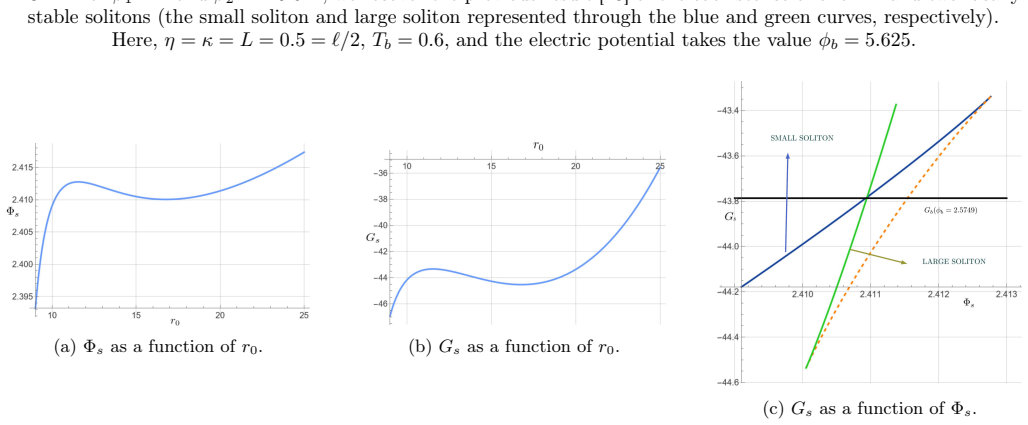
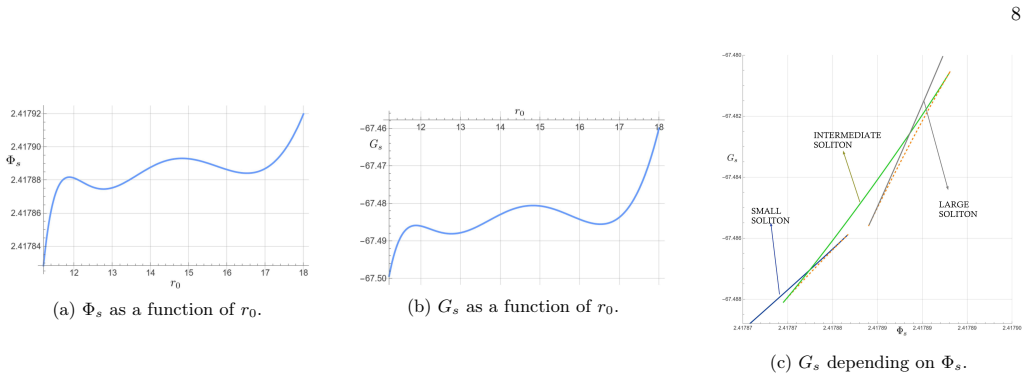
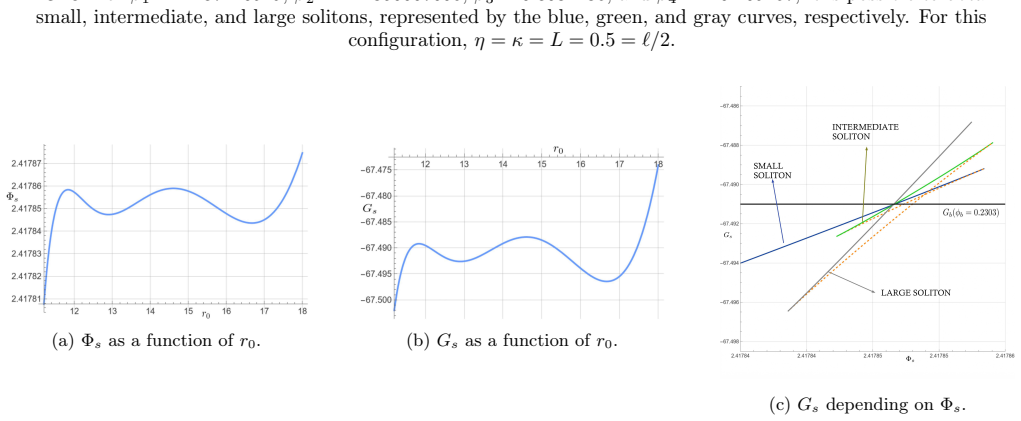
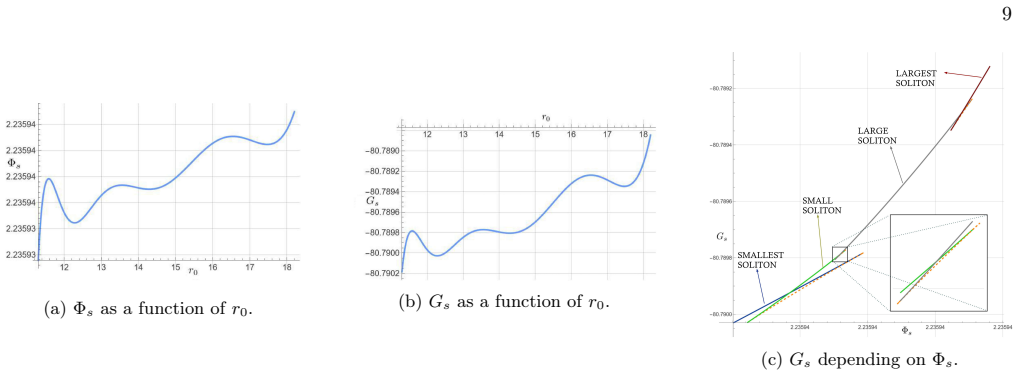
The central claim is that the Plebański formulation with polynomial H(P) furnishes the first multicritical points in four-dimensional gravity. The mapping from power series in F produces globally regular, asymptotically AdS solutions whose thermodynamics in the grand-canonical ensemble display multiple swallowtails in the soliton sector. This allows coexistence of several magnetically charged solitons with one electrically charged black hole, with the number of coexisting phases controlled by the polynomial degree. The black-hole sector remains free of swallowtail structures.
What carries the argument
The polynomial structural function H(P) in the Plebański formulation, which maps nonlinear electrodynamics theories and sets the number of coexisting thermodynamic phases through its degree.
If this is right
- The soliton sector supports multiple first-order phase transitions at the multicritical points.
- Several magnetically charged solitons can coexist with one electrically charged black hole.
- The number of coexisting phases rises with the degree of the structural polynomial.
- The black-hole branch admits no analogous multiple coexistence.
- The construction supplies a direct link between nonlinear-electrodynamics couplings and thermodynamic phase structure.
Where Pith is reading between the lines
- Higher-degree polynomials would be expected to generate arbitrarily many coexisting phases if the degree control persists.
- The same mapping technique could be tested on other nonlinear electrodynamics models to check whether swallowtail multiplicity appears beyond polynomials.
- Stability analysis of the multicritical configurations in the canonical ensemble would test whether the grand-canonical results survive ensemble change.
Load-bearing premise
The explicit mapping from power-series theories in the Maxwell invariant to the Plebański formulation produces globally regular asymptotically AdS solutions whose thermodynamic quantities can be computed in the grand-canonical ensemble without extra constraints or instabilities.
What would settle it
Numerical computation of the Gibbs free energy for a concrete polynomial of degree n that fails to produce n distinct swallowtails or n coexisting soliton phases in the grand-canonical ensemble would falsify the link between polynomial degree and number of phases.
Figures


read the original abstract
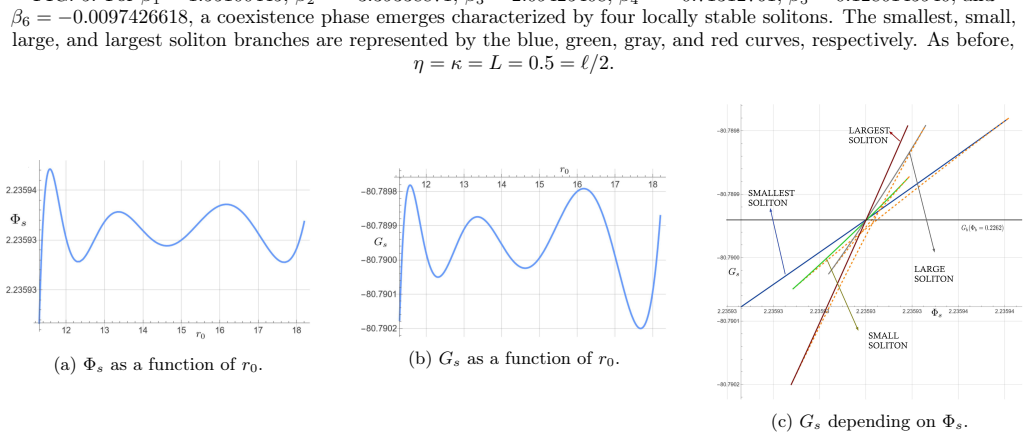
We present the first realization of multicritical points in four-dimensional general relativity, specifically within the context of Pleba\'nski nonlinear electrodynamics, using a polynomial structural function denoted as $\mathcal{H}(P)$. We show that this construction provides a systematic mechanism to engineer multicritical behavior in gravitational systems. By establishing an explicit mapping between matter theories expressed as power series in the Maxwell invariant $F$ and the Pleba\'nski formulation, we construct new families of electrically charged asymptotically anti-de Sitter black holes and magnetically charged solitons. In the grand-canonical ensemble, we analyze their thermodynamic properties and uncover a rich phase structure. We demonstrate that the soliton sector develops multiple swallowtail structures, signaling first-order phase transitions and allowing the coexistence of several magnetically charged solitons with a single electrically charged black hole. These configurations define multicritical points that generalize previously known triple points. We further show that the number of coexisting phases is controlled by the degree of the polynomial structural function, providing a direct link between the nonlinear electrodynamics couplings and the thermodynamic phase structure. In contrast, the black hole branch does not display swallowtail behavior, and it does not allow multiple electrically charged black holes to coexist with a magnetically charged soliton.
Editorial analysis
A structured set of objections, weighed in public.
Referee Report
Summary. The paper claims the first realization of multicritical points in 4D GR via Plebański nonlinear electrodynamics with polynomial structural function H(P). It constructs an explicit mapping from power-series matter theories in the Maxwell invariant F to the Plebański formulation, yielding new families of electrically charged asymptotically AdS black holes and magnetically charged solitons. In the grand-canonical ensemble the soliton sector exhibits multiple swallowtail structures (first-order transitions allowing coexistence of several magnetically charged solitons with one electrically charged black hole), defining multicritical points that generalize triple points; the number of coexisting phases is stated to be controlled by the degree of H(P). The black-hole branch shows no swallowtail behavior.
Significance. If the thermodynamic analysis and regularity of the constructed solutions hold, the work supplies a systematic, tunable mechanism (via polynomial degree) for engineering multicritical behavior in gravitational systems and directly links nonlinear-electrodynamics couplings to phase structure. The explicit F-to-Plebański mapping and grand-canonical treatment of both soliton and black-hole branches constitute concrete strengths.
major comments (2)
- [Abstract] Abstract and introduction: the central claim that the number of coexisting phases 'is controlled by the degree of the polynomial structural function' treats the degree as a free modeling parameter whose selection produces the desired multicritical behavior; without an explicit fitting procedure or derivation showing that the swallowtail count follows necessarily from the field equations rather than from the choice of degree, the robustness of the multicritical-point construction remains unclear.
- [Abstract] The abstract asserts that the F-to-Plebański mapping produces globally regular, asymptotically AdS solutions whose grand-canonical thermodynamics can be computed directly. Because no explicit metric ansatz, structural function H(P), or thermodynamic potential expressions appear in the provided description, it is impossible to verify that the claimed swallowtail structures and phase coexistence follow from the stated equations without additional constraints or instabilities.
Simulated Author's Rebuttal
We thank the referee for the careful review and constructive comments on our manuscript. We address each major comment point by point below, providing clarifications and indicating where revisions will strengthen the presentation.
read point-by-point responses
-
Referee: [Abstract] Abstract and introduction: the central claim that the number of coexisting phases 'is controlled by the degree of the polynomial structural function' treats the degree as a free modeling parameter whose selection produces the desired multicritical behavior; without an explicit fitting procedure or derivation showing that the swallowtail count follows necessarily from the field equations rather than from the choice of degree, the robustness of the multicritical-point construction remains unclear.
Authors: The polynomial degree enters as a model parameter, but once fixed the Einstein equations with the Plebański source determine the metric and thermodynamic potential uniquely. Explicit computation shows that each additional degree introduces higher-order terms in the free-energy expression that produce additional swallowtail features; this scaling is derived directly from the on-shell action and is not imposed by hand. We will revise the introduction to include a short outline of this derivation, making the link between the field equations and the number of coexisting phases explicit. revision: yes
-
Referee: [Abstract] The abstract asserts that the F-to-Plebański mapping produces globally regular, asymptotically AdS solutions whose grand-canonical thermodynamics can be computed directly. Because no explicit metric ansatz, structural function H(P), or thermodynamic potential expressions appear in the provided description, it is impossible to verify that the claimed swallowtail structures and phase coexistence follow from the stated equations without additional constraints or instabilities.
Authors: The abstract is a concise summary; the full manuscript supplies the metric ansatz, the explicit polynomial H(P), the F-to-P mapping, and the thermodynamic potentials, all derived from the field equations. Regularity and asymptotic AdS behavior are verified by direct substitution, and the grand-canonical analysis proceeds without extra constraints. We will add a brief parenthetical reference to the relevant sections in a revised abstract to guide readers to the explicit expressions. revision: partial
Circularity Check
No significant circularity; explicit construction from chosen structural function
full rationale
The paper defines a polynomial structural function H(P) of chosen degree, maps matter theories expressed as power series in F to the Plebański formulation, constructs the corresponding asymptotically AdS solutions, and computes their grand-canonical thermodynamics. The resulting swallowtail structures and the direct dependence of the number of coexisting phases on the polynomial degree are immediate consequences of this modeling choice and the explicit thermodynamic potentials derived from it. No step reduces a claimed first-principles prediction to a fitted input or self-citation; the central result is the engineered phase structure itself, which is self-contained within the presented mapping and ensemble analysis.
Axiom & Free-Parameter Ledger
free parameters (1)
- degree of polynomial H(P)
axioms (2)
- standard math Four-dimensional general relativity with asymptotically anti-de Sitter boundary conditions
- domain assumption Plebański formulation of nonlinear electrodynamics
Reference graph
Works this paper leans on
-
[1]
Multicritical points of gravitational solitons and a black hole in four dimensions
carried out a detailed analysis of the phase struc- ture of spherically symmetric charged BHs in both the canonical and grand-canonical ensembles, showing that the electric potential plays a central role in shaping the thermodynamic landscape. At sufficiently large poten- tial, a single BH branch emerges as the thermodynami- cally preferred configuration ...
work page internal anchor Pith review Pith/arXiv arXiv 2026
-
[2]
M. Natsuume, Lect. Notes Phys. 903 (2015), pp.1-294 doi:10.1007/978-4-431-55441-7 [arXiv:1409.3575 [hep- th]]
work page internal anchor Pith review Pith/arXiv arXiv doi:10.1007/978-4-431-55441-7 2015
-
[3]
J. M. Maldacena, Int. J. Theor. Phys. 38, 1113- 1133 (1999) doi:10.1023/A:1026654312961 [arXiv:hep- th/9711200 [hep-th]]
-
[4]
S. S. Gubser, I. R. Klebanov and A. M. Polyakov, Phys. Lett. B 428 (1998), 105-114 doi:10.1016/S0370- 2693(98)00377-3 [arXiv:hep-th/9802109 [hep-th]]
work page internal anchor Pith review Pith/arXiv arXiv doi:10.1016/s0370- 1998
-
[5]
Anti De Sitter Space And Holography
E. Witten, Adv. Theor. Math. Phys.2 (1998), 253-291 doi:10.4310/ATMP.1998.v2.n2.a2 [arXiv:hep-th/9802150 [hep-th]]
work page internal anchor Pith review Pith/arXiv arXiv doi:10.4310/atmp.1998.v2.n2.a2 1998
-
[6]
S. W. Hawking and D. N. Page, Commun. Math. Phys. 87 (1983) 577
1983
-
[7]
Anti-de Sitter Space, Thermal Phase Transition, And Confinement In Gauge Theories
E. Witten, Adv. Theor. Math. Phys.2 (1998), 505-532 doi:10.4310/ATMP.1998.v2.n3.a3 [arXiv:hep-th/9803131 [hep-th]]
work page internal anchor Pith review Pith/arXiv arXiv doi:10.4310/atmp.1998.v2.n3.a3 1998
-
[8]
Charged AdS Black Holes and Catastrophic Holography
A. Chamblin, R. Emparan, C. V. Johnson and R. C. Myers, Phys. Rev. D 60 (1999), 064018 doi:10.1103/PhysRevD.60.064018[arXiv:hep-th/9902170 [hep-th]]
work page internal anchor Pith review Pith/arXiv arXiv doi:10.1103/physrevd.60.064018 1999
-
[9]
Black hole chemistry: thermodynamics with Lambda
D. Kubiznak, R. B. Mann and M. Teo, Class. Quant. Grav. 34 (2017) no.6, 063001 doi:10.1088/1361- 6382/aa5c69 [arXiv:1608.06147 [hep-th]]
work page internal anchor Pith review Pith/arXiv arXiv doi:10.1088/1361- 2017
-
[10]
R. B. Mann, Int. J. Mod. Phys. D34, no.09, 2542001 (2025)
2025
-
[11]
D. Kubiznak and R. B. Mann, Can. J. Phys. 93, no.9, 999-1002 (2015) doi:10.1139/cjp-2014-0465 [arXiv:1404.2126 [gr-qc]]
-
[12]
P-V criticality of charged AdS black holes
D. Kubiznak and R. B. Mann, JHEP 07 (2012), 033 doi:10.1007/JHEP07(2012)033 [arXiv:1205.0559 [hep- th]]
work page internal anchor Pith review Pith/arXiv arXiv doi:10.1007/jhep07(2012)033 2012
-
[13]
S. W. Wei, Y. X. Liu and R. B. Mann, Phys. Rev. Lett. 123 (2019) no.7, 071103 doi:10.1103/PhysRevLett.123.071103 [arXiv:1906.10840 [gr-qc]]
-
[14]
J. P. S. Lemos, Phys. Lett. B 353 (1995), 46-51 doi:10.1016/0370-2693(95)00533-Q [arXiv:gr-qc/9404041 [gr-qc]]
work page internal anchor Pith review Pith/arXiv arXiv doi:10.1016/0370-2693(95)00533-q 1995
-
[15]
Black holes with unusual topology
L. Vanzo, Phys. Rev. D 56 (1997), 6475-6483 doi:10.1103/PhysRevD.56.6475 [arXiv:gr-qc/9705004 [gr-qc]]
work page internal anchor Pith review Pith/arXiv arXiv doi:10.1103/physrevd.56.6475 1997
-
[16]
Black Holes and Wormholes in 2+1 Dimensions
S. Aminneborg, I. Bengtsson, D. Brill, S. Holst and P. Peldan, Class. Quant. Grav. 15 (1998), 627-644 doi:10.1088/0264-9381/15/3/013 [arXiv:gr-qc/9707036 [gr-qc]]
work page internal anchor Pith review Pith/arXiv arXiv doi:10.1088/0264-9381/15/3/013 1998
-
[17]
Anti-de Sitter space and black holes
M. Banados, A. Gomberoff and C. Martinez, Class. Quant. Grav. 15 (1998), 3575-3598 doi:10.1088/0264- 9381/15/11/018 [arXiv:hep-th/9805087 [hep-th]]
work page internal anchor Pith review Pith/arXiv arXiv doi:10.1088/0264- 1998
-
[18]
R. B. Mann, Annals Israel Phys. Soc. 13 (1997), 311 [arXiv:gr-qc/9709039 [gr-qc]]
work page internal anchor Pith review Pith/arXiv arXiv 1997
-
[19]
D. Birmingham, Class. Quant. Grav. 16 (1999), 1197-1205 doi:10.1088/0264-9381/16/4/009 [arXiv:hep- 12 th/9808032 [hep-th]]
-
[20]
G. T. Horowitz and R. C. Myers, Phys. Rev. D 59 (1998), 026005 doi:10.1103/PhysRevD.59.026005 [arXiv:hep-th/9808079 [hep-th]]
work page internal anchor Pith review Pith/arXiv arXiv doi:10.1103/physrevd.59.026005 1998
-
[21]
Phase Transitions for Flat adS Black Holes
S. Surya, K. Schleich and D. M. Witt, Phys. Rev. Lett. 86 (2001), 5231-5234 doi:10.1103/PhysRevLett.86.5231 [arXiv:hep-th/0101134 [hep-th]]
work page internal anchor Pith review Pith/arXiv arXiv doi:10.1103/physrevlett.86.5231 2001
-
[22]
Phase Transition of Electrically Charged Ricci-flat Black Holes
N. Banerjee and S. Dutta, JHEP 07, 047 (2007) doi:10.1088/1126-6708/2007/07/047 [arXiv:0705.2682 [hep-th]]
work page internal anchor Pith review Pith/arXiv arXiv doi:10.1088/1126-6708/2007/07/047 2007
-
[23]
A. Anabalon, D. Astefanesei, D. Choque and J. D. Edelstein, JHEP 07, 129 (2020) doi:10.1007/JHEP07(2020)129 [arXiv:1912.03318 [hep- th]]
-
[24]
A. Anabalón, P. Concha, J. Oliva, C. Quijada and E. Rodríguez, Phys. Lett. B 835 (2022), 137521 doi:10.1016/j.physletb.2022.137521 [arXiv:2205.01609 [hep-th]]
-
[25]
S. Gunasekaran, R. B. Mann and D. Kubiznak, JHEP 11, 110 (2012) doi:10.1007/JHEP11(2012)110 [arXiv:1208.6251 [hep-th]]
work page internal anchor Pith review Pith/arXiv arXiv doi:10.1007/jhep11(2012)110 2012
-
[26]
C. Gao, Phys. Rev. D 104, no.6, 064038 (2021) doi:10.1103/PhysRevD.104.064038 [arXiv:2106.13486 [gr-qc]]
-
[27]
Black holes of multiple horizons without mass inflation
C. Gao and T. Saken, Eur. Phys. J. C86(2026) no.5, 481 doi:10.1140/epjc/s10052-026-15643-x [arXiv:2508.12646 [gr-qc]]
work page internal anchor Pith review Pith/arXiv arXiv doi:10.1140/epjc/s10052-026-15643-x 2026
-
[28]
M. Tavakoli, J. Wu and R. B. Mann, JHEP 12, 117 (2022) [erratum: JHEP 12, 012 (2023)] doi:10.1007/JHEP12(2022)117 [arXiv:2207.03505 [hep- th]]
-
[29]
C. Quijada, A. Anabalón, R. B. Mann and J. Oliva, Phys. Rev. D 110 (2024) no.2, L021902 doi:10.1103/PhysRevD.110.L021902 [arXiv:2308.16341 [hep-th]]
-
[30]
Plebański,Lectures on Non-Linear Electrodynamics (Nordita, 1968)
J. Plebański,Lectures on Non-Linear Electrodynamics (Nordita, 1968)
1968
-
[31]
Humberto Salazar I., Alberto García, and Jerzy Ple- bański, JournalofMathematicalPhysics 28, 2171(1987); doi: 10.1063/1.527430
-
[32]
Regular Black Hole in General Relativity Coupled to Nonlinear Electrodynamics
E. Ayon-Beato and A. Garcia, Phys. Rev. Lett. 80 (1998), 5056-5059 doi:10.1103/PhysRevLett.80.5056 [arXiv:gr-qc/9911046 [gr-qc]]
work page internal anchor Pith review Pith/arXiv arXiv doi:10.1103/physrevlett.80.5056 1998
-
[33]
E. Ayon-Beato and A. Garcia, Phys. Lett. B493 (2000), 149-152 doi:10.1016/S0370-2693(00)01125-4 [arXiv:gr- qc/0009077 [gr-qc]]
-
[34]
E. Ayon-Beato and A. Garcia, Phys. Lett. B464 (1999), 25 doi:10.1016/S0370-2693(99)01038-2 [arXiv:hep- th/9911174 [hep-th]]
-
[35]
A. A. Díaz García, Annals Phys. 441 (2022), 168880 doi:10.1016/j.aop.2022.168880 [arXiv:2201.10682 [gr-qc]]
-
[36]
M. Bravo-Gaete, F. F. Santos and X. Zhang, Fortsch. Phys. 73 (2025) no.12, e70049 doi:10.1002/prop.70049 [arXiv:2510.23826 [hep-th]]
- [37]
-
[38]
E. Ayón-Beato, Annals Phys. 469 (2024), 169771 doi:10.1016/j.aop.2024.169771 [arXiv:2203.12809 [gr- qc]]
-
[39]
A. Álvarez, M. Bravo-Gaete, M. M. Juárez-Aubry and G. V. Rodríguez, Phys. Rev. D105 (2022) no.8, 084032 doi:10.1103/PhysRevD.105.084032 [arXiv:2202.11252 [gr-qc]]
-
[40]
J. Lin, M. Bravo-Gaete and X. Zhang, Phys. Rev. D109 (2024) no.10, 104039 doi:10.1103/PhysRevD.109.104039 [arXiv:2401.02045 [gr-qc]]
-
[41]
M. Bravo-Gaete, L. Guajardo, D. F. Higuita-Borja and J. A. Méndez-Zavaleta, Phys. Rev. D113 (2026) no.2, 024039 doi:10.1103/gs9f-dx3h [arXiv:2509.03838 [hep- th]]
-
[42]
M. Bravo-Gaete, L. Guajardo and J. Oliva, Phys. Rev. D 106 (2022) no.2, 024017 doi:10.1103/PhysRevD.106.024017 [arXiv:2205.09282 [hep-th]]
-
[43]
S. Hyun and C. H. Nam, Eur. Phys. J. C 79 (2019) no.9, 737 doi:10.1140/epjc/s10052-019-7248-8 [arXiv:1908.09294 [gr-qc]]
-
[44]
M. S. Churilova and Z. Stuchlik, Annals Phys. 418 (2020), 168181 doi:10.1016/j.aop.2020.168181 [arXiv:1910.12660 [gr-qc]]
-
[45]
Russel, Combinatorics
M. Russel, Combinatorics. John Wiley and Sons, 2003
2003
- [46]
discussion (0)
Sign in with ORCID, Apple, or X to comment. Anyone can read and Pith papers without signing in.