Projected multi-reference alignment
Pith reviewed 2026-06-29 20:45 UTC · model grok-4.3
The pith
The first three moments of projected observations determine a generic dihedral orbit in the high-noise regime.
A machine-rendered reading of the paper's core claim, the machinery that carries it, and where it could break.
Core claim
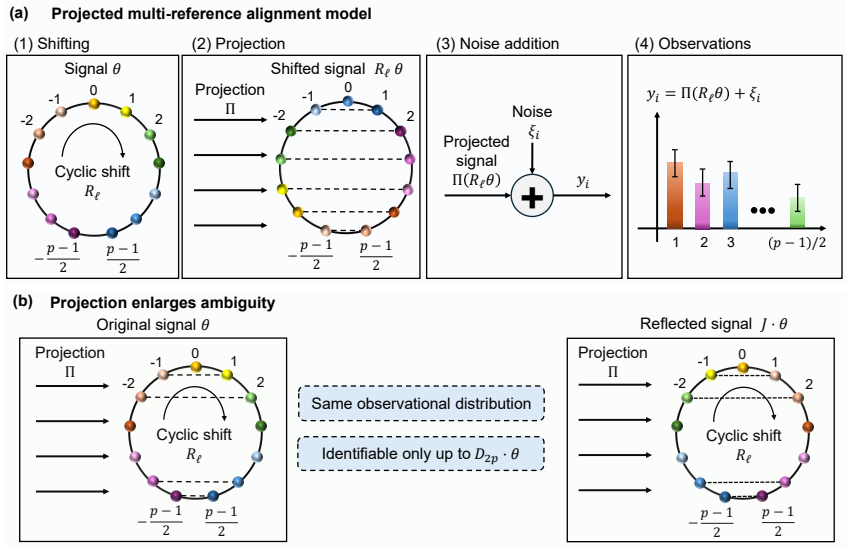
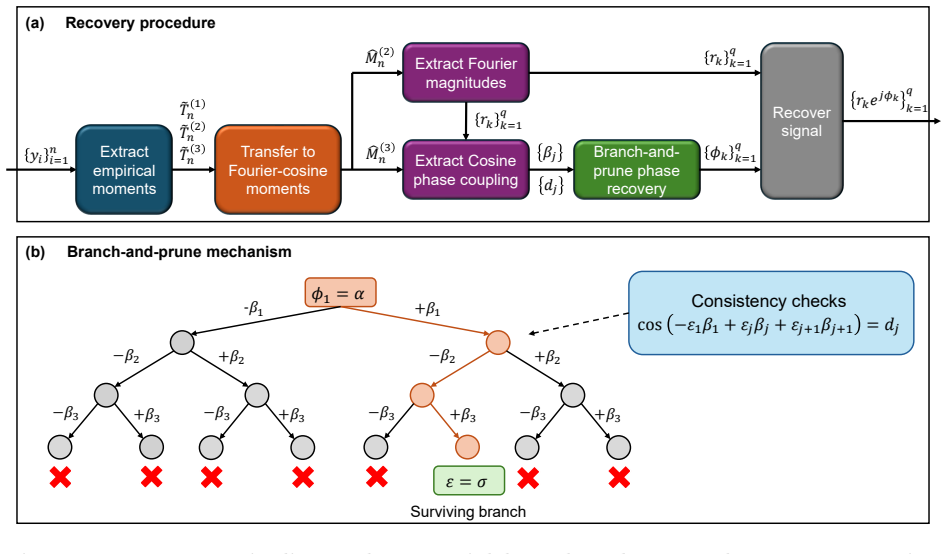
We prove that in the high-noise regime, the first three moments of the projected observations determine a generic dihedral orbit. The main mechanism is a reduction, at the moment level, from projected MRA to the reflection-invariant phase-coupling structure of dihedral MRA. In Fourier-cosine coordinates adapted to the projection, the first moment determines the mean component, the second moment determines the Fourier magnitudes, and selected third moments yield the cosine phase-coupling relations appearing in the dihedral bispectrum. These relations lead to a constructive recovery scheme from moments up to order three.
What carries the argument
Moment-level reduction from projected MRA to the reflection-invariant phase-coupling structure of dihedral MRA, expressed in Fourier-cosine coordinates adapted to the projection.
If this is right
- The first moment determines the mean component in the adapted coordinates.
- The second moment determines the Fourier magnitudes.
- Selected third moments recover the cosine phase-coupling relations of the dihedral bispectrum.
- A constructive recovery procedure exists using only moments up to order three.
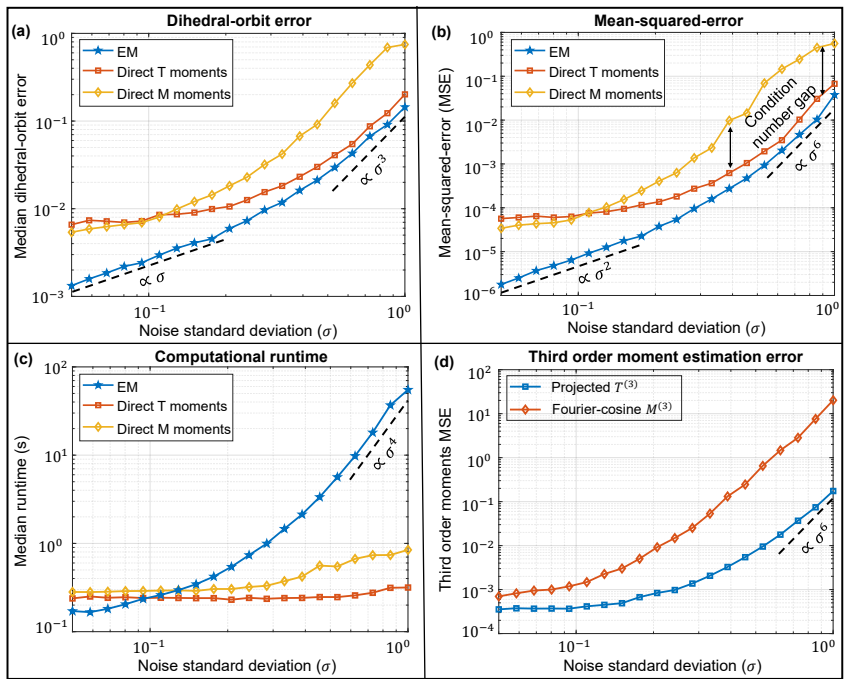
- Expectation-maximization and direct moment optimization both exhibit the predicted sample-complexity scaling n ≳ σ^6.
Where Pith is reading between the lines
- The same moment-reduction strategy could be examined for other fixed projections that discard partial symmetry information.
- Performance on non-generic orbits or alternative projection choices would test the boundary of the generic-case guarantee.
- Techniques developed for the dihedral bispectrum might be imported to improve the third-moment recovery step.
Load-bearing premise
The signal belongs to a generic dihedral orbit and the fixed projection merges reflection-symmetric index pairs.
What would settle it
Two distinct generic dihedral orbits that produce identical first three moments under the projected observation model.
Figures
read the original abstract
Motivated by structural biology applications, we study the projected multi-reference alignment (MRA) model, in which an unknown signal is observed through noisy samples, each generated by applying a random cyclic shift followed by a fixed projection. The projection merges reflection-symmetric index pairs, thereby discarding orientation information. The goal is to recover the dihedral orbit of the signal. We prove that in the high-noise regime, the first three moments of the projected observations determine a generic dihedral orbit. The main mechanism is a reduction, at the moment level, from projected MRA to the reflection-invariant phase-coupling structure of dihedral MRA. In Fourier-cosine coordinates adapted to the projection, the first moment determines the mean component, the second moment determines the Fourier magnitudes, and selected third moments yield the cosine phase-coupling relations appearing in the dihedral bispectrum. These relations lead to a constructive recovery scheme from moments up to order three. We complement the population theory with finite-sample experiments comparing expectation--maximization (EM), direct moment optimization, and direct Fourier-cosine moment optimization. The results show that, in the high-noise regime, both EM and direct moment optimization are consistent with the predicted third-moment sample-complexity scaling $n \gtrsim \sigma^6$, where $n$ is the number of observations and $\sigma^2$ is the noise variance.
Editorial analysis
A structured set of objections, weighed in public.
Referee Report
Summary. The manuscript studies the projected multi-reference alignment (MRA) model, in which an unknown signal is observed via noisy samples each formed by a random cyclic shift followed by a fixed projection that merges reflection-symmetric index pairs and discards orientation. The central claim is that, in the high-noise regime, the first three population moments of the projected observations uniquely determine a generic dihedral orbit of the signal. The argument reduces the moment equations, at the population level, to the reflection-invariant phase-coupling structure of dihedral MRA; in adapted Fourier-cosine coordinates the first moment fixes the mean, the second fixes magnitudes, and selected third-moment entries recover the cosine phase relations of the dihedral bispectrum, yielding a constructive recovery scheme. Finite-sample experiments compare EM, direct moment optimization, and Fourier-cosine moment optimization and report consistency with the predicted n ≳ σ^6 scaling.
Significance. If the uniqueness result holds, the work supplies a moment-based identifiability theorem for projected MRA under explicit genericity and projection-merging assumptions, together with a constructive scheme from moments of order at most three. The reduction to the independently established phase-coupling structure of dihedral MRA and the empirical validation of the high-noise sample-complexity scaling are concrete strengths. The contribution is relevant to structural-biology applications in which projection-like observations appear.
minor comments (2)
- [Abstract] Abstract and §3: the phrase 'selected third moments' is used to recover the cosine phase relations; an explicit characterization of which Fourier-cosine entries suffice would make the constructive scheme easier to verify.
- The finite-sample experiments are summarized at a high level; adding implementation details (e.g., initialization, convergence criteria, or exact parameter settings for the three compared methods) would improve reproducibility.
Simulated Author's Rebuttal
We thank the referee for the detailed summary, positive significance assessment, and recommendation of minor revision. No major comments were listed in the report, so we have no specific points requiring point-by-point response or manuscript changes at this stage.
Circularity Check
No significant circularity; derivation is self-contained via explicit moment-to-orbit mapping
full rationale
The paper establishes uniqueness by an explicit reduction: in Fourier-cosine coordinates, the first population moment determines the mean, the second determines magnitudes, and selected third-moment entries recover the cosine phase couplings of the dihedral bispectrum, yielding a constructive scheme under the stated genericity and projection-merging assumptions. This mapping is derived directly from the moment definitions and the projection properties rather than by fitting parameters to data or invoking a self-citation chain as the sole justification. The reference to dihedral MRA phase-coupling structure functions as an external mathematical target for the reduction, not as a load-bearing premise that collapses back into the present work. No step equates a claimed prediction to its own inputs by construction.
Axiom & Free-Parameter Ledger
axioms (2)
- domain assumption The signal belongs to a generic dihedral orbit
- domain assumption The high-noise regime governs the observations
Forward citations
Cited by 2 Pith papers
-
Beyond Frequency Marching: Orbit Recovery in Dihedral and Projected Multireference Alignment
First poly-time algorithm for dihedral and projected MRA via recursive method of moments on the third moment tensor, conditional on a verifiable rank conjecture for power-of-two lengths.
-
The generalized method of moments is (almost) statistically efficient in low-SNR Gaussian latent-variable models
In low-SNR Gaussian latent-variable models, optimally weighted GMoM using minimal-order moments achieves the same leading asymptotic covariance as MLE via matching layerwise expansions of the information operators.
Reference graph
Works this paper leans on
-
[1]
Estimation in the group action channel
Emmanuel Abbe, Joao M Pereira, and Amit Singer. Estimation in the group action channel. In2018 IEEE International Symposium on Information Theory (ISIT), pages 561–565. IEEE, 2018
2018
-
[2]
Group-invariant moments under tomographic projections
Amnon Balanov, Tamir Bendory, and Dan Edidin. Group-invariant moments under tomographic projections.arXiv preprint arXiv:2604.08330, 2026
work page internal anchor Pith review Pith/arXiv arXiv 2026
-
[3]
Expectation-maximization for low-SNR multi-reference alignment.arXiv preprint arXiv:2505.21435, 2026
Amnon Balanov, Wasim Huleihel, and Tamir Bendory. Expectation-maximization for low-SNR multi-reference alignment.arXiv preprint arXiv:2505.21435, 2026. 27
-
[4]
Optimal rates of estima- tion for multi-reference alignment.Mathematical Statistics and Learning, 2(1):25–75, 2020
Afonso Bandeira, Jonathan Niles-Weed, and Philippe Rigollet. Optimal rates of estima- tion for multi-reference alignment.Mathematical Statistics and Learning, 2(1):25–75, 2020
2020
-
[5]
Estimation under group actions: recovering orbits from invari- ants.Applied and Computational Harmonic Analysis, 66:236–319, 2023
Afonso S Bandeira, Ben Blum-Smith, Joe Kileel, Jonathan Niles-Weed, Amelia Perry, and Alexander S Wein. Estimation under group actions: recovering orbits from invari- ants.Applied and Computational Harmonic Analysis, 66:236–319, 2023
2023
-
[6]
Multireference align- ment using semidefinite programming
Afonso S Bandeira, Moses Charikar, Amit Singer, and Andy Zhu. Multireference align- ment using semidefinite programming. InProceedings of the 5th conference on Innova- tions in theoretical computer science, pages 459–470, 2014
2014
-
[7]
Single-particle cryo-electron microscopy: Mathematical theory, computational challenges, and opportunities.IEEE signal processing magazine, 37(2):58–76, 2020
Tamir Bendory, Alberto Bartesaghi, and Amit Singer. Single-particle cryo-electron microscopy: Mathematical theory, computational challenges, and opportunities.IEEE signal processing magazine, 37(2):58–76, 2020
2020
-
[8]
Bispectrum inversion with application to multireference alignment.IEEE Transactions on signal processing, 66(4):1037–1050, 2017
Tamir Bendory, Nicolas Boumal, Chao Ma, Zhizhen Zhao, and Amit Singer. Bispectrum inversion with application to multireference alignment.IEEE Transactions on signal processing, 66(4):1037–1050, 2017
2017
-
[9]
Dihedral multi-reference alignment.IEEE Transactions on Information Theory, 68(5):3489–3499, 2022
Tamir Bendory, Dan Edidin, William Leeb, and Nir Sharon. Dihedral multi-reference alignment.IEEE Transactions on Information Theory, 68(5):3489–3499, 2022
2022
-
[10]
A spectral method for stable bispectrum inversion with application to multireference alignment.IEEE Signal Processing Letters, 25(7):911–915, 2018
Hua Chen, Mona Zehni, and Zhizhen Zhao. A spectral method for stable bispectrum inversion with application to multireference alignment.IEEE Signal Processing Letters, 25(7):911–915, 2018
2018
-
[11]
The reflection-invariant bispectrum: Signal recovery in the dihedral model.Journal of Fourier Analysis and Applications, 32(1):1, 2026
Dan Edidin and Josh Katz. The reflection-invariant bispectrum: Signal recovery in the dihedral model.Journal of Fourier Analysis and Applications, 32(1):1, 2026
2026
-
[12]
Likelihood landscape and maximum likelihood estimation for the discrete orbit recovery model.Communications on Pure and Applied Mathematics, 76(6):1208–1302, 2023
Zhou Fan, Yi Sun, Tianhao Wang, and Yihong Wu. Likelihood landscape and maximum likelihood estimation for the discrete orbit recovery model.Communications on Pure and Applied Mathematics, 76(6):1208–1302, 2023
2023
-
[13]
Sparse multi-reference alignment: Phase retrieval, uniform uncertainty principles and the beltway problem.Foundations of Com- putational Mathematics, 23(5):1851–1898, 2023
Subhroshekhar Ghosh and Philippe Rigollet. Sparse multi-reference alignment: Phase retrieval, uniform uncertainty principles and the beltway problem.Foundations of Com- putational Mathematics, 23(5):1851–1898, 2023
2023
-
[14]
Wavelet invariants for statistically robust multi- reference alignment.Information and Inference: A Journal of the IMA, 10(4):1287– 1351, 2021
Matthew Hirn and Anna Little. Wavelet invariants for statistically robust multi- reference alignment.Information and Inference: A Journal of the IMA, 10(4):1287– 1351, 2021
2021
-
[15]
Likelihood maximization and moment matching in low snr gaussian mixture models.Communications on Pure and Applied Mathematics, 76(4):788–842, 2023
Anya Katsevich and Afonso S Bandeira. Likelihood maximization and moment matching in low snr gaussian mixture models.Communications on Pure and Applied Mathematics, 76(4):788–842, 2023
2023
-
[16]
The sample complexity of multireference alignment.SIAM Journal on Mathematics of Data Science, 1(3):497–517, 2019
Amelia Perry, Jonathan Weed, Afonso S Bandeira, Philippe Rigollet, and Amit Singer. The sample complexity of multireference alignment.SIAM Journal on Mathematics of Data Science, 1(3):497–517, 2019. 28
2019
-
[17]
Multi-reference alignment in high dimensions: Sample complexity and phase transition.SIAM Journal on Mathematics of Data Science, 3(2):494–523, 2021
Elad Romanov, Tamir Bendory, and Or Ordentlich. Multi-reference alignment in high dimensions: Sample complexity and phase transition.SIAM Journal on Mathematics of Data Science, 3(2):494–523, 2021
2021
-
[18]
Optimal determination of particle orienta- tion, absolute hand, and contrast loss in single-particle electron cryomicroscopy.Journal of molecular biology, 333(4):721–745, 2003
Peter B Rosenthal and Richard Henderson. Optimal determination of particle orienta- tion, absolute hand, and contrast loss in single-particle electron cryomicroscopy.Journal of molecular biology, 333(4):721–745, 2003
2003
-
[19]
Computational methods for single-particle electron cryomicroscopy.Annual review of biomedical data science, 3:163–190, 2020
Amit Singer and Fred J Sigworth. Computational methods for single-particle electron cryomicroscopy.Annual review of biomedical data science, 3:163–190, 2020. 29
2020
discussion (0)
Sign in with ORCID, Apple, or X to comment. Anyone can read and Pith papers without signing in.