Constraining Early Dark Energy cosmological models with Big Bang Nucleosynthesis
Pith reviewed 2026-06-29 15:58 UTC · model grok-4.3
The pith
Early Dark Energy models with linear or polytropic equations of state are limited by BBN to densities below 10^{-13} and 10^{-5} MeV^4 at 95% confidence.
A machine-rendered reading of the paper's core claim, the machinery that carries it, and where it could break.
Core claim
By constructing a BBN simulator with nested sampling, the authors derive that a linear equation of state restricts dark energy density to less than 10^{-13} MeV^4 and a polytropic equation of state to less than 10^{-5} MeV^4 at 95% confidence level. A temperature-dependent equation of state remains consistent with observed primordial abundances for coupling parameters ≲ 10^{-2}, because it permits high-temperature deviations from the standard expansion history yet dilutes quickly enough to reproduce general-relativistic results before weak freeze-out.
What carries the argument
A nested-sampling BBN simulator that maps any chosen dark-energy equation of state onto the expansion rate and then onto final light-element yields, thereby placing upper bounds on the dark-energy density contribution in the radiation-dominated era.
If this is right
- Linear-equation-of-state Early Dark Energy is allowed only if its density stays below 10^{-13} MeV^4 at 95% confidence.
- Polytropic models are permitted up to 10^{-5} MeV^4 but still must remain negligible during BBN.
- Temperature-dependent models with couplings ≲ 10^{-2} can produce early deviations from Lambda-CDM while matching standard abundances by weak freeze-out.
- Any Early Dark Energy contribution that survives these bounds must dilute before the epoch of neutron-proton freeze-out.
Where Pith is reading between the lines
- More precise future measurements of primordial abundances could shrink the remaining viable parameter space for temperature-dependent models.
- The same simulator framework could be applied to later epochs such as recombination to obtain independent limits on the same models.
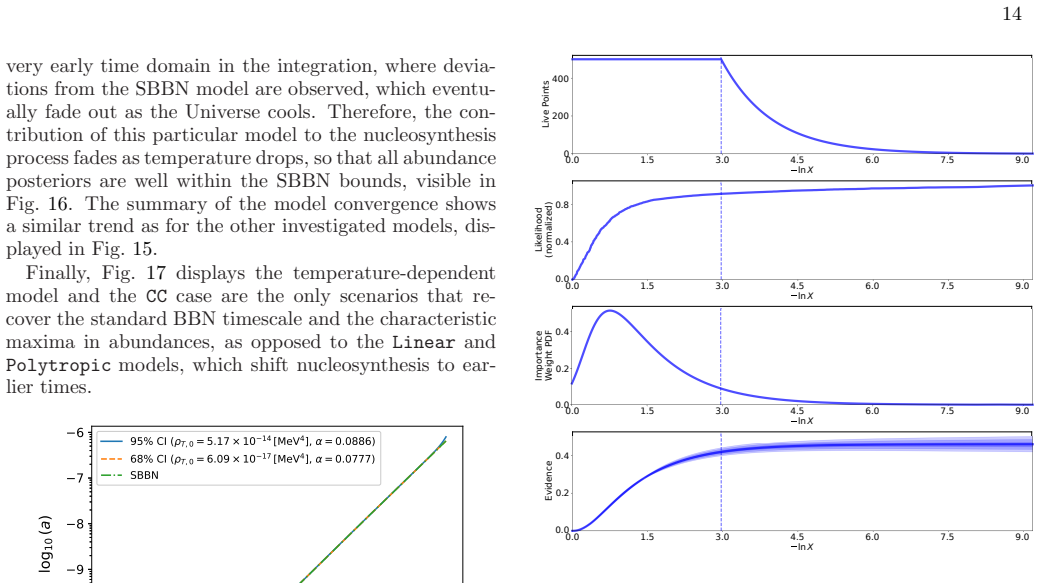
- Models that solve the Hubble tension must incorporate a rapid dilution mechanism to remain compatible with both BBN and late-time data.
Load-bearing premise
The BBN simulator correctly converts any modified expansion history into nuclear reaction rates and final abundances without unmodeled systematics or missing reaction channels.
What would settle it
Primordial helium-4 or deuterium abundances measured at a precision that would require a dark-energy density above 10^{-13} MeV^4 (linear case) or 10^{-5} MeV^4 (polytropic case) during the radiation era.
Figures
read the original abstract
The recent cosmological picture contains a significant tension indicating that our standard $\Lambda$CDM picture may be incomplete. Early Dark Energy models can alleviate the Hubble tension, by assuming an early acceleration that could explain the divergence between the early and late-time cosmological data. We investigate the implications of Early Dark Energy models on the Big Bang Nucleosynthesis processes by considering several cosmological models, including a model assuming a simple cosmological constant, alongside with varying equations of state dark energy models. We construct a simulator through a nested sampling algorithm, with the help of which we estimate the upper bounds for model parameters, and determine the maximum allowable dark energy density contribution during the radiation-dominated era. Our results are obtained through the \href{https://github.com/croi900/eden}{eden} program. We show that for a linear or polytropic equation of state, the dark energy density is constrained to less than $10^{-13}$ MeV$^4$ and $10^{-5}$ MeV$^4$, respectively, at the 95\% confidence level. Furthermore, we identify a temperature-dependent equation of state of dark energy as the most physically compelling framework, which remains consistent with primordial abundances for coupling parameters $\lesssim 10^{-2}$. This model successfully allows for high-temperature deviations from the standard $\Lambda$CDM expansion history, while rapidly diluting to obtain standard general relativistic results in the weak freeze-out era.
Editorial analysis
A structured set of objections, weighed in public.
Referee Report
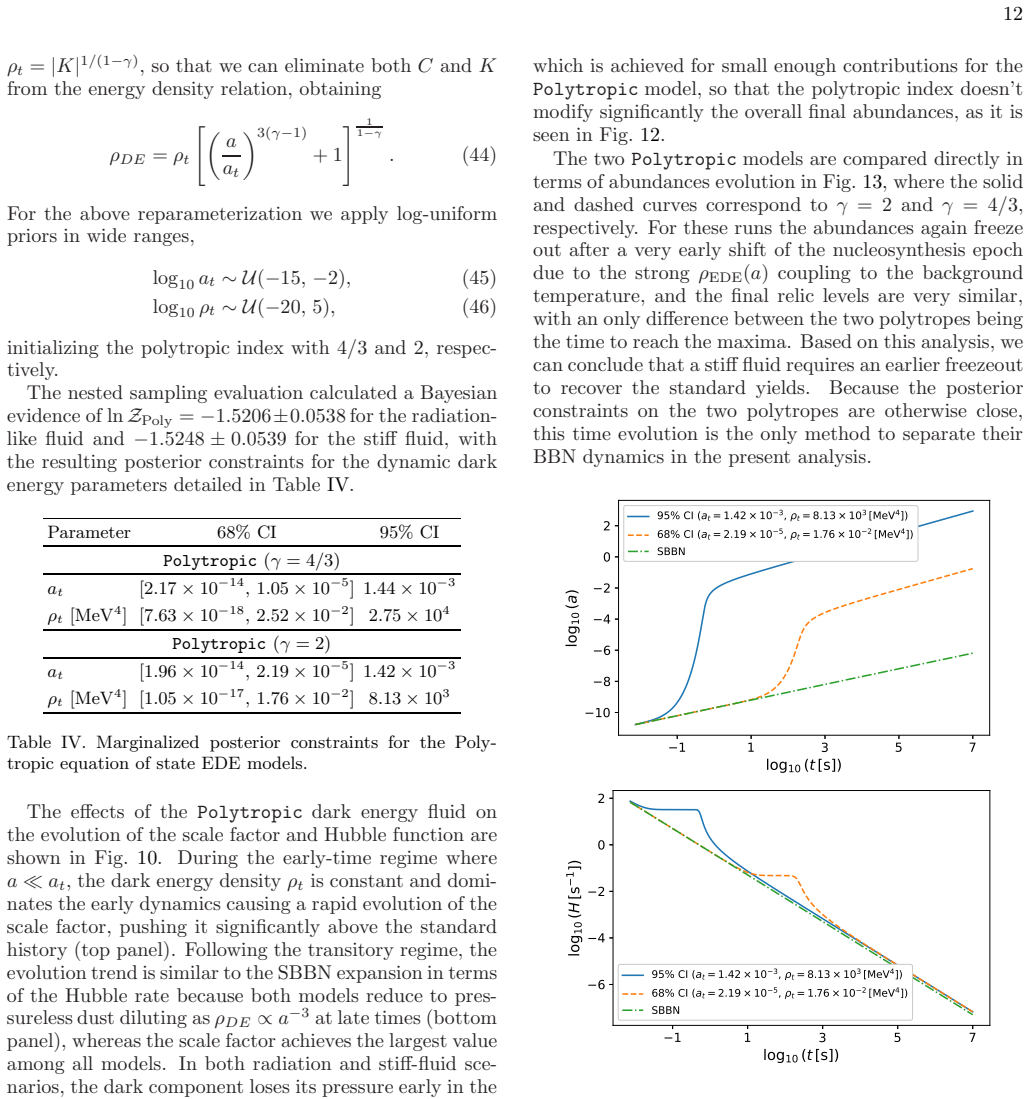
Summary. The paper claims that Early Dark Energy (EDE) models can be tightly constrained by BBN abundances. Using a custom nested-sampling code (eden) the authors report 95% CL upper bounds on dark-energy density of <10^{-13} MeV^4 (linear EOS) and <10^{-5} MeV^4 (polytropic EOS), and argue that a temperature-dependent EOS remains consistent with observed primordial abundances for coupling parameters ≲10^{-2} while allowing high-temperature deviations from ΛCDM.
Significance. If the eden simulator is shown to be reliable, the derived bounds would usefully limit the parameter space of EDE scenarios proposed to address the Hubble tension, and the preference for a temperature-dependent EOS would provide a concrete target for model building. The work therefore has potential impact on both early-universe cosmology and BBN phenomenology, provided the numerical implementation is validated.
major comments (2)
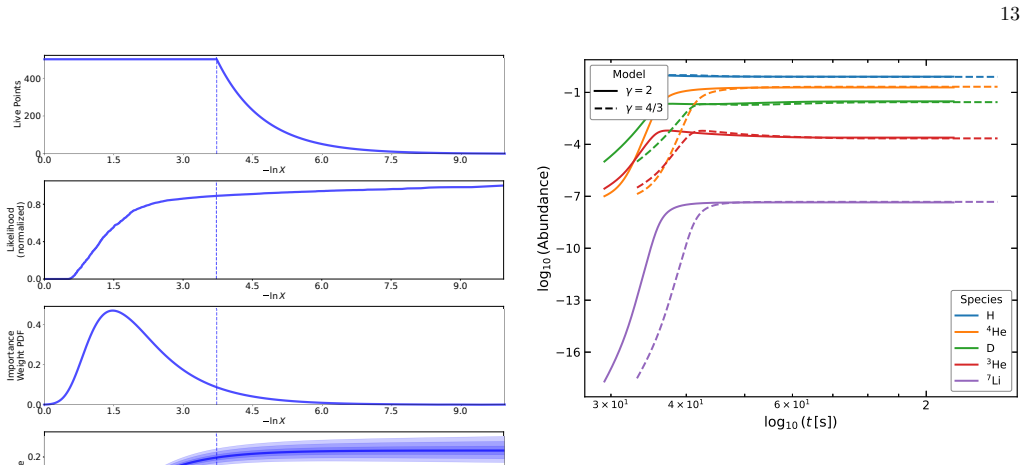
- [Simulator description (Abstract and Methods)] The central results (all reported bounds and the temperature-dependent EOS conclusion) rest on the accuracy of the eden simulator for non-standard expansion histories, yet the manuscript supplies no description of the nuclear reaction network, reaction-rate library, neutron-lifetime treatment, or integration scheme. Without these details it is impossible to assess whether modified H(z) is correctly mapped to final abundances Y_p, D/H, etc.
- [Validation and convergence checks] No benchmark comparison of eden against established BBN codes (PRIMAT, AlterBBN, or similar) is presented for the standard ΛCDM case. Such a cross-check is required to confirm that any systematic offset in the standard expansion history does not shift the allowed EDE parameter space by an unknown amount.
minor comments (1)
- [Abstract] The abstract sentence 'alongside with varying equations of state dark energy models' is grammatically awkward; rephrasing would improve readability.
Simulated Author's Rebuttal
We thank the referee for the constructive feedback. The two major comments highlight important gaps in the presentation of the eden code. We respond to each below and will revise the manuscript to address them.
read point-by-point responses
-
Referee: [Simulator description (Abstract and Methods)] The central results (all reported bounds and the temperature-dependent EOS conclusion) rest on the accuracy of the eden simulator for non-standard expansion histories, yet the manuscript supplies no description of the nuclear reaction network, reaction-rate library, neutron-lifetime treatment, or integration scheme. Without these details it is impossible to assess whether modified H(z) is correctly mapped to final abundances Y_p, D/H, etc.
Authors: We agree that the manuscript must contain an explicit description of the eden simulator. In the revised version we will add a dedicated subsection to the Methods section that details the nuclear reaction network, the reaction-rate library, the neutron-lifetime treatment, and the integration scheme. These additions will make clear how the modified expansion history is mapped onto the final abundances. revision: yes
-
Referee: [Validation and convergence checks] No benchmark comparison of eden against established BBN codes (PRIMAT, AlterBBN, or similar) is presented for the standard ΛCDM case. Such a cross-check is required to confirm that any systematic offset in the standard expansion history does not shift the allowed EDE parameter space by an unknown amount.
Authors: We acknowledge the absence of benchmark comparisons. We will add a new subsection presenting direct comparisons of eden results in the standard ΛCDM limit against PRIMAT and AlterBBN for the key abundances Y_p and D/H. This validation will confirm that the standard expansion history is reproduced correctly and that the reported EDE bounds are not influenced by numerical offsets. revision: yes
Circularity Check
No circularity: constraints obtained via standard parameter fitting to BBN data
full rationale
The paper constructs a custom BBN simulator (eden) and uses nested sampling to fit EDE model parameters (linear, polytropic, temperature-dependent EOS) directly to primordial abundance observations, reporting the resulting 95% CL upper bounds on dark energy density as the primary result. This is the explicit methodology and does not involve any claimed first-principles derivation, prediction of a fitted quantity, self-definitional loop, or load-bearing self-citation that reduces the central claim to its inputs by construction. The derivation chain (modified expansion history → nuclear rates → abundances → posterior bounds) is self-contained as a data-driven constraint exercise with no reduction to tautology.
Axiom & Free-Parameter Ledger
free parameters (2)
- coupling parameter =
lesssim 10^{-2}
- dark energy density amplitude =
<10^{-13} or <10^{-5} MeV^4
axioms (2)
- domain assumption Standard BBN nuclear reaction rates apply unchanged under EDE-modified expansion histories
- domain assumption Nested sampling yields unbiased posterior upper limits for these models
Reference graph
Works this paper leans on
-
[1]
Linear Equation of State 4
-
[2]
Polytropic Equation of State 5
-
[3]
Constraining Early Dark Energy cosmological models with Big Bang Nucleosynthesis
Temperature-Dependent Equation of State 5 III. Nucleosynthesis Modeling 5 A. Big Bang Nucleosynthesis Theory 5 B. PRyMordial Framework Integration 6 C. Nested Sampling Algorithm 7 IV. Implementation and Results 8 A. The Cosmological Constant Model 8 B. The Linear EDE Model 10 C. The Polytropic EDE Model 11 D. The Temperature-dependent EDE Model 12 V. Disc...
work page internal anchor Pith review Pith/arXiv arXiv 2026
-
[4]
Other works that constrain EDE components by both DESI and ACT datasets, are mentioned [29–32]
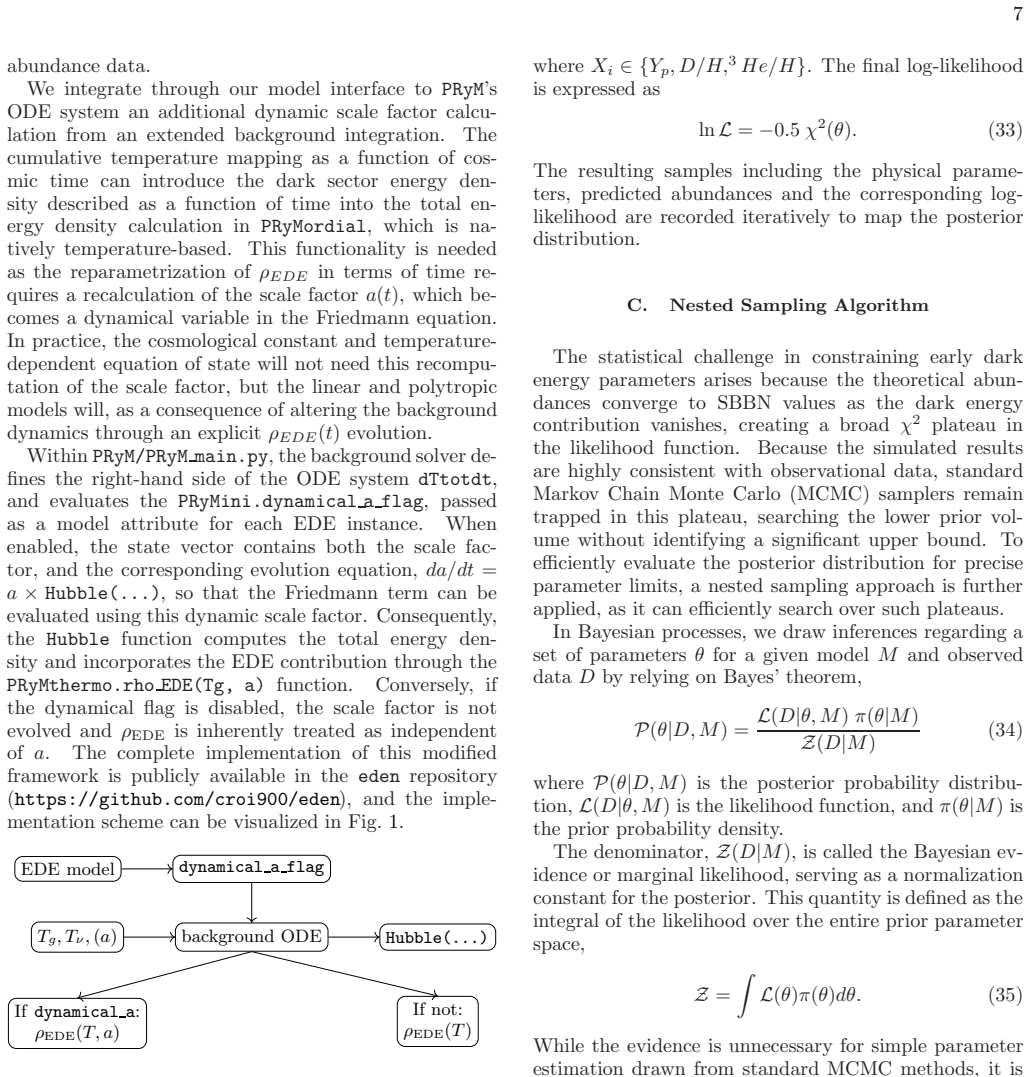
and in the early Universe, cosmic birefringence acts as a parity-violating signature of the dark sector [27, 28]. Other works that constrain EDE components by both DESI and ACT datasets, are mentioned [29–32]. Besides the CMB data constraints, Big Bang Nucle- osynthesis (BBN) can impose upper limits by measuring weak freeze-out deviations from a modified H...
-
[5]
The function R is extremely useful when considering open likelihoods, that is, when data only constrain the value of the parame- ters from below or from above
it was shown that there is a simple way to obtain prior-independent constraints by using Bayesian analy- sis, and by using the R function. The function R is extremely useful when considering open likelihoods, that is, when data only constrain the value of the parame- ters from below or from above. The obtained formal- ism was applied to the case of the an...
-
[6]
Linear Equation of State The simplest Early Dark Energy extension of the stan- dard ΛCDM model is obtained by assuming a linear equa- tion of state for dark energy, where the pressure of the dark energy component is strictly proportional to its en- ergy density through a constant equation of state param- eter w pDE (t) = wρDE (t), (12) where we specificall...
-
[7]
The pressure de- pends non-linearly on the energy density, governed by a polytropic constant K and an index γ, pDE (t) = Kρ γ DE (t)
Polytropic Equation of State Alternatively, we consider a polytropic equation of state for the Early Dark Energy, a formulation frequently used to model various physical fluids. The pressure de- pends non-linearly on the energy density, governed by a polytropic constant K and an index γ, pDE (t) = Kρ γ DE (t). (18) Under this assumption the conservation eq...
-
[8]
7255 K being the present-day CMB temper- ature
Temperature-Dependent Equation of State Finally, we explore a scenario where the dark energy equation of state evolves with temperature T alongside the thermal bath of particles, ρDE (T ) = ρDE, 0 ( T T0 ) 3(1+w(T )) , (24) with T0 = 2. 7255 K being the present-day CMB temper- ature. The equation of state is parameterized as follows pDE = w(T )ρDE , (25) ...
-
[9]
In this analysis, the parameter estima- tion process will rely exclusively on the primordial helium mass fraction Yp, deuterium and 3He abundance
(see Table I) allows us to determine strict limits on the EDE density. In this analysis, the parameter estima- tion process will rely exclusively on the primordial helium mass fraction Yp, deuterium and 3He abundance. We ex- clude Lithium-7 from the χ 2 likelihood calculations as the Lithium problem is highly debated in the literature, since Standard BBN ...
-
[10]
725 K. In contrast, the EDE component ρDE, 0 in the linear case or the constant C in the polytropic case can- not be directly inferred by observational data, which is due to the non-interacting nature of the models consid- ered. As the dark energy is minimally coupled to the standard plasma, it evolves independently according to its own equation of state ...
-
[11]
At iteration i, identify the live point θi with the lowest likelihood, denoted as Li
-
[12]
Remove this point from the active set and record its coordinates and likelihood
-
[13]
Estimate the shrinkage of the prior volume; on av- erage, the maximum of N random variables drawn uniformly from [0 , X i− 1] shrinks the volume by a factor of exp( − 1/N ), so that Xi ≈ exp(− i/N )
-
[14]
Compute the weight of the removed point, wi = Xi− 1 − Xi, and add its contribution to the numer- ical approximation of the evidence Z ≈ ∑Liwi
-
[15]
The iteration continues until a predefined convergence criterion is met, when the remaining evidence is a negli- gibly small fraction of the accumulated evidence Z
Sample a new point from the prior distribution, im- posing the strict constraint that its likelihood must exceed Li. The iteration continues until a predefined convergence criterion is met, when the remaining evidence is a negli- gibly small fraction of the accumulated evidence Z. As the sequence of prior volumes Xi is probabilistic, nested sampling contai...
-
[16]
07 × 10− 33 cm− 2
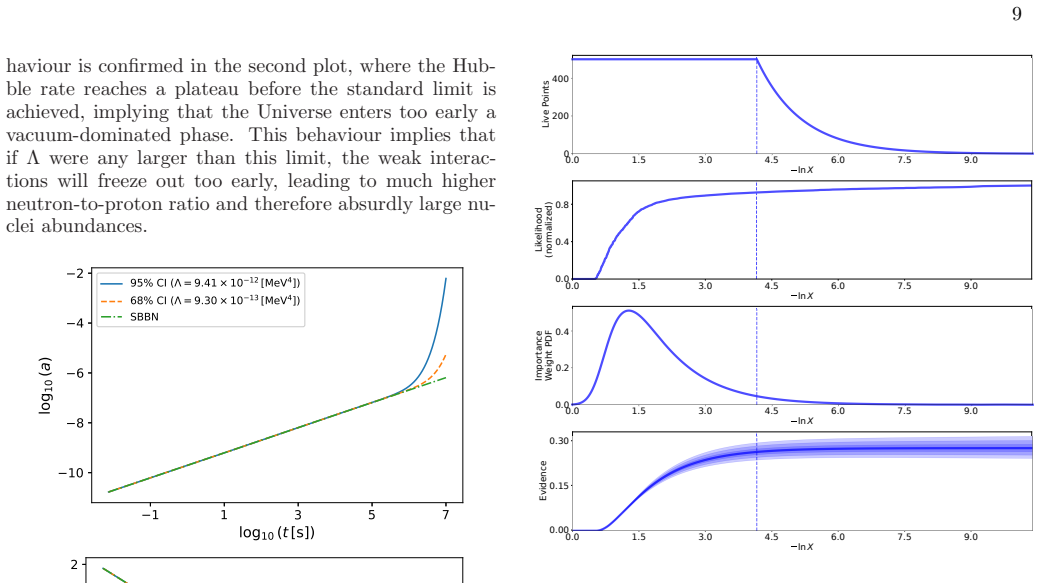
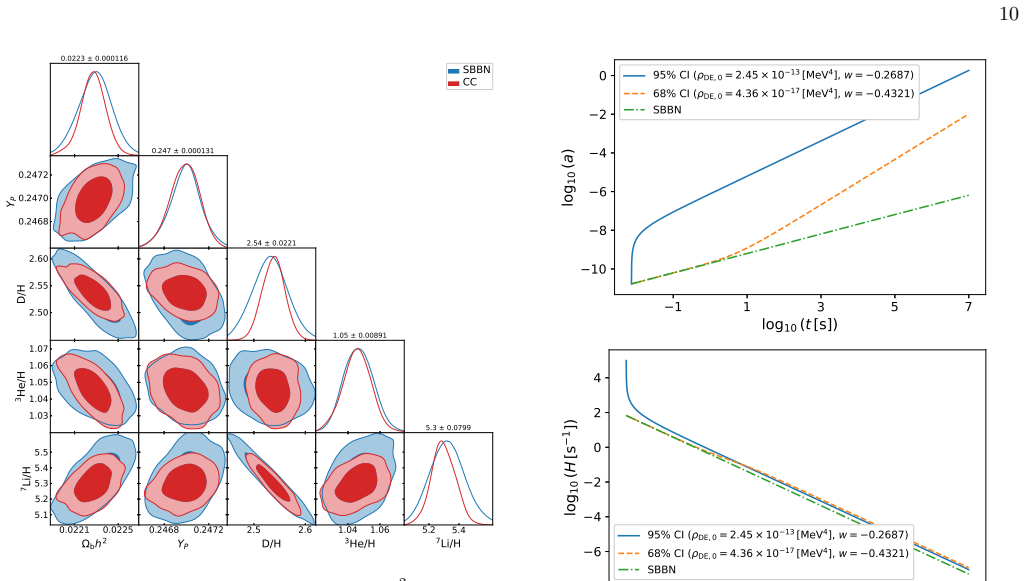
41 × 10− 12 MeV4 represents a physical geometric limit of Λ < 4. 07 × 10− 33 cm− 2. The effects of our upper bound on the cosmological constant Λ are shown in Fig. 2, which tracks the logarith- mic evolution of both the scale factor (top panel) and the Hubble rate (bottom panel) against the standard simula- tion trend obtained with no New Physics contribut...
-
[17]
The normalized likelihood increases fast up to a flat plateau, representing the parameter space that approaches the standard limit
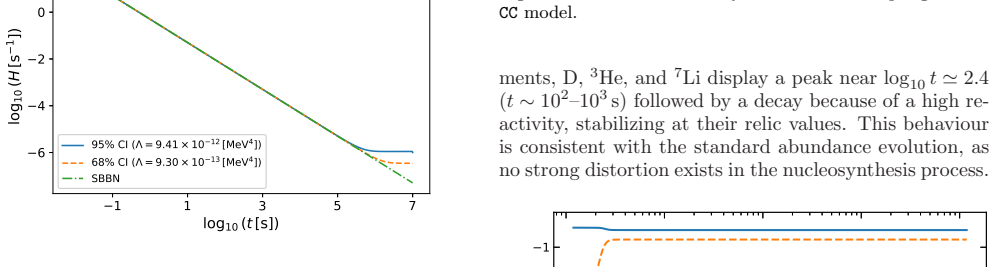
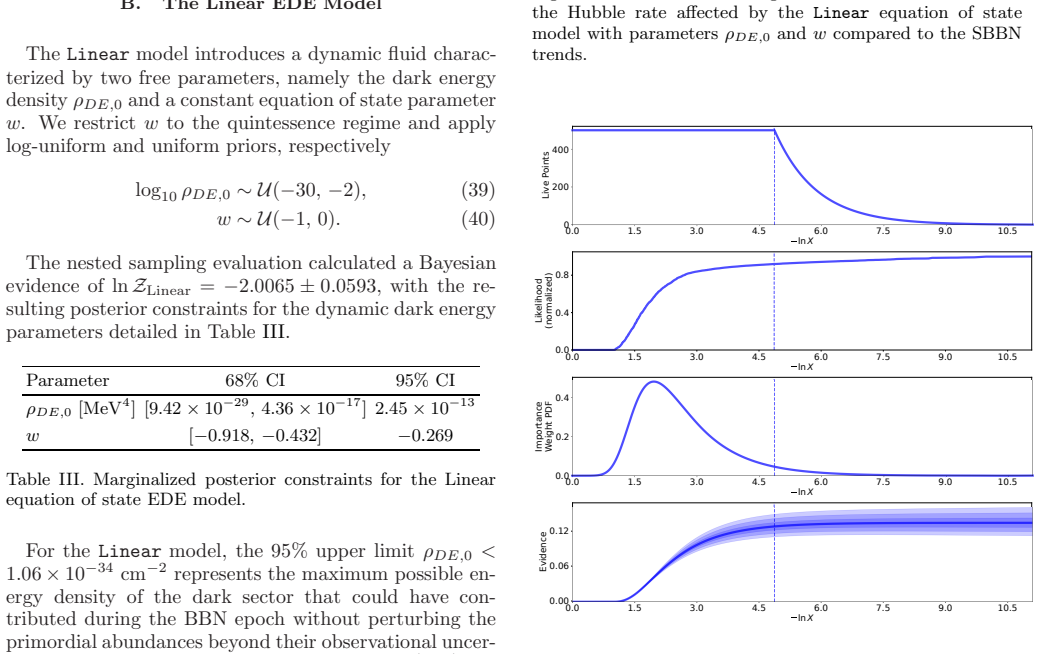
As the algorithm compresses the prior volume from left to right though − ln X, the number of live points remains constant initially and then decays as the sampler narrows the parameter search space. The normalized likelihood increases fast up to a flat plateau, representing the parameter space that approaches the standard limit. The real proof of convergen...
-
[19]
2472 Y P 0.0223 ± 0.000116
-
[20]
247 ± 0.000131 2.5 2.6 D/H 2.54 ± 0.0221 1.04 1.06 3 He/H 1.05 ± 0.00891
-
[21]
Nuclear abundances together with Ω bh2 for the CC model overlaid with SBBN results from PRyMordial
2 5.4 7 Li/H 5.3 ± 0.0799 SBBN CC Figure 5. Nuclear abundances together with Ω bh2 for the CC model overlaid with SBBN results from PRyMordial. B. The Linear EDE Model The Linear model introduces a dynamic fluid charac- terized by two free parameters, namely the dark energy density ρDE, 0 and a constant equation of state parameter w. We restrict w to the q...
-
[22]
As the energy density scales as a− 3(1+w), an equation of state parameter closer to zero would cause the dark sector’s density to act as pressureless matter
06 × 10− 34 cm− 2 represents the maximum possible en- ergy density of the dark sector that could have con- tributed during the BBN epoch without perturbing the primordial abundances beyond their observational uncer- tainties. As the energy density scales as a− 3(1+w), an equation of state parameter closer to zero would cause the dark sector’s density to a...
-
[23]
Figure 8 shows the abundances over time diagnostic for the Linear model
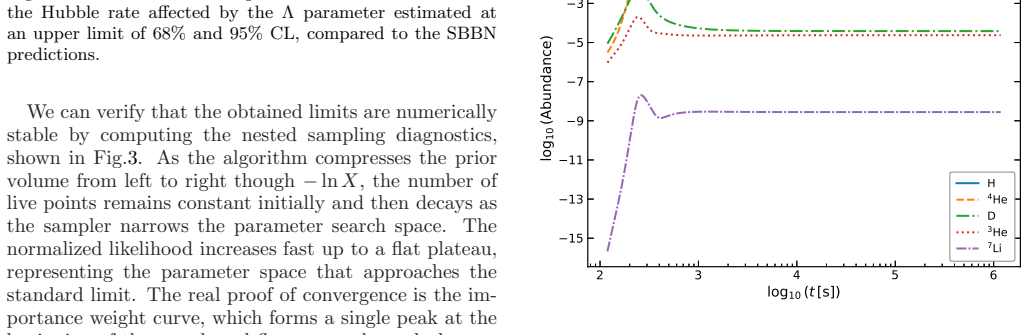
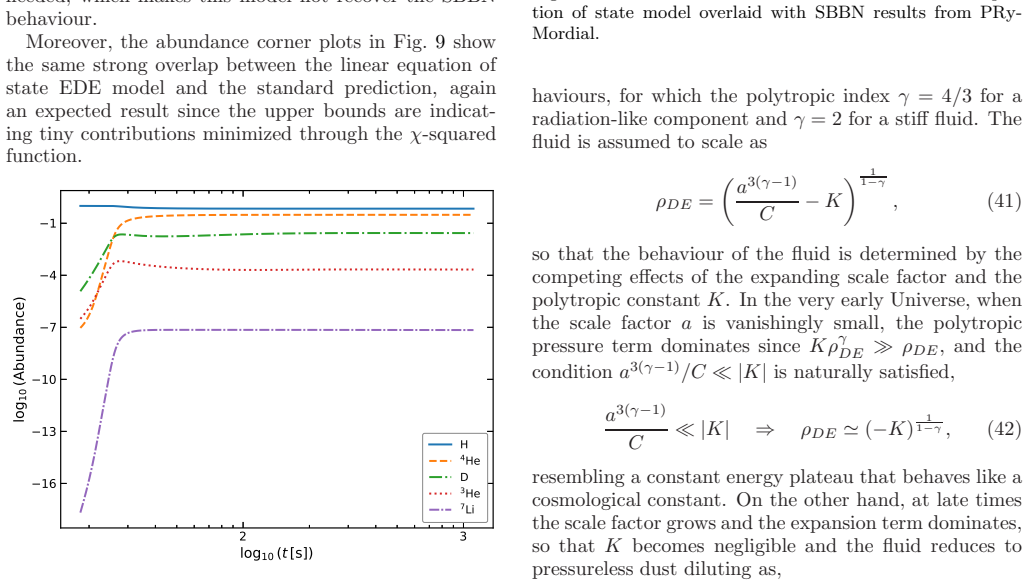
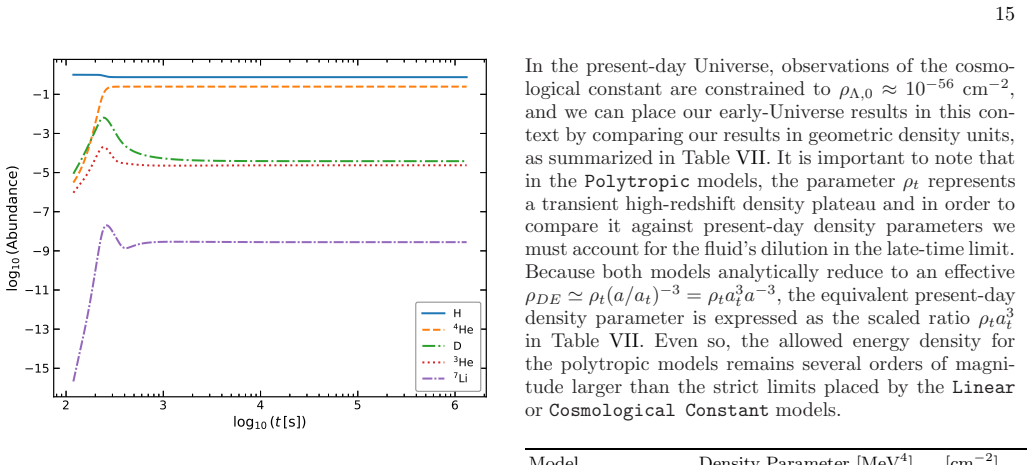
The same qualitative re- sult as in the CC model are indicating a clear prior volume exploration in the initial computing time, followed by a convergence towards a 95% confidence level upper bound. Figure 8 shows the abundances over time diagnostic for the Linear model. The evolutions of D, 3He and 7Li show no peaks and the synthesis timescale is shortened...
-
[24]
2 5.3 5.4 5.5 7 Li/H 1.02 1.04 1.06 3 He/H 2.50 2.55 2.60 D/H
-
[25]
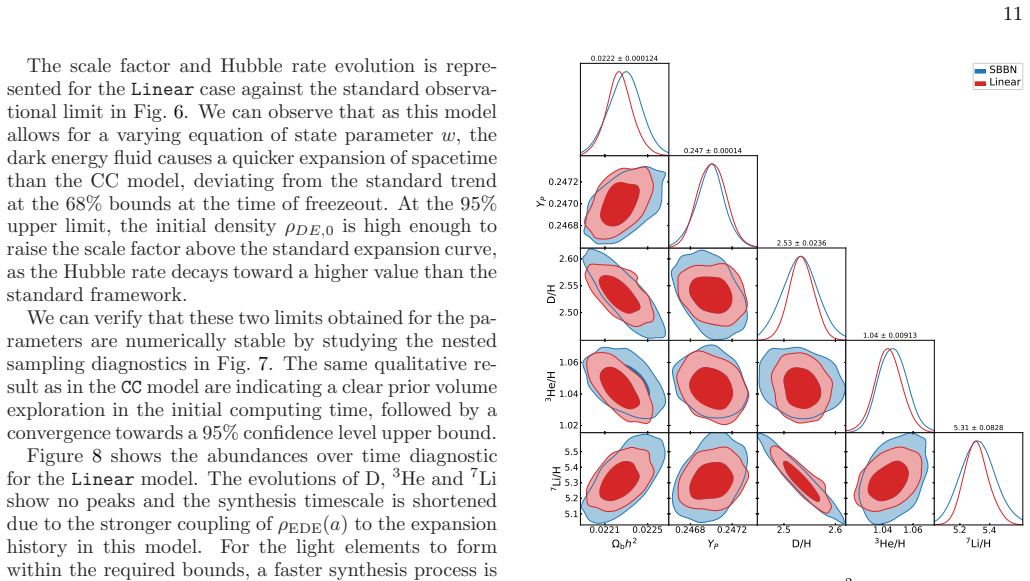
2472 Y P 0.0222 ± 0.000124
-
[26]
247 ± 0.00014 2.5 2.6 D/H 2.53 ± 0.0236 1.04 1.06 3 He/H 1.04 ± 0.00913
-
[27]
Nuclear abundances and Ω bh2 for the Linear equa- tion of state model overlaid with SBBN results from PRy- Mordial
2 5.4 7 Li/H 5.31 ± 0.0828 SBBN Linear Figure 9. Nuclear abundances and Ω bh2 for the Linear equa- tion of state model overlaid with SBBN results from PRy- Mordial. haviours, for which the polytropic index γ = 4 / 3 for a radiation-like component and γ = 2 for a stiff fluid. The fluid is assumed to scale as ρDE = ( a3(γ − 1) C − K ) 1 1− γ , (41) so that the...
-
[28]
During the early-time regime where a ≪ at, the dark energy density ρt is constant and domi- nates the early dynamics causing a rapid evolution of the scale factor, pushing it significantly above the standard history (top panel). Following the transitory regime, the evolution trend is similar to the SBBN expansion in terms of the Hubble rate because both mo...
-
[29]
2 5.3 5.4 5.5 7 Li/H 1.03 1.04 1.05 1.06 3 He/H 2.50 2.55 2.60 D/H
-
[30]
2472 Y P 2.50 2.55 D/H 1.04 1.06 3 He/H
2468 0. 2472 Y P 2.50 2.55 D/H 1.04 1.06 3 He/H
-
[31]
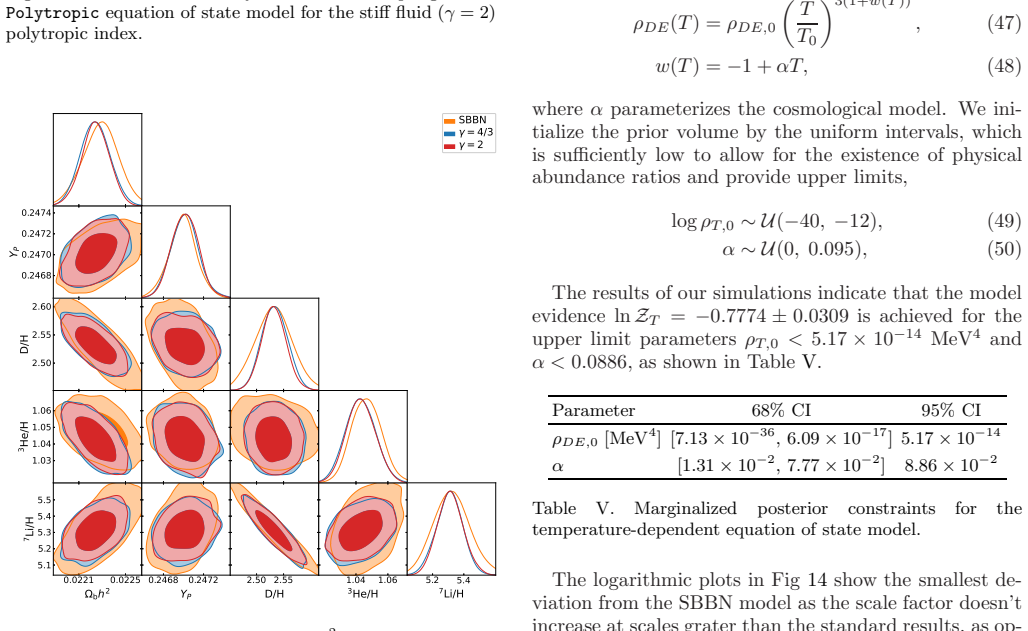
Nuclear abundances and Ω bh2 for the Polytropic equation of state with both radiation and stiff fluid models overlaid with SBBN results from PRyMordial
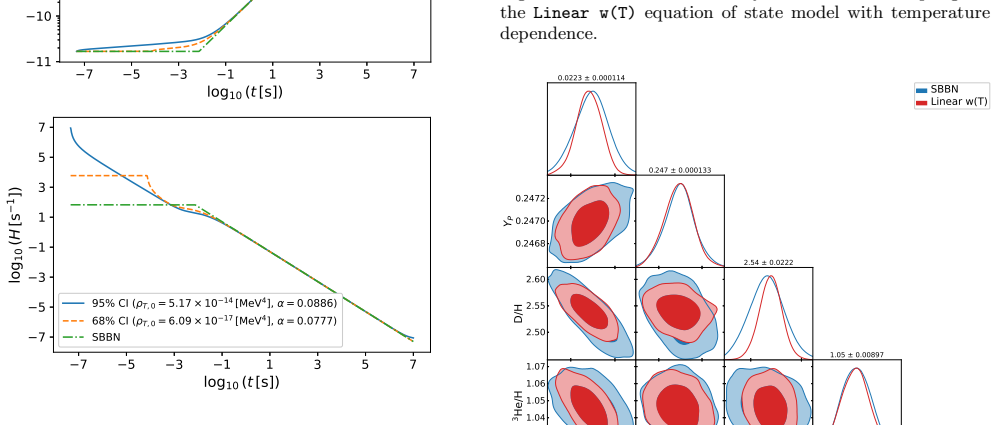
2 5.4 7 Li/H SBBN γ = 4/3 γ = 2 Figure 12. Nuclear abundances and Ω bh2 for the Polytropic equation of state with both radiation and stiff fluid models overlaid with SBBN results from PRyMordial. This allows us to write a linear temperature dependence 2 3 × 10 1 4 × 10 1 6 × 10 1 log 10 ( t [s]) −16 −13 −10 −7 −4 −1 log 10 (Abundance) Model γ = 2 γ = 4/3 Sp...
-
[32]
The summary of the model convergence shows a similar trend as for the other investigated models, dis- played in Fig. 15. Finally, Fig. 17 displays the temperature-dependent model and the CC case are the only scenarios that re- cover the standard BBN timescale and the characteristic maxima in abundances, as opposed to the Linear and Polytropic models, whic...
-
[33]
2 5.3 5.4 5.5 7 Li/H 1.03 1.04 1.05 1.06 1.07 3 He/H 2.50 2.55 2.60 D/H
-
[34]
2472 Y P 0.0223 ± 0.000114
-
[35]
247 ± 0.000133 2.5 2.6 D/H 2.54 ± 0.0222 1.04 1.06 3 He/H 1.05 ± 0.00897
-
[36]
Nuclear abundances and Ω bh2 for the temperature- dependent equation of state compared with the SBBN results from PRyMordial
29 ± 0.08 SBBN Linear w(T) Figure 16. Nuclear abundances and Ω bh2 for the temperature- dependent equation of state compared with the SBBN results from PRyMordial. sidered. We also studied the temperature evolution for a linear equation of state model, by including these modi- fications into the background equations of PRyMordial’s modeling of the first Fri...
-
[37]
A. G. Riess et al., Observational Evidence from Super- novae for an Accelerating Universe and a Cosmological Constant, Astron. J., 116, 1009, (1998)
1998
-
[38]
Perlmutter et al., Measurements of Ω and Λ from 42 High Redshift Supernovae , Astrophys
S. Perlmutter et al., Measurements of Ω and Λ from 42 High Redshift Supernovae , Astrophys. J., 517, 565, (1999)
1999
-
[39]
Aghanim et al., (Planck Collaboration), Planck 2018 results
N. Aghanim et al., (Planck Collaboration), Planck 2018 results. VI. Cosmological parameters, Astron. Astrophys. 641, A6 (2020)
2018
-
[40]
S. Alam et al., Completed SDSS-IV extended Baryon Os- cillation Spectroscopic Survey: Cosmological implicatio ns from two decades of spectroscopic surveys at the Apache Point Observatory , Phys. Rev. D, 103, 083533, (2021)
2021
-
[41]
A. G. Adame et al. (DESI), DESI 2024 VI: cosmologi- cal constraints from the measurements of baryon acoustic oscillations, JCAP 02, 021 (2025)
2024
-
[42]
Abdul Karim et al
M. Abdul Karim et al. (DESI), DESI DR2 Results II: Measurements of Baryon Acoustic Oscillations and Cosmological Constraints , Phys. Rev. D, 112, 083515, (2025)
2025
-
[43]
Calabrese et al
E. Calabrese et al. (ACT), The Atacama Cosmology Tele- scope: DR6 Constraints on Extended Cosmological Mod- els, JCAP, 2025, 063, (2025)
2025
-
[44]
Li, G.-H
T.-N. Li, G.-H. Du, S.-H. Zhou, Y.-H. Li, J.-F. Zhang, and X. Zhang, Robust evidence for dynamical dark energy in light of DESI DR2 and joint ACT, SPT, and Planck data, Physics of the Dark Universe 52, 102254 (2026)
2026
-
[45]
Capozziello, H
S. Capozziello, H. Chaudhary, T. Harko,and G.Mustafa, Is dark energy dynamical in the DESI era? A critical review, Physics of the Dark Universe 51, 102196 (2026)
2026
-
[46]
Di Valentino et al., In the realm of the Hubble tension- a review of solutions , Class
E. Di Valentino et al., In the realm of the Hubble tension- a review of solutions , Class. Quant. Grav., 38, 153001, (2021)
2021
-
[47]
Sch¨ oneberg et al., The H0 Olympics: A fair ranking of proposed models , Phys
N. Sch¨ oneberg et al., The H0 Olympics: A fair ranking of proposed models , Phys. Rept., 984, 1, (2022)
2022
-
[48]
Wetterich, Phenomenology of early dark energy , Phys
C. Wetterich, Phenomenology of early dark energy , Phys. Lett. B 594, 17 (2004)
2004
-
[49]
Doran and J
M. Doran and J. Robbers, Early dark energy cosmologies, JCAP 06, 026 (2006)
2006
-
[50]
Pettorino, L
V. Pettorino, L. Amendola, and C. Wetterich, How early is early dark energy? , Phys. Rev. D 87, 083009 (2013)
2013
-
[51]
Karwal and M
T. Karwal and M. Kamionkowski, Dark energy at early times, the Hubble parameter, and the string axiverse , Phys. Rev. D, 94, 103523, (2016)
2016
-
[52]
Poulin, T
V. Poulin, T. L. Smith, T. Karwal, and M. Kamionkowski, Early Dark Energy Can Resolve The Hubble Tension, Phys. Rev. Lett., 122, 22, (2019)
2019
-
[53]
M.-X. Lin, G. Benevento, W. Hu, and M. Raveri, Acous- tic Dark Energy: Potential Conversion of the Hubble Tension, Phys. Rev. D, 100, 063542, (2019)
2019
-
[54]
Niedermann and M
F. Niedermann and M. S. Sloth, New Early Dark Energy , Phys. Rev. D, 103, 043504, (2021)
2021
-
[55]
Agrawal, F.-Y
P. Agrawal, F.-Y. Cyr-Racine, D. Pinner, and L. Randall, Rock ’n ’ roll solutions to the Hubble tension , Phys. Dark Univ., 42, 101347, (2023)
2023
-
[56]
Kamionkowski and A
M. Kamionkowski and A. G. Riess, The Hubble Tension and Early Dark Energy , Ann. Rev. Nucl. Part. Sci., 73, 1, (2023)
2023
-
[57]
Poulin, T
V. Poulin, T. L. Smith, and T. Karwal, The Ups and Downs of Early Dark Energy solutions to the Hubble ten- sion: A review of models, hints and constraints circa 2023, Phys. Dark Univ., 42, 101348, (2023)
2023
-
[58]
Nojiri, S
S. Nojiri, S. D. Odintsov, and V. K. Oikonomou, Modified Gravity Theories on a Nutshell: Inflation, Bounce and Late-time Evolution , Phys. Rept., 692, 1, (2017)
2017
-
[59]
Y. Cai, S. Capozziello, M. De Laurentis, and E. N. Sari- dakis, f(T) teleparallel gravity and cosmology, Rept. Prog. Phys., 79, 106901, (2016)
2016
-
[60]
Braglia, M
M. Braglia, M. Ballardini, F. Finelli, and K. Koyama, Early modified gravity in light of the H0 tension and LSS data, Phys. Rev. D, 103, 043528, (2021)
2021
-
[61]
Franco Abell´ an et al., Probing early modification of gravity with Planck, ACT and SPT , JCAP, 12, 017, (2023)
G. Franco Abell´ an et al., Probing early modification of gravity with Planck, ACT and SPT , JCAP, 12, 017, (2023)
2023
-
[62]
M. Najafi et al., When Dark Energy Turns On: Constraints on a Critical Emergence Model , arXiv, 2603.13137, (2026)
-
[63]
Kochappan et al., Observational evidence for early dark energy as a unified explanation for cosmic birefrin- gence and the Hubble tension , Phys
J. Kochappan et al., Observational evidence for early dark energy as a unified explanation for cosmic birefrin- gence and the Hubble tension , Phys. Rev. D, 112, 063562 (2025)
2025
-
[64]
L. Yin, G.-H. Du, T.-N. Li, and X. Zhang, Joint constraints on cosmic birefringence and early dark en- ergy from ACT, Planck, DESI, and PantheonPlus , arXiv:2601.13624 (2026)
-
[65]
Lodha et al., Extended dark energy analysis using DESI DR2 BAO measurements , Phys
K. Lodha et al., Extended dark energy analysis using DESI DR2 BAO measurements , Phys. Rev. D 112, 083511 (2025)
2025
-
[66]
Chaussidon et al., Early time solution as an alterna- tive to the late time evolving dark energy with DESI DR2 BAO, Phys
E. Chaussidon et al., Early time solution as an alterna- tive to the late time evolving dark energy with DESI DR2 BAO, Phys. Rev. D 112, 063548 (2025)
2025
-
[67]
F. J. Qu, K. M. Surrao, B. Bolliet, J. C. Hill, B. D. Sherwin, and H. T. Jense, Accelerated inference on accel- erated cosmic expansion: New constraints on axionlike early dark energy with DESI BAO and ACT DR6 CMB lensing, Phys. Rev. D 111, 123507 (2025)
2025
-
[68]
H. Wang and Y.-S. Piao, Dark energy after pre- recombination early dark energy in light of DESI DR2 and the latest ACT and SPT data , arXiv:2511.16606 (2025)
-
[69]
R. A. Alpher, H. Bethe, and G. Gamow, The Origin of Chemical Elements , Phys. Rev., 73, 7, (1948)
1948
-
[70]
C. Copi, D. Schramm, M. Turner, Big-bang nucleosynthe- sis and the baryon density of the universe , Science 5195, 192 (1995)
1995
-
[71]
J. P. Kneller, Gary Steigman, BBN for pedestrians , New J. Phys. 6, 117 (2004). 18
2004
-
[72]
B. D. Fields, K. A. Olive, Big bang nucleosynthesis , Nu- clear Physics A 777, 208 (2006)
2006
-
[73]
Steigman, Primordial Nucleosynthesis in the Preci- sion Cosmology Era , Annu
G. Steigman, Primordial Nucleosynthesis in the Preci- sion Cosmology Era , Annu. Rev. Nucl. Part. Sci. 57, 463 (2007)
2007
-
[74]
R. H. Cyburt, B. D. Fields, K. A. Olive, and T.-H. Yeh, Big Bang Nucleosynthesis , Rev. Mod. Phys., 88, 015004, (2016)
2016
-
[75]
R. J. Cooke, M. Pettini, and C. C. Steidel, One Percent Determination of the Primordial Deuterium Abundance , Astrophys. J. 855, 102 (2018)
2018
-
[76]
Aver et al., Improving helium abundance determina- tions with Leo P as a case study , JCAP 03, 027 (2021)
E. Aver et al., Improving helium abundance determina- tions with Leo P as a case study , JCAP 03, 027 (2021)
2021
-
[77]
B. D. Fields, K. A. Olive, T.-H. Yeh, and C. Young, Big-Bang Nucleosynthesis after Planck , JCAP, 03, 010, (2020)
2020
-
[78]
Allahverdi et al., The First Three Seconds: a Review of Possible Expansion Histories of the Early Universe , Open J
R. Allahverdi et al., The First Three Seconds: a Review of Possible Expansion Histories of the Early Universe , Open J. Astrophys., 4(1), 1, (2021)
2021
-
[79]
Navas et al
S. Navas et al. (Particle Data Group), Phys. Rev. D 110, 030001, (2024)
2024
-
[80]
B. D. Fields, The primordial lithium problem , Ann. Rev. Nucl. Part. Sci., 61, 47, (2011)
2011
-
[81]
D. I. Santiago, D. Kalligas, and C. W. F. Everitt, Constraints on the scalar-tensor theories of gravitation from primordial nucleosynthesis , Phys. Rev. D 54, 3750 (1996)
1996
discussion (0)
Sign in with ORCID, Apple, or X to comment. Anyone can read and Pith papers without signing in.