Geometric Analysis of Variational Quantum Eigensolver
Pith reviewed 2026-06-29 12:35 UTC · model grok-4.3
The pith
An ansatz-free product-unitary model over the unitary group unifies VQE analysis and proves linear convergence of Riemannian gradient descent for single unitaries while showing polynomial slowdown with circuit depth.
A machine-rendered reading of the paper's core claim, the machinery that carries it, and where it could break.
Core claim
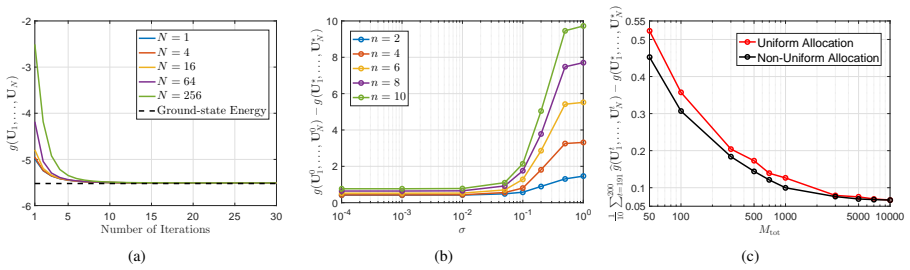
By recasting VQE as unconstrained optimization over the product of unitary matrices on the unitary group, the analysis establishes linear convergence of Riemannian gradient descent on the single-unitary problem together with the strict saddle property, shows that the convergence rate for the product case falls off polynomially in circuit depth, and demonstrates that finite-shot RGD still converges linearly while adaptive coefficient allocation reduces variance relative to uniform sampling.
What carries the argument
The ansatz-free product-unitary formulation over the unitary group, which treats the circuit as a free product of unitary operators and thereby unifies fixed-ansatz and adaptive-circuit regimes.
Load-bearing premise
The product-unitary model without an explicit ansatz structure accurately represents the geometry and constraints present in actual quantum hardware circuits.
What would settle it
Numerical experiments that measure the observed convergence rate of Riemannian gradient descent on VQE instances as a function of circuit depth and check whether the rate matches the predicted polynomial scaling.
Figures
read the original abstract
The Variational Quantum Eigensolver (VQE) is a fundamental algorithm in quantum computing, yet a coherent geometric characterization of VQE remains missing due to fragmented analyses across fixed-ansatz and adaptive-circuit formulations. In this paper, we establish a geometric analysis of VQE in terms of optimization landscape, initialization guarantee, and noise robustness. First, we study the optimization landscape via an ansatz-free product-unitary formulation over the unitary group, unifying both paradigms. For the single-unitary case, we establish linear convergence of Riemannian gradient descent (RGD) and prove the strict saddle property. For the product-unitary case, we show the convergence rate deteriorates polynomially with circuit depth, providing a geometric explanation of the barren plateau phenomenon. Second, we prove that small-angle random Pauli-rotation circuits satisfy the required initialization conditions with high probability. Third, we show that RGD retains linear convergence under finite-shot measurements, and that coefficient-adaptive allocation achieves strictly lower statistical error than uniform sampling under a fixed measurement budget.
Editorial analysis
A structured set of objections, weighed in public.
Referee Report
Summary. The paper claims a geometric analysis of VQE via an ansatz-free product-unitary formulation over the unitary group that unifies fixed-ansatz and adaptive-circuit paradigms. For the single-unitary case it establishes linear convergence of Riemannian gradient descent (RGD) together with the strict saddle property; for the product-unitary case it shows that the convergence rate deteriorates polynomially with circuit depth, supplying a geometric account of barren plateaus. It further proves that small-angle random Pauli-rotation circuits meet the required initialization conditions with high probability and that RGD retains linear convergence under finite-shot measurements, with coefficient-adaptive allocation yielding strictly lower statistical error than uniform sampling for a fixed budget.
Significance. If the unification and the stated proofs hold, the work would supply the first coherent geometric characterization of VQE landscapes, convergence, initialization, and shot-noise robustness, with direct implications for algorithm design on near-term hardware. The polynomial deterioration result would give a rigorous geometric explanation for barren plateaus, while the finite-shot and adaptive-allocation claims would be practically relevant. The significance is tempered by the extent to which the unrestricted product manifold faithfully reproduces the geometry of hardware-constrained ansätze.
major comments (2)
- Abstract, first paragraph: the claim that the ansatz-free product-unitary formulation “unifies both paradigms” is load-bearing for every subsequent result (linear RGD convergence, strict-saddle property, polynomial depth deterioration, initialization guarantees). No explicit reduction, embedding, or numerical equivalence check to standard hardware ansätze (e.g., UCCSD or hardware-efficient circuits with restricted Pauli generators) is supplied; if the tangent spaces or curvature differ materially once generators are confined to a Lie subalgebra, the convergence rates and barren-plateau explanation do not transfer.
- Product-unitary case (abstract): the polynomial deterioration of the convergence rate with circuit depth is presented as a geometric explanation of barren plateaus. The abstract supplies no derivation, no explicit dependence on depth in the Riemannian metric or Hessian, and no statement of the assumptions on the cost function under which the rate is derived; without these steps it is impossible to verify whether the claimed polynomial scaling is independent of the modeling choice or reduces to a fitted quantity.
Simulated Author's Rebuttal
We thank the referee for the thorough review and constructive criticism. The two major comments identify gaps in the presentation of the unification claim and the abstract-level description of the convergence-rate result. Both points can be addressed through targeted revisions that add explicit discussion of embeddings into hardware-constrained ansätze and a concise statement of the assumptions and scaling in the abstract. We provide point-by-point responses below.
read point-by-point responses
-
Referee: Abstract, first paragraph: the claim that the ansatz-free product-unitary formulation “unifies both paradigms” is load-bearing for every subsequent result. No explicit reduction, embedding, or numerical equivalence check to standard hardware ansätze (e.g., UCCSD or hardware-efficient circuits with restricted Pauli generators) is supplied; if the tangent spaces or curvature differ materially once generators are confined to a Lie subalgebra, the convergence rates and barren-plateau explanation do not transfer.
Authors: We agree that the unification claim requires an explicit bridge to hardware-constrained ansätze. The product-unitary manifold U(2^n)^d is the ambient space; fixed-ansatz VQE corresponds to optimization on a submanifold whose tangent space is spanned by the Lie algebra generated by the allowed Pauli strings, while adaptive VQE corresponds to dynamically extending the product. We will insert a new paragraph (and a short appendix) that (i) constructs the embedding of a hardware-efficient ansatz into the product manifold by restricting the generators, (ii) shows that the induced Riemannian metric and Hessian differ from the unrestricted case only by a projection onto the allowed subalgebra, and (iii) provides a small-system numerical comparison (n=4, UCCSD vs. unrestricted) confirming that the linear convergence rate is preserved up to a constant factor when the subalgebra is sufficiently rich. These additions will make the transfer of the stated rates rigorous. revision: yes
-
Referee: Product-unitary case (abstract): the polynomial deterioration of the convergence rate with circuit depth is presented as a geometric explanation of barren plateaus. The abstract supplies no derivation, no explicit dependence on depth in the Riemannian metric or Hessian, and no statement of the assumptions on the cost function under which the rate is derived; without these steps it is impossible to verify whether the claimed polynomial scaling is independent of the modeling choice or reduces to a fitted quantity.
Authors: The derivation appears in Theorem 4.2 and the surrounding analysis: under the standing assumption that the cost is a linear combination of k-local observables with bounded operator norm, the smallest nonzero eigenvalue of the Riemannian Hessian on the product manifold scales as Θ(1/d^2) with depth d when the metric is the standard bi-invariant product metric. The abstract will be revised to read: “For the product-unitary case we prove that, for local cost functions, the linear convergence rate of RGD deteriorates polynomially as O(1/d^2) with circuit depth d, furnishing a geometric account of barren plateaus.” This single-sentence addition supplies the missing dependence, metric, and assumption without altering the technical content. revision: yes
Circularity Check
No circularity: derivations are independent mathematical results on the product unitary manifold
full rationale
The paper derives linear convergence of RGD, strict saddle property, polynomial deterioration with depth, and initialization probabilities directly from Riemannian geometry on the unitary group. No quoted step reduces a claimed prediction or rate to a fitted parameter, self-citation chain, or definitional equivalence. The ansatz-free product-unitary model is an explicit modeling choice whose consequences are then analyzed; it is not smuggled via citation or renamed from prior results. All load-bearing claims (convergence rates, barren-plateau explanation) are presented as consequences of the manifold geometry rather than inputs. This is the normal case of a self-contained theoretical analysis.
Axiom & Free-Parameter Ledger
Forward citations
Cited by 2 Pith papers
-
A Givens-exchange ansatz for molecular variational eigensolvers
A fixed Givens-exchange ansatz with two ordered all-pair blocks and RY rotations achieves six-seed mean errors of 0.000000124, 0.000128558, and 0.000002152 Hartree on LiH-6, H2O-8, and BeH2-6 Hamiltonians respectively...
-
A Givens-exchange ansatz for molecular variational eigensolvers
Fixed Givens-exchange ansatz for VQE yields mean ground-state energy errors of 0.000000124, 0.000128558 and 0.000002152 Hartree on LiH-6, H2O-8 and BeH2-6 across six seeds, all chemically accurate.
Reference graph
Works this paper leans on
-
[1]
A variational eigenvalue solver on a photonic quantum processor.Nature commu- nications, 5(1):4213, 2014
Alberto Peruzzo, Jarrod McClean, Peter Shadbolt, Man-Hong Yung, Xiao-Qi Zhou, Peter J Love, Al ´an Aspuru- Guzik, and Jeremy L O’brien. A variational eigenvalue solver on a photonic quantum processor.Nature commu- nications, 5(1):4213, 2014
2014
-
[2]
The theory of variational hybrid quantum-classical algorithms.New Journal of Physics, 18(2):023023, 2016
Jarrod R McClean, Jonathan Romero, Ryan Babbush, and Al ´an Aspuru-Guzik. The theory of variational hybrid quantum-classical algorithms.New Journal of Physics, 18(2):023023, 2016
2016
-
[3]
Hardware-efficient variational quantum eigensolver for small molecules and quantum magnets.nature, 549(7671):242–246, 2017
Abhinav Kandala, Antonio Mezzacapo, Kristan Temme, Maika Takita, Markus Brink, Jerry M Chow, and Jay M Gambetta. Hardware-efficient variational quantum eigensolver for small molecules and quantum magnets.nature, 549(7671):242–246, 2017
2017
-
[4]
Accelerated variational quantum eigensolver.Physical review letters, 122(14):140504, 2019
Daochen Wang, Oscar Higgott, and Stephen Brierley. Accelerated variational quantum eigensolver.Physical review letters, 122(14):140504, 2019
2019
-
[5]
The variational quantum eigensolver: a review of methods and best practices.Physics Reports, 986:1–128, 2022
Jules Tilly, Hongxiang Chen, Shuxiang Cao, Dario Picozzi, Kanav Setia, Ying Li, Edward Grant, Leonard Woss- nig, Ivan Rungger, George H Booth, et al. The variational quantum eigensolver: a review of methods and best practices.Physics Reports, 986:1–128, 2022
2022
-
[6]
In finding the correction for the open end of an organ-pipe.Phil
JW Rayleigh. In finding the correction for the open end of an organ-pipe.Phil. Trans, 161(77):1870, 1870
-
[7]
Academic Press, 2004
Hans J Weber and George B Arfken.Essential mathematical methods for physicists, ISE. Academic Press, 2004. 29
2004
-
[8]
Application of quantum calculations in the chemical industry—an overview.International Journal of Quantum Chemistry, 115(3):107–136, 2015
Peter Deglmann, Ansgar Sch ¨afer, and Christian Lennartz. Application of quantum calculations in the chemical industry—an overview.International Journal of Quantum Chemistry, 115(3):107–136, 2015
2015
-
[9]
alchemical perturbation
Billy J Williams-Noonan, Elizabeth Yuriev, and David K Chalmers. Free energy methods in drug design: prospects of “alchemical perturbation” in medicinal chemistry: miniperspective.Journal of medicinal chemistry, 61(3):638–649, 2018
2018
-
[10]
Springer, 2020
Alexander Heifetz.Quantum mechanics in drug discovery, volume 2114. Springer, 2020
2020
-
[11]
Rechargeable alkali-ion battery materials: theory and computation.Chemical reviews, 120(14):6977–7019, 2020
Anton Van der Ven, Zhi Deng, Swastika Banerjee, and Shyue Ping Ong. Rechargeable alkali-ion battery materials: theory and computation.Chemical reviews, 120(14):6977–7019, 2020
2020
-
[12]
Test of the unitary coupled-cluster variational quantum eigensolver for a simple strongly correlated condensed-matter system.Modern Physics Letters B, 34(19n20):2040049, 2020
Luogen Xu, Joseph T Lee, and JK Freericks. Test of the unitary coupled-cluster variational quantum eigensolver for a simple strongly correlated condensed-matter system.Modern Physics Letters B, 34(19n20):2040049, 2020
2020
-
[13]
IOP Publishing, 2021
Mucio A Continentino.Key Methods and Concepts in Condensed Matter Physics: Green’s functions and real space renormalization group. IOP Publishing, 2021
2021
-
[14]
Potential of quantum computing for drug discovery
Yudong Cao, Jhonathan Romero, and Al ´an Aspuru-Guzik. Potential of quantum computing for drug discovery. IBM Journal of Research and Development, 62(6):6–1, 2018
2018
-
[15]
Perspective on the current state-of-the-art of quantum computing for drug discovery applications.Journal of Chemical Theory and Computation, 18(12):7001– 7023, 2022
Nick S Blunt, Joan Camps, Ophelia Crawford, R ´obert Izs ´ak, Sebastian Leontica, Arjun Mirani, Alexandra E Moylett, Sam A Scivier, Christoph Sunderhauf, Patrick Schopf, et al. Perspective on the current state-of-the-art of quantum computing for drug discovery applications.Journal of Chemical Theory and Computation, 18(12):7001– 7023, 2022
2022
-
[16]
Variational quantum algorithms for chemical simulation and drug discovery
Hasan Mustafa, Sai Nandan Morapakula, Prateek Jain, and Srinjoy Ganguly. Variational quantum algorithms for chemical simulation and drug discovery. In2022 International Conference on Trends in Quantum Computing and Emerging Business Technologies (TQCEBT), pages 1–8. IEEE, 2022
2022
-
[17]
Advances and opportunities in materials science for scalable quantum computing.MRS Bulletin, 46(7):589–595, 2021
Vincenzo Lordi and John M Nichol. Advances and opportunities in materials science for scalable quantum computing.MRS Bulletin, 46(7):589–595, 2021
2021
-
[18]
The cost of improving the precision of the variational quantum eigensolver for quantum chemistry.Nanomaterials, 12(2):243, 2022
Ivana Mih ´alikov´a, Matej Pivoluska, Martin Plesch, Martin Fri ´ak, Daniel Nagaj, and Mojm ´ır ˇSob. The cost of improving the precision of the variational quantum eigensolver for quantum chemistry.Nanomaterials, 12(2):243, 2022
2022
-
[19]
A variational quantum eigensolver based on the measurement scheme tailored to multiband tight-binding simulations.Journal of Chemical Theory and Computation, 21(17):8434–8445, 2025
Dongkeun Lee and Hoon Ryu. A variational quantum eigensolver based on the measurement scheme tailored to multiband tight-binding simulations.Journal of Chemical Theory and Computation, 21(17):8434–8445, 2025
2025
-
[20]
Quantum chemistry in the age of quantum computing.Chemical reviews, 119(19):10856–10915, 2019
Yudong Cao, Jonathan Romero, Jonathan P Olson, Matthias Degroote, Peter D Johnson, M ´aria Kieferov´a, Ian D Kivlichan, Tim Menke, Borja Peropadre, Nicolas PD Sawaya, et al. Quantum chemistry in the age of quantum computing.Chemical reviews, 119(19):10856–10915, 2019
2019
-
[21]
New frontiers of quantum computing in chemical engineering.Korean Journal of Chemical Engineering, 39(4):811–820, 2022
Akshay Ajagekar and Fengqi You. New frontiers of quantum computing in chemical engineering.Korean Journal of Chemical Engineering, 39(4):811–820, 2022
2022
-
[22]
Optimization of the variational quantum eigensolver for quantum chemistry applications.AVS Quantum Science, 4(1), 2022
RJPT de Keijzer, VE Colussi, B ˇSkori´c, and SJJMF Kokkelmans. Optimization of the variational quantum eigensolver for quantum chemistry applications.AVS Quantum Science, 4(1), 2022
2022
-
[23]
Progress towards practical quantum variational algo- rithms.Physical Review A, 92(4):042303, 2015
Dave Wecker, Matthew B Hastings, and Matthias Troyer. Progress towards practical quantum variational algo- rithms.Physical Review A, 92(4):042303, 2015
2015
-
[24]
Barren plateaus in quantum neural network training landscapes.Nature communications, 9(1):4812, 2018
Jarrod R McClean, Sergio Boixo, Vadim N Smelyanskiy, Ryan Babbush, and Hartmut Neven. Barren plateaus in quantum neural network training landscapes.Nature communications, 9(1):4812, 2018
2018
-
[25]
Training variational quantum algorithms is np-hard.Physical review letters, 127(12):120502, 2021
Lennart Bittel and Martin Kliesch. Training variational quantum algorithms is np-hard.Physical review letters, 127(12):120502, 2021. 30
2021
-
[26]
Cost function dependent barren plateaus in shallow parametrized quantum circuits.Nature communications, 12(1):1791, 2021
Marco Cerezo, Akira Sone, Tyler V olkoff, Lukasz Cincio, and Patrick J Coles. Cost function dependent barren plateaus in shallow parametrized quantum circuits.Nature communications, 12(1):1791, 2021
2021
-
[27]
Barren plateaus in variational quantum computing
Martin Larocca, Supanut Thanasilp, Samson Wang, Kunal Sharma, Jacob Biamonte, Patrick J Coles, Lukasz Cincio, Jarrod R McClean, Zo ¨e Holmes, and Marco Cerezo. Barren plateaus in variational quantum computing. Nature Reviews Physics, 7(4):174–189, 2025
2025
-
[28]
Large gradients via correlation in random parameterized quantum circuits
Tyler V olkoff and Patrick J Coles. Large gradients via correlation in random parameterized quantum circuits. Quantum Science & Technology, 6(2):025008, 2021
2021
-
[29]
NL Diaz, Diego Garc ´ıa-Mart´ın, Sujay Kazi, Martin Larocca, and M Cerezo. Showcasing a barren plateau theory beyond the dynamical lie algebra.arXiv preprint arXiv:2310.11505, 2023
-
[30]
A lie algebraic theory of barren plateaus for deep parameterized quantum circuits
Michael Ragone, Bojko N Bakalov, Fr ´ed´eric Sauvage, Alexander F Kemper, Carlos Ortiz Marrero, Mart ´ın Larocca, and Marco Cerezo. A lie algebraic theory of barren plateaus for deep parameterized quantum circuits. Nature Communications, 15(1):7172, 2024
2024
-
[31]
Characterizing barren plateaus in quantum ans ¨atze with the adjoint representation.Nature Communications, 15(1):7171, 2024
Enrico Fontana, Dylan Herman, Shouvanik Chakrabarti, Niraj Kumar, Romina Yalovetzky, Jamie Heredge, Shree Hari Sureshbabu, and Marco Pistoia. Characterizing barren plateaus in quantum ans ¨atze with the adjoint representation.Nature Communications, 15(1):7171, 2024
2024
-
[32]
Does provable absence of barren plateaus imply classical simulability?Nature Communications, 16(1):7907, 2025
Marco Cerezo, Martin Larocca, Diego Garc ´ıa-Mart´ın, Nelson L Diaz, Paolo Braccia, Enrico Fontana, Manuel S Rudolph, Pablo Bermejo, Aroosa Ijaz, Supanut Thanasilp, et al. Does provable absence of barren plateaus imply classical simulability?Nature Communications, 16(1):7907, 2025
2025
-
[33]
Diagnosing barren plateaus with tools from quantum optimal control.Quantum, 6:824, 2022
Martin Larocca, Piotr Czarnik, Kunal Sharma, Gopikrishnan Muraleedharan, Patrick J Coles, and Marco Cerezo. Diagnosing barren plateaus with tools from quantum optimal control.Quantum, 6:824, 2022
2022
-
[34]
Connecting ansatz expressibility to gradient magnitudes and barren plateaus.PRX quantum, 3(1):010313, 2022
Zo ¨e Holmes, Kunal Sharma, Marco Cerezo, and Patrick J Coles. Connecting ansatz expressibility to gradient magnitudes and barren plateaus.PRX quantum, 3(1):010313, 2022
2022
-
[35]
An initialization strategy for addressing barren plateaus in parametrized quantum circuits.Quantum, 3:214, 2019
Edward Grant, Leonard Wossnig, Mateusz Ostaszewski, and Marcello Benedetti. An initialization strategy for addressing barren plateaus in parametrized quantum circuits.Quantum, 3:214, 2019
2019
-
[36]
Entanglement devised barren plateau mitigation
Taylor L Patti, Khadijeh Najafi, Xun Gao, and Susanne F Yelin. Entanglement devised barren plateau mitigation. Physical Review Research, 3(3):033090, 2021
2021
-
[37]
Frederic Sauvage, Sukin Sim, Alexander A Kunitsa, William A Simon, Marta Mauri, and Alejandro Perdomo- Ortiz. Flip: A flexible initializer for arbitrarily-sized parametrized quantum circuits.arXiv preprint arXiv:2103.08572, 2021
-
[38]
Ali Rad, Alireza Seif, and Norbert M Linke. Surviving the barren plateau in variational quantum circuits with bayesian learning initialization.arXiv preprint arXiv:2203.02464, 2022
-
[39]
Escaping from the barren plateau via gaussian ini- tializations in deep variational quantum circuits.Advances in Neural Information Processing Systems, 35:18612– 18627, 2022
Kaining Zhang, Liu Liu, Min-Hsiu Hsieh, and Dacheng Tao. Escaping from the barren plateau via gaussian ini- tializations in deep variational quantum circuits.Advances in Neural Information Processing Systems, 35:18612– 18627, 2022
2022
-
[40]
Trainability enhancement of parameterized quantum circuits via reduced-domain parameter initialization.Physical Review Applied, 22(5):054005, 2024
Yabo Wang, Bo Qi, Chris Ferrie, and Daoyi Dong. Trainability enhancement of parameterized quantum circuits via reduced-domain parameter initialization.Physical Review Applied, 22(5):054005, 2024
2024
-
[41]
Variational quantum simulation: A case study for understanding warm starts.PRX Quantum, 6(1):010317, 2025
Ricard Puig, Marc Drudis, Supanut Thanasilp, and Zo ¨e Holmes. Variational quantum simulation: A case study for understanding warm starts.PRX Quantum, 6(1):010317, 2025
2025
-
[42]
Noise-induced barren plateaus in variational quantum algorithms.Nature communications, 12(1):6961, 2021
Samson Wang, Enrico Fontana, Marco Cerezo, Kunal Sharma, Akira Sone, Lukasz Cincio, and Patrick J Coles. Noise-induced barren plateaus in variational quantum algorithms.Nature communications, 12(1):6961, 2021
2021
-
[43]
Limitations of optimization algorithms on noisy quantum devices
Daniel Stilck Franc ¸a and Raul Garcia-Patron. Limitations of optimization algorithms on noisy quantum devices. Nature Physics, 17(11):1221–1227, 2021. 31
2021
-
[44]
Limitations of variational quan- tum algorithms: a quantum optimal transport approach.PRX Quantum, 4(1):010309, 2023
Giacomo De Palma, Milad Marvian, Cambyse Rouz ´e, and Daniel Stilck Franc ¸a. Limitations of variational quan- tum algorithms: a quantum optimal transport approach.PRX Quantum, 4(1):010309, 2023
2023
-
[45]
Emergence of noise-induced barren plateaus in arbitrary layered noise models.Quantum Science and Technology, 9(4):045019, 2024
Marco Schumann, Frank K Wilhelm, and Alessandro Ciani. Emergence of noise-induced barren plateaus in arbitrary layered noise models.Quantum Science and Technology, 9(4):045019, 2024
2024
-
[46]
Engineered dissipation to mitigate barren plateaus.npj Quantum Information, 10(1):81, 2024
Antonio Sannia, Francesco Tacchino, Ivano Tavernelli, Gian Luca Giorgi, and Roberta Zambrini. Engineered dissipation to mitigate barren plateaus.npj Quantum Information, 10(1):81, 2024
2024
-
[47]
Stochastic noise can be helpful for variational quantum algorithms.Physical Review A, 111(5):052441, 2025
Junyu Liu, Frederik Wilde, Antonio Anna Mele, Xin Jin, Liang Jiang, and Jens Eisert. Stochastic noise can be helpful for variational quantum algorithms.Physical Review A, 111(5):052441, 2025
2025
-
[48]
Beyond unital noise in variational quantum algorithms: noise- induced barren plateaus and limit sets.Quantum, 9:1617, 2025
Phattharaporn Singkanipa and Daniel A Lidar. Beyond unital noise in variational quantum algorithms: noise- induced barren plateaus and limit sets.Quantum, 9:1617, 2025
2025
-
[49]
Optimizing quantum circuits with riemannian gradient flow.Physical Review A, 107(6):062421, 2023
Roeland Wiersema and Nathan Killoran. Optimizing quantum circuits with riemannian gradient flow.Physical Review A, 107(6):062421, 2023
2023
-
[50]
Randomized adaptive quantum state preparation
Alicia B Magann, Sophia E Economou, and Christian Arenz. Randomized adaptive quantum state preparation. Physical Review Research, 5(3):033227, 2023
2023
-
[51]
Emanuel Malvetti, Christian Arenz, Gunther Dirr, and Thomas Schulte-Herbr ¨uggen. Randomized gradient de- scents on riemannian manifolds: Almost sure convergence to global minima in and beyond quantum optimization. arXiv preprint arXiv:2405.12039, 2024
-
[52]
Equating quantum imaginary time evolution, rieman- nian gradient flows, and stochastic implementations.Physical Review Research, 8(2):023024, 2026
Nathan A McMahon, Mahum Pervez, and Christian Arenz. Equating quantum imaginary time evolution, rieman- nian gradient flows, and stochastic implementations.Physical Review Research, 8(2):023024, 2026
2026
-
[53]
Mahum Pervez, Ariq Haqq, Nathan A McMahon, and Christian Arenz. Riemannian gradient descent-based quantum algorithms for ground state preparation with guarantees.arXiv preprint arXiv:2512.13401, 2025
-
[54]
Zhijian Lai, Hantao Nie, Jiayuan Wu, and Dong An. Quantum circuit design from a retraction-based riemannian optimization framework.arXiv preprint arXiv:2602.20605, 2026
-
[55]
An adaptive variational algori- thm for exact molecular simulations on a quantum computer.Nature communications, 10(1):3007, 2019
Harper R Grimsley, Sophia E Economou, Edwin Barnes, and Nicholas J Mayhall. An adaptive variational algori- thm for exact molecular simulations on a quantum computer.Nature communications, 10(1):3007, 2019
2019
-
[56]
qubit-adapt-vqe: An adaptive algorithm for constructing hardware-efficient ans ¨atze on a quantum processor.PRX Quantum, 2(2):020310, 2021
Ho Lun Tang, VO Shkolnikov, George S Barron, Harper R Grimsley, Nicholas J Mayhall, Edwin Barnes, and Sophia E Economou. qubit-adapt-vqe: An adaptive algorithm for constructing hardware-efficient ans ¨atze on a quantum processor.PRX Quantum, 2(2):020310, 2021
2021
-
[57]
Subtleties in the train- ability of quantum machine learning models.Quantum Machine Intelligence, 5(1):21, 2023
Supanut Thanasilp, Samson Wang, Nhat Anh Nghiem, Patrick Coles, and Marco Cerezo. Subtleties in the train- ability of quantum machine learning models.Quantum Machine Intelligence, 5(1):21, 2023
2023
-
[58]
On the practical usefulness of the hardware efficient ansatz.Quantum, 8:1395, 2024
Lorenzo Leone, Salvatore FE Oliviero, Lukasz Cincio, and Marco Cerezo. On the practical usefulness of the hardware efficient ansatz.Quantum, 8:1395, 2024
2024
-
[59]
First-order methods almost always avoid saddle points: The case of vanishing step-sizes.Advances in Neural Information Processing Systems, 32, 2019
Ioannis Panageas, Georgios Piliouras, and Xiao Wang. First-order methods almost always avoid saddle points: The case of vanishing step-sizes.Advances in Neural Information Processing Systems, 32, 2019
2019
-
[60]
Smooth manifolds
John M Lee. Smooth manifolds. InIntroduction to smooth manifolds, pages 1–29. Springer, 2003
2003
-
[61]
On the product of semi-groups of operators.Proceedings of the American Mathematical Society, 10(4):545–551, 1959
Hale F Trotter. On the product of semi-groups of operators.Proceedings of the American Mathematical Society, 10(4):545–551, 1959
1959
-
[62]
Universal quantum simulators.Science, 273(5278):1073–1078, 1996
Seth Lloyd. Universal quantum simulators.Science, 273(5278):1073–1078, 1996
1996
-
[63]
Global optimality in low-rank matrix optimization
Zhihui Zhu, Qiuwei Li, Gongguo Tang, and Michael B Wakin. Global optimality in low-rank matrix optimization. IEEE Transactions on Signal Processing, 66(13):3614–3628, 2018. 32
2018
-
[64]
Structured low-rank matrix factorization: Global optimality, algorithms, and applications.IEEE transactions on pattern analysis and machine intelligence, 42(6):1468–1482, 2019
Benjamin D Haeffele and Ren ´e Vidal. Structured low-rank matrix factorization: Global optimality, algorithms, and applications.IEEE transactions on pattern analysis and machine intelligence, 42(6):1468–1482, 2019
2019
-
[65]
Nonconvex optimization meets low-rank matrix factorization: An overview.IEEE Transactions on Signal Processing, 67(20):5239–5269, 2019
Yuejie Chi, Yue M Lu, and Yuxin Chen. Nonconvex optimization meets low-rank matrix factorization: An overview.IEEE Transactions on Signal Processing, 67(20):5239–5269, 2019
2019
-
[66]
The global optimization geometry of low-rank matrix optimization.IEEE Transactions on Information Theory, 67(2):1308–1331, 2021
Zhihui Zhu, Qiuwei Li, Gongguo Tang, and Michael B Wakin. The global optimization geometry of low-rank matrix optimization.IEEE Transactions on Information Theory, 67(2):1308–1331, 2021
2021
-
[67]
Learning long-term dependencies with gradient descent is difficult.IEEE transactions on neural networks, 5(2):157–166, 1994
Yoshua Bengio, Patrice Simard, and Paolo Frasconi. Learning long-term dependencies with gradient descent is difficult.IEEE transactions on neural networks, 5(2):157–166, 1994
1994
-
[68]
On the difficulty of training recurrent neural networks
Razvan Pascanu, Tomas Mikolov, and Yoshua Bengio. On the difficulty of training recurrent neural networks. In International conference on machine learning, pages 1310–1318. Pmlr, 2013
2013
-
[69]
A Simple Way to Initialize Recurrent Networks of Rectified Linear Units
Quoc V Le, Navdeep Jaitly, and Geoffrey E Hinton. A simple way to initialize recurrent networks of rectified linear units.arXiv preprint arXiv:1504.00941, 2015
work page internal anchor Pith review Pith/arXiv arXiv 2015
-
[70]
Unitary evolution recurrent neural networks
Martin Arjovsky, Amar Shah, and Yoshua Bengio. Unitary evolution recurrent neural networks. InInternational conference on machine learning, pages 1120–1128. PMLR, 2016
2016
-
[71]
Which neural net architectures give rise to exploding and vanishing gradients?Advances in neural information processing systems, 31, 2018
Boris Hanin. Which neural net architectures give rise to exploding and vanishing gradients?Advances in neural information processing systems, 31, 2018
2018
-
[72]
An optimal statistical and computational framework for generalized tensor estimation.The Annals of Statistics, 50(1):1–29, 2022
Rungang Han, Rebecca Willett, and Anru R Zhang. An optimal statistical and computational framework for generalized tensor estimation.The Annals of Statistics, 50(1):1–29, 2022
2022
-
[73]
Guaranteed nonconvex factorization approach for tensor train recovery.Journal of Machine Learning Research, 25(383):1–48, 2024
Zhen Qin, Michael B Wakin, and Zhihui Zhu. Guaranteed nonconvex factorization approach for tensor train recovery.Journal of Machine Learning Research, 25(383):1–48, 2024
2024
-
[74]
Robust low-rank tensor train recovery.IEEE Transactions on Signal Processing, 73:2022–2038, 2025
Zhen Qin and Zhihui Zhu. Robust low-rank tensor train recovery.IEEE Transactions on Signal Processing, 73:2022–2038, 2025
2022
-
[75]
Zhen Qin and Zhihui Zhu. Computational and statistical guarantees for tensor-on-tensor regression with tensor train decomposition.IEEE Transactions on Pattern Analysis and Machine Intelligence, 47(11):10577–10587, 2025
2025
-
[76]
Zhen Qin, Michael B Wakin, and Zhihui Zhu. A scalable factorization approach for high-order structured tensor recovery.arXiv preprint arXiv:2506.16032, 2025
-
[77]
Optimization landscape of neural networks.Mathematical Aspects of Deep Learning, 1:200, 2022
Ren ´e Vidal, Zhihui Zhu, and Benjamin D Haeffele. Optimization landscape of neural networks.Mathematical Aspects of Deep Learning, 1:200, 2022
2022
-
[78]
Random coordinate descent: a simple alternative for optimizing parameterized quantum circuits.Physical Review Research, 6(3):033029, 2024
Zhiyan Ding, Taehee Ko, Jiahao Yao, Lin Lin, and Xiantao Li. Random coordinate descent: a simple alternative for optimizing parameterized quantum circuits.Physical Review Research, 6(3):033029, 2024
2024
-
[79]
Optimizing parameters of quantum circuits with sparsity-inducing coordinate descent
Rudy Raymond and Zichang He. Optimizing parameters of quantum circuits with sparsity-inducing coordinate descent. InProceedings of the Thirty-Fourth International Joint Conference on Artificial Intelligence, pages 6111–6119, 2025
2025
-
[80]
Interpolation-based coordinate descent method for parameterized quantum circuits.Communications Physics, 2026
Zhijian Lai, Jiang Hu, Taehee Ko, Jiayuan Wu, and Dong An. Interpolation-based coordinate descent method for parameterized quantum circuits.Communications Physics, 2026
2026
discussion (0)
Sign in with ORCID, Apple, or X to comment. Anyone can read and Pith papers without signing in.