Logarithmic coefficients for exponential classes of starlike and convex functions
Pith reviewed 2026-06-29 08:53 UTC · model grok-4.3
The pith
Exponential subordination yields sharp bounds on logarithmic coefficients and Hankel determinants for starlike and convex functions.
A machine-rendered reading of the paper's core claim, the machinery that carries it, and where it could break.
Core claim
Functions belonging to the exponential starlike and convex classes satisfy sharp coefficient estimates, logarithmic coefficient inequalities, and the explicit bounds |H_{2,1}(F_f/2)| and |T_{2,1}(F_f/2)|, where the classes are defined by the stated subordination conditions to e^{αz}.
What carries the argument
The subordination relations zf'(z)/f(z) ≺ e^{αz} and 1 + zf''(z)/f'(z) ≺ e^{αz} (0 < α ≤ 1), which define the exponential starlike and convex classes and serve as the source of all coefficient and determinant bounds.
Load-bearing premise
The subordination conditions correctly identify the exponential analogues of starlike and convex functions and the extremal functions that attain the stated bounds lie inside these classes.
What would settle it
An explicit function satisfying one of the subordination conditions whose second or third coefficient, or whose |H_{2,1}(F_f/2)| value, exceeds the derived sharp bound would disprove the claims.
Figures
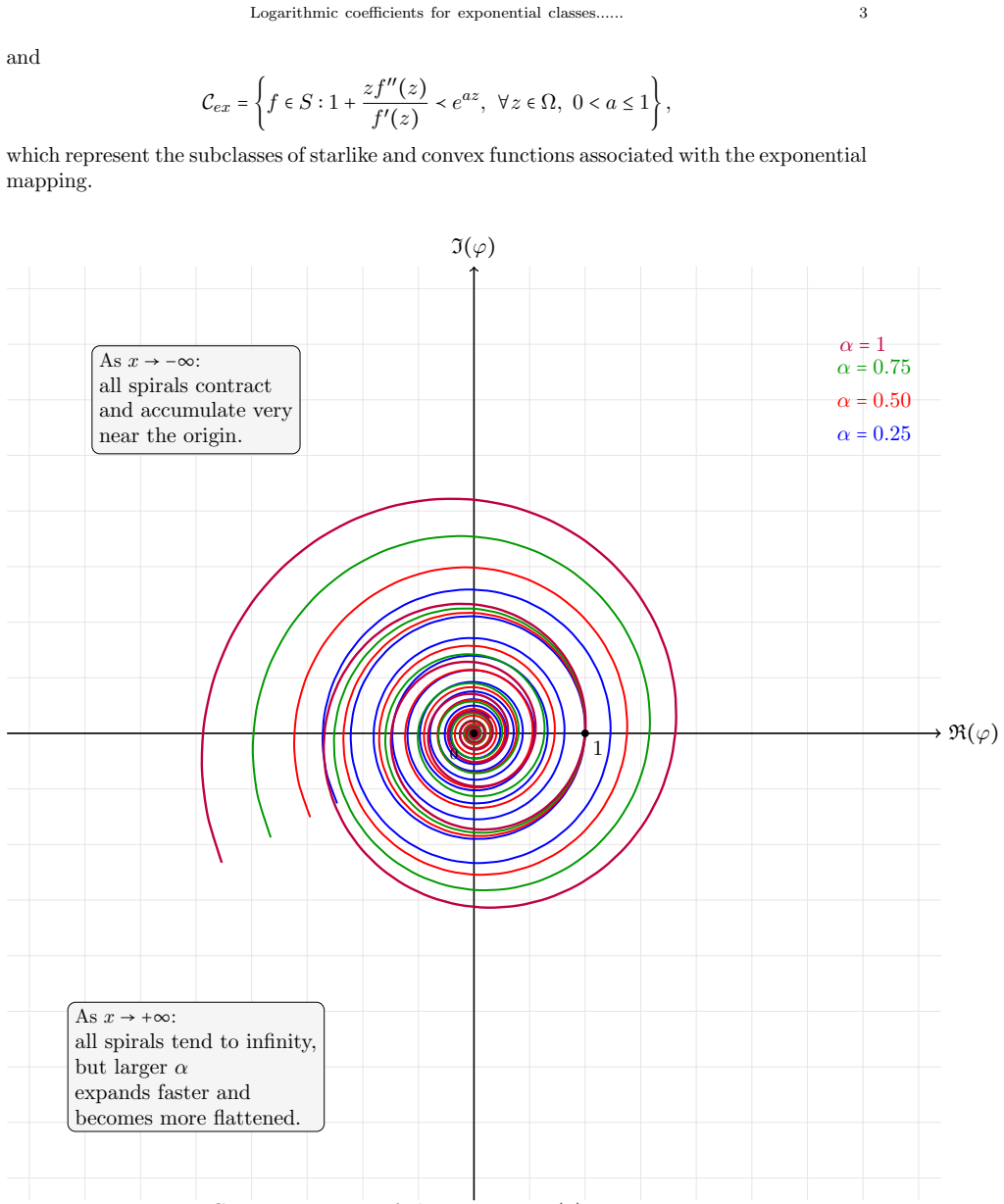
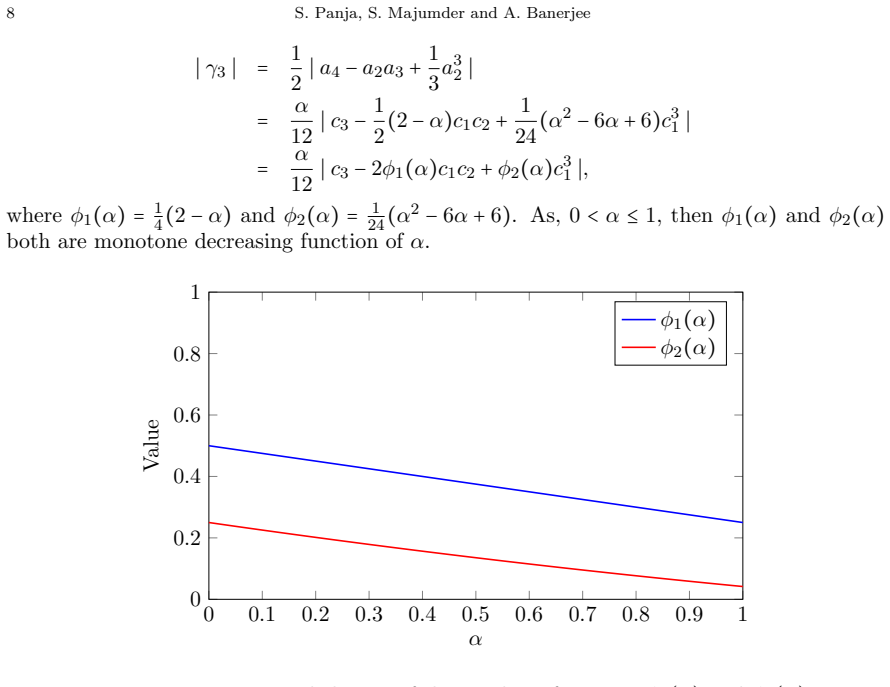
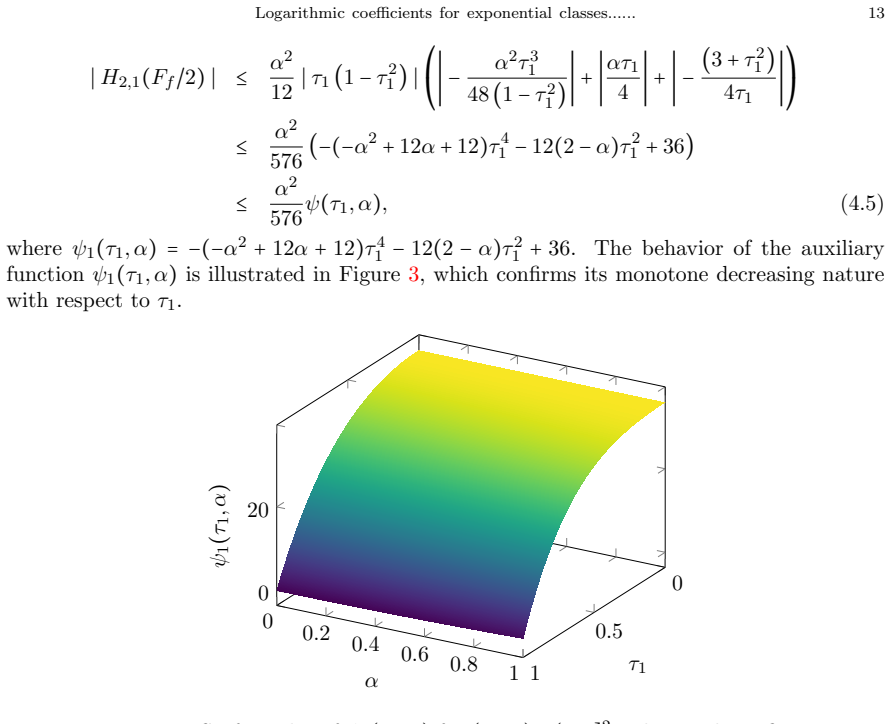
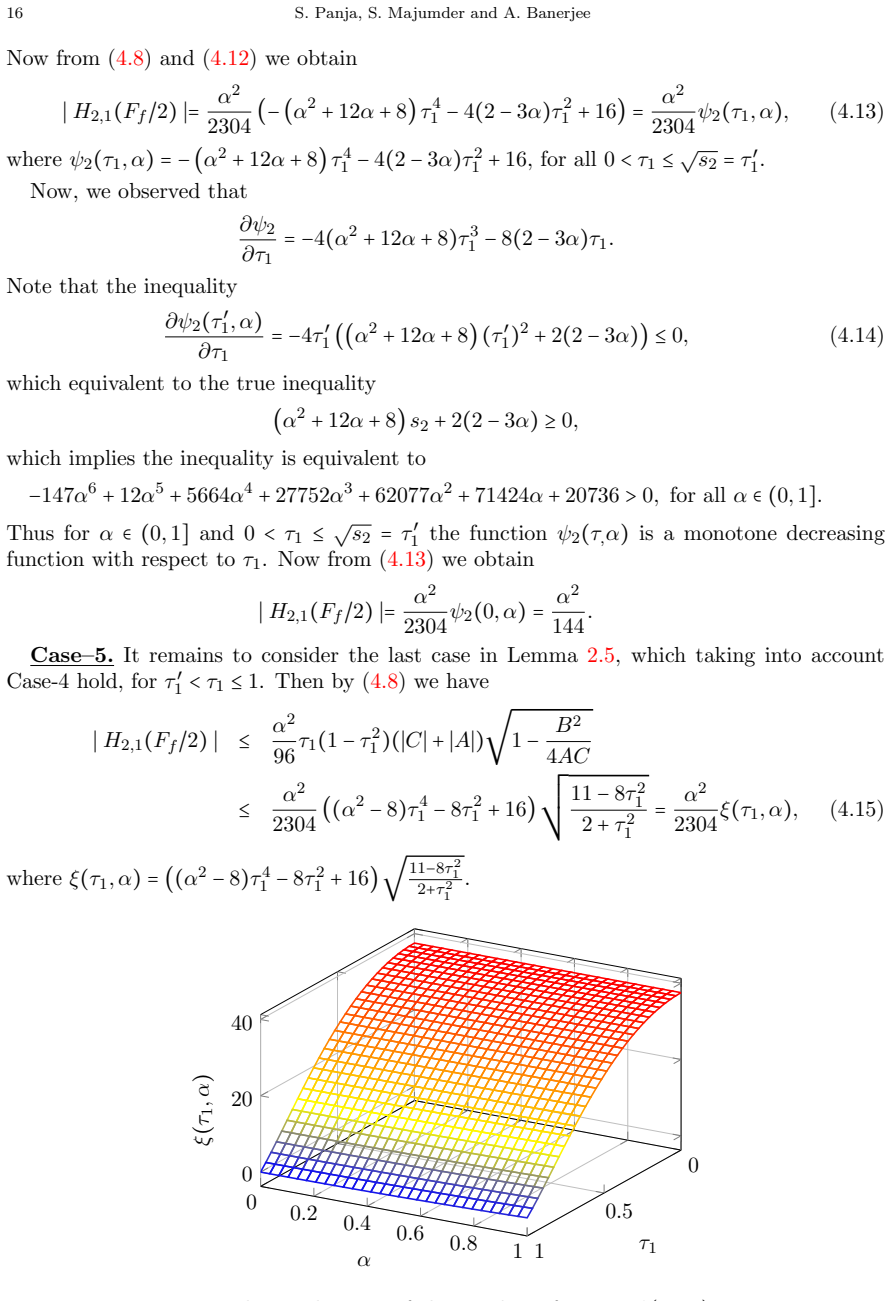
read the original abstract
In this paper, we investigate two subclasses of analytic and univalent functions associated with the exponential mapping $\varphi(z)=e^{\alpha z},\qquad 0<\alpha\le1,$ defined via the subordination conditions $\frac{zf'(z)}{f(z)}\prec e^{\alpha z} \quad \text{and} \quad 1+\frac{zf''(z)}{f'(z)}\prec e^{\alpha z}$. These classes provide a natural exponential analogue of several classical subclasses arising in geometric function theory. We obtain sharp coefficient estimates, logarithmic coefficient inequalities and sharp bounds for the associated Hankel and upper bounds for Toeplitz determinants. In particular, explicit estimates are derived for $$ |H_{2,1}(F_f/2)|, \quad |T_{2,1}(F_f/2)|, $$ for functions belonging to the introduced exponential subclasses of starlike and convex functions. Our results extend and unify several earlier works on exponential subclasses and highlight connections with logarithmic coefficients and determinant functionals.
Editorial analysis
A structured set of objections, weighed in public.
Referee Report
Summary. The paper defines two subclasses of univalent functions via subordination: starlike-type functions satisfying zf'(z)/f(z) ≺ e^{αz} and convex-type functions satisfying 1 + zf''(z)/f'(z) ≺ e^{αz} for 0 < α ≤ 1. It derives sharp coefficient estimates, inequalities for logarithmic coefficients, sharp bounds on the Hankel determinant |H_{2,1}(F_f/2)|, and upper bounds on the Toeplitz determinant |T_{2,1}(F_f/2)|, extending prior results on exponential subclasses in geometric function theory.
Significance. If the sharpness claims hold with verified equality cases, the explicit determinant bounds would provide concrete extensions of coefficient majorization results to quadratic functionals on logarithmic coefficients, unifying several earlier works on exponential mappings and offering testable predictions for extremal problems in the classes.
major comments (2)
- [Main results on Hankel determinants] The claim of sharp bounds on |H_{2,1}(F_f/2)| (stated in the abstract and derived in the main results) relies on coefficient majorization |c_n| ≤ α^n/n! from the subordinant e^{αz}, but the Hankel determinant is a quadratic form; the manuscript does not explicitly evaluate the determinant at the extremal function satisfying zf'(z)/f(z) = e^{αz} (or a suitable rotation) to confirm attainment, as opposed to deriving an upper estimate that may not be sharp.
- [Introduction and class definitions] The definition of the classes via subordination to e^{αz} is standard, but the paper does not verify that the extremal function for the subordination lies in the class and realizes the stated maximum for the determinant expression (as opposed to individual coefficients), which is load-bearing for the sharpness assertion.
minor comments (2)
- Notation for F_f (the function whose coefficients enter the determinants) should be defined explicitly at first use rather than assumed from context.
- [Abstract] The abstract mentions 'explicit estimates' for both determinants; clarify whether the Toeplitz bound is claimed to be sharp or only an upper bound, as the wording is slightly ambiguous.
Simulated Author's Rebuttal
We thank the referee for the careful reading and constructive feedback on our manuscript. The comments highlight important points regarding the verification of sharpness for the Hankel determinant bounds. We address each major comment below and will revise the manuscript accordingly.
read point-by-point responses
-
Referee: [Main results on Hankel determinants] The claim of sharp bounds on |H_{2,1}(F_f/2)| (stated in the abstract and derived in the main results) relies on coefficient majorization |c_n| ≤ α^n/n! from the subordinant e^{αz}, but the Hankel determinant is a quadratic form; the manuscript does not explicitly evaluate the determinant at the extremal function satisfying zf'(z)/f(z) = e^{αz} (or a suitable rotation) to confirm attainment, as opposed to deriving an upper estimate that may not be sharp.
Authors: We agree that an explicit evaluation at the extremal function is required to rigorously confirm sharpness of the quadratic functional, as the majorization on individual coefficients does not automatically guarantee attainment for the determinant. In the revised version we will compute |H_{2,1}(F_f/2)| directly for the function defined by zf'(z)/f(z) = e^{αz} (and its rotations) and verify that the stated bound is attained, thereby strengthening the sharpness claim. revision: yes
-
Referee: [Introduction and class definitions] The definition of the classes via subordination to e^{αz} is standard, but the paper does not verify that the extremal function for the subordination lies in the class and realizes the stated maximum for the determinant expression (as opposed to individual coefficients), which is load-bearing for the sharpness assertion.
Authors: The extremal function is defined by equality in the subordination relation and therefore belongs to the class by construction. As noted in our response to the first comment, we will add the explicit determinant evaluation at this function in the revision to confirm it attains the maximum value of the expression. revision: yes
Circularity Check
No circularity; derivation relies on standard subordination and coefficient majorization without self-referential reduction
full rationale
The abstract and provided excerpts frame the work as obtaining sharp estimates for logarithmic coefficients, Hankel determinants, and Toeplitz determinants via subordination to e^{αz} (0<α≤1). No quoted step equates a claimed prediction or bound to a fitted parameter or prior self-citation by construction; coefficient bounds follow from |c_n| ≤ α^n/n! with the classes defined directly by the subordination conditions. The central claims on |H_{2,1}(F_f/2)| remain independent of any self-citation chain or ansatz smuggling, consistent with extensions of prior literature without load-bearing reduction to the paper's own inputs.
Axiom & Free-Parameter Ledger
Forward citations
Cited by 1 Pith paper
-
Sharp Coefficient Estimates for the Exponential Starlike class $\mathcal{S}_{ex}^{\ast}$
Sharp estimates for inverse logarithmic coefficients Γ1–Γ3, |Γ2|−|Γ1|, the Hankel determinant H2,1, the Hermitian–Toeplitz determinant T3,1, and the generalized Fekete–Szegő functional are obtained for the exponential...
Reference graph
Works this paper leans on
-
[1]
Ali, Coefficients of the inverse of strongly starlike functions,Bull
R. Ali, Coefficients of the inverse of strongly starlike functions,Bull. Malays. Math. Sci. Soc.,26(2003), 63–71
2003
-
[2]
M. F. Ali and V. Allu, On logarithmic coefficients of some close-to-convex functions,Proc. Amer. Math. Soc.,146(3)(2018), 1131–1142
2018
-
[3]
M. F. Ali and V. Allu, Logarithmic coefficients of some close-to-convex functions,Bull. Aust. Math. Soc., 95(2017), 228-237
2017
-
[4]
Alimohammadi, E
D. Alimohammadi, E. A. Analouei, T. Bulboacˇa, and N. E. Cho, Logarithmic coefficient bounds and coefficient conjectures for classes associated with convex functions,J. Funct. Space., 2021(1)(2021), P. 6690027
2021
-
[5]
Allu and A
V. Allu and A. Shaji, Se cond Hankel determinant for logarithmic inverse coefficients of convex and starlike functions,Bull. Aust. Math. Soc.,111(1)(2025), 128–139
2025
-
[6]
Arora and S
K. Arora and S. S. Kumar, Starlike functions associated with a petal shaped domain,Bull. Korean Math. Soc.,59(4)(2022), 993–1010
2022
-
[7]
N. E. Cho, B. Kowalczyk, O. S. Kwon, A. Lecko and Y. J. Sim, On the third logarithmic coefficient in some subclasses of close-to-convex functions,Rev. R. Acad. Cienc. Exactas F´ıs. Nat. Ser. A Mat. RACSAM,114(2)(2020), Paper No. 52, 14 pp
2020
-
[9]
N. E. Cho, B. Kowalczyk and A. Lecko, Sharp bounds of some coefficient functionals over the class of functions convex in the direction of the imaginary axis,Bull. Aust. Math. Soc.,100(2019), 86–96
2019
-
[10]
J. H. Choi, Y. C. Kim and T. Sugawa, A general approach to the Fekete-Szeg¨ o problem,J. Math. Soc. Japan,59(2007), 707–727
2007
-
[11]
P. L. Duren, Univalent Functions, Springer-Verlag, New York, 1983
1983
-
[12]
Janowski, Extremal problems for a family of functions with positive real part and for some related families,Ann
W. Janowski, Extremal problems for a family of functions with positive real part and for some related families,Ann. Polon. Math.,23(1970/71), 159–177. Logarithmic coefficients for exponential classes...... 19
1970
-
[13]
Kargar, On logarithmic coefficients of certain starlike functions related to the vertical strip,J
R. Kargar, On logarithmic coefficients of certain starlike functions related to the vertical strip,J. Anal., 27(2019), 985–995
2019
-
[14]
Kowalczyk and A
B. Kowalczyk and A. Lecko, Second Hankel determinant of logarithmic coefficients of convex and starlike functions, Bull. Aus. Math. Soc.,105(3)(2022), 458–467
2022
-
[15]
Kowalczyk and A
B. Kowalczyk and A. Lecko, The second Hankel determinant of the logarithmic coefficients of strongly starlike and strongly convex functions,Rev. R. Acad. Cienc. Exactas F´ıs. Nat. Ser. A Mat. RACSAM ,117(2)(2023), Paper No. 91
2023
-
[16]
S. S. Kumar and G. Kamaljeet, A cardioid domain and starlike functions,Anal. Math. Phys.,11(2)(2021), 34 pp
2021
-
[17]
S. S. Kumar and P. Yadav, On a Class of Starlike Functions Associated with a Bean Shaped domain, Iran. J. Sci.,50(2026), 197–211
2026
-
[18]
L¨ owner, Untersuchungen ¨ uber schlichte konforme Abbildungen des Einheitskreises
K. L¨ owner, Untersuchungen ¨ uber schlichte konforme Abbildungen des Einheitskreises. I,Math. Annalen, 89(1)(1923), 103–121
1923
-
[19]
W. C. Ma and D. Minda, A unified treatment of some special classes of univalent functions,Proceedings of the Conference on Complex Analysis(Tianjin, 1992), pp. 157–169, Conf. Proc. Lecture Notes Anal., Vol. I, International Press, Cambridge, MA, 1994
1992
-
[20]
Mendiratta, S
R. Mendiratta, S. Nagpal, and V. Ravichandran, On a subclass of strongly starlike functions associated with exponentia function,Bull. Malays. Math. Sci. Soc.,38(1)(2015), 365–386
2015
-
[21]
I. M. Milin, Univalent Functions and Orthonormal Systems,Transl. Math. Monogr., Vol.49, AMS, 1977
1977
-
[22]
Mundalia and S
M. Mundalia and S. S. Kumar, Coefficient problems for certain close-to-convex functions,Bull. Iran. Math. Soc.49(1)(2023), Paper No. 5
2023
-
[23]
Ponnusamy and T
S. Ponnusamy and T. Sugawa, Sharp inequalities for logarithmic coefficients and their applications,Bull. Sci. Math.166(2021), 102931
2021
-
[24]
Ponnusamy, N
S. Ponnusamy, N. L. Sharma, and K. J. Wirths, Logarithmic Coefficients of the Inverse of Univalent Functions,Result. Math.73(160)(2018)
2018
-
[25]
Ponnusamy, N
S. Ponnusamy, N. L. Sharma, and K. J. Wirths, Logarithmic coefficients problems in families related to starlike and convex functions,J. Aust. Math. Soc.,109(2020), 230–249
2020
-
[26]
R. k. Raina and J. Sok´ ol, On coefficient estimates for a certain class of starlike functions,Hacet. J. Math. Stat.,44(6)(2015), 1427–1433
2015
-
[27]
Ravichandran and S
V. Ravichandran and S. Verma, Bound for the fifth coefficient of certain starlike functions,C. R. Math. Acad. Sci. Paris,353(2015), 505–510
2015
-
[28]
Rønning, On starlike functions associated with parabolic regions,Ann
F. Rønning, On starlike functions associated with parabolic regions,Ann. Univ. Mariae Curie-Sk lodowska Sect.,45(1991), 117–122
1991
-
[29]
P. O. Sabir, Sharp bounds on Toeplitz determinants for starlike and convex functions associated with bilinear transformations,Symmetry,16(5)(2024), 595
2024
-
[30]
P. O. Sabir and A. A. Ali, Toeplitz and Hankel determinants of logarithmic coefficients forr-valent q-starlike andr-valentq-convex functions. MethodsX,15(2025), 103463
2025
-
[31]
L. Shi, M. Arif, J. Iqbal, K. Ullah and S. M. Ghufran, Sharp bounds of Hankel determinant on logarithmic coefficients for functions starlike with exponential function,Fract. Fract.,6(11)(2022), p.645
2022
-
[32]
Sok´ ol and J
J. Sok´ ol and J. Stankiewicz, Radius of convexity of some subclasses of strongly starlike functions,Zesz. Nauk. Politech. Rzesz. Mat.,19(1996), 101–105
1996
-
[33]
Thomas, On the logarithmic coefficients of close-to-convex functions,Proc
D. Thomas, On the logarithmic coefficients of close-to-convex functions,Proc. Amer. Math. Soc., 144(4)(2016), 1681–1687
2016
-
[34]
Zaprawa, Initial logarithmic coefficients for functions starlike with respect to symmetric points,Bol
P. Zaprawa, Initial logarithmic coefficients for functions starlike with respect to symmetric points,Bol. Soc. Mat. Mex.,27(3)(2021), Paper No. 62, 13 pp. Department of Mathematics, University of Kalyani, West Bengal 741235, India. Email address:panjasantu07@gmail.com Department of Mathematics, Raiganj University, Raiganj, West Bengal-733134, India. Email...
2021
discussion (0)
Sign in with ORCID, Apple, or X to comment. Anyone can read and Pith papers without signing in.