Functional renormalization group study of the jet quenching parameter near the QCD critical end point
Pith reviewed 2026-06-28 22:18 UTC · model grok-4.3
The pith
The jet quenching parameter rises sharply near the QCD critical end point from critical sigma fluctuations.
A machine-rendered reading of the paper's core claim, the machinery that carries it, and where it could break.
Core claim
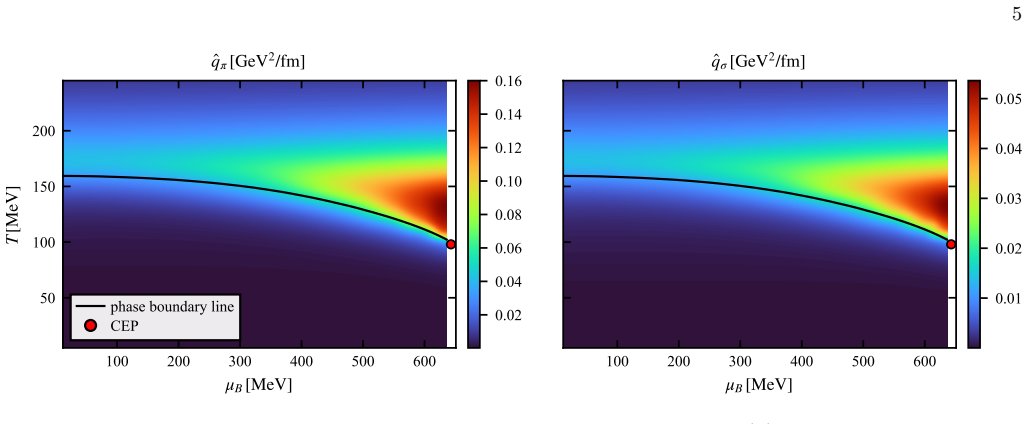
In a QCD-assisted low-energy effective theory treated with the functional renormalization group, the jet quenching parameter is obtained from the spectral functions of the chiral order-parameter field. The sigma and pi meson contributions are calculated at finite temperature and baryon chemical potential. The parameter receives its main support above the chiral phase boundary and displays a clear enhancement at high baryon chemical potential as the crossover turns sharper toward the critical end point, matching the expected signature of partonic critical opalescence.
What carries the argument
The mapping of the jet quenching parameter to the spectral functions of the sigma and pi mesons, computed from analytically continued mesonic two-point functions within the functional renormalization group.
If this is right
- The jet quenching parameter draws its dominant contributions from the region above the chiral phase boundary.
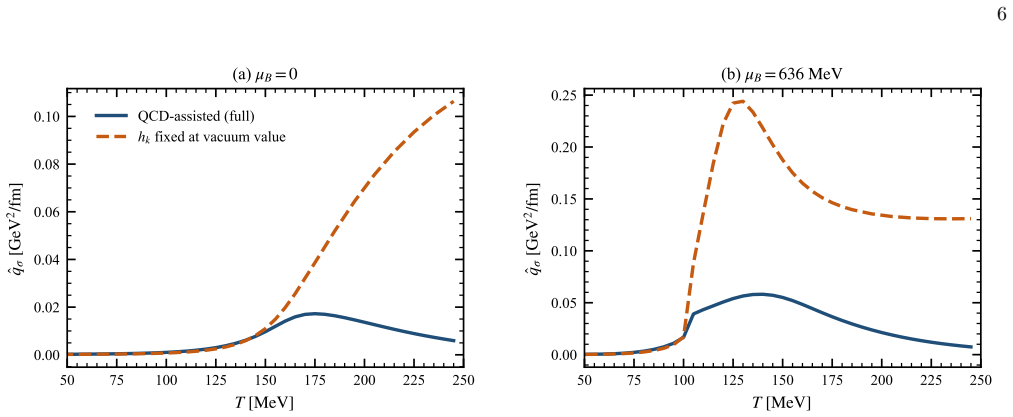
- It undergoes a pronounced increase at large baryon chemical potential as the crossover sharpens toward the critical end point.
- This increase is carried by critical fluctuations of the sigma field and matches the partonic critical opalescence picture.
- Both sigma and pi meson spectral functions enter the calculation of the parameter.
Where Pith is reading between the lines
- Jet quenching observables in heavy-ion collisions could serve as a probe for the location of the critical end point.
- The enhancement pattern may appear in other transport coefficients that couple to the same critical fluctuations.
- Future lattice or effective-theory studies at still higher chemical potential could test whether the rise saturates or continues.
Load-bearing premise
The relation that connects the jet quenching parameter to the spectral functions of the chiral order-parameter field remains valid at finite baryon chemical potential and close to the critical end point.
What would settle it
Heavy-ion collision data showing no rise in average jet transverse momentum broadening at collision energies that reach large baryon chemical potential near the expected location of the critical end point.
Figures

read the original abstract
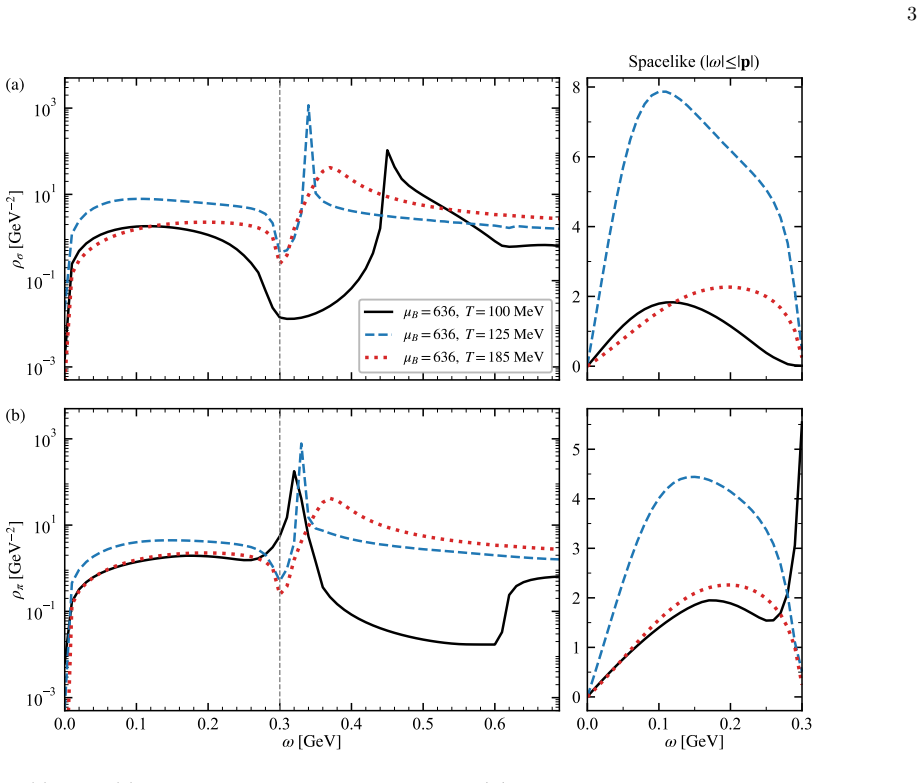
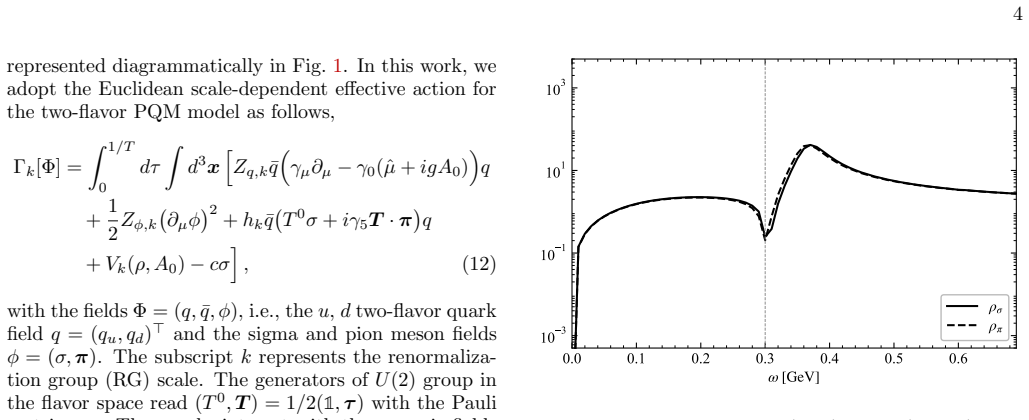
We investigate the jet quenching parameter $\hat{q}$ in the QCD phase diagram within a QCD-assisted low-energy effective theory using the functional renormalization group (fRG). Following the formalism that relates $\hat{q}$ to the spectral functions of the chiral order-parameter field, we compute the $\sigma$ and $\pi$ meson contributions to $\hat{q}$ at finite temperature and baryon chemical potential from analytically continued mesonic two-point functions. We find that $\hat{q}$ receives appreciable contributions mainly above the chiral phase boundary and exhibits a pronounced enhancement at large baryon chemical potential as the chiral crossover sharpens toward the critical end point (CEP), a behavior consistent with the picture of partonic critical opalescence (PCO), a pronounced enhancement of jet transverse momentum broadening induced by the critical $\sigma$ field fluctuations.
Editorial analysis
A structured set of objections, weighed in public.
Referee Report
Summary. The manuscript computes the jet quenching parameter χq in the QCD phase diagram using the functional renormalization group (fRG) applied to a QCD-assisted low-energy effective theory. Following an existing formalism that relates χq to the spectral functions of the chiral order-parameter fields, the authors extract the σ and π meson contributions from analytically continued mesonic two-point functions at finite temperature and baryon chemical potential. They report that χq receives appreciable contributions mainly above the chiral phase boundary and exhibits a pronounced enhancement at large μ_B as the crossover sharpens toward the critical end point, interpreted as consistent with partonic critical opalescence.
Significance. If the mapping from spectral functions to χq remains valid in the critical region, the calculation supplies a non-perturbative estimate of jet transverse-momentum broadening near the CEP that could serve as an observable signature in heavy-ion collisions. The fRG framework is well suited to capture the strong fluctuations that become important near the CEP, and the reported enhancement provides a concrete, falsifiable prediction that can be confronted with future data or lattice studies.
major comments (1)
- [Abstract, paragraph 2; formalism section] The central claim that χq is enhanced near the CEP rests on the step that maps the jet quenching parameter directly to the spectral functions of the σ and π fields. The manuscript invokes this relation (abstract, paragraph 2) but supplies no explicit derivation or domain-of-validity test at finite baryon density when the σ propagator softens critically. If the original derivation assumes μ=0 or weak fluctuations, the extrapolation to the CEP regime is load-bearing and requires additional justification or numerical checks against known limits.
minor comments (2)
- [Introduction] The notation distinguishing the jet quenching parameter χq from the spectral functions ρ_σ,ρ_π should be introduced more explicitly in the introductory paragraphs to aid readability.
- [Results figures] Figure captions should state the specific values of the renormalization scale and cutoff scheme used for the fRG flow to allow direct reproduction of the plotted enhancement.
Simulated Author's Rebuttal
We thank the referee for the positive assessment of our manuscript and for the constructive major comment. We address the point below and agree that additional clarification will strengthen the presentation.
read point-by-point responses
-
Referee: [Abstract, paragraph 2; formalism section] The central claim that χq is enhanced near the CEP rests on the step that maps the jet quenching parameter directly to the spectral functions of the σ and π fields. The manuscript invokes this relation (abstract, paragraph 2) but supplies no explicit derivation or domain-of-validity test at finite baryon density when the σ propagator softens critically. If the original derivation assumes μ=0 or weak fluctuations, the extrapolation to the CEP regime is load-bearing and requires additional justification or numerical checks against known limits.
Authors: We thank the referee for highlighting this important aspect. The relation between the jet quenching parameter and the spectral functions of the chiral fields is adopted from the established formalism in the cited reference, which expresses χq in terms of the imaginary part of the retarded gluon propagator within the effective theory. Although that derivation was performed at vanishing baryon density, its central assumptions (dominance of soft modes and validity of the low-energy effective description) continue to hold when critical fluctuations are included non-perturbatively via the fRG. To address the referee's concern, we will add a dedicated paragraph in the formalism section that (i) recalls the key steps of the mapping, (ii) discusses its domain of applicability at finite μ_B, and (iii) presents a consistency check against the μ_B = 0 limit already computed in the literature. This revision will make the extrapolation to the CEP regime explicit and transparent. revision: yes
Circularity Check
No significant circularity; derivation applies external formalism to independent fRG computation
full rationale
The paper follows a pre-existing formalism to relate hat q to spectral functions of sigma and pi fields obtained from fRG-computed mesonic two-point functions at finite T and mu. No quoted step reduces the reported enhancement near the CEP to a fitted input, self-defined quantity, or self-citation chain by construction. The computation of analytically continued propagators and their contributions to hat q proceeds from the effective theory without the output being tautological to the inputs. Self-referential use of fRG is standard methodology and does not load-bear the central claim in a circular manner. The derivation chain remains self-contained against external benchmarks.
Axiom & Free-Parameter Ledger
Forward citations
Cited by 1 Pith paper
-
Phase structure of strong interaction matter from Functional QCD
A pedagogical review introducing functional QCD methods for studying the phase diagram of strong interaction matter at finite temperature and density.
Reference graph
Works this paper leans on
-
[1]
Y. Aoki, G. Endrodi, Z. Fodor, S. D. Katz, and K. K. Sz- abo, The Order of the quantum chromodynamics transi- tion predicted by the standard model of particle physics, Nature443, 675 (2006), arXiv:hep-lat/0611014
Pith/arXiv arXiv 2006
-
[2]
The chiral and deconfinement aspects of the QCD transition
A. Bazavovet al., The chiral and deconfinement aspects of the QCD transition, Phys. Rev. D85, 054503 (2012), arXiv:1111.1710 [hep-lat]
work page internal anchor Pith review Pith/arXiv arXiv 2012
- [3]
- [4]
- [5]
- [6]
- [7]
-
[8]
M. A. Stephanov, QCD Phase Diagram and the Criti- cal Point, Prog. Theor. Phys. Suppl.153, 139 (2004), arXiv:hep-ph/0402115
work page internal anchor Pith review Pith/arXiv arXiv 2004
-
[9]
K. Fukushima and C. Sasaki, The phase diagram of nu- clear and quark matter at high baryon density, Prog. Part. Nucl. Phys.72, 99 (2013), arXiv:1301.6377 [hep- ph]
Pith/arXiv arXiv 2013
- [10]
-
[11]
Fu, QCD at finite temperature and density within the fRG approach: an overview, Commun
W.-j. Fu, QCD at finite temperature and density within the fRG approach: an overview, Commun. Theor. Phys. 74, 097304 (2022), arXiv:2205.00468 [hep-ph]
-
[12]
C. S. Fischer and J. M. Pawlowski, Phase structure and observables at high densities from first principles QCD, (2026), arXiv:2603.11135 [hep-ph]
arXiv 2026
-
[13]
M. A. Stephanov, Non-Gaussian fluctuations near the QCD critical point, Phys. Rev. Lett.102, 032301 (2009), arXiv:0809.3450 [hep-ph]
Pith/arXiv arXiv 2009
-
[14]
M. A. Stephanov, On the sign of kurtosis near the QCD critical point, Phys. Rev. Lett.107, 052301 (2011), arXiv:1104.1627 [hep-ph]
Pith/arXiv arXiv 2011
- [15]
-
[16]
Adamet al.(STAR), Nonmonotonic Energy Depen- dence of Net-Proton Number Fluctuations, Phys
J. Adamet al.(STAR), Nonmonotonic Energy Depen- dence of Net-Proton Number Fluctuations, Phys. Rev. Lett.126, 092301 (2021), arXiv:2001.02852 [nucl-ex]
-
[17]
B. E. Aboonaet al.(STAR), Precision Measurement of Net-Proton-Number Fluctuations in Au+Au Colli- sions at RHIC, Phys. Rev. Lett.135, 142301 (2025), arXiv:2504.00817 [nucl-ex]
arXiv 2025
-
[18]
W.-j. Fu and J. M. Pawlowski, Correlating the skewness and kurtosis of baryon number distributions, Phys. Rev. D93, 091501 (2016), arXiv:1512.08461 [hep-ph]
Pith/arXiv arXiv 2016
-
[19]
W.-j. Fu, J. M. Pawlowski, F. Rennecke, and B.-J. Schaefer, Baryon number fluctuations at finite temper- ature and density, Phys. Rev. D94, 116020 (2016), arXiv:1608.04302 [hep-ph]
Pith/arXiv arXiv 2016
-
[20]
W.-j. Fu, X. Luo, J. M. Pawlowski, F. Rennecke, R. Wen, and S. Yin, Hyper-order baryon number fluctuations at finite temperature and density, Phys. Rev. D104, 094047 (2021), arXiv:2101.06035 [hep-ph]
arXiv 2021
- [21]
- [22]
- [23]
-
[24]
High-order fluctuations of temperature in hot QCD matter
J. Chen, W.-j. Fu, S. Yin, and C. Zhang, High-order fluctuations of temperature in hot QCD matter, (2025), arXiv:2504.06886 [hep-ph]
work page internal anchor Pith review Pith/arXiv arXiv 2025
-
[25]
H.-L. Chen, W.-j. Fu, X.-G. Huang, and G.-L. Ma, Fluc- tuations and Correlations of Quark Spin in Hot and Dense QCD Matter, Phys. Rev. Lett.135, 032302 (2025), arXiv:2410.20704 [hep-ph]
- [26]
- [27]
-
[28]
R. Baier, Jet quenching, Nucl. Phys.A715, 209 (2003), arXiv:hep-ph/0209038
work page internal anchor Pith review Pith/arXiv arXiv 2003
-
[29]
Elastic energy loss and longitudinal straggling of a hard jet
A. Majumder, Elastic energy loss and longitudinal strag- gling of a hard jet, Phys. Rev.C80, 031902 (2009), arXiv:0810.4967 [nucl-th]
work page internal anchor Pith review Pith/arXiv arXiv 2009
-
[30]
L. Adamczyket al.(STAR), Beam Energy Dependence of Jet-Quenching Effects in Au+Au Collisions at √sNN = 7.7, 11.5, 14.5, 19.6, 27, 39, and 62.4 GeV, Phys. Rev. Lett.121, 032301 (2018), arXiv:1707.01988 [nucl-ex]
work page internal anchor Pith review Pith/arXiv arXiv 2018
- [31]
-
[32]
Exact evolution equation for the effective potential
C. Wetterich, Exact evolution equation for the effective potential, Phys. Lett. B301, 90 (1993), arXiv:1710.05815 [hep-th]
work page internal anchor Pith review Pith/arXiv arXiv 1993
- [33]
-
[34]
Chiral symmetry breaking in continuum QCD
M. Mitter, J. M. Pawlowski, and N. Strodthoff, Chiral symmetry breaking in continuum QCD, Phys. Rev. D 91, 054035 (2015), arXiv:1411.7978 [hep-ph]
work page internal anchor Pith review Pith/arXiv arXiv 2015
-
[35]
From Quarks and Gluons to Hadrons: Chiral Symmetry Breaking in Dynamical QCD
J. Braun, L. Fister, J. M. Pawlowski, and F. Rennecke, From Quarks and Gluons to Hadrons: Chiral Symmetry Breaking in Dynamical QCD, Phys. Rev. D94, 034016 (2016), arXiv:1412.1045 [hep-ph]
work page internal anchor Pith review Pith/arXiv arXiv 2016
-
[36]
A. K. Cyrol, L. Fister, M. Mitter, J. M. Pawlowski, and N. Strodthoff, Landau gauge Yang-Mills correlation func- tions, Phys. Rev. D94, 054005 (2016), arXiv:1605.01856 [hep-ph]
work page internal anchor Pith review Pith/arXiv arXiv 2016
-
[37]
A. K. Cyrol, M. Mitter, J. M. Pawlowski, and N. Strodthoff, Nonperturbative quark, gluon, and me- son correlators of unquenched QCD, Phys. Rev. D97, 054006 (2018), arXiv:1706.06326 [hep-ph]
work page internal anchor Pith review Pith/arXiv arXiv 2018
-
[38]
Correlation functions of three-dimensional Yang-Mills theory from the FRG
L. Corell, A. K. Cyrol, M. Mitter, J. M. Pawlowski, and N. Strodthoff, Correlation functions of three-dimensional Yang-Mills theory from the FRG, SciPost Phys.5, 066 (2018), arXiv:1803.10092 [hep-ph]
work page internal anchor Pith review Pith/arXiv arXiv 2018
- [39]
- [40]
- [41]
- [42]
- [43]
-
[44]
Kaon Distribution Amplitudes from Euclidean Functional QCD
W. Cui, D.-y. Zhang, C. Huang, and W.-j. Fu, Kaon Dis- tribution Amplitudes from Euclidean Functional QCD, (2026), arXiv:2604.23739 [hep-ph]
work page internal anchor Pith review Pith/arXiv arXiv 2026
-
[45]
J. Braun, W.-j. Fu, J. M. Pawlowski, F. Rennecke, D. Rosenbl¨ uh, and S. Yin, Chiral susceptibility in ( 2+1 )-flavor QCD, Phys. Rev. D102, 056010 (2020), arXiv:2003.13112 [hep-ph]
- [46]
- [47]
- [48]
-
[49]
Calculating the Jet Quenching Parameter $\hat{q}$ in Lattice Gauge Theory
A. Majumder, Calculating the jet quenching parameter q in lattice gauge theory, Phys. Rev. C87, 034905 (2013), arXiv:1202.5295 [nucl-th]
work page internal anchor Pith review Pith/arXiv arXiv 2013
-
[50]
P. C. Martin and J. Schwinger, Theory of many-particle systems. i, Phys. Rev.115, 1342 (1959)
1959
-
[51]
Flow equations for spectral functions at finite external momenta
R.-A. Tripolt, L. von Smekal, and J. Wambach, Flow equations for spectral functions at finite external mo- menta, Phys. Rev. D90, 074031 (2014), arXiv:1408.3512 [hep-ph]
work page internal anchor Pith review Pith/arXiv arXiv 2014
-
[52]
C. Jung, F. Rennecke, R.-A. Tripolt, L. von Smekal, and J. Wambach, In-Medium Spectral Functions of Vector- and Axial-Vector Mesons from the Functional Renor- malization Group, Phys. Rev. D95, 036020 (2017), arXiv:1610.08754 [hep-ph]
work page internal anchor Pith review Pith/arXiv arXiv 2017
-
[53]
The theory and phenomenology of perturbative QCD based jet quenching
A. Majumder and M. Van Leeuwen, The Theory and Phenomenology of Perturbative QCD Based Jet Quenching, Prog. Part. Nucl. Phys.66, 41 (2011), arXiv:1002.2206 [hep-ph]
work page internal anchor Pith review Pith/arXiv arXiv 2011
-
[54]
K. M. Burkeet al.(JET), Extracting the jet transport co- efficient from jet quenching in high-energy heavy-ion col- lisions, Phys. Rev.C90, 014909 (2014), arXiv:1312.5003 [nucl-th]
work page internal anchor Pith review Pith/arXiv arXiv 2014
-
[55]
J. W. Cronin, H. J. Frisch, M. J. Shochet, J. P. Boymond, P. A. Piroue, and R. L. Sumner, Production of Hadrons with Large Transverse Momentum at 200-GeV and 300- GeV, Phys. Rev. Lett.31, 1426 (1973)
1973
-
[56]
Antreasyan, J
D. Antreasyan, J. W. Cronin, H. J. Frisch, M. J. Shochet, L. Kluberg, P. A. Piroue, and R. L. Sumner, Production of Hadrons at Large Transverse Momentum in 200, 300 and 400 GeV pp and pn Collisions, Phys. Rev. D19, 764 (1979)
1979
-
[57]
Cronin effect vs. geometrical shadowing in d+Au collisions at RHIC
A. Accardi and M. Gyulassy, Cronin effect versus geo- metrical shadowing in d + Au collisions at RHIC, Phys. Lett. B586, 244 (2004), arXiv:nucl-th/0308029
work page internal anchor Pith review Pith/arXiv arXiv 2004
-
[58]
Initial State Parton Broadening and Energy Loss Probed in d+Au at RHIC
I. Vitev, Initial state parton broadening and energy loss probed in d + Au at RHIC, Phys. Lett. B562, 36 (2003), arXiv:nucl-th/0302002
work page internal anchor Pith review Pith/arXiv arXiv 2003
- [59]
-
[60]
Vitev, Testing the mechanism of QGP-induced en- ergy loss, Phys
I. Vitev, Testing the mechanism of QGP-induced en- ergy loss, Phys. Lett. B639, 38 (2006), arXiv:hep- ph/0603010
discussion (0)
Sign in with ORCID, Apple, or X to comment. Anyone can read and Pith papers without signing in.