Moderate-to-Large-x Gluon Helicity from J/psi Production at sqrt{s}=27~GeV
Pith reviewed 2026-06-28 22:16 UTC · model grok-4.3
The pith
Inclusive J/ψ production at √s=27 GeV measures the double-spin asymmetry A_LL to access gluon helicity Δg(x) for x from 0.1 to 0.9.
A machine-rendered reading of the paper's core claim, the machinery that carries it, and where it could break.
Core claim
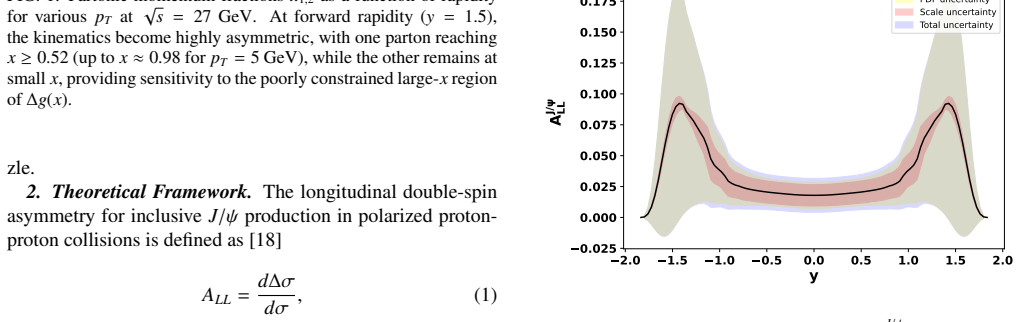
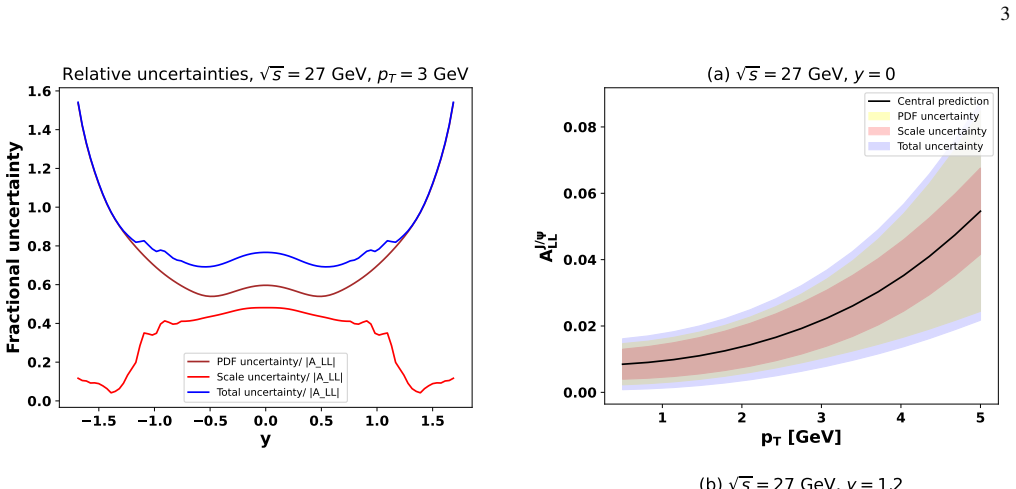
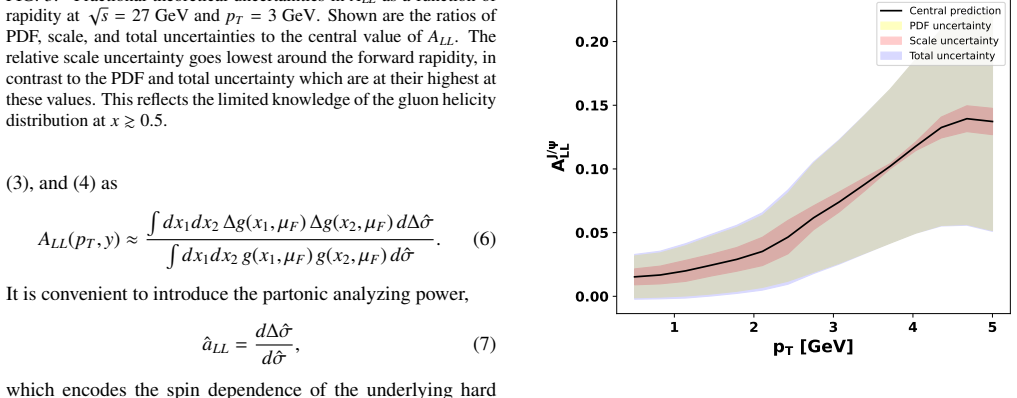
We estimate A_LL as a function of transverse momentum and rapidity using polarized parton distribution functions, finding asymmetries reaching |A_LL|≈0.09 at p_T=3 GeV, with enhanced sensitivity at forward rapidity. The dominant theoretical uncertainty arises from polarized parton distribution functions. These results demonstrate that inclusive J/ψ measurements at SPD/NICA provide a sensitive and complementary probe of gluon polarization at moderate and large x, extending constraints from RHIC into a kinematic regime not directly accessible to the EIC.
What carries the argument
The longitudinal double-spin asymmetry A_LL in gluon-gluon fusion dominated inclusive J/ψ production, which encodes the product of gluon helicity distributions Δg(x1)Δg(x2) at the relevant momentum fractions.
If this is right
- A_LL reaches its largest values at forward rapidity where one gluon momentum fraction extends to 0.5-0.9.
- Central rapidity measurements constrain the region around x=0.1-0.2.
- The dominant uncertainty in the predicted asymmetry comes from the choice of polarized parton distribution functions.
- The kinematic coverage complements existing RHIC data while remaining inaccessible to the EIC.
Where Pith is reading between the lines
- If the predicted asymmetries are observed, global fits of gluon helicity could incorporate a new data set at moderate-to-large x.
- Forward-rapidity bins would give the strongest leverage on the large-x tail of Δg(x).
- The approach could be cross-checked by comparing the same observable in other quarkonium channels once data become available.
Load-bearing premise
Nonperturbative long-distance effects largely cancel in the asymmetry, so the measured A_LL directly reflects the underlying gluon polarization.
What would settle it
A future measurement of A_LL at SPD/NICA that lies well outside the range predicted from current polarized PDFs would show that the asymmetry does not provide the claimed direct sensitivity.
Figures

read the original abstract
We present a feasibility study of the longitudinal double-spin asymmetry $A_{LL}$ in inclusive $J/\psi$ production in polarized proton-proton collisions at $\sqrt{s}\approx 27~\mathrm{GeV}$ at the Spin Physics Detector (SPD) of the Nuclotron-based Ion Collider fAcility (NICA). At these moderate energies, $J/\psi$ production is dominated by gluon-gluon fusion, probing gluon momentum fractions $x\approx 0.1$-$0.2$ at central rapidity and highly asymmetric configurations at forward rapidity, where one parton can reach $x\approx 0.5$-$0.9$. This provides direct sensitivity to the poorly constrained moderate- to large-$x$ region of the gluon helicity distribution $\Delta g(x)$. We estimate $A_{LL}$ as a function of transverse momentum and rapidity using polarized parton distribution functions, focusing on the underlying partonic spin asymmetry. Nonperturbative long-distance effects are treated in a simplified manner and largely cancel in the asymmetry, enabling a direct assessment of gluon polarization sensitivity. We find asymmetries reaching $|A_{LL}|\approx 0.09$ at $p_T=3~\mathrm{GeV}$, with enhanced sensitivity at forward rapidity. The dominant theoretical uncertainty arises from polarized parton distribution functions. These results demonstrate that inclusive $J/\psi$ measurements at SPD/NICA provide a sensitive and complementary probe of gluon polarization at moderate and large $x$, extending constraints from RHIC into a kinematic regime not directly accessible to the EIC.
Editorial analysis
A structured set of objections, weighed in public.
Referee Report
Summary. The manuscript is a feasibility study of the longitudinal double-spin asymmetry A_LL in inclusive J/ψ production in polarized pp collisions at √s≈27 GeV at SPD/NICA. It estimates A_LL(p_T, y) using existing polarized PDFs under the assumption that gluon-gluon fusion dominates and that nonperturbative long-distance effects largely cancel, concluding that the process provides direct sensitivity to moderate-to-large-x Δg(x) with |A_LL| reaching ~0.09.
Significance. If the cancellation assumption holds, the work identifies a potentially useful complementary observable for constraining Δg(x) at x~0.1-0.9, extending RHIC reach into a regime inaccessible to the EIC. The reliance on standard pQCD and existing PDFs is a strength for reproducibility, though the estimates inherit the uncertainties of those fits.
major comments (2)
- [Abstract] Abstract: The statement that nonperturbative long-distance effects 'are treated in a simplified manner and largely cancel in the asymmetry' is asserted without explicit verification. At √s≈27 GeV multiple NRQCD channels (color-singlet and octet) plus feed-down from χ_c and ψ(2S) contribute, and the polarized LDMEs are not guaranteed to cancel identically in the numerator and denominator of A_LL; this assumption is load-bearing for the direct mapping from measured A_LL to Δg(x).
- [Abstract] Abstract: The reported A_LL values are obtained by direct evaluation of existing polarized PDFs (fitted to prior data) in the new kinematic region rather than independent derivations, which weakens the claim of providing new sensitivity constraints beyond what is already encoded in those PDFs.
Simulated Author's Rebuttal
We thank the referee for the careful review and constructive comments on our feasibility study. We address each major comment below, with revisions made to clarify assumptions and scope.
read point-by-point responses
-
Referee: [Abstract] Abstract: The statement that nonperturbative long-distance effects 'are treated in a simplified manner and largely cancel in the asymmetry' is asserted without explicit verification. At √s≈27 GeV multiple NRQCD channels (color-singlet and octet) plus feed-down from χ_c and ψ(2S) contribute, and the polarized LDMEs are not guaranteed to cancel identically in the numerator and denominator of A_LL; this assumption is load-bearing for the direct mapping from measured A_LL to Δg(x).
Authors: We agree that the cancellation is an assumption requiring explicit support. The study is a parton-level feasibility estimate; we have revised the abstract to state the assumption more explicitly and added a paragraph in the theory section noting that full verification would require polarized NRQCD calculations with LDMEs, which lies beyond the present scope. revision: partial
-
Referee: [Abstract] Abstract: The reported A_LL values are obtained by direct evaluation of existing polarized PDFs (fitted to prior data) in the new kinematic region rather than independent derivations, which weakens the claim of providing new sensitivity constraints beyond what is already encoded in those PDFs.
Authors: The manuscript is a feasibility study that evaluates A_LL using existing polarized PDFs to quantify the expected asymmetry size in NICA kinematics. We have revised the abstract and conclusions to remove any implication of deriving new constraints and to emphasize that the work motivates future measurements by showing the potential sensitivity to moderate-to-large-x Δg. revision: yes
Circularity Check
No significant circularity; standard feasibility estimate using external PDFs
full rationale
The paper performs a feasibility study by evaluating A_LL from existing polarized PDFs (e.g., those constrained by RHIC data) in the SPD kinematics at √s≈27 GeV. This is a forward prediction for a new measurement, not a derivation that reduces to its own inputs by construction. The abstract explicitly states use of 'polarized parton distribution functions' and simplified treatment of LDMEs with asserted cancellation, but no equation or step equates the output asymmetry to a fit parameter or self-cited result. No self-citation chains, ansatz smuggling, or renaming of known results appear in the provided text. The central claim of sensitivity follows directly from kinematics (x≈0.1-0.9) and PDF uncertainties, which are external benchmarks. This matches the default case of a self-contained calculation against external inputs.
Axiom & Free-Parameter Ledger
axioms (2)
- domain assumption Gluon-gluon fusion dominates J/ψ production at √s ≈ 27 GeV
- domain assumption Nonperturbative long-distance effects largely cancel in the double-spin asymmetry A_LL
Reference graph
Works this paper leans on
-
[1]
Introduction.Understanding the origin of the proton spin remains a central challenge in quantum chromodynam- ics (QCD). Following the discovery by the European Muon Collaboration (EMC) that quark helicities account for only a small fraction of the proton spin [1, 2], substantial experi- mental and theoretical effort has been devoted to determining the con...
Pith/arXiv arXiv 2026
-
[2]
Theoretical Framework.The longitudinal double-spin asymmetry for inclusiveJ/ψproduction in polarized proton- proton collisions is defined as [18] ALL = d∆σ dσ ,(1) wheredσandd∆σdenote the unpolarized and helicity- dependent differential cross sections, respectively. The po- larized cross section is given by [19] d∆σ= 1 2 dσ++ −dσ +− .(2) Within the QCD co...
-
[3]
1 as functions of rapidity for various transverse momenta at √s=27 GeV
Results.The partonic momentum fractionsx 1,2 probed in pp→J/ψ+Xare shown in Fig. 1 as functions of rapidity for various transverse momenta at √s=27 GeV. At midrapidity (y=0), the kinematics are symmetric (x 1 =x 2), with momen- tum fractions increasing fromx≈0.12 atp T =0.5 GeV to x≈0.32 atp T =8 GeV. At forward rapidity (y=1.5), the configurations become...
-
[4]
Conclusion.We have presented predictions for the longitu- dinal double-spin asymmetryA LL in inclusiveJ/ψproduction in polarized proton-proton collisions at √s=27 GeV, within the kinematic coverage of the SPD experiment at NICA. The observable is found to be sensitive to gluon momentum frac- tions in the rangex≈0.1-0.2 at central rapidity and extends to t...
2025
-
[5]
Ashman et al
J. Ashman et al. (European Muon), Phys. Lett. B206, 364 (1988)
1988
-
[6]
Ashman et al
J. Ashman et al. (European Muon), Nucl. Phys. B328, 1 (1989)
1989
-
[7]
R. L. Jaffe and A. Manohar, Nucl. Phys. B337, 509 (1990)
1990
- [8]
- [9]
-
[10]
D. de Florian, R. Sassot, M. Stratmann, and W. V ogelsang, Phys. Rev. Lett.113, 012001 (2014), 1404.4293
Pith/arXiv arXiv 2014
-
[11]
E. R. Nocera, R. D. Ball, S. Forte, G. Ridolfi, and J. Rojo (NNPDF), Nucl. Phys. B887, 276 (2014), 1406.5539
Pith/arXiv arXiv 2014
-
[12]
J. J. Ethier, N. Sato, and W. Melnitchouk, Phys. Rev. Lett.119, 132001 (2017), 1705.05889
Pith/arXiv arXiv 2017
-
[13]
L. Adamczyk et al. (STAR), Phys. Rev. Lett.115, 092002 (2015), 1405.5134
Pith/arXiv arXiv 2015
-
[14]
M. S. Abdallah et al. (STAR), Phys. Rev. D105, 092011 (2022), 2110.11020
arXiv 2022
- [15]
-
[16]
A. Accardi et al., Eur. Phys. J. A52, 268 (2016), 1212.1701
Pith/arXiv arXiv 2016
-
[17]
A. Arbuzov et al., Prog. Part. Nucl. Phys.119, 103858 (2021), 2011.15005
arXiv 2021
- [18]
-
[19]
O. Teryaev and A. Tkabladze, Phys. Rev. D56, 7331 (1997), hep-ph/9612301
Pith/arXiv arXiv 1997
-
[20]
R. D. Ball et al. (NNPDF), Eur. Phys. J. C77, 663 (2017), 1706.00428
Pith/arXiv arXiv 2017
-
[21]
A. Buckley, J. Ferrando, S. Lloyd, K. Nordstr ¨om, B. Page, M. R ¨ufenacht, M. Sch ¨onherr, and G. Watt, Eur. Phys. J. C75, 132 (2015), 1412.7420
Pith/arXiv arXiv 2015
-
[22]
G. Bunce, N. Saito, J. Soffer, and W. V ogelsang, Ann. Rev. Nucl. Part. Sci.50, 525 (2000), hep-ph/0007218
Pith/arXiv arXiv 2000
-
[23]
B. Jager, M. Stratmann, and W. V ogelsang, Phys. Rev. D68, 114018 (2003), hep-ph/0309051
Pith/arXiv arXiv 2003
-
[24]
J. C. Collins, D. E. Soper, and G. F. Sterman, Adv. Ser. Direct. High Energy Phys.5, 1 (1989), hep-ph/0409313
Pith/arXiv arXiv 1989
-
[25]
G. T. Bodwin, E. Braaten, and G. P. Lepage, Phys. Rev. D 51, 1125 (1995), [Erratum: Phys.Rev.D 55, 5853 (1997)], hep- ph/9407339
arXiv 1995
-
[26]
E. C. Aschenauer, R. Sassot, and M. Stratmann, Phys. Rev. D 92, 094030 (2015), 1509.06489
Pith/arXiv arXiv 2015
discussion (0)
Sign in with ORCID, Apple, or X to comment. Anyone can read and Pith papers without signing in.