Unveiling the Entropy Dynamics of Chain-of-Thought Reasoning
Pith reviewed 2026-06-28 14:52 UTC · model grok-4.3
The pith
Chain-of-thought reasoning follows a sharp two-phase entropy pattern that marks the shift to reliable but redundant answers.
A machine-rendered reading of the paper's core claim, the machinery that carries it, and where it could break.
Core claim
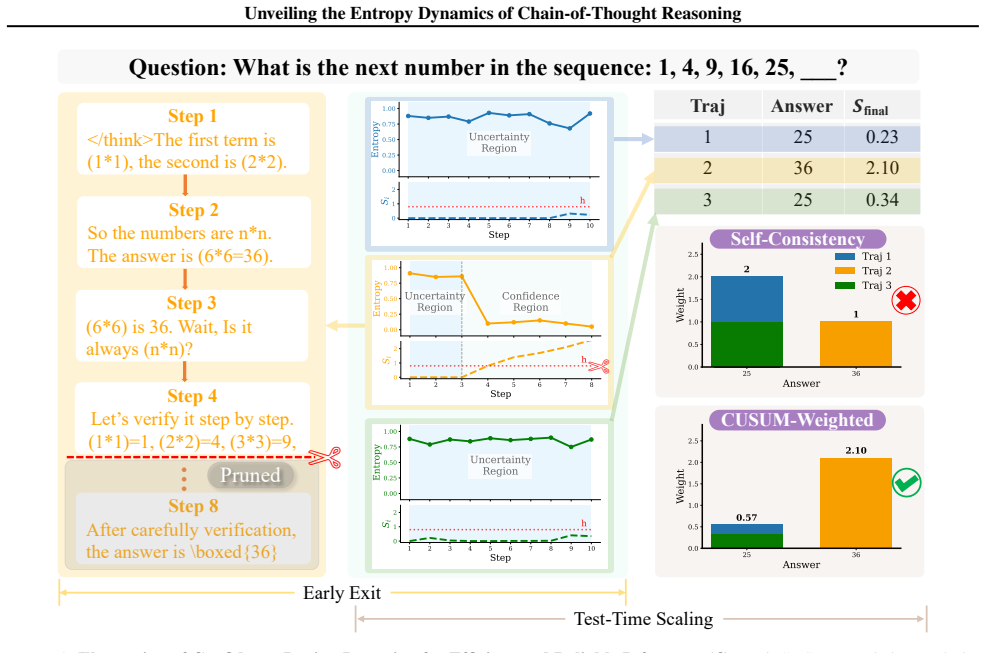
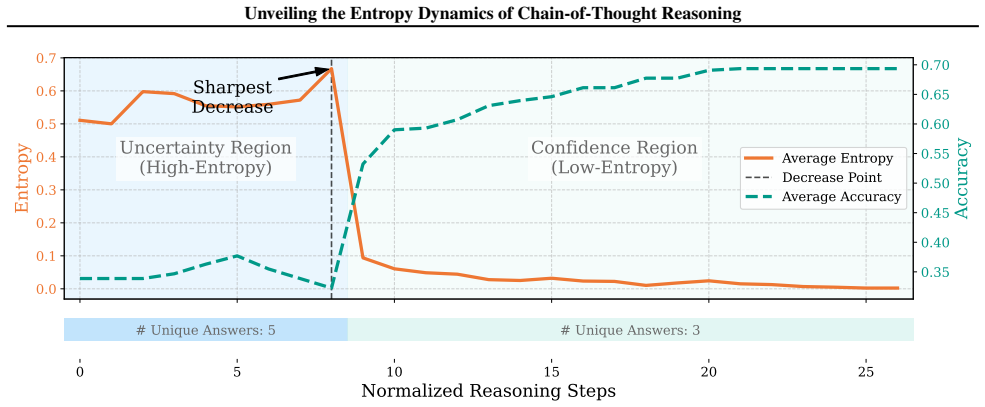
Chain-of-thought reasoning exhibits a consistent two-phase entropy structure consisting of an Uncertainty Region of exploration that transitions sharply to a Confidence Region of convergence. The Confidence Region exhibits high reliability, in which answers become highly accurate and stable, together with high redundancy, in which models generate unnecessary tokens long after reaching the correct answer. These properties are operationalized by treating Confidence Region detection as a sequential change-point problem solved with the CUSUM algorithm, yielding a training-free method that improves both early-exit efficiency and test-time scaling performance.
What carries the argument
the two-phase entropy structure of CoT trajectories, with the transition to the Confidence Region located by CUSUM change-point detection on token entropy
If this is right
- Early-exit policies can terminate generation once the Confidence Region is reached while preserving or improving final accuracy.
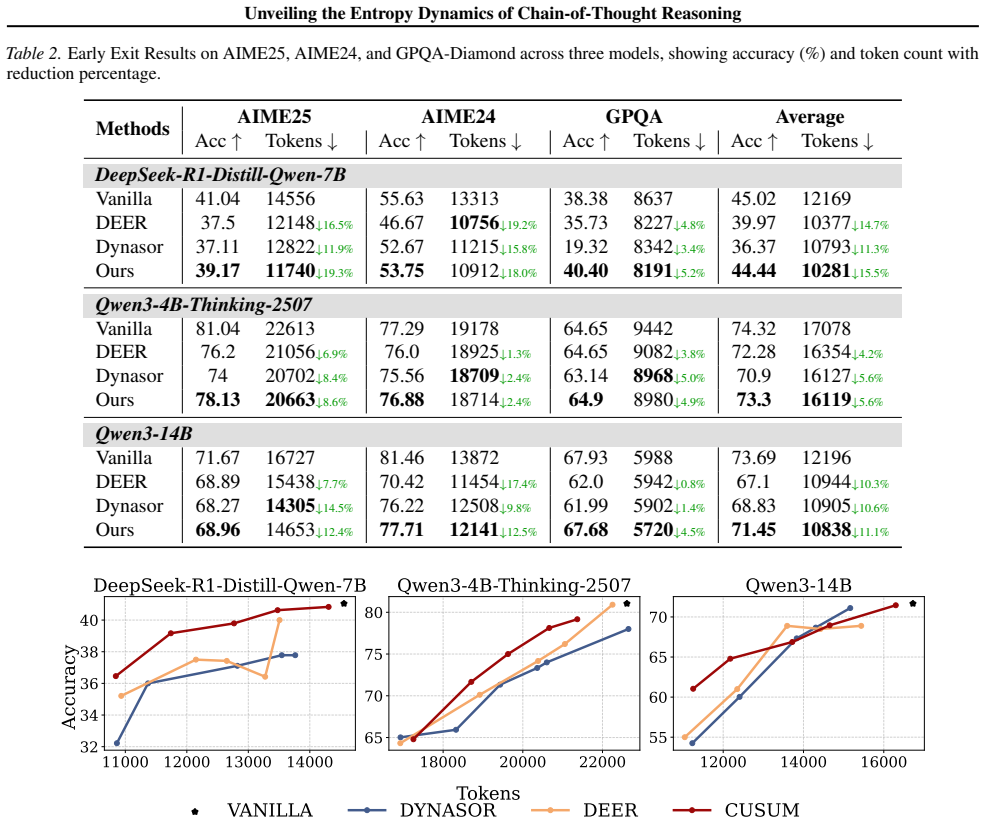
- CUSUM-based early exit reaches 63 percent accuracy with an 11 percent token reduction and beats prior early-exit baselines on the accuracy-versus-efficiency frontier.
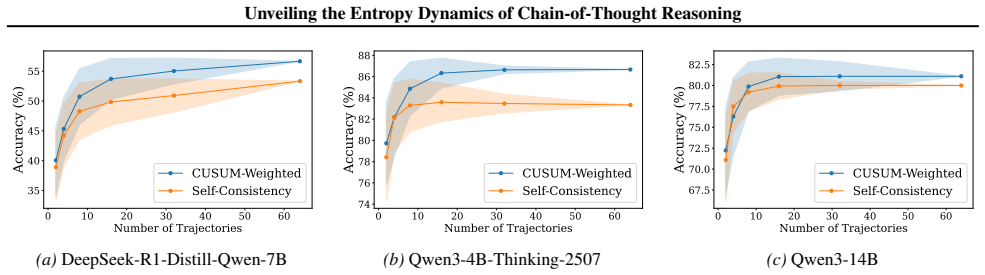
- Test-time scaling that weights trajectories according to their entry into the Confidence Region outperforms standard self-consistency voting.
- Inference controllers become training-free because they rely only on real-time entropy monitoring rather than learned stopping modules.
Where Pith is reading between the lines
- The redundancy finding implies that future training objectives could penalize continued generation after the answer has stabilized.
- If the two-phase pattern holds for other structured reasoning formats, the same CUSUM monitor could be applied without modification to tree-of-thought or graph-of-thought traces.
- The reliability signal might serve as an internal quality metric for selecting which intermediate reasoning steps to keep in compressed or distilled models.
Load-bearing premise
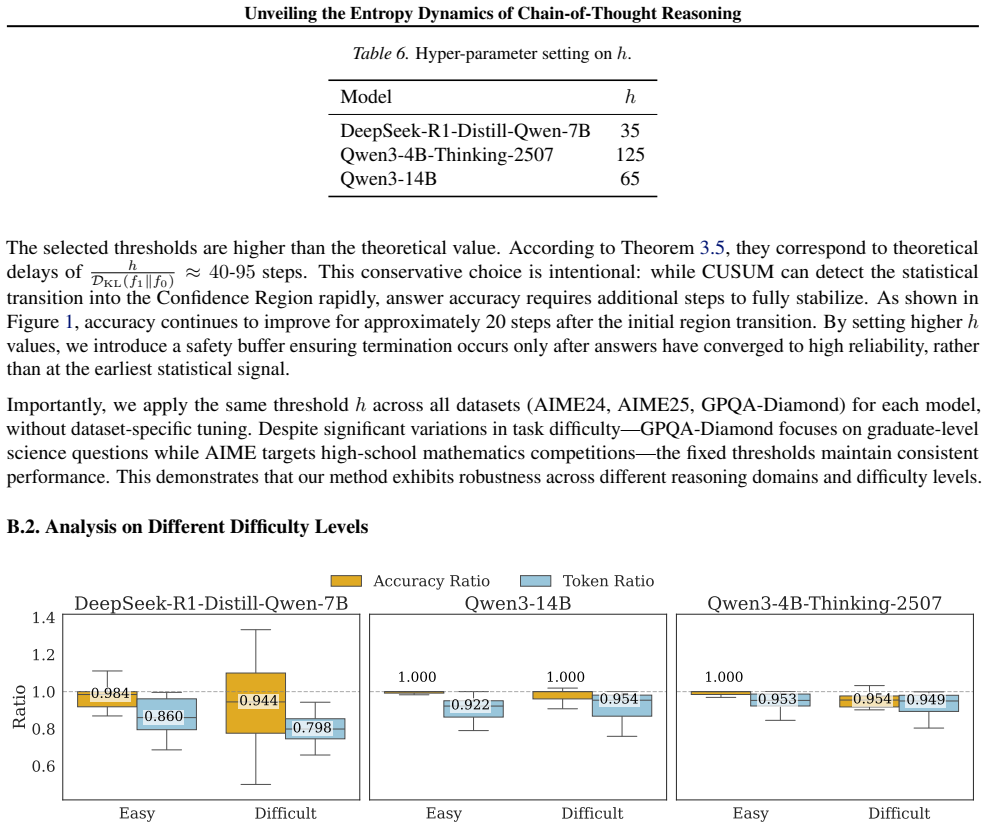
The same two-phase entropy pattern appears reliably enough across models, tasks, and datasets that a single untuned classical detector works without retraining or task-specific rules.
What would settle it
A broad set of CoT benchmarks in which entropy traces show no statistically detectable change point that aligns with the onset of high-accuracy, stable answers.
Figures




read the original abstract
This paper investigates the entropy dynamics of Chain-of-Thought (CoT) and uncovers a consistent two-phase structure: an Uncertainty Region of exploration transitioning sharply to a Confidence Region of convergence. We demonstrate that the Confidence Region possesses two critical properties: 1) High Reliability -- answers in the confidence region become highly accurate and stable, and 2) High Redundancy -- models generate unnecessary tokens long after reaching the correct answer. These properties unlock more efficient and reliable inference strategies: 1) Early Exit leverages reliability and redundancy to terminate computation safely when returns diminish, and 2)Test-Time Scaling uses the Confidence Region signal to prioritize converged trajectories. To operationalize these insights, we formulate Confidence Region detection as a sequential change-point detection problem, being the first to apply classical change-point methods to monitor CoT reasoning. Using the Cumulative Sum (CUSUM) algorithm, a statistically optimal change-point detector, we develop a training-free framework for real-time inference control. Experiments show our approach establishes a superior Pareto-frontier for early exit. CUSUM achieves 63.06% accuracy with 11.1% token reduction, outperforming DEER and Dynasor by 3.28% and 4.36% in accuracy respectively. For test-time scaling, CUSUM-weighted voting consistently outperforms self-consistency.
Editorial analysis
A structured set of objections, weighed in public.
Referee Report
Summary. The paper claims that Chain-of-Thought reasoning exhibits a consistent two-phase entropy structure—an Uncertainty Region of exploration transitioning sharply to a Confidence Region of convergence—and that this region has high reliability (accurate, stable answers) and high redundancy (unnecessary tokens after the correct answer). It formulates detection of the Confidence Region as a change-point problem and applies the off-the-shelf CUSUM algorithm in a training-free manner to enable Early Exit and weighted-voting Test-Time Scaling, reporting 63.06% accuracy with 11.1% token reduction (outperforming DEER by 3.28% and Dynasor by 4.36% in accuracy) and superior self-consistency results.
Significance. If the two-phase structure and untuned CUSUM detection hold across settings, the work supplies a practical, training-free inference-control method that improves the accuracy–efficiency Pareto frontier for CoT. The explicit use of a classical, statistically optimal change-point detector on entropy traces is a clear strength and distinguishes the contribution from purely heuristic early-exit heuristics.
major comments (2)
- [Abstract] Abstract: the reported accuracy (63.06%) and token-reduction (11.1%) figures are presented without dataset identities, model sizes, number of runs, or statistical significance tests, and without any ablation on CUSUM detection threshold; this directly weakens the central empirical claim that a single untuned CUSUM reliably locates the Confidence Region.
- [Abstract] Abstract and method description: the claim that the two-phase entropy structure is 'consistent' across models, tasks, and datasets (allowing a single CUSUM without task-specific tuning) is load-bearing for both the Early Exit and Test-Time Scaling results, yet no cross-model, cross-task, or cross-prompt-length validation or sensitivity analysis on CUSUM parameters is supplied.
minor comments (1)
- [Method] The description of entropy-sequence preprocessing and the exact CUSUM formulation (window size, threshold derivation) would benefit from an explicit equation or pseudocode block to allow reproduction.
Simulated Author's Rebuttal
We thank the referee for the constructive comments on the abstract and empirical claims. We address each point below and will revise the manuscript to strengthen clarity and support for the central claims.
read point-by-point responses
-
Referee: [Abstract] Abstract: the reported accuracy (63.06%) and token-reduction (11.1%) figures are presented without dataset identities, model sizes, number of runs, or statistical significance tests, and without any ablation on CUSUM detection threshold; this directly weakens the central empirical claim that a single untuned CUSUM reliably locates the Confidence Region.
Authors: We agree the abstract omits key experimental context due to length limits. In revision we will expand the abstract to specify the primary dataset, model sizes, number of runs, and note that results include statistical significance testing. We will also add a dedicated ablation on CUSUM threshold sensitivity to the experiments section, directly supporting the reliability of the untuned detector. revision: yes
-
Referee: [Abstract] Abstract and method description: the claim that the two-phase entropy structure is 'consistent' across models, tasks, and datasets (allowing a single CUSUM without task-specific tuning) is load-bearing for both the Early Exit and Test-Time Scaling results, yet no cross-model, cross-task, or cross-prompt-length validation or sensitivity analysis on CUSUM parameters is supplied.
Authors: The current experiments demonstrate the two-phase structure and effective single-CUSUM performance on the evaluated models and tasks. To more rigorously substantiate the consistency claim we will add, in revision, cross-model results on additional models, cross-task evaluation on further datasets, prompt-length sensitivity, and explicit CUSUM parameter sensitivity analysis. revision: yes
Circularity Check
No circularity: off-the-shelf CUSUM applied to observed entropy traces
full rationale
The paper observes entropy sequences during CoT generation, applies the classical CUSUM change-point detector (an external statistical method with no parameters fitted from the evaluation data), and reports downstream accuracy and token-reduction metrics on separate test instances. No equations redefine the reported gains as quantities fitted from the same data, no self-citation chain supplies the central two-phase claim, and the detector is not trained or tuned on the outcomes it is evaluated against. The derivation therefore remains self-contained against external benchmarks.
Axiom & Free-Parameter Ledger
free parameters (1)
- CUSUM detection threshold
axioms (1)
- domain assumption Entropy of next-token distributions during CoT exhibits a detectable, consistent change point separating exploration from convergence.
Forward citations
Cited by 1 Pith paper
-
Delayed Verification Destabilizes Multi-Agent LLM Belief: Instability Thresholds and Optimal Corrector Placement
Models delayed verification in multi-agent LLMs as graph consensus, derives stability thresholds (inverse golden ratio for delay two) via grounded Laplacian, and gives a supermodular greedy rule for corrector placemen...
Reference graph
Works this paper leans on
-
[2]
URL https://api.semanticscholar. org/CorpusID:282758174. Huang, J., Lin, B., Feng, G., Chen, J., He, D., and Hou, L. Efficient reasoning for large reasoning language mod- els via certainty-guided reflection suppression.CoRR, abs/2508.05337, 2025. doi: 10.48550/ARXIV.2508.05
-
[4]
URL https://openreview.net/forum ?id=chfJJYC3iL. Kokoszka, P. and Leipus, R. Change-point in the mean of dependent observations.Statistics & Probability Letters, 40(4):385–393, 1998. ISSN 0167-7152. doi: https: //doi.org/10.1016/S0167-7152(98)00145-X. URL https://www.sciencedirect.com/scienc e/article/pii/S016771529800145X. Laaouach, Y . HALT-CoT: Model-a...
-
[5]
URL https://openreview.net/forum ?id=CX5c7C1CZa. Labs, B. Bespoke-stratos: The unreason- able effectiveness of reasoning distillation. https://www.bespokelabs.ai/blog/bespoke-stratos- the-unreasonable-effectiveness-of-reasoning-distillation,
-
[6]
Li, L., Wang, Z., Wu, Y ., Cai, J., and Yang, X
Accessed: 2025-01-22. Li, L., Wang, Z., Wu, Y ., Cai, J., and Yang, X. Cot vectors: Transferring and probing the reasoning mechanisms of llms.CoRR, abs/2510.00579, 2025. doi: 10.48550/ARX IV.2510.00579. URL https://doi.org/10.485 50/arXiv.2510.00579. Lightman, H., Kosaraju, V ., Burda, Y ., Edwards, H., Baker, B., Lee, T., Leike, J., Schulman, J., Sutskev...
-
[7]
Liu, Z., Liu, H., Zhou, D., and Ma, T
URL https://openreview.net/forum ?id=v8L0pN6EOi. Liu, Z., Liu, H., Zhou, D., and Ma, T. Chain of thought empowers transformers to solve inherently serial prob- lems. InThe Twelfth International Conference on Learn- ing Representations, ICLR 2024, Vienna, Austria, May 7-11, 2024. OpenReview.net, 2024. URL https: //openreview.net/forum?id=3EWTEy9MTM. Lorden...
arXiv 2024
-
[8]
11 Unveiling the Entropy Dynamics of Chain-of-Thought Reasoning Page, E
URL https://openreview.net/forum ?id=NjNGlPh8Wh. 11 Unveiling the Entropy Dynamics of Chain-of-Thought Reasoning Page, E. S. Continuous inspection schemes.Biometrika, 41(1/2):100–115, 1954. URL https://www.jstor. org/stable/2333009. Rein, D., Hou, B. L., Stickland, A. C., Petty, J., Pang, R. Y ., Dirani, J., Michael, J., and Bowman, S. R. GPQA: A graduate...
-
[11]
URL https: //doi.org/10.1109/TIT.2021.3074961
doi: 10.1109/TIT.2021.3074961. URL https: //doi.org/10.1109/TIT.2021.3074961. Xu, S., Xie, W., Zhao, L., and He, P. Chain of draft: Think- ing faster by writing less.CoRR, abs/2502.18600, 2025a. doi: 10.48550/ARXIV.2502.18600. URL https: //doi.org/10.48550/arXiv.2502.18600. Xu, T., Yang, H., Zhao, F., Wu, Z., and Dai, X. A two- agent game for zero-shot re...
-
[12]
URL https://aclanthology.org/2025.findin gs-acl.828/
doi: 10.18653/v1/2025.findings-acl.828. URL https://aclanthology.org/2025.findin gs-acl.828/. Yang, C., Si, Q., Duan, Y ., Zhu, Z., Zhu, C., Lin, Z., Cao, L., and Wang, W. Dynamic early exit in reasoning models. CoRR, abs/2504.15895, 2025a. doi: 10.48550/ARXIV .2504.15895. URL https://doi.org/10.48550 /arXiv.2504.15895. Yang, S., Wu, J., Chen, X., Xiao, Y...
-
[13]
2026 Sulfur fractionation in coronal plumes as observed by Solar Orbiter/SPICE
URL https://doi.org/10.48550/arXiv .2504.02956. Yang, Z., Qi, P., Zhang, S., Bengio, Y ., Cohen, W. W., Salakhutdinov, R., and Manning, C. D. Hotpotqa: A dataset for diverse, explainable multi-hop question an- swering. In Riloff, E., Chiang, D., Hockenmaier, J., and Tsujii, J. (eds.),Proceedings of the 2018 Confer- ence on Empirical Methods in Natural Lan...
work page internal anchor Pith review doi:10.48550/arxiv 2018
discussion (0)
Sign in with ORCID, Apple, or X to comment. Anyone can read and Pith papers without signing in.