Evolutionary Discovery of Bivariate Bicycle Codes with LLM-Guided Search
Pith reviewed 2026-06-28 14:36 UTC · model grok-4.3
The pith
LLM-guided evolution of code-generating programs yields 465 distinct bivariate-bicycle quantum codes at lengths up to 360.
A machine-rendered reading of the paper's core claim, the machinery that carries it, and where it could break.
Core claim
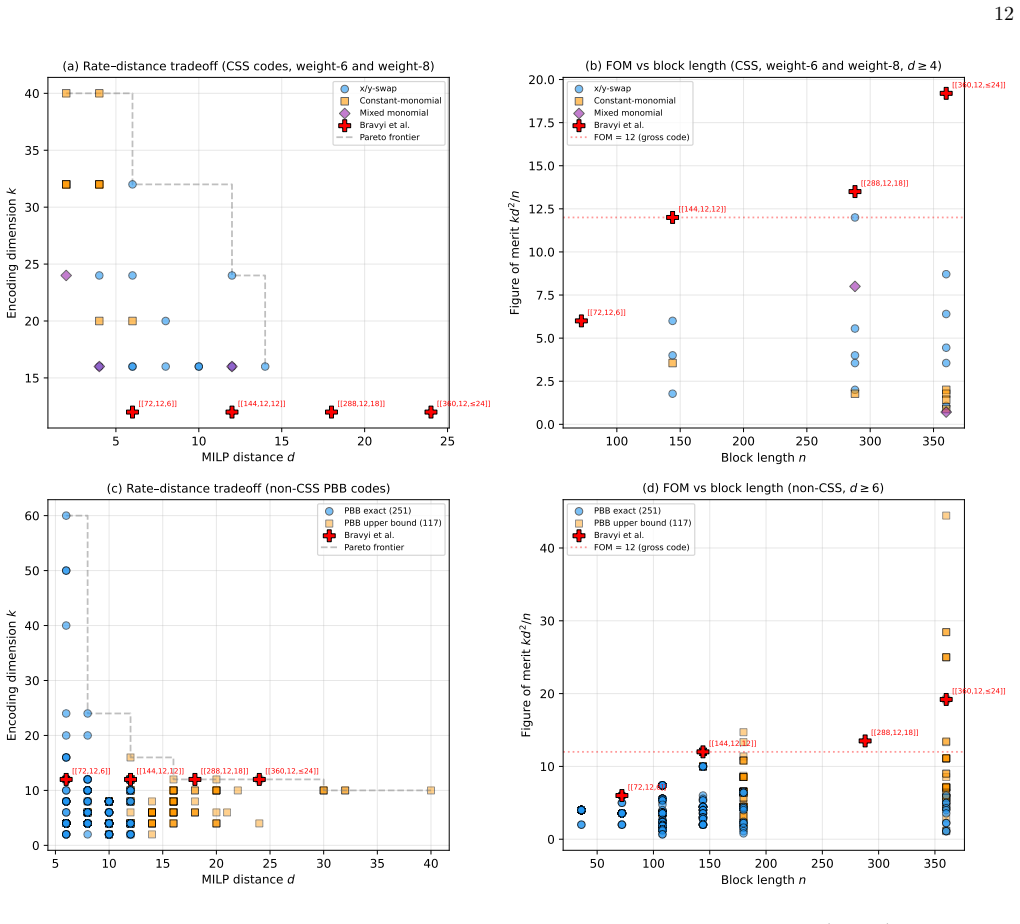
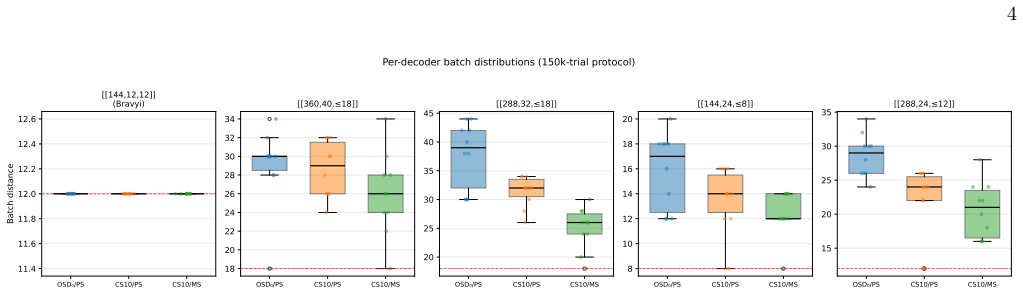
An LLM-guided evolutionary workflow in which models mutate Python generators for bivariate-bicycle ansatze, followed by GF(2) rank checks, distance certification, MILP bounds, Tanner-graph deduplication, decomposability tests, and local-Clifford equivalence, produces 465 distinct codes at n ≤ 360, including an indecomposable [[288,16,12]] CSS code and perturbed non-CSS codes that attain the gross-code figure of merit at [[144,12,12]].
What carries the argument
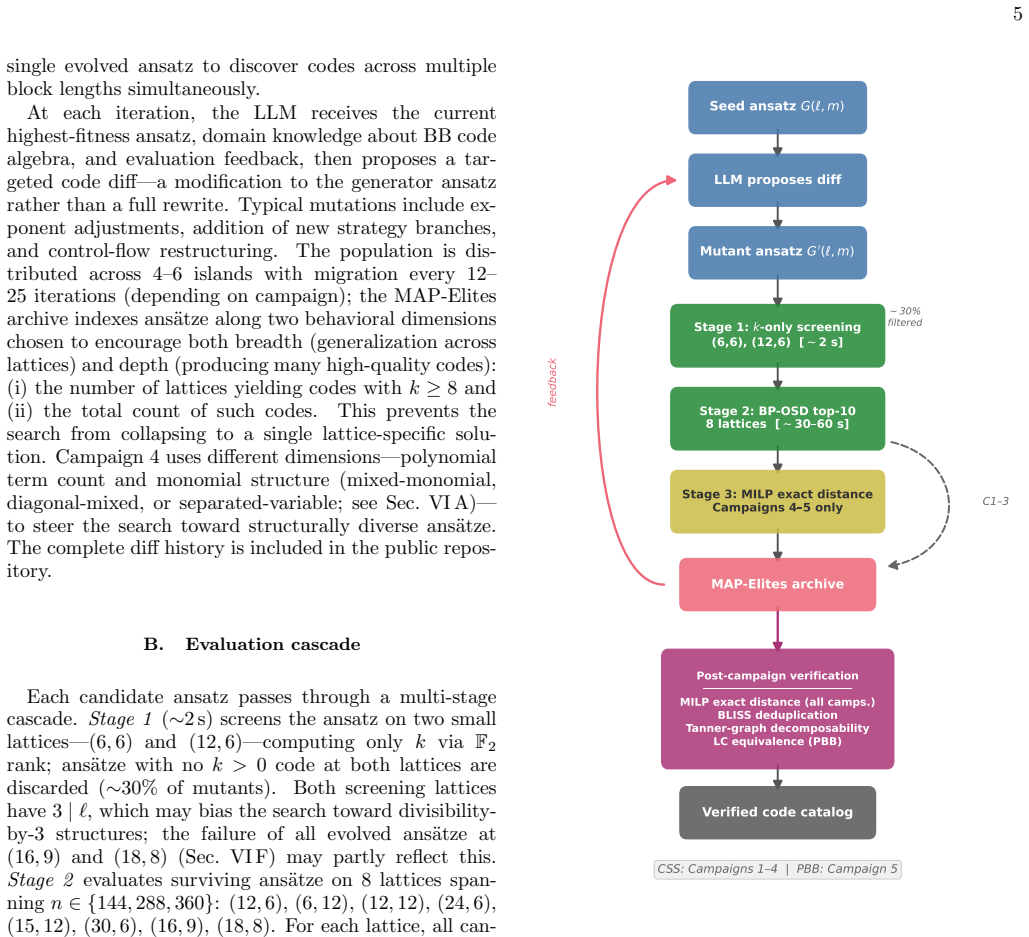
LLM-driven mutation of Python programs that output parity-check matrices for bivariate-bicycle and perturbed bivariate-bicycle constructions, evaluated by a staged validation pipeline of linear-algebra rank, distance estimation, MILP, BLISS deduplication, and equivalence checks.
Load-bearing premise
The staged validation pipeline correctly computes ranks, distances, and equivalence classes for every candidate without false positives or missed duplicates.
What would settle it
A single reported code whose actual distance, after independent recomputation, falls below the certified value listed in the paper.
Figures
read the original abstract
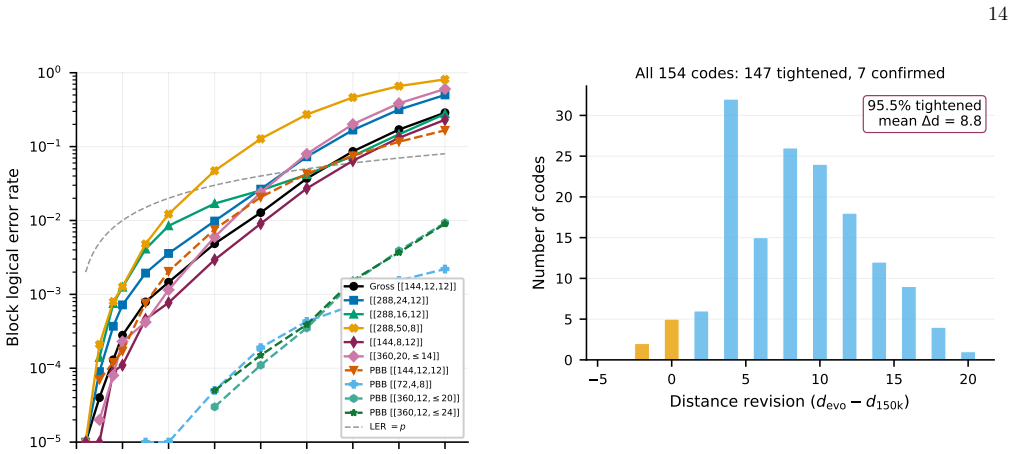
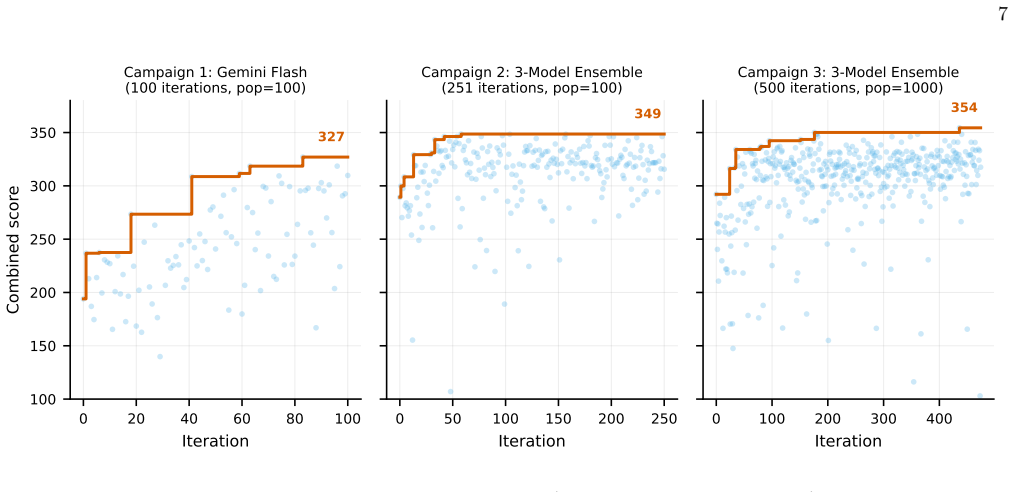
Quantum LDPC code discovery requires searching large algebraic design spaces while reliably certifying the parameters and equivalence classes of any candidates found. We introduce an LLM-guided evolutionary workflow in which language models mutate Python programs that generate bivariate-bicycle and perturbed bivariate-bicycle code ans\"atze. Across five campaigns, the system performed approximately 1{,}650 evolutionary iterations, screened about $2 \times 10^5$ candidate codes, and required ${\sim}140$ hours of computation and ${\sim}$US\$400 in LLM inference cost. Candidate codes are evaluated through a staged validation pipeline combining $\mathrm{GF}(2)$ rank computation, distance estimation and certification, mixed-integer linear programming, BLISS Tanner-graph deduplication, decomposability analysis, and local-Clifford equivalence checks. At block length $n \leq 360$, the workflow identifies 465 distinct candidate codes: 97 CSS bivariate-bicycle codes and 368 non-CSS perturbed variants. The CSS search recovers known high-performing codes and finds new finite-length representatives, including an indecomposable [[288,16,12]] code and higher-weight codes with up to $k = 50$ at distance $d = 8$. The non-CSS search produces perturbed codes matching the gross-code figure of merit at [[144,12,12]], along with additional high-distance candidates reported as certified values or upper bounds according to MILP status. Overall, these results show that LLM-guided program evolution can serve as a practical tool for structured quantum-code discovery when paired with independent evaluation.
Editorial analysis
A structured set of objections, weighed in public.
Referee Report
Summary. The paper introduces an LLM-guided evolutionary workflow for discovering bivariate-bicycle quantum LDPC codes and perturbed variants. Through approximately 1,650 iterations screening 2×10^5 candidates, it identifies 465 distinct codes at n ≤ 360, including 97 CSS codes and 368 non-CSS, with examples like an indecomposable [[288,16,12]] code and [[144,12,12]] matching gross-code merit, certified via a staged pipeline of GF(2) rank, MILP distance certification, BLISS deduplication, and equivalence checks.
Significance. If the reported parameters hold under independent verification, the work shows that LLM-guided program evolution can practically explore algebraic design spaces for quantum LDPC codes, recovering known high-performing codes while producing new finite-length representatives. The explicit use of external validation tools (MILP, BLISS isomorphism checks, local-Clifford equivalence) is a methodological strength that supports reproducibility of the numerical claims.
major comments (2)
- [Validation pipeline description] Validation pipeline (description of staged checks): the claim of 465 distinct codes with exact parameters (e.g., [[288,16,12]] indecomposable, [[144,12,12]]) depends on MILP distance certification producing no false-positive exact distances. The manuscript provides no MILP formulation, solver parameters, time limits, optimality-gap statistics, or error analysis for n=288 instances, so it is impossible to confirm that reported d=12 values are certified rather than upper bounds.
- [Staged validation pipeline] BLISS deduplication and equivalence checks (staged pipeline): the count of 465 distinct candidates and the novelty of the indecomposable [[288,16,12]] code rest on the correctness of Tanner-graph isomorphism tests and local-Clifford enumeration. No implementation details, test cases, or verification that all equivalences were exhaustively checked are supplied, which directly affects the reported distinctness and parameter counts.
minor comments (2)
- [Abstract] Abstract: the phrase 'ans"atze' contains a stray quote character that should be corrected for typesetting.
- [Results] The manuscript would benefit from an explicit table summarizing the 465 codes by CSS/non-CSS, distance certification status (exact vs. upper bound), and MILP gap status.
Simulated Author's Rebuttal
We thank the referee for their careful reading and constructive comments on the manuscript. We address each major comment below and will incorporate the requested details into a revised version to improve reproducibility.
read point-by-point responses
-
Referee: [Validation pipeline description] Validation pipeline (description of staged checks): the claim of 465 distinct codes with exact parameters (e.g., [[288,16,12]] indecomposable, [[144,12,12]]) depends on MILP distance certification producing no false-positive exact distances. The manuscript provides no MILP formulation, solver parameters, time limits, optimality-gap statistics, or error analysis for n=288 instances, so it is impossible to confirm that reported d=12 values are certified rather than upper bounds.
Authors: We agree that the manuscript does not provide the MILP formulation, solver parameters, time limits, optimality-gap statistics, or error analysis. In the revised version we will add an appendix or subsection detailing the exact MILP formulation used for distance certification, the solver and its parameters, time limits applied, optimality-gap tolerances, and certification statistics for the n=288 instances (and others), making clear which distances are certified exact values versus upper bounds. revision: yes
-
Referee: [Staged validation pipeline] BLISS deduplication and equivalence checks (staged pipeline): the count of 465 distinct candidates and the novelty of the indecomposable [[288,16,12]] code rest on the correctness of Tanner-graph isomorphism tests and local-Clifford enumeration. No implementation details, test cases, or verification that all equivalences were exhaustively checked are supplied, which directly affects the reported distinctness and parameter counts.
Authors: We acknowledge that the manuscript supplies insufficient implementation details, test cases, and verification for the BLISS Tanner-graph isomorphism tests and local-Clifford equivalence enumeration. The revised manuscript will expand the validation-pipeline description to include the precise BLISS usage, the local-Clifford enumeration algorithm, representative test cases, and confirmation that equivalence checks were exhaustive for the reported codes, thereby supporting the distinctness counts and novelty claims. revision: yes
Circularity Check
No circularity: results from explicit computational search and external validation
full rationale
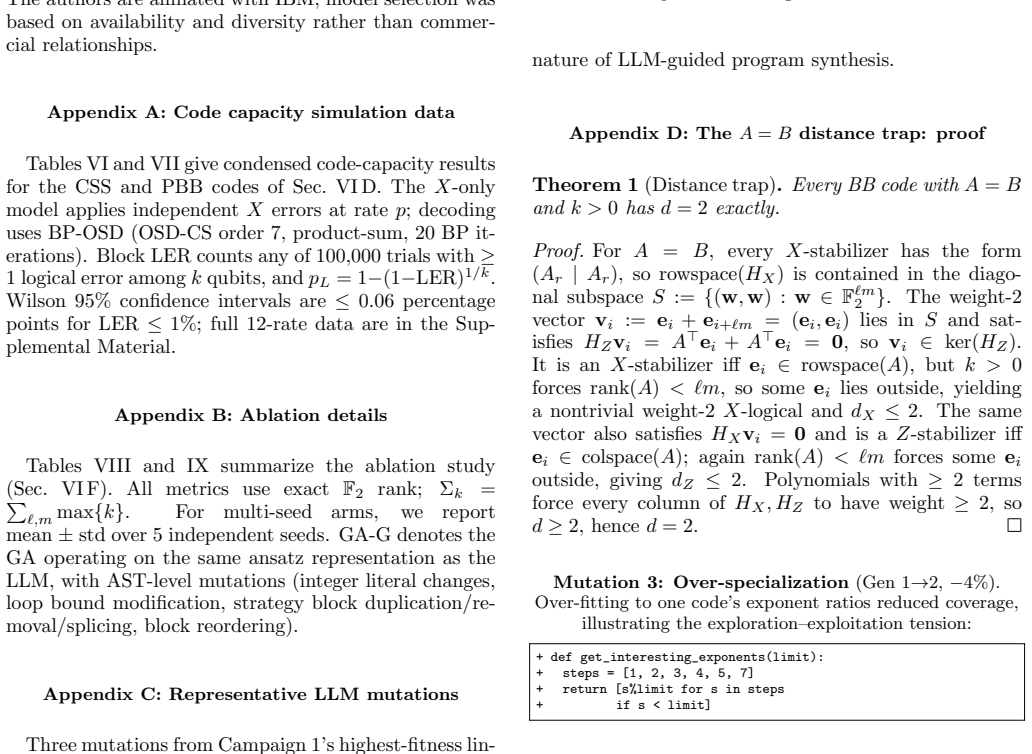
The paper describes an LLM-guided evolutionary search that mutates Python programs to generate candidate bivariate-bicycle codes, followed by a staged validation pipeline (GF(2) rank, distance estimation via MILP, BLISS deduplication, decomposability analysis, and local-Clifford checks). No step reduces a claimed result to its own inputs by definition, renames a fitted quantity as a prediction, or relies on a load-bearing self-citation whose content is unverified. The 465 codes and their parameters (e.g., [[288,16,12]]) are outputs of independent computational procedures rather than tautological redefinitions. The workflow is self-contained against external benchmarks and receives the default non-circularity finding.
Axiom & Free-Parameter Ledger
Forward citations
Cited by 2 Pith papers
-
Evolving Quantum Error-Correcting Encodings for Molecular Simulation
LLM-driven evolutionary program synthesis discovers Generalized Superfast Encodings with exact distance 5 (and 6 on one instance) for molecular Hamiltonians, the first beyond distance 3.
-
Large-Language-Model Discovery of Quantum LDPC Codes through Structured Concept Evolution
A new LLM-guided search method called structured concept evolution discovers competitive lifted-product qLDPC code families including non-abelian constructions.
Reference graph
Works this paper leans on
-
[1]
A. R. Calderbank and P. W. Shor, Good quantum error-correcting codes exist, Physical Review A54, 1098 (1996)
1996
-
[2]
A. M. Steane, Multiple-particle interference and quan- tum error correction, Proceedings of the Royal Society of London A452, 2551 (1996)
1996
-
[3]
Junttila and P
T. Junttila and P. Kaski, Engineering an efficient canon- ical labeling tool for large and sparse graphs, inProceed- ings of the 9th Workshop on Algorithm Engineering and Experiments (ALENEX)(SIAM, 2007) pp. 135–149
2007
- [4]
-
[5]
J. N. Eberhardt, F. R. F. Pereira, and V. Steffan, Prun- ing qLDPC codes: Towards bivariate bicycle codes with open boundary conditions, arXiv:2412.04181 [quant-ph] (2024), preprint
arXiv 2024
-
[6]
J.-P. Tillich and G. Z´ emor, Quantum LDPC codes with positive rate and minimum distance proportional to the square root of the blocklength, IEEE Transactions on Information Theory60, 1193 (2014), arXiv:0903.0566
Pith/arXiv arXiv 2014
-
[7]
P. Panteleev and G. Kalachev, Degenerate quantum LDPC codes with good finite length performance, Quan- tum5, 585 (2021), arXiv:1904.02703
arXiv 2021
-
[8]
Roffe, D
J. Roffe, D. R. White, S. Burton, and E. Campbell, De- coding across the quantum low-density parity-check code landscape, Physical Review Research2, 043423 (2020)
2020
-
[9]
B. C. B. Symons, A. Rajput, and D. E. Browne, Se- quences of bivariate bicycle codes from covering graphs, arXiv:2511.13560 [quant-ph] (2025), preprint
Pith/arXiv arXiv 2025
-
[10]
Z. Liang and Y.-A. Chen, Self-dual bivariate bicycle codes with transversal Clifford gates, arXiv:2510.05211 [quant-ph] (2025), v2, January 2026
arXiv 2025
- [11]
- [12]
-
[13]
Huangfu and J
Q. Huangfu and J. A. J. Hall, Parallelizing the dual re- vised simplex method, Mathematical Programming Com- putation10, 119 (2018)
2018
-
[14]
Sole disc
P. Virtanen, R. Gommers, T. E. Oliphant, M. Haber- land, T. Reddy, D. Cournapeau, E. Burovski, P. Peter- son, W. Weckesser, J. Bright,et al., SciPy 1.0: Fun- damental algorithms for scientific computing in Python, Nature Methods17, 261 (2020). 9 TABLE II. All verified codes atn= 288 (98 polynomial representations, 49 distinct codes), sorted by FOM =kd 2/n...
2020
discussion (0)
Sign in with ORCID, Apple, or X to comment. Anyone can read and Pith papers without signing in.