Mechanical properties of the nucleon in the chiral confining model. I -- formal developments
Pith reviewed 2026-06-28 08:01 UTC · model grok-4.3
The pith
Imposing the von Laue stability condition on trial states in the chiral confining model produces explicit expressions for the nucleon's mass, average pressure, energy density, and internal pressure distribution.
A machine-rendered reading of the paper's core claim, the machinery that carries it, and where it could break.
Core claim
The nucleon trial states in the chiral confining model are fixed by imposing the von Laue stability condition. This yields detailed expressions for the total energy (identified with the nucleon mass), the average pressure, the energy density, and the pressure distribution inside the nucleon.
What carries the argument
The von Laue stability condition applied to localized or momentum-projected trial states that include both the confining potential and the pion cloud.
Load-bearing premise
The von Laue stability condition can be imposed directly on the model's trial states to guarantee mechanical stability without creating inconsistencies between the energy and pressure functionals.
What would settle it
A numerical evaluation in which the spatial integral of the derived pressure distribution fails to vanish after the stability condition has been imposed.
Figures


read the original abstract
We discuss the issue of the mechanical stability of the nucleon within a class of models in which massive constituent quarks are subject to a confining potential and are coupled to a surrounding pion cloud enveloping the quark core. The nucleon trial states (either localized factorized wave functions or momentum-projected states) are determined by imposing the von Laue stability condition. This article is primarily devoted to the formal aspects related to the detailed expressions for the total energy (mass), the average pressure, the energy density and the pressure distribution inside the nucleon. It will be accompanied by a complementary article addressing the evolution of nucleon properties with density, associated with the restoration of chiral symmetry.
Editorial analysis
A structured set of objections, weighed in public.
Referee Report
Summary. The manuscript develops formal expressions for the nucleon mass (total energy), average pressure, energy density, and pressure distribution in a chiral confining model consisting of massive constituent quarks subject to a confining potential and coupled to a pion cloud. Trial states are constructed either as localized factorized wave functions or as momentum-projected states, with variational parameters fixed by imposing the von Laue stability condition; explicit integrals and functionals for the mechanical quantities are derived. This is presented as Part I (formal developments), with a companion paper planned on density evolution and chiral symmetry restoration.
Significance. If the derivations are internally consistent, the work supplies a concrete variational framework that links confinement, chiral dynamics, and mechanical stability of the nucleon, yielding explicit expressions that could be evaluated numerically and compared across models. The explicit treatment of both factorized and projected states, together with the direct use of the von Laue condition as a constraint, is a methodological strength that supports reproducibility of the resulting functionals.
major comments (1)
- [Trial-state construction and von Laue imposition] The central procedure of determining the trial states by direct imposition of the von Laue condition (abstract and the section describing the trial-state construction) must be shown to produce energy and pressure expressions that are not tautological with the model parameters; an explicit demonstration that the resulting functionals remain independent after the constraint is applied is required, as this underpins the claim of obtaining detailed, mechanically stable distributions.
Simulated Author's Rebuttal
We thank the referee for the careful reading of the manuscript and for the constructive comment. We address the major comment below.
read point-by-point responses
-
Referee: [Trial-state construction and von Laue imposition] The central procedure of determining the trial states by direct imposition of the von Laue condition (abstract and the section describing the trial-state construction) must be shown to produce energy and pressure expressions that are not tautological with the model parameters; an explicit demonstration that the resulting functionals remain independent after the constraint is applied is required, as this underpins the claim of obtaining detailed, mechanically stable distributions.
Authors: We agree that an explicit demonstration of independence strengthens the presentation. The von Laue condition is imposed to constrain a single variational parameter that sets the overall spatial extent of the trial state, thereby enforcing global mechanical equilibrium. The local energy density and pressure distributions, however, are obtained from the diagonal and off-diagonal components of the stress-energy tensor constructed from the quark and pion fields. These components retain explicit dependence on the model parameters (constituent quark mass, confining potential strength, and pion-quark coupling) through the self-consistent solution of the trial wave functions. In the revised manuscript we will insert a short subsection that illustrates this independence by recomputing the pressure profile for two different values of the confining strength while readjusting the variational parameter to restore the von Laue integral; the resulting distinct radial shapes confirm that the mechanical functionals are not rendered tautological by the constraint. revision: yes
Circularity Check
No significant circularity detected
full rationale
The paper determines trial states by imposing the external von Laue stability condition on the chiral confining model (with quark core and pion cloud), then derives formal expressions for mass, average pressure, energy density, and pressure distributions. This constraint is treated as an independent mechanical requirement rather than a self-derived or fitted quantity internal to the model. No equations in the abstract or description reduce the outputs to inputs by construction, no self-citation chains bear the central claim, and the derivation remains self-contained against external benchmarks without renaming known results or smuggling ansatze.
Axiom & Free-Parameter Ledger
axioms (1)
- domain assumption The von Laue stability condition determines the nucleon trial states in this model class.
Forward citations
Cited by 1 Pith paper
-
Mechanical properties of the nucleon in the chiral confining model. II -- in-medium evolution of the nucleon properties
In the chiral confining model, in-medium nucleon mass evolution driven by scalar-field response and separation of confinement versus chiral effects governs repulsive three-body forces for saturation, alongside changes...
Reference graph
Works this paper leans on
-
[1]
Localized nucleonic state We will first consider trial nucleon states where the three-quark Fock-space amplitude is just the product of the three single-quark amplitudes properly projected onto the color singlet state withI=J= 1/2, namely, ΦX N (p1,p 2,p 3) =e −i(p 1+p2+p3)·X N Φ (p1) Φ (p2) Φ (p3) (9) Φ (p1) Φ (p2) Φ (p3) =R 0(p1)R0(p2)R0(p3),(10) with t...
-
[2]
As in Ref
Momentum projected nucleon state A significant source of improvement in the description of nucleon properties is to replace the localized nucleon state, not possessing a well-defined total 3-momentum by a momentum projected nucleon state with well defined momentum P, denoted by|N(P N)⟩, or sometimes for short by|P N ⟩in the formal developments. As in Ref....
-
[3]
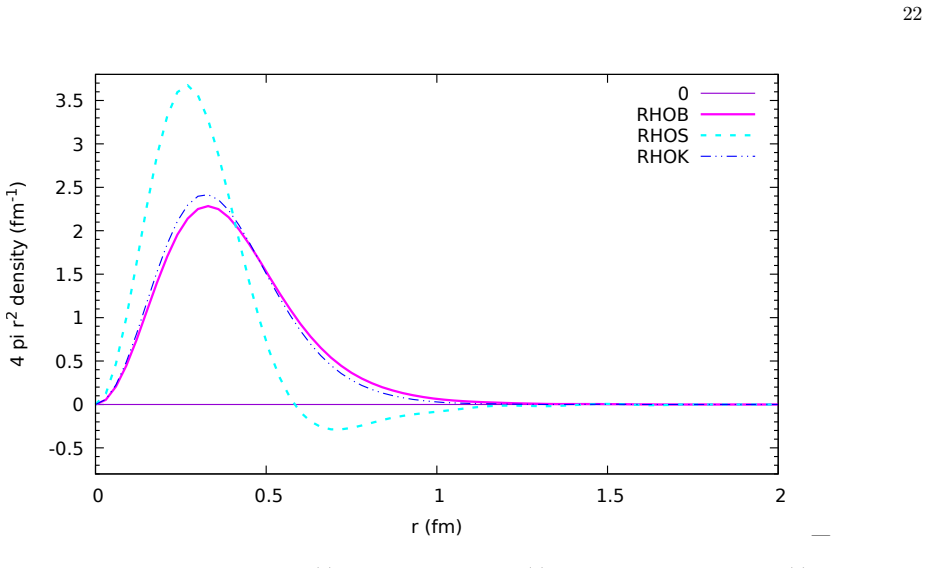
Local quark densities Let us consider the local densities,t Γ(r)≡t Γ(x= (0,r)) (i.e., implicitly taken att= 0 in this discussion), associated with local density operators, ˆTΓ(r) = ¯q(r) Γq(r). Examples include the quark kinetic energy density operator,H QK(r) = ¯q(r) (−iγ·∇r)q(r), the scalar density operator, ˆρS(r) = ¯q(r)q(r), or the quark number densi...
-
[4]
quark core bag
expressed in the Breit frame (in analogy to the electromagnetic form factors [15]) that may be experimentally accessed through scattering processes involving an external probe coupled to the nucleon via the local density operator ˆTΓ(r). This is indeed the case for the components of the energy momentum tensor (EMT), whose matrix elements, ⟨∆N /2| ˆT µν(0)...
-
[5]
static nucleonic bag
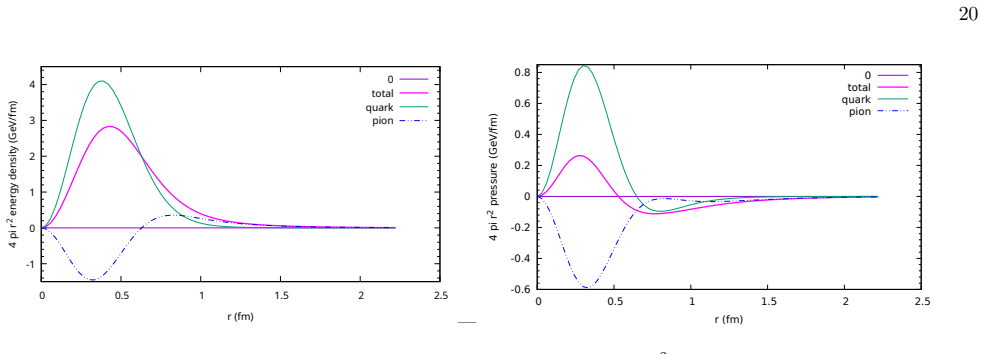
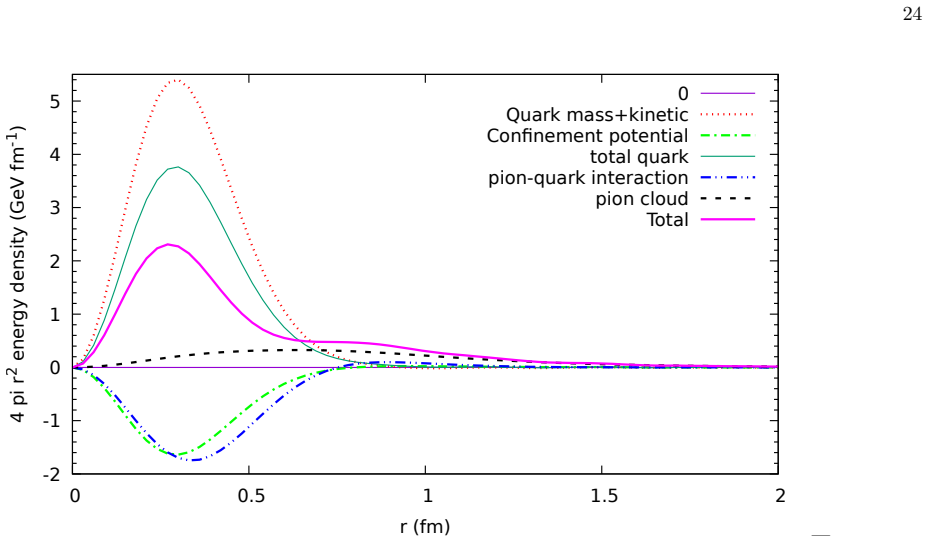
Quark core contribution to the energy density and pressure of the static CCM nucleonic bag The quark operators ˆTΓ entering ˆT ii and ˆT 00 areH QK,H QM,H C andP C. They are of the form ˆTΓ ∼¯q(r)Γ(r)q(r). The “static nucleonic bag” wave function is not translationally invariant and consequently the state|N:0 X ⟩= |N(X N = 0)⟩is not an eigenstate of the f...
-
[6]
static CCM nucleonic bag
Pion cloud contribution to the energy density and pressure of the “static CCM nucleonic bag” The calculation of the pion cloud contribution to the static EMT tensor also necessitates a projection procedure. To this end, let us introduce the following Green’s function: Ga(r, t;r ′, t′) = X ∆ ⟨∆N /2| −iT(Φ a(r, t),Φ a(r′, t′) )| −∆ N /2⟩.(126) From the equa...
-
[7]
= X ∆ ⟨∆N /2| −iT ˜S† k(t1), ˜Sq(t′ 1) | −∆ N /2⟩= Z dν 2π e−iν(t1−t′
-
[8]
bag pressure
Π0D(k,q;ν) Π0D(k,q;ν) = X n,∆ ⟨∆N /2| ˜S† k |n⟩ ⟨n| ˜Sq | −∆ N /2⟩ ν−E n +iη − ⟨∆N /2| ˜Sq |n⟩ ⟨n| ˜S† k | −∆ N /2⟩ ν+E n −iη ! .(129) 18 To avoid possible confusion between the numerouskandk ′, we replace in Eq. (128) thek ′ integration variable with q. After performing the time integration we arrive at: Ga(r, t;r, t ′) = 1 2Fπ 2Z d3k (2π)3 d3q (2π)3 ei(...
2020
-
[9]
G. Chanfray, H. Hansen, B. K. Pradhan, companion paper: ”Mechanical properties of the nucleon in the chiral confining model. II - in-medium evolution of the nucleon properties”; arXiv : 2606.03633 [nucl-th]
-
[10]
G. Chanfray, M. Ericson and M. Martini, Universe 9 (2023) 7, 316; arXiv: 2307.03484 [nucl-th]
arXiv 2023
- [11]
-
[12]
G. Chanfray, M. Ericson, H. Hansen, J. Margueron, and M. Martini, Symmetry 17, 313 (2025); arXiv:2501.10177 [nucl-th]
arXiv 2025
-
[13]
Yu. A. Simonov, J. A. Tjon, Phys. Rev. D 62, 014501 (2000)
2000
-
[14]
Yu. A. Simonov, J. A. Tjon, J. Weda, Phys. Rev. D 65, 094013 (2002)
2002
-
[15]
Yu. S. Kalashnikova, A. V. Nefediev, J. E. F. T. Ribeiro, Phys.Usp. 60 (2017) 7, 667-693; arXiv: 1707.04886 [hep-ph]
Pith/arXiv arXiv 2017
-
[16]
Yu. A. Simonov, Phys. Rev. D 99, 056012 (2019)
2019
-
[17]
Krein, Eur
G. Krein, Eur. Phys. J. A. 18, 511 (2003); M. E. Bracco, G. Krein, M. Nielsen, Phys. Lett. B 432, 258 (1998)
2003
-
[18]
Hillery, R.F
M. Hillery, R.F. O’Connell, M.O. Scully, E.P.Wigner, Phys. Rep. 106, 121 (1984)
1984
-
[19]
Lorc´ e, H
C. Lorc´ e, H. Moutarde, A. P. Trawinski, Eur. Phys. J. C, 79 (2019)
2019
-
[20]
Chanfray and P
G. Chanfray and P. Schuck, Phys. Rev. A38, 4832 (1988)
1988
-
[21]
Schuck et al, Progr
P. Schuck et al, Progr. Part. Nucl. Phys., 22, 181 (1989)
1989
-
[22]
R. G. Sachs, Phys. Rev. 126, 2256 (1962)
1962
-
[23]
Xiong et al., Nature (London) 575, 147 (2019)
W. Xiong et al., Nature (London) 575, 147 (2019)
2019
-
[24]
M.V. Polyakov, P. Schweitzer, Int.J.Mod.Phys. A33, 1830025 (2018). arXiv:1805.06596 [hep-ph]
Pith/arXiv arXiv 2018
-
[25]
Burkert, L
V.D. Burkert, L. Elouadrhiri, F.X. Girod, Nature 557 7705, 396 (2018)
2018
-
[26]
L. Favart, M. Guidal, T. Horn, P. Kroll, Eur. Phys. J. A 52, 158 (2016); arXiv:1511.04535
Pith/arXiv arXiv 2016
-
[27]
G. E. Brown, Nucl. Phys. A 358, 39c (1981)
1981
-
[28]
De Kam, H
J. De Kam, H. J. Pirner, Nucl. Phys. A 389, 640 (1982)
1982
-
[29]
S. P. Klevansky, Review of Modern Physics 64, 649 (1992)
1992
-
[30]
von Laue, Ann
M. von Laue, Ann. Phys. (Leipzig) 340, 524 (1911)
1911
-
[31]
Polyakov, Phys
M.V. Polyakov, Phys. Lett. B555, 57 (2003)
2003
-
[32]
Goeke, J
K. Goeke, J. Grabis, J. Ossmann, M.V. Polyakov, P. Schweitzer, A. Silva, and D. Urbano, Phys. Rev. D75, 094021 (2007)
2007
-
[33]
Lorc´ e, A
C. Lorc´ e, A. Metz, B. Pasquini and S. Rodini, jheph11, 121 (2021)
2021
-
[34]
Chanfray, M
G. Chanfray, M. Ericson, Phys. Rev. C 75, 015206 (2007)
2007
-
[35]
Chanfray, P
G. Chanfray, P. Schuck and W. N¨ orenberg, Nucl. Phys. A519, 311c (1990)
1990
-
[36]
Chanfray, M
G. Chanfray, M. Ericson, Phys. Rev. C 83, 015204 (2011)
2011
-
[37]
Diakonov et al, Nucl
D. Diakonov et al, Nucl. Phys. B480 (1996)
1996
discussion (0)
Sign in with ORCID, Apple, or X to comment. Anyone can read and Pith papers without signing in.