Mechanical properties of the nucleon in the chiral confining model. II -- in-medium evolution of the nucleon properties
Pith reviewed 2026-06-28 07:58 UTC · model grok-4.3
The pith
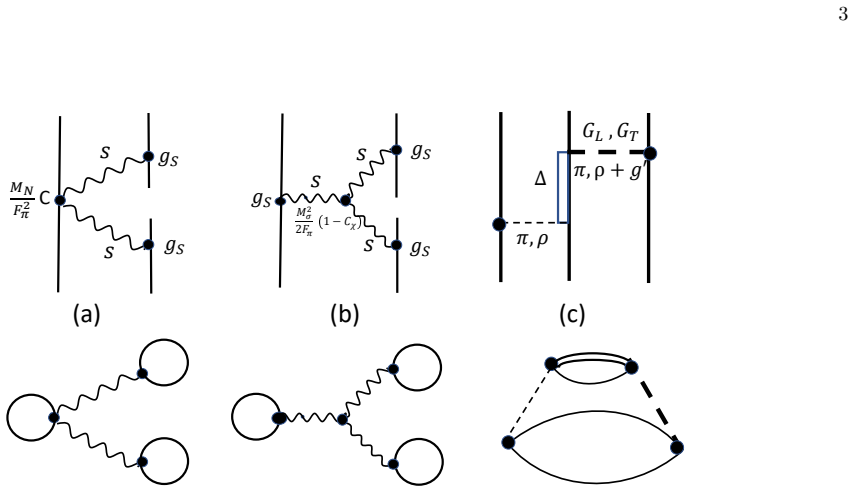
The in-medium nucleon mass evolution in the chiral confining model generates the repulsive three-body forces needed for nuclear saturation.
A machine-rendered reading of the paper's core claim, the machinery that carries it, and where it could break.
Core claim
In the chiral confining model the in-medium nucleon mass evolves according to the composite nucleon's response to the scalar field, with confinement and chiral symmetry breaking contributing differently; this evolution directly generates the repulsive three-body forces required for the nuclear saturation mechanism. The modifications of the energy density and pressure distributions inside the bound nucleon are computed explicitly.
What carries the argument
The von Laue stability condition imposed on localized factorized or momentum-projected nucleon trial states to fix their parameters in the presence of the scalar field.
If this is right
- The repulsive three-body forces arise directly from the density-dependent drop in nucleon mass.
- Confinement and chiral symmetry breaking play distinct roles in setting the size of that mass drop.
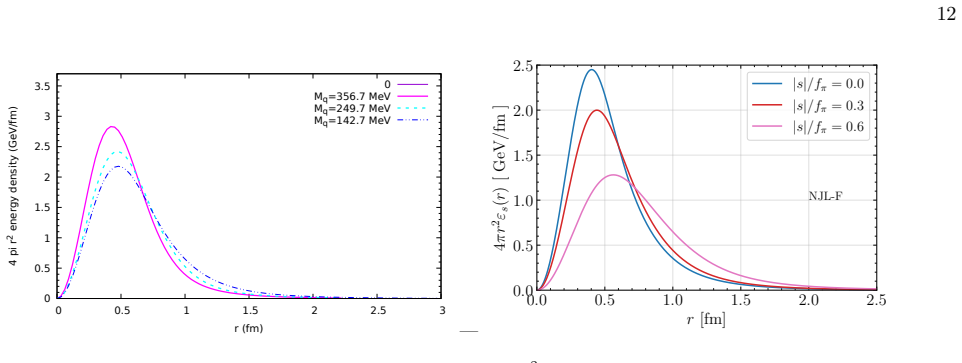
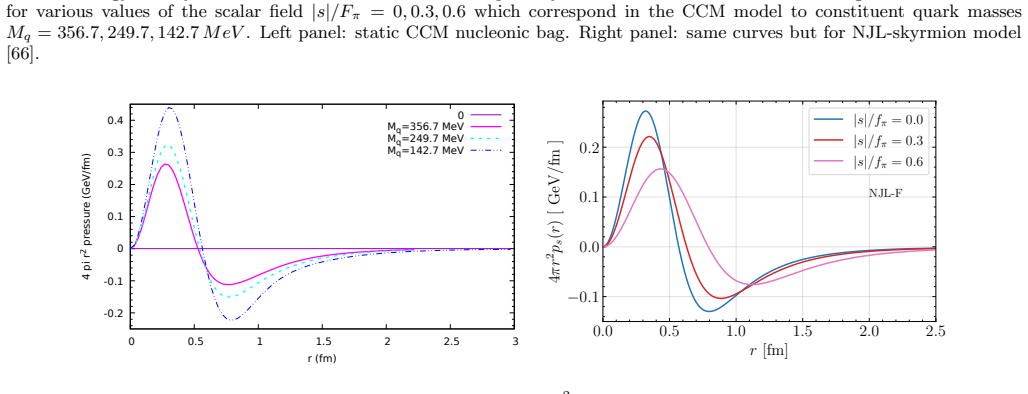
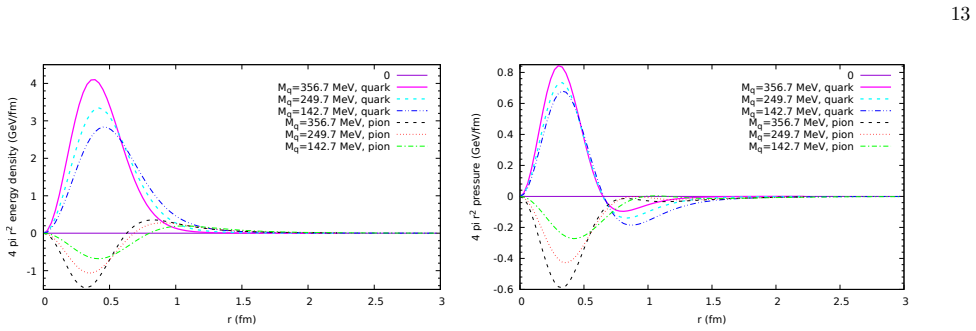
- The internal pressure distribution inside the nucleon is altered by the medium, affecting its mechanical stability.
- The same mass evolution supplies a microscopic route to the equation of state of dense matter in neutron stars.
Where Pith is reading between the lines
- The framework could be used to compute nucleon properties in finite nuclei by relaxing the infinite-matter approximation.
- Predictions for the in-medium mass shift offer a possible link to observables in heavy-ion collisions or electron-nucleus scattering.
- The mapping to neutron-star matter could be tested by comparing the resulting equation of state against astrophysical mass-radius constraints.
Load-bearing premise
The in-medium nucleon trial states are correctly determined by imposing the von Laue stability condition established in the companion paper.
What would settle it
A calculation showing that the three-body repulsion generated by the computed nucleon mass shift is either too weak or too strong to produce saturation at the empirical density would disprove the mechanism.
Figures
read the original abstract
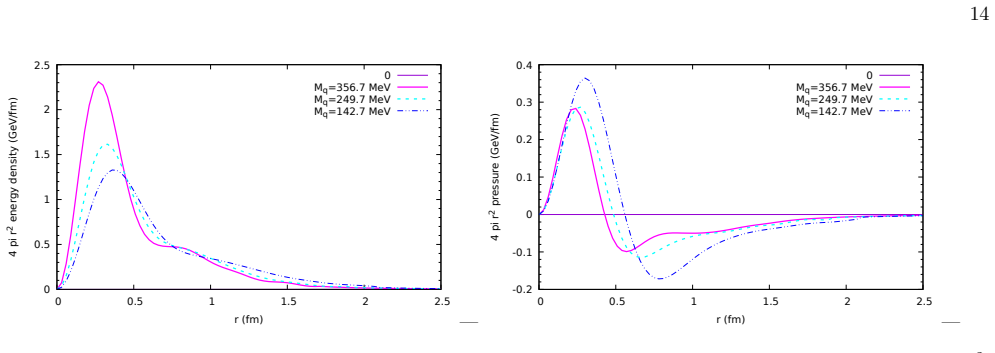
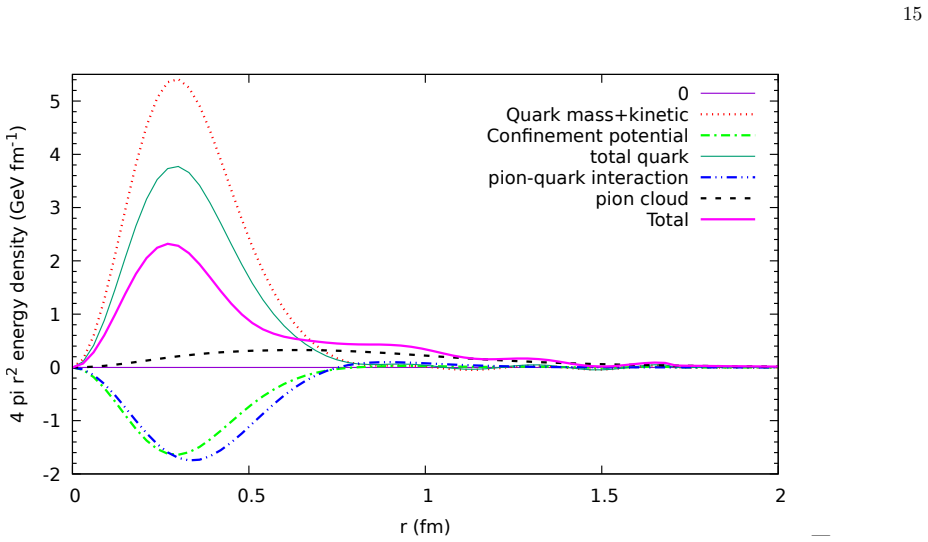
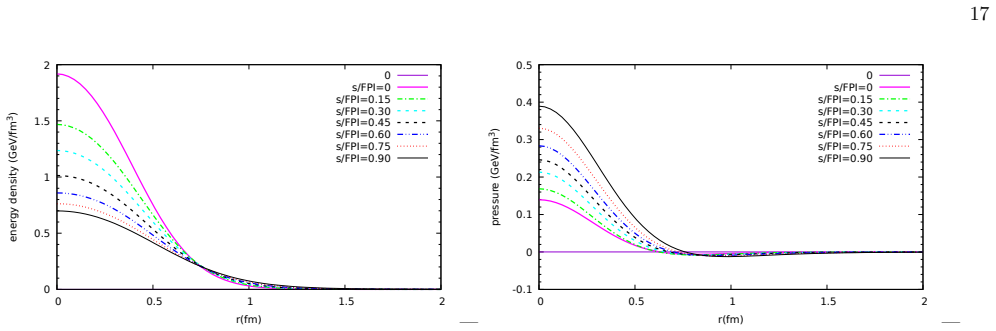
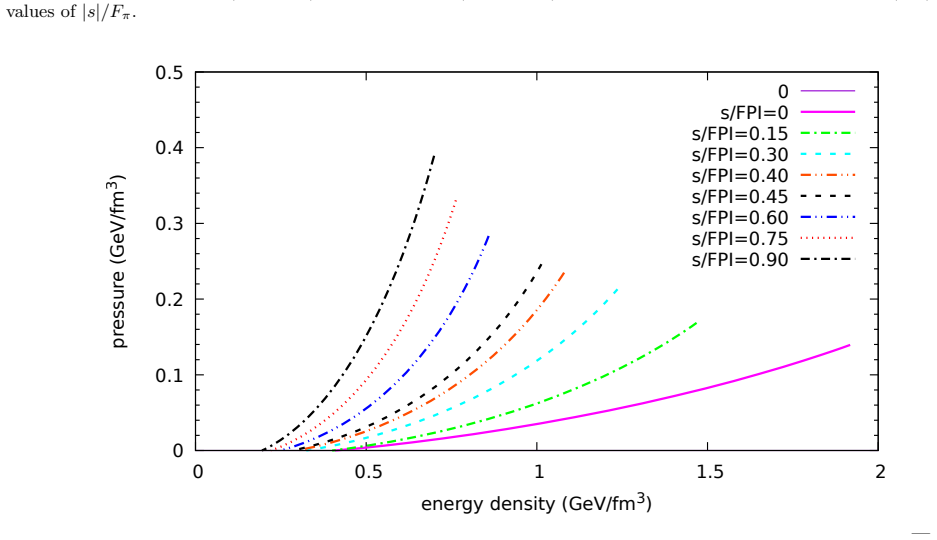
This article is devoted to the study of the evolution of the properties of nucleons bound in nuclear matter within the framework of the chiral confining model. The in-medium nucleon trial states (either localized factorized wave functions or momentum-projected states) are determined by imposing the von Laue stability condition, according to the formal results established in a preliminary companion paper (labeled as I). The main results concern the response of the composite nucleon to the scalar field, as well as the respective roles of confinement and chiral symmetry breaking in the evolution of the in-medium nucleon mass. This evolution governs the repulsive three-body forces required for the nuclear saturation mechanism. We also analyze the modification of the energy density distribution and the pressure distribution inside the in-medium nucleon. We also draw some perspectives concerning the mapping between bound nucleon properties and the equation of state of dense matter as realized in the deep interior of neutron stars.
Editorial analysis
A structured set of objections, weighed in public.
Referee Report
Summary. The paper studies the in-medium evolution of nucleon properties in the chiral confining model. In-medium nucleon trial states, either localized factorized wave functions or momentum-projected states, are fixed by imposing the von Laue stability condition from the companion paper I. The central results concern the nucleon's response to the scalar field and the roles of confinement and chiral symmetry breaking in the evolution of the in-medium nucleon mass, which is claimed to govern the repulsive three-body forces necessary for the nuclear saturation mechanism. The work also analyzes changes in the energy density and pressure distributions inside the nucleon and offers perspectives on mapping these properties to the equation of state of dense matter in neutron stars.
Significance. If the central claims hold, this provides a valuable connection between the mechanical properties of nucleons in medium and the nuclear saturation, potentially explaining the need for three-body repulsion in effective models. The variational approach with stability conditions is a strength, offering a systematic way to study in-medium modifications. However, the significance depends on how well the model compares to empirical data or other calculations, and its applicability to neutron star interiors.
major comments (2)
- [Section describing the determination of in-medium nucleon trial states] The imposition of the von Laue stability condition from paper I to determine the in-medium trial states is central to the mass evolution results. The manuscript should provide a detailed justification or derivation showing that no additional medium-specific corrections are needed for the composite nucleon, as any such omission could undermine the reliability of the extracted density-dependent mass shift and its link to three-body forces.
- [Results section on mass evolution and three-body forces] The claim that the evolution of the in-medium nucleon mass governs the repulsive three-body forces for saturation is load-bearing for the nuclear saturation mechanism. The paper needs to demonstrate explicitly how the computed mass response (via scalar field) translates quantitatively into a three-body repulsion term, including any numerical estimates or direct comparisons to saturation properties.
minor comments (2)
- Ensure that all references to companion paper I are clear and that key results from I are summarized briefly for self-containment.
- Clarify the notation for the trial wave functions and any parameters used in the variational procedure.
Simulated Author's Rebuttal
We thank the referee for the careful reading of our manuscript and the constructive comments. We address each major point below and will revise the manuscript to strengthen the presentation while preserving the core variational framework established in paper I.
read point-by-point responses
-
Referee: [Section describing the determination of in-medium nucleon trial states] The imposition of the von Laue stability condition from paper I to determine the in-medium trial states is central to the mass evolution results. The manuscript should provide a detailed justification or derivation showing that no additional medium-specific corrections are needed for the composite nucleon, as any such omission could undermine the reliability of the extracted density-dependent mass shift and its link to three-body forces.
Authors: The von Laue condition is imposed exactly as derived variationally in paper I for the composite system; the quark-level dynamics and scalar-field coupling already incorporate the medium response, so no further ad-hoc corrections enter the trial-state optimization. To address the request for explicitness, we will insert a concise recap of the key steps from paper I (with the relevant equations) into Section II of the revised manuscript. revision: yes
-
Referee: [Results section on mass evolution and three-body forces] The claim that the evolution of the in-medium nucleon mass governs the repulsive three-body forces for saturation is load-bearing for the nuclear saturation mechanism. The paper needs to demonstrate explicitly how the computed mass response (via scalar field) translates quantitatively into a three-body repulsion term, including any numerical estimates or direct comparisons to saturation properties.
Authors: Within the model the density-dependent mass shift directly modifies the single-particle energy functional, generating an effective repulsion whose leading density dependence is cubic and therefore equivalent to a three-body force. We will add a new subsection that extracts the numerical coefficient of this effective three-body term from the computed mass response, provides its value at saturation density, and compares it with the three-body repulsion strengths required in standard Skyrme and relativistic mean-field parametrizations that reproduce the empirical saturation point. revision: yes
Circularity Check
No significant circularity detected
full rationale
The paper determines in-medium trial states by imposing the von Laue stability condition from companion paper I, then computes the nucleon's response to the scalar field, mass evolution, and internal energy/pressure distributions within the chiral confining model. This constitutes a standard variational procedure in which the stability condition serves as a physical constraint to fix state parameters, after which the mass shift and its implications for three-body forces are calculated as outputs. No quoted equation or step reduces a claimed prediction or central result to an input by construction, nor does any load-bearing premise collapse solely to a self-citation without independent model content. The derivation chain remains self-contained against the model's own equations and assumptions.
Axiom & Free-Parameter Ledger
Forward citations
Cited by 1 Pith paper
-
Mechanical properties of the nucleon in the chiral confining model. I -- formal developments
Formal derivation of nucleon mass, pressure, and density distributions in the chiral confining model via the von Laue stability condition applied to localized or momentum-projected trial states.
Reference graph
Works this paper leans on
-
[1]
Quark energy For the localized CCM static bag,|N:0 X ⟩ ≡ |N(X N = 0)⟩, the various contributions to the quark energy and the average pressure, are given by: EQ =E QK +E QM +E C = Z d3r εQ(r) = Z d3r εQK(r) + Z d3r εQM(r) + Z d3r εC(r) PC =− Z d3rP C(r) (A1) εQK(r) =⟨N:0 X |q †(r) h −iα· ⃗∇r i q(r)|N:0 X ⟩ = 3 u(r)v′(r)−u ′(r)v(r) + 2u(r)v(r) r (A2) εQM(r)...
-
[2]
Pionic energy For the localized CCM static bag,|N:0 X ⟩ ≡ |N(X N = 0)⟩, the various contributions to the pionic energy are given by: EπM = 3 2 1 2Fπ(S) 2Z d3k (2π)3 k2 M2 π(S) 2ω2 k Γ2(k) 1 ωk 1 ωk +ϵ Nk + 1 (ωk +ϵ Nk)2 +32 25 1 ωk 1 ωk +ϵ ∆k + 1 (ωk +ϵ ∆k)2 (A10) EπK = 3 2 1 2Fπ(S) 2Z d3k (2π)3 k4 2ω2 k Γ2(k) 1 ωk 1 ωk +ϵ Nk + 1 (ωk +ϵ Nk)2 +32 25 1 ωk 1...
-
[3]
Quark core contribution to the energy density and pressure For the localized CCM static bag,|N:0 X ⟩ ≡ |N(X N = 0)⟩, the various contributions to the quark energy densities and pressure distributions, are given by: εQK(r)/3 = (ψ) † (r)[−iα· ⃗∇r] (ψ) (r) =u(r)v ′(r)−u ′(r)v(r) + 2u(r)v(r) r (A15) εQM(r)/3 = (ψ) † (r)β M q (ψ) (r) =M q u2(r)−v 2(r) (A16) εC...
-
[4]
Pionic contribution to the energy density and pressure For the localized CCM static bag,|N:0 X ⟩ ≡ |N(X N = 0)⟩, the various contributions to the energy densities and pressure distributions of pionic origin, are given by: επM (r) = 3 2 1 2Fπ(S) 2Z d3k (2π)3 d3q (2π)3 j1(kr)j 1(qr) Γ(k) Γ(q) M2 π(S)k q 2ωkωq 1 (ωk +ω q)(ωk + ¯ϵN kq) + 1 (ωk +ω q)(ωq + ¯ϵN ...
-
[5]
G. Chanfray, H.Hansen, B. K. Pradhan, companion paper: ”Mechanical properties of the nucleon in the chiral confining model. I - formal developments”; arXiv : 2606.03588 [nucl-th]
-
[6]
B. D. Serot, J. D. Walecka, The Relativistic Nuclear Many-Body Problem, Advances in Nucl. Phys. 16, 1 (1986)
1986
-
[7]
B. D. Serot, J. D. Walecka, Int. J. Mod. Phys. E 16, 15 (1997)
1997
-
[8]
Chanfray, M
G. Chanfray, M. Ericson and P. A. M. Guichon, Phys. Rev. C 63, 055202 (2001)
2001
-
[9]
Chanfray, D
G. Chanfray, D. Davesne, M. Ericson and M. Martini, Eur. Phys. J. A 27, 191 (2006). 22
2006
-
[10]
Boguta, Phys
J. Boguta, Phys. Lett. 120B, 34 (1983)
1983
-
[11]
Second High Energy Heavy Ion Summer Study
A. K. Kerman and L. D. Miller in “Second High Energy Heavy Ion Summer Study”,LBL-3675, 1974
1974
-
[12]
Bentz, A
W. Bentz, A. W. Thomas, Nucl. Phys. A 696 (2001) 138
2001
-
[13]
Chanfray, Nucl
G. Chanfray, Nucl. Phys. A 721, 76c (2003)
2003
-
[14]
Chanfray, M
G. Chanfray, M. Ericson, Eur. Phys. J. A 25, 151 (2005)
2005
-
[15]
Chanfray, M
G. Chanfray, M. Ericson, Phys. Rev. C 75, 015206 (2007)
2007
-
[16]
Ericson, G
M. Ericson, G. Chanfray, Eur. Phys. J. A 34, 215 (2007)
2007
-
[17]
Massot, G
E. Massot, G. Chanfray, Phys. Rev. C 78, 015204 (2008)
2008
-
[18]
Massot, G
E. Massot, G. Chanfray, Phys. Rev. C 80, 015202 (2009)
2009
-
[19]
P. A. M. Guichon, Phys. Lett. B 200, 235 (1988)
1988
-
[20]
P. A. M Guichon, K. Saito, E. Rodionov and A. W. Thomas, Nucl. Phys. A 601, 349 (1996)
1996
-
[21]
P. A. M. Guichon, A. W. Thomas, Phys. Rev. Lett. 93, 132502 (2004)
2004
-
[22]
P. A. M. Guichon, H. H. Matevosyan, N. Sandulescu and A. W. Thomas, Nucl. Phys. A 772, 1 (2006)
2006
-
[23]
Stone, P
R. Stone, P. A. M. Guichon, P. G. Reinhard and A. W. Thomas, Phys. Rev. Lett. 116, 092511 (2016)
2016
-
[24]
P. A. M Guichon, J. R. Stone and A. W. Thomas, Progr. Part. Nucl. Phys. 100, 262 (2018)
2018
-
[25]
Massot, J
E. Massot, J. Margueron and G. Chanfray, EPL 97, 39002 (2012)
2012
-
[26]
Somasundaram, J
R. Somasundaram, J. Margueron, G. Chanfray and H. Hansen, Eur. Phys. J. A 58, 5 (2022)
2022
-
[27]
M. Chamseddine, J. Margueron, G. Chanfray, H. Hansen and R. Somasundaram, Eur. Phys. J. A 59 (2023) 8, 177; arXiv:2304.01817 [nucl-th]
arXiv 2023
-
[28]
G. Chanfray, H. Hansen and J. Margueron, Eur. Phys. J. A 59, 11 (2023); arXiv: 2304.01036 [nucl-th]
arXiv 2023
-
[29]
G. Chanfray, M. Ericson and M. Martini, Universe 9 (2023) 7, 316; arXiv: 2307.03484 [nucl-th]
arXiv 2023
- [30]
-
[31]
M. Chamseddine, J. Margueron, H. Hansen and G. Chanfray, Eur. Phys. J. A 60 (2024) 6, 137; arXiv: 2401.10100 [nucl-th]
arXiv 2024
-
[32]
D. B. Leinweber, A. W. Thomas and R. D. Young, arXiv: 0302020 [hep-lat]
-
[33]
D. B. Leinweber, A. W. Thomas and R. D. Young, Phys. Rev. Lett. 92, 242002 (2004)
2004
-
[34]
A. W. Thomas, P. A. M. Guichon, D. B. Leinweber and R. D. Young Progr. Theor. Phys. Suppl. 156 (2004) 124; arXiv: 0411014 [nucl-th]
2004
-
[35]
Armour, C.R
W. Armour, C.R. Alton,D. B. Leinweber, A. W. Thomas and R. D. Young, Nucl. Phys. A 840, 97 (2010)
2010
-
[36]
J. I. Fujita and H. Miyazawa, Prog. Theor. Phys. 17, 360 (1957)
1957
-
[37]
Brown and A
G. Brown and A. M Green, Nucl. Phys. A 137, 1 (1969)
1969
-
[38]
S. A. Coon, M. D. Scadron, P. C. McNamee, B. R. Barrett, D. W. E. Blatt. and B. H. J. McKeller, Nucl. Phys. A 317, 242 (1979)
1979
-
[39]
H. T. Coelho, T. K. Das, and M. R. Robilotta, Phys. Rev. C 28, 1812 (1983)
1983
-
[40]
M. R. Robilotta and H. T. Coelho, Nucl. Phys. A 460, 645 (1986)
1986
-
[41]
R. Machleidt and D. R. Entem, Phys. Rep. 503, 1 (2011); arXiv: 1105.2919 [nucl-th]
Pith/arXiv arXiv 2011
-
[42]
Chanfray, M
G. Chanfray, M. Ericson, Phys. Rev. C 83, 015204 (2011)
2011
-
[43]
Lai-Him Chan, Phys. Rev. Lett. 57, 1199 (1986)
1986
-
[44]
G. Chanfray, M. Ericson, H. Hansen, J. Margueron, and M. Martini, Symmetry 17, 313 (2025), arXiv:2501.10177 [nucl-th]
arXiv 2025
-
[45]
Yu. A. Simonov, Phys. At. Nucl. 60, 2069 (1997)
2069
-
[46]
Yu. A. Simonov, Few-BodySyst. 25, 45 (1998)
1998
-
[47]
Yu. A. Simonov, J. A. Tjon, Phys. Rev. D 62, 014501 (2000)
2000
-
[48]
Yu. A. Simonov, J. A. Tjon, J. Weda, Phys. Rev. D 65, 094013 (2002)
2002
-
[49]
Yu. A. Simonov, Phys. Rev. D 65, 094018 (2002)
2002
-
[50]
Yu. A. Simonov, Phys. At.Nucl. 67, 846 (2004), arXiv: 0302090 [hep-ph]
2004
-
[51]
Yu. A. Simonov, Phys. At. Nucl. 67, 1027 (2004), arXiv: 0305281 [hep-ph]
2004
-
[52]
Yu. A. Simonov, Int. Mod. Phys. A 31, 165016 (2016), arXiv:1509.06930 [hep-ph]
Pith/arXiv arXiv 2016
-
[53]
Di Giacomo, H
A. Di Giacomo, H. G. Dosch, V. I. Shevchenko and Yu .A. Simonov, Phys. Rep. 372, 319 (2002)
2002
-
[54]
Yu. A. Simonov, Phys. Rev. D 99, 056012 (2019)
2019
-
[55]
Krein, Eur
G. Krein, Eur. Phys. J. A. 18, 511 (2003); M. E. Bracco, G. Krein, M. Nielsen, Phys. Lett. B 432, 258 (1998)
2003
-
[56]
Xiong et al., Nature (London) 575, 147 (2019)
W. Xiong et al., Nature (London) 575, 147 (2019)
2019
-
[57]
G. E. Brown, Nucl. Phys. A 358, 39c (1981)
1981
-
[58]
De Kam, H
J. De Kam, H. J. Pirner, Nucl. Phys. A 389, 640 (1982)
1982
-
[59]
S. P. Klevansky, Review of Modern Physics 64, 649 (1992)
1992
-
[60]
Lorc´ e, A
C. Lorc´ e, A. Metz, B. Pasquini and S. Rodini, jheph11, 121 (2021)
2021
-
[61]
von Laue, Ann
M. von Laue, Ann. Phys. (Leipzig) 340, 524 (1911)
1911
-
[62]
M. V. Polyakov, Phys. Lett. B555, 57 (2003)
2003
-
[63]
Goeke, J
K. Goeke, J. Grabis, J. Ossmann, M.V. Polyakov, P. Schweitzer, A. Silva, and D. Urbano, Phys. Rev. D75, 094021 (2007)
2007
-
[64]
M.V. Polyakov, P. Schweitzer, Int.J.Mod.Phys. A33, 1830025 (2018), arXiv:1805.06596 [hep-ph]
Pith/arXiv arXiv 2018
-
[65]
C. Lorc´ e, H. Moutarde, A. P. Trawinski, Eur. Phys. J. C, 79 (2019) arXiv:1810.09837 [hep-ph]
Pith/arXiv arXiv 2019
-
[66]
R. G. Sachs, Phys. Rev. 126, 2256 (1962). arXiv: 2511.1167 [nucl-th]
arXiv 1962
-
[67]
Burkert, L
V.D. Burkert, L. Elouadrhiri, F.X. Girod, Nature 557 7705, 396 (2018)
2018
-
[68]
L. Favart, M. Guidal, T. Horn, P. Kroll, Eur. Phys. J. A 52, 158 (2016); arXiv:1511.04535
Pith/arXiv arXiv 2016
-
[69]
Hillery, R.F
M. Hillery, R.F. O’Connell, M.O. Scully, E.P.Wigner, Phys. Rep. 106, 121 (1984)
1984
-
[70]
B. K. Pradhan, G. Chanfray, H. Hansen, J. Margueron, arXiv: 2511.11167[nucl-th]. 23
-
[71]
K. Fukushima, T. Kojo and W. Weise, Phys. Rev. D 102, 096017 (2020); arXiv: 2008.08436 [hep-ph]
arXiv 2020
discussion (0)
Sign in with ORCID, Apple, or X to comment. Anyone can read and Pith papers without signing in.