REVIEW 1 major objections 1 minor 5 cited by
DESI-favored dark energy models reduce the locally determined Hubble constant by as much as 2.5 km/s/Mpc compared to LambdaCDM.
Reviewed by Pith at T0; open to challenge. T0 means a machine referee read the full paper against a public rubric. the ladder, T0–T4 →
T0 review · grok-4.3
2026-06-28 04:33 UTC pith:ZVSN2POO
load-bearing objection The paper gives specific numbers showing local H0 drops 2.5, 1.1, or 0.5 km/s/Mpc when local data are refit inside the w0wa region favored by DESI, depending on the data combo. the 1 major comments →
The DESI results impact the local determination of H₀
The pith
A machine-rendered reading of the paper's core claim, the machinery that carries it, and where it could break.
Core claim
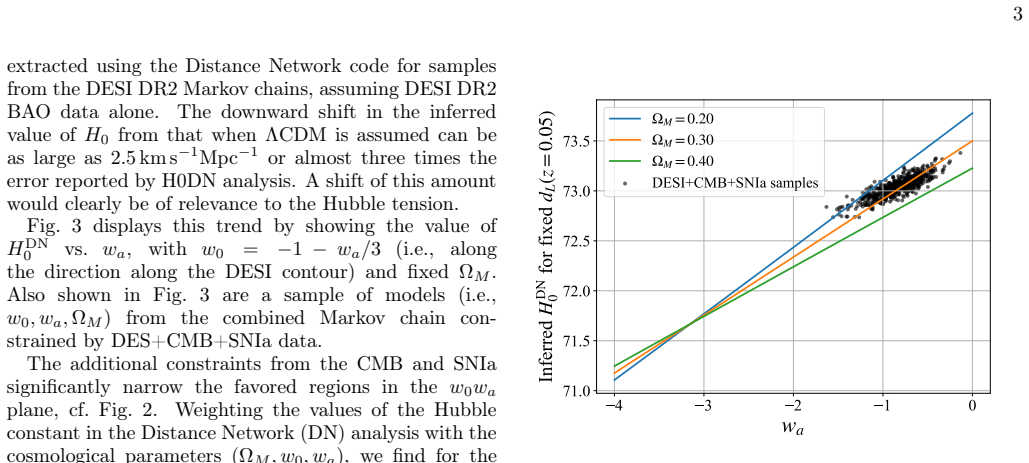
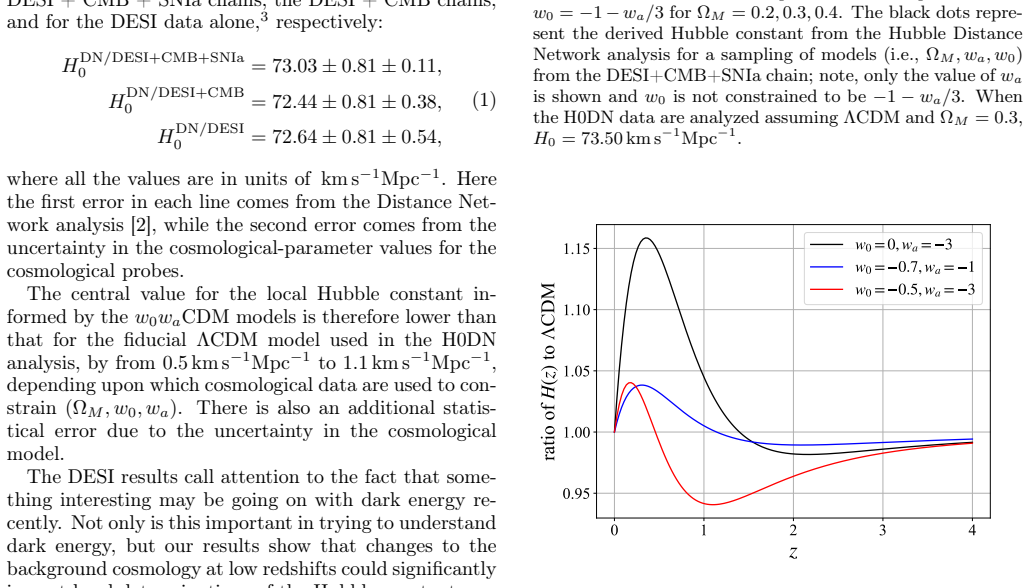
If local distance measurements are analyzed with the w0wa models preferred by the DESI measurements, the value for the Hubble constant can be as much as 2.5 km s^{-1} Mpc^{-1} smaller than the value obtained assuming LambdaCDM. When these w0wa models are further constrained by cosmic microwave background (CMB) and type Ia supernova (SNIa) data, the downward shift is 1.1 ± 0.38 km s^{-1} Mpc^{-1} (DESI + CMB) and 0.5 ± 0.1 km s^{-1} Mpc^{-1} (DESI + CMB + SNIa). The dependence of local determinations of H0 on the background cosmology, combined with the fact that the low-redshift cosmology is not well constrained, is relevant to the Hubble tension.
What carries the argument
The w0wa parametrization of dark energy, which sets a time-varying equation-of-state and thereby changes the low-redshift expansion history used to convert local distance-ladder observables into an H0 value.
Load-bearing premise
The w0wa parametrization and parameter values favored by DESI BAO data constitute an appropriate background cosmology for re-deriving H0 from local distance-ladder observations.
What would settle it
Re-deriving the local H0 value with the exact DESI best-fit w0 and wa parameters and finding no shift relative to the LambdaCDM result would falsify the reported downward correction.
If this is right
- Local H0 determinations become sensitive to the assumed dark energy model at low redshift.
- DESI-preferred w0wa models produce an H0 value up to 2.5 km s^{-1} Mpc^{-1} lower than LambdaCDM.
- Adding CMB data limits the downward shift to 1.1 ± 0.38 km s^{-1} Mpc^{-1}.
- Further adding SNIa data reduces the shift to 0.5 ± 0.1 km s^{-1} Mpc^{-1}.
- This model dependence is directly relevant to interpreting the Hubble tension.
Where Pith is reading between the lines
- Standard future analyses of the distance ladder should default to evolving dark energy models if DESI results hold.
- Part of the current Hubble tension may reflect the use of an incorrect low-redshift cosmology rather than new early-universe physics.
- Tighter low-redshift constraints on w0 and wa from upcoming surveys would directly test the size of the reported H0 shift.
Editorial analysis
A structured set of objections, weighed in public.
Referee Report
Summary. The manuscript claims that re-analyzing local distance-ladder observations under the w0wa dark-energy parametrization favored by DESI BAO data yields a lower best-fit H0 than the standard LambdaCDM assumption, with a maximum downward shift of 2.5 km s^{-1} Mpc^{-1} for DESI-only constraints; the shift reduces to 1.1 ± 0.38 km s^{-1} Mpc^{-1} when CMB data are added and to 0.5 ± 0.1 km s^{-1} Mpc^{-1} for the DESI+CMB+SNIa combination. The dependence of the local H0 inference on the assumed low-redshift expansion history is presented as relevant to the Hubble tension.
Significance. If the quoted shifts are reproducible, the result illustrates that local H0 determinations are not cosmology-independent at the level of current precision and that the specific w0wa models preferred by DESI can move the local value closer to early-universe inferences. The paper supplies concrete numerical estimates for three data combinations, thereby quantifying one possible contribution to the tension that arises purely from the choice of background model.
major comments (1)
- [Abstract] Abstract and main text: the numerical H0 shifts (2.5, 1.1 ± 0.38, 0.5 ± 0.1 km s^{-1} Mpc^{-1}) are stated without any derivation, explicit integral for luminosity distance, list of local distance-ladder data, adopted w0wa parameter values, or error-budget breakdown. Because these numbers constitute the central claim, the absence of the calculation prevents verification that the reported uncertainties are correctly propagated from the external DESI constraints.
minor comments (1)
- The manuscript would benefit from a short methods paragraph or appendix that reproduces the luminosity-distance integral and states the precise local data cuts and fitting procedure used to obtain the quoted shifts.
Simulated Author's Rebuttal
We thank the referee for their report and for highlighting the need for greater transparency in the derivation of our central results. We agree that the manuscript would benefit from explicit details on the calculation and will revise accordingly to address this concern.
read point-by-point responses
-
Referee: [Abstract] Abstract and main text: the numerical H0 shifts (2.5, 1.1 ± 0.38, 0.5 ± 0.1 km s^{-1} Mpc^{-1}) are stated without any derivation, explicit integral for luminosity distance, list of local distance-ladder data, adopted w0wa parameter values, or error-budget breakdown. Because these numbers constitute the central claim, the absence of the calculation prevents verification that the reported uncertainties are correctly propagated from the external DESI constraints.
Authors: We agree that the derivation must be shown explicitly. In the revised manuscript we will add a dedicated methods section that (i) states the luminosity-distance integral d_L(z) = (1+z)∫_0^z c dz'/[H_0 E(z')] with the standard w_0w_a expression for E(z), (ii) lists the local distance-ladder data (Cepheid-calibrated SN Ia from the SH0ES compilation) and the exact reference, (iii) quotes the adopted (w_0, w_a) central values and covariance matrices taken from the three DESI analyses (BAO-only, BAO+CMB, BAO+CMB+SNIa), and (iv) describes the error propagation: the local H_0 posterior is obtained by marginalizing the distance-ladder likelihood over the external w_0w_a posterior, yielding the quoted shifts and uncertainties. These additions will allow direct reproduction of the numbers. revision: yes
Circularity Check
No significant circularity identified
full rationale
The paper computes the shift in local H0 by inserting externally constrained w0wa expansion histories (from DESI BAO, plus optional CMB and SNIa) into the standard luminosity-distance integral applied to local distance-ladder data. This is a direct numerical consequence of the integral expression for d_L(z) under a different H(z); no equation inside the paper defines the output H0 value in terms of itself or renames a fitted parameter as a prediction. No self-citation is invoked as a uniqueness theorem or load-bearing premise, and the central claim remains conditional on the external DESI constraints rather than internally forced.
Axiom & Free-Parameter Ledger
axioms (1)
- domain assumption The w0wa parametrization favored by DESI BAO data is a valid background cosmology for local H0 inference
read the original abstract
Measurements of baryon acoustic oscillations (BAO) by the Dark Energy Spectroscopic Instrument (DESI) have revealed evidence for dark energy that evolves. If local distance measurements are analyzed with the $w_0w_a$ models preferred by the DESI measurements, the value for the Hubble constant can be as much as $2.5\,\mathrm{km\,s^{-1}Mpc^{-1}}$ smaller than the value obtained assuming $\Lambda$CDM. When these $w_0w_a$ models are further constrained by cosmic microwave background (CMB) and type Ia supernova (SNIa) data, the downward shift is $1.1 \pm 0.38\,\mathrm{km\,s^{-1}Mpc^{-1}}$ (DESI + CMB) and $0.5 \pm 0.1\,\mathrm{km\,s^{-1}Mpc^{-1}}$ (DESI + CMB + SNIa). The dependence of local determinations of $H_0$ on the background cosmology, combined with the fact that the low-redshift cosmology is not well constrained, is relevant to the Hubble tension.
Figures

Forward citations
Cited by 5 Pith papers
-
Late Time Dynamical Dark Energy and the CMB-Distance Ladder Tension
The SNIa absolute-magnitude tension between the distance ladder (−19.204) and CMB+ΛCDM (−19.430) is independent of late-time expansion history, and DESI's w0–wa dark-energy hints shift H0 by only ~0.3–0.4 km/s/Mpc.
-
Breaking Free from the Swampland of Impossible Universes through the DESI Portal
DESI data favoring time-evolving dark energy may place constant-Λ cosmology in the string swampland and favor string-inspired dynamical dark energy.
-
Breaking Free from the Swampland of Impossible Universes through the DESI Portal
DESI data indicating evolving dark energy may allow string theory to describe observed universes without violating swampland constraints on constant dark energy.
-
Breaking Free from the Swampland of Impossible Universes through the DESI Portal
A review summarizing advancements over the past two years that link DESI baryon acoustic oscillation data to string-inspired scenarios with dynamic dark energy.
-
Breaking Free from the Swampland of Impossible Universes through the DESI Portal
A review of string-inspired dynamical dark energy models claiming compatibility with DESI's hints of evolving dark energy under swampland constraints.
Reference graph
Works this paper leans on
-
[1]
W. L. Freedman, Science390, 1320 (2025)
2025
-
[2]
S. Casertanoet al.(H0DN), Astron. Astrophys.708, A166 (2026), arXiv:2510.23823 [astro-ph.CO]
work page internal anchor Pith review Pith/arXiv arXiv 2026
-
[3]
Planck 2018 results. VI. Cosmological parameters
N. Aghanimet al.(PLANCK), Astronomy & As- trophysics641, A6 (2020), arXiv:1807.06209v4 [astro- ph.CO]
work page internal anchor Pith review Pith/arXiv arXiv 2020
-
[4]
DESI DR2 Results II: Measurements of Baryon Acoustic Oscillations and Cosmological Constraints
M. Abdul Karimet al.(DESI), Phys. Rev. D112, 083515 (2025), arXiv:2503.14738 [astro-ph.CO]
work page internal anchor Pith review Pith/arXiv arXiv 2025
-
[5]
The Atacama Cosmology Telescope: DR6 Power Spectra, Likelihoods and $\Lambda$CDM Parameters
T. Louiset al.(Atacama Cosmology Telescope), JCAP 11, 062, arXiv:2503.14452 [astro-ph.CO]. 4 Becauser(z LS)depends upon the integral of1/H(z), a modifi- cation that involves a bump in the low-redshift expansion rate decreasesr(z LS), which leads to a decrease in the CMB value forH 0
work page internal anchor Pith review Pith/arXiv arXiv
-
[6]
Tensions between the Early and the Late Universe
L. Verde, T. Treu, and A. G. Riess, Nature Astron.3, 891 (2019), arXiv:1907.10625 [astro-ph.CO]
work page internal anchor Pith review Pith/arXiv arXiv 2019
-
[7]
In the Realm of the Hubble tension $-$ a Review of Solutions
E. Di Valentino, O. Mena, S. Pan, L. Visinelli, W. Yang, A. Melchiorri, D. F. Mota, A. G. Riess, and J. Silk, Class. Quant.Grav.38,153001(2021),arXiv:2103.01183[astro- ph.CO]
work page internal anchor Pith review Pith/arXiv arXiv 2021
-
[8]
The Hubble Tension and Early Dark Energy
M. Kamionkowski and A. G. Riess, Ann. Rev. Nucl. Part. Sci.73, 153 (2023), arXiv:2211.04492 [astro-ph.CO]
work page internal anchor Pith review Pith/arXiv arXiv 2023
- [9]
-
[10]
W. L. Freedman and B. F. Madore, Ann. Rev. As- tron. Astrophys.48, 673 (2010), arXiv:1004.1856 [astro- ph.CO]
work page internal anchor Pith review Pith/arXiv arXiv 2010
-
[11]
A. G. Riesset al., Astrophys. J. Lett.934, L7 (2022), arXiv:2112.04510 [astro-ph.CO]
work page internal anchor Pith review Pith/arXiv arXiv 2022
- [12]
-
[13]
K.Lodhaet al.(DESI),Phys.Rev.D112,083511(2025), arXiv:2503.14743 [astro-ph.CO]
work page internal anchor Pith review Pith/arXiv arXiv 2025
-
[14]
The Pantheon+ Analysis: Cosmological Constraints
D. Broutet al., Astrophys. J.938, 110 (2022), arXiv:2202.04077 [astro-ph.CO]
work page internal anchor Pith review Pith/arXiv arXiv 2022
-
[15]
T. M. C. Abbottet al.(DES), Astrophys. J. Lett.973, L14 (2024), arXiv:2401.02929 [astro-ph.CO]
work page internal anchor Pith review Pith/arXiv arXiv 2024
-
[16]
E. V. Linder, Phys. Rev. Lett.90, 091301 (2003), arXiv:astro-ph/0208512
work page internal anchor Pith review Pith/arXiv arXiv 2003
-
[17]
Accelerating Universes with Scaling Dark Matter
M. Chevallier and D. Polarski, Int. J. Mod. Phys. D10, 213 (2001), arXiv:gr-qc/0009008
work page internal anchor Pith review Pith/arXiv arXiv 2001
-
[18]
M.L.AbreuandM.S.Turner,DESIDarkSecrets(2025), arXiv:2502.08876 [astro-ph.CO]
work page internal anchor Pith review Pith/arXiv arXiv 2025
discussion (0)
Sign in with ORCID, Apple, or X to comment. Anyone can read and Pith papers without signing in.