Search for heavy Majorana neutrinos at muon-proton colliders via lepton-number-violating signals
Pith reviewed 2026-06-28 00:46 UTC · model grok-4.3
The pith
Future muon-proton colliders can set stronger limits on heavy Majorana neutrinos than the LHC for masses 200-3000 GeV.
A machine-rendered reading of the paper's core claim, the machinery that carries it, and where it could break.
Core claim
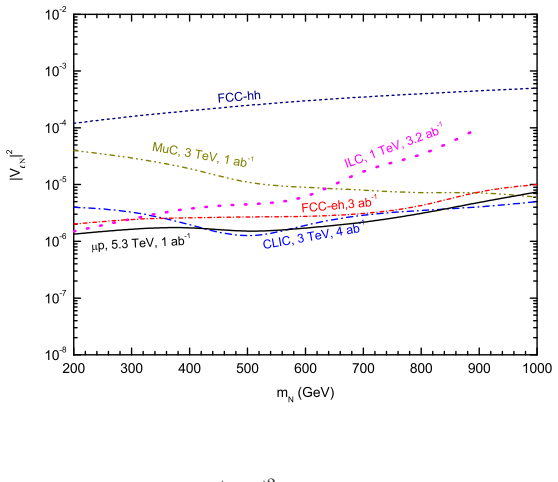
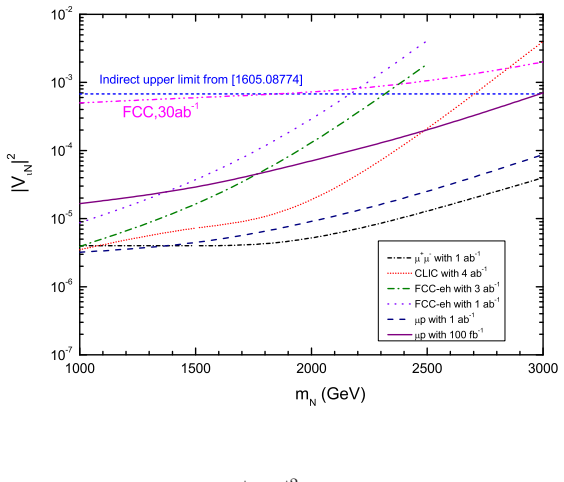
At a muon-proton collider with center-of-mass energy of approximately 5.3 TeV, the lepton-number-violating process μ−p → jN → j(ℓ+ W−) produces projected 2σ exclusion limits on |V_ℓN|^2 that are substantially superior to existing bounds from the LHC and other high-energy colliders for heavy Majorana neutrinos with masses 200 GeV ≤ m_N ≤ 3000 GeV, using 100 fb−1 or 1 ab−1 of integrated luminosity after accounting for realistic detector effects.
What carries the argument
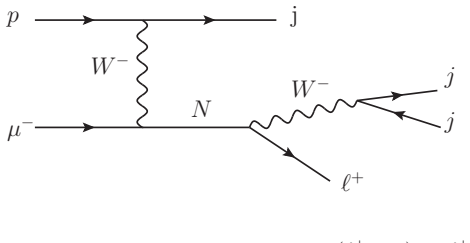
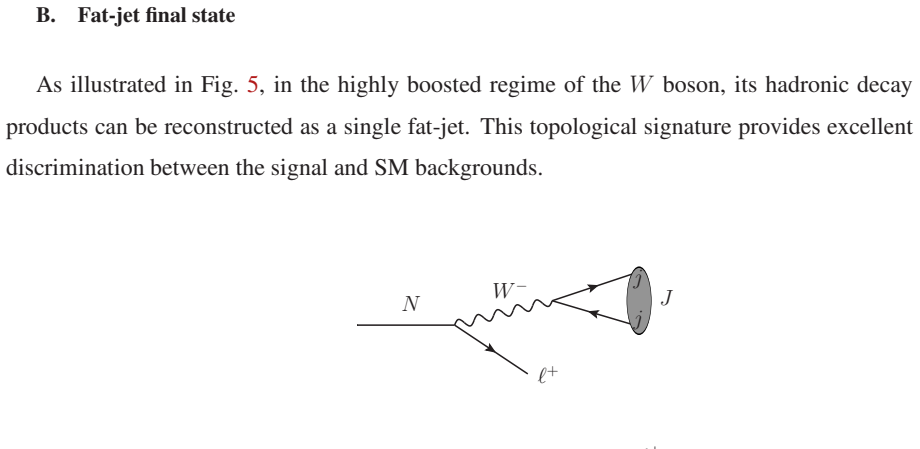
The lepton-number-violating decay chain N → ℓ+ W− (with W− → jj or merged into fat-jet J) in the production process μ−p → jN, distinguished by final states of one lepton plus three jets or one lepton plus fat-jet.
If this is right
- The mixing parameter |V_ℓN|^2 faces tighter constraints than current collider bounds for the full mass interval 200-3000 GeV.
- Muon-proton colliders become viable competitive facilities for heavy neutrino searches.
- Both low-mass resolved-jet and high-mass fat-jet regimes are covered by the same overall strategy.
- The projected reach holds under the two specified integrated luminosity scenarios.
Where Pith is reading between the lines
- Detector optimization for boosted object identification would directly enhance reach at the high-mass end.
- Similar lepton-number-violating signatures could be examined at other proposed lepton-hadron colliders with adjusted beam energies.
- Absence of signal would narrow the viable parameter space in minimal type-I seesaw extensions.
- The analysis highlights the value of combining muon and proton beams for accessing both production and decay vertices in one collision.
Load-bearing premise
Background processes and detector effects including fat-jet reconstruction can be accurately modeled in simulation for a collider that has not been built, without unaccounted systematic uncertainties dominating the projected limits.
What would settle it
If the observed event counts in the defined signal regions after all selection cuts fall well below the expected signal-plus-background yield at the stated luminosities, the claim of superior sensitivity would be falsified.
Figures
read the original abstract
We propose a novel search strategy for heavy Majorana neutrinos based on the lepton-number-violating process $\mu^{-}p \to jN \to j(\ell^{+}W^{-})$ at future muon-proton ($\mu p$) colliders equipped with 1 TeV muon beams and 7 TeV proton beams, yielding a center-of-mass energy of approximately 5.3 TeV. For heavy neutrinos with masses in the range $200~\text{GeV} \lesssim m_N \lesssim 1000~\text{GeV}$, this analysis targets the decay chain $N \to \ell^{+}W^{-} \to \ell^{+}jj$, producing a characteristic final state consisting of one charged lepton and three well-resolved jets. For TeV-scale Majorana neutrinos, the $W$ boson is highly boosted, such that its hadronic decay products coalesce into a prominent fat-jet ($J$) signature. We conduct comprehensive signal and background analyses that account for realistic detector effects to assess the search sensitivity. We derive the projected $2\sigma$ exclusion limits on the neutrino mixing parameter $|V_{\ell N}|^2$ based on two typical integrated luminosity scenarios of $100~\text{fb}^{-1}$ and $1~\text{ab}^{-1}$. The results demonstrate that the proposed search strategy can achieve constraints substantially superior to the existing bounds from the LHC and other high-energy colliders. This study demonstrates that future $\mu p$ colliders can provide competitive sensitivity for probing heavy Majorana neutrinos over the mass range $200~\text{GeV} \leq m_N \leq 3000~\text{GeV}$.
Editorial analysis
A structured set of objections, weighed in public.
Referee Report
Summary. The paper proposes a search for heavy Majorana neutrinos at future μp colliders (1 TeV muon + 7 TeV proton beams, √s ≈ 5.3 TeV) via the LNV process μ−p → jN → j(ℓ+W−). It targets 200 GeV ≲ m_N ≲ 3000 GeV, using resolved three-jet final states for lower masses and fat-jet signatures for boosted W decays at higher masses. Comprehensive MC signal/background analyses including detector effects are performed, yielding projected 2σ exclusion limits on |V_ℓN|^2 for 100 fb−1 and 1 ab−1 luminosities that are claimed to be substantially stronger than existing LHC and other collider bounds.
Significance. If the simulated efficiencies and background rejection hold, the work would show that μp colliders can extend sensitivity to heavy Majorana neutrino mixing in a mass window where current LHC constraints weaken, using a distinctive LNV signature. The dual treatment of resolved and boosted topologies is a positive feature of the analysis design.
major comments (1)
- [Analysis and results sections] Analysis and results sections: The central claim that the μp search yields |V_ℓN|^2 limits substantially superior to LHC bounds for 200 GeV ≤ m_N ≤ 3000 GeV rests on MC-derived signal efficiencies and background rejection (including fat-jet tagging for boosted W → jj). Because the collider does not exist, all background rates, parton-shower modeling, and detector response are taken from Monte Carlo with assumed performance parameters; no data-driven validation or control-region closure test is possible. This assumption is load-bearing, as any under-estimate of QCD multijet or electroweak backgrounds directly inflates the projected sensitivity.
minor comments (2)
- [Introduction] The center-of-mass energy is given as 'approximately 5.3 TeV'; providing the exact formula used for √s would improve precision.
- [Analysis section] The abstract and text refer to 'comprehensive signal and background analyses that account for realistic detector effects' without specifying the jet algorithm, cone size, or fat-jet tagging efficiency parametrization; adding these details would aid reproducibility.
Simulated Author's Rebuttal
We thank the referee for the thorough review and for highlighting the reliance on Monte Carlo modeling in our projections. We address this point directly below and have revised the manuscript to strengthen the discussion of assumptions and uncertainties.
read point-by-point responses
-
Referee: The central claim that the μp search yields |V_ℓN|^2 limits substantially superior to LHC bounds for 200 GeV ≤ m_N ≤ 3000 GeV rests on MC-derived signal efficiencies and background rejection (including fat-jet tagging for boosted W → jj). Because the collider does not exist, all background rates, parton-shower modeling, and detector response are taken from Monte Carlo with assumed performance parameters; no data-driven validation or control-region closure test is possible. This assumption is load-bearing, as any under-estimate of QCD multijet or electroweak backgrounds directly inflates the projected sensitivity.
Authors: We agree that the projections rest on Monte Carlo modeling with assumed detector performance, which is unavoidable for a future collider. We have used standard tools (MadGraph5_aMC@NLO, Pythia8, Delphes with a custom μp card) and adopted conservative background estimates by including all relevant SM processes at leading order with matching. In the revised manuscript we have added an explicit subsection (Section 4.3) discussing the main sources of theoretical and detector-related uncertainties, including variations in parton-shower parameters, jet-energy scale, and fat-jet tagging efficiency, and we quote the resulting variation on the projected limits. We also emphasize that our background rejection relies on kinematic features (e.g., same-sign lepton plus jets with large invariant mass) that are robust against moderate mis-modeling. While these steps do not replace data-driven validation, they follow the standard practice for phenomenological studies of proposed colliders and allow a transparent assessment of the sensitivity reach. revision: partial
Circularity Check
No circularity: projected limits from independent Monte Carlo simulation
full rationale
The paper's central result consists of projected 2σ exclusion limits on |V_ℓN|^2 obtained by running signal and background Monte Carlo samples through a cut-based analysis that includes detector effects and fat-jet tagging. No equation in the provided text reduces the final sensitivity to a fitted parameter by construction, nor does any load-bearing step rely on a self-citation chain, imported uniqueness theorem, or ansatz smuggled from prior work by the same author. The simulation framework is self-contained against external benchmarks (standard MC generators and assumed detector performance) and does not recycle its own output as input. This is the normal, non-circular case for a phenomenological collider-projection study.
Axiom & Free-Parameter Ledger
free parameters (1)
- integrated luminosity scenarios
axioms (1)
- domain assumption Standard Model processes accurately describe backgrounds at the proposed collider energies
Reference graph
Works this paper leans on
-
[1]
Henan Institute of Science and Technology, Xinxiang 453003, China
-
[2]
School of Electro-Mechanical Engineering, Zhongyuan Institute of Science and Technology, Xuchang 461000, China Abstract We propose a novel search strategy for heavy Majorana neutri nos based on the lepton-number- violating process µ − p → jN → j(ℓ+W − ) at future muon-proton ( µp ) colliders equipped with 1 TeV muon beams and 7 TeV proton beams, yielding ...
Pith/arXiv arXiv 2026
-
[3]
The signature, which consists of a high- pT lepton accompanied by three jets, receives contri- butions from several SM background processes
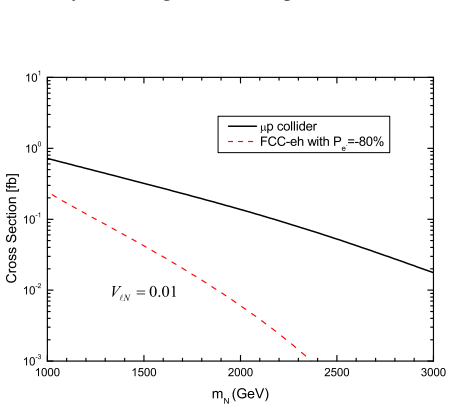
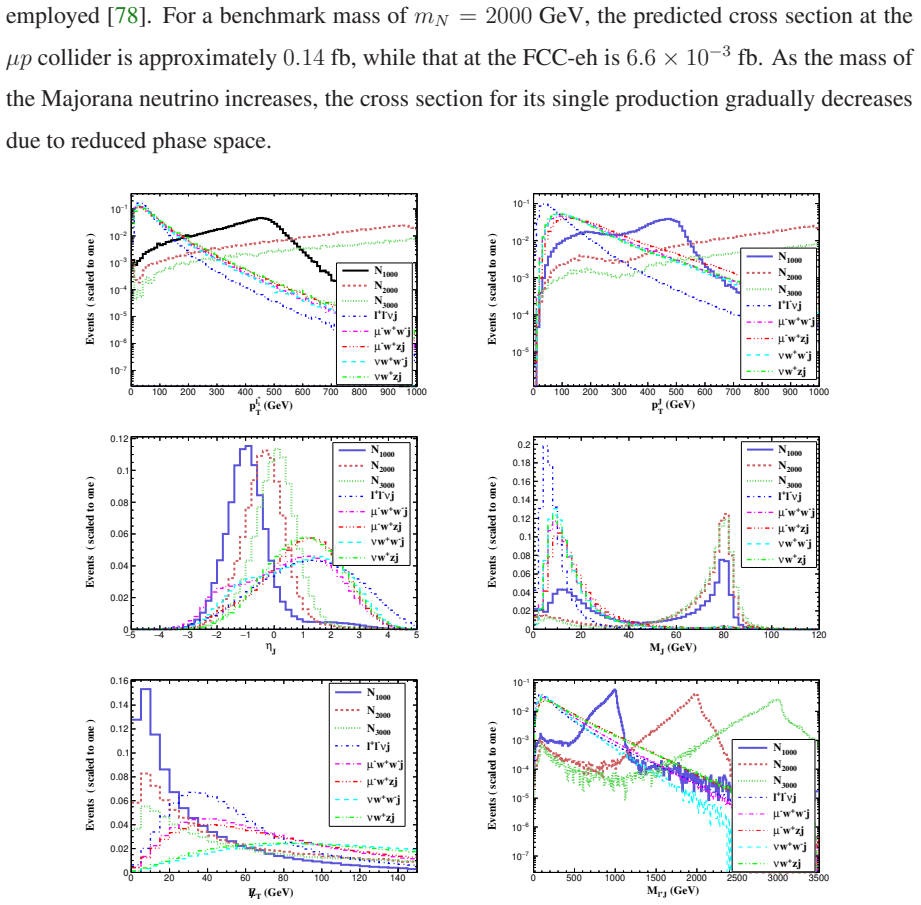
83 fb. The signature, which consists of a high- pT lepton accompanied by three jets, receives contri- butions from several SM background processes. Table I lists the dominant backgrounds together with their production cross sections at the µp collider. All cross sections are computed at lead- ing order using M ADGRAPH 5_ AMC@NLO [ 84], with the NNPDF23L01...
2000
-
[4]
8 × 10− 5 for L = 1000 fb− 1, respectively
2 × 10− 6 to 8. 8 × 10− 5 for L = 1000 fb− 1, respectively. In Ref. [ 24], the authors investigated heavy Majorana neutrinos in the mass range 200 − 3200 GeV via the qqℓ final state at the 3 TeV CLIC, assuming an integrated luminosi ty of 4 ab − 1 and an electron beam polarization of − 80%. Reference [ 30] explored the physics po- tential of muon colliders...
-
[5]
Minkowski, Phys
P . Minkowski, Phys. Lett. B 67 (1977), 421-428
1977
-
[6]
Y anagida, Prog
T. Y anagida, Prog. Theor. Phys. 64 (1980), 1103
1980
-
[7]
M. Gell-Mann, P . Ramond and R. Slansky, Conf. Proc. C790927 (1979), 315-321, arXiv:1306.4669 [hep-th]
Pith/arXiv arXiv 1979
-
[8]
S. L. Glashow, NA TO Sci. Ser. B 61 (1980), 687
1980
-
[9]
R. N. Mohapatra and G. Senjanovic, Phys. Rev. Lett. 44 (1980), 912
1980
-
[10]
M. Agostini, G. Benato, J. A. Detwiler, J. Menéndez and F. Vissani, Rev. Mod. Phys. 95 (2023) no.2, 025002, arXiv:2202.01787 [hep-ex]
arXiv 2023
-
[11]
Y . Cai, T. Han, T. Li and R. Ruiz, Front. in Phys. 6 (2018), 40, arXiv:1711.02180 [hep-ph]
Pith/arXiv arXiv 2018
-
[12]
A. M. Sirunyan et al. [CMS], Phys. Rev. Lett. 120 (2018) no.22, 221801, arXiv:1802.02965 [hep- ex]
Pith/arXiv arXiv 2018
- [13]
-
[14]
A. M. Sirunyan et al. [CMS], JHEP 03 (2020), 051, arXiv:1911.04968 [hep-ex]
arXiv 2020
-
[15]
A. M. Sirunyan et al. [CMS], JHEP 01 (2019), 122, arXiv:1806.10905 [hep-ex]
Pith/arXiv arXiv 2019
-
[16]
M. Aaboud et al. [A TLAS], JHEP01 (2019), 016, arXiv:1809.11105 [hep-ex]
Pith/arXiv arXiv 2019
-
[17]
A. Tumasyan et al. [CMS], Phys. Rev. Lett. 131 (2023) no.1, 011803, arXiv:2206.08956 [hep-ex]
arXiv 2023
- [18]
-
[19]
A. Hayrapetyan et al. [CMS], JHEP 06 (2024), 123, arXiv:2403.00100 [hep-ex]
arXiv 2024
-
[20]
A. Atre, T. Han, S. Pascoli and B. Zhang, JHEP 05 (2009), 030, arXiv:0901.3589 [hep-ph]
Pith/arXiv arXiv 2009
-
[21]
P . S. B. Dev, A. Pilaftsis and U. k. Y ang, Phys. Rev. Lett.112 (2014) no.8, 081801, arXiv:1308.2209 [hep-ph]. 15
Pith/arXiv arXiv 2014
-
[22]
J. C. Helo, M. Hirsch and S. Kovalenko, Phys. Rev. D 89 (2014), 073005, [erratum: Phys. Rev. D 93 (2016) no.9, 099902], arXiv:1312.2900 [hep-ph]
Pith/arXiv arXiv 2014
-
[23]
A. Das and N. Okada, Phys. Rev. D 93 (2016) no.3, 033003, arXiv:1510.04790 [hep-ph]
Pith/arXiv arXiv 2016
-
[24]
S. Antusch, E. Cazzato, O. Fischer, A. Hammad and K. Wang , JHEP 1810 (2018), 067, arXiv:1805.11400 [hep-ph]
Pith/arXiv arXiv 2018
-
[25]
K. S. Babu, R. K. Barman, D. Gonçalves and A. Ismail, JHEP 06 (2024), 132, arXiv:2212.08025 [hep-ph]
arXiv 2024
-
[26]
P . D. Bolton, J. Kriewald, M. Nemevšek, F. Nesti and J. C. V asquez, Phys. Rev. D111 (2025) no.3, 035016, arXiv:2408.00833 [hep-ph]
arXiv 2025
-
[27]
Y . Zhang and B. Zhang, JHEP 02 (2019), 175, arXiv:1805.09520 [hep-ph]
Pith/arXiv arXiv 2019
-
[28]
K. M˛ ekała, J. Reuter and A. F. ˙Zarnecki, JHEP 06 (2022), 010, arXiv:2202.06703 [hep-ph]
arXiv 2022
-
[29]
P . C. Lu, Z. G. Si, Z. Wang, X. H. Y ang and X. Y . Zhang, Chin. Phys. C 47 (2023) no.4, 043107, arXiv:2212.10027 [hep-ph]
arXiv 2023
-
[30]
A. Das, S. Mandal and S. Shil, Phys. Rev. D 108 (2023) no.1, 015022, arXiv:2304.06298 [hep-ph]
arXiv 2023
-
[31]
K. Wang, T. Xu and L. Zhang, Phys. Rev. D 95 no.7 (2017), 075021, arXiv:1610.02618 [hep-ph]
Pith/arXiv arXiv 2017
-
[32]
K. M˛ ekała, J. Reuter and A. F. ˙Zarnecki, Phys. Lett. B 841 (2023), 137945, arXiv:2301.02602 [hep-ph]
arXiv 2023
-
[33]
T. H. Kwok, L. Li, T. Liu and A. Rock, Phys. Rev. D 110 (2024) no.7, 075009, arXiv:2301.05177 [hep-ph]
arXiv 2024
-
[34]
P . Li, Z. Liu and K. F. Lyu, JHEP 03 (2023), 231, arXiv:2301.07117 [hep-ph]
arXiv 2023
-
[35]
J. L. Y ang, C. H. Chang and T. F. Feng, Chin. Phys. C 48 (2024) no.4, 043101, arXiv:2302.13247 [hep-ph]
arXiv 2024
- [36]
-
[37]
T. Li, C. Y . Y ao and M. Y uan, JHEP09 (2023), 131, arXiv:2306.17368 [hep-ph]
arXiv 2023
-
[38]
Z. Wang, X. H. Y ang and X. Y . Zhang, Phys. Lett. B 853 (2024), 138643, arXiv:2311.15166 [hep- ph]
arXiv 2024
-
[39]
R. Y . He, J. Q. Huang, J. Y . Xu, F. X. Y ang, Z. L. Han and F. L. Shao, Chin. Phys. C 48 (2024) no.9, 093102, arXiv:2401.14687 [hep-ph]
arXiv 2024
-
[40]
Q. H. Cao, K. Cheng and Y . Liu, Phys. Rev. Lett. 134 (2025) no.2, 021801, arXiv:2403.06561 16 [hep-ph]
arXiv 2025
-
[41]
L. Bellagamba, G. Polesello and N. V alle, Eur. Phys. J. C 85 (2025), 1069, arXiv:2503.19464 [hep-ex]
arXiv 2025
-
[42]
Y . B. Liu and J. W. Lian, Chin. Phys. C 50 (2026), 033110, arXiv:2511.02557 [hep-ph]
arXiv 2026
-
[43]
V . D. Shiltsev, Conf. Proc. C 970512 (1997), 420-421
1997
-
[44]
I. F. Ginzburg, Turk. J. Phys. 22 (1998), 607-610
1998
-
[45]
K. Cheung, AIP Conf. Proc. 441 no.1 (1998), 338-344, arXiv:hep-ph/9802219 [hep-ph]
Pith/arXiv arXiv 1998
-
[46]
K. Cheung, AIP Conf. Proc. 542 no.1 (2000), 160-170, arXiv:hep-ph/0001275 [hep-ph]
Pith/arXiv arXiv 2000
-
[47]
M. Carena, D. Choudhury, C. Quigg and S. Raychaudhuri, P hys. Rev. D 62 (2000), 095010, arXiv:hep-ph/0006144 [hep-ph]
Pith/arXiv arXiv 2000
-
[48]
U. Kaya, B. Ketenoglu and S. Sultansoy, arXiv:1807.098 67 [physics.acc-ph]
-
[49]
U. Kaya, B. Ketenoglu, S. Sultansoy and F. Zimmermann, a rXiv:1905.05564 [physics.acc-ph]
arXiv 1905
-
[50]
Keteno ˘glu, B
B. Keteno ˘glu, B. Da ˘glı, A. Öztürk and S. Sultansoy, Mod. Phys. Lett. A 37 no.37n38 (2022), 2230013,
2022
-
[51]
Dagli, B
B. Dagli, B. Ketenoglu and S. Sultansoy, arXiv:2206.00 037 [physics.acc-ph]
-
[52]
U. Kaya, B. Ketenoglu, S. Sultansoy and F. Zimmermann, E PL 138 no.2 (2022), 24002,
2022
- [53]
-
[54]
A. Caliskan, S. O. Kara and A. Ozansoy, Adv. High Energy P hys. 2017 (2017), 1540243, arXiv:1701.03426 [hep-ph]
Pith/arXiv arXiv 2017
-
[55]
Y . C. Acar, U. Kaya and B. B. Oner, Chin. Phys. C 42 no.8 (2018), 083108, arXiv:1703.04030 [hep-ph]
Pith/arXiv arXiv 2018
-
[56]
A. Caliskan, Acta Phys. Pol. B 50 (2019), 1409, arXiv:1802.09874 [hep-ph]
arXiv 2019
-
[57]
Caliskan, Turk
A. Caliskan, Turk. J. Phys. 42 no.4 (2018), 343-349,
2018
-
[58]
E. Alici and M. Köksal, Mod. Phys. Lett. A 34 no.36 (2019), 1950298, arXiv:1905.00588 [hep-ph]
arXiv 2019
-
[59]
Ozansoy, Phys
A. Ozansoy, Phys. Sci. Eng. 61 no.1 (2019), 111-128,
2019
-
[60]
S. Spor, A. A. Billur and M. Köksal, Eur. Phys. J. Plus 135 no.8 (2020), 683, arXiv:2002.01445 [hep-ph]
arXiv 2020
-
[61]
K. Cheung and Z. S. Wang, Phys. Rev. D 103 (2021), 116009, arXiv:2101.10476 [hep-ph]
arXiv 2021
- [62]
- [63]
- [64]
-
[65]
J. Z. Han, Y . B. Liu and S. Moretti, Phys. Rev. D 112 no.3 (2025), 035016, arXiv:2501.01026 [hep-ph]
arXiv 2025
-
[66]
R. Benbrik, M. Berrouj, M. Boukidi, H. Chatoui, M. Ech-c haouy, K. Kahime and K. Salime, Eur. Phys. J. C 86, no.5, 511 (2026), arXiv:2601.07758 [hep-ph]
arXiv 2026
-
[67]
H. Sagheer, M. T. Javaid, M. Hussain, M. D. Farooq, I. Ahm ed and J. Muhammad, arXiv:2602.01010 [hep-ph]
-
[68]
H. Liang, X. G. He, W. G. Ma, S. M. Wang and R. Y . Zhang, JHEP09 (2010), 023, arXiv:1006.5534 [hep-ph]
Pith/arXiv arXiv 2010
-
[69]
C. Blaksley, M. Blennow, F. Bonnet, P . Coloma and E. Fern andez-Martinez, Nucl. Phys. B 852 (2011), 353-365, arXiv:1105.0308 [hep-ph]
Pith/arXiv arXiv 2011
-
[70]
L. Duarte, G. A. González-Sprinberg and O. A. Sampayo, P hys. Rev. D 91 no.5 (2015), 053007, arXiv:1412.1433 [hep-ph]
Pith/arXiv arXiv 2015
-
[71]
S. Mondal and S. K. Rai, Phys. Rev. D 94 no.3 (2016), 033008, arXiv:1605.04508 [hep-ph]
Pith/arXiv arXiv 2016
-
[72]
S. Antusch, E. Cazzato and O. Fischer, Int. J. Mod. Phys. A 32 no.14 (2017), 1750078, arXiv:1612.02728 [hep-ph]
Pith/arXiv arXiv 2017
-
[73]
M. Lindner, F. S. Queiroz, W. Rodejohann and C. E. Y aguna , JHEP 06 (2016), 140, arXiv:1604.08596 [hep-ph]
Pith/arXiv arXiv 2016
-
[74]
S. Y . Li, Z. G. Si and X. H. Y ang, Phys. Lett. B 795 (2019), 49-55, arXiv:1811.10313 [hep-ph]
Pith/arXiv arXiv 2019
-
[75]
A. Das, S. Jana, S. Mandal and S. Nandi, Phys. Rev. D 99 no.5 (2019), 055030, arXiv:1811.04291 [hep-ph]
Pith/arXiv arXiv 2019
-
[76]
S. Antusch, O. Fischer and A. Hammad, JHEP 03 (2020), 110, arXiv:1908.02852 [hep-ph]
arXiv 2020
-
[77]
Azuelos et al
G. Azuelos et al. [LHeC/FCC-eh Study Group], PoS ICHEP2020 (2021), 227,
2021
-
[78]
A. Das, S. Mandal and T. Modak, Phys. Rev. D 102 no.3 (2020), 033001, arXiv:2005.02266 [hep- ph]
arXiv 2020
- [79]
-
[80]
H. Gu, Y . n. Mao, H. Sun and K. Wang, JHEP 09 (2023), 152, arXiv:2210.17050 [hep-ph]
arXiv 2023
discussion (0)
Sign in with ORCID, Apple, or X to comment. Anyone can read and Pith papers without signing in.