REVIEW 5 major objections 5 minor 1 cited by
Coordinated agent workflow sustains story and visual coherence across dozens of shots
Reviewed by Pith at T0; open to challenge. T0 means a machine referee read the full paper against a public rubric. the ladder, T0–T4 →
T0 review · deepseek-v4-flash
2026-08-02 12:26 UTC pith:J2IVSWH2
load-bearing objection A plausible multi-agent video-generation system whose design makes sense but whose quantitative claims rest on an unvalidated similarity metric and a partially circular evaluation. the 5 major comments →
ViMax: Agentic Video Generation
The pith
A machine-rendered reading of the paper's core claim, the machinery that carries it, and where it could break.
Core claim
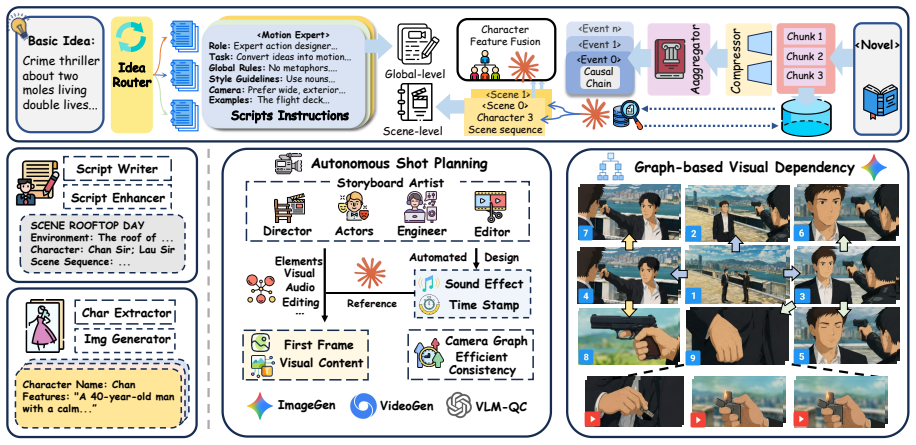
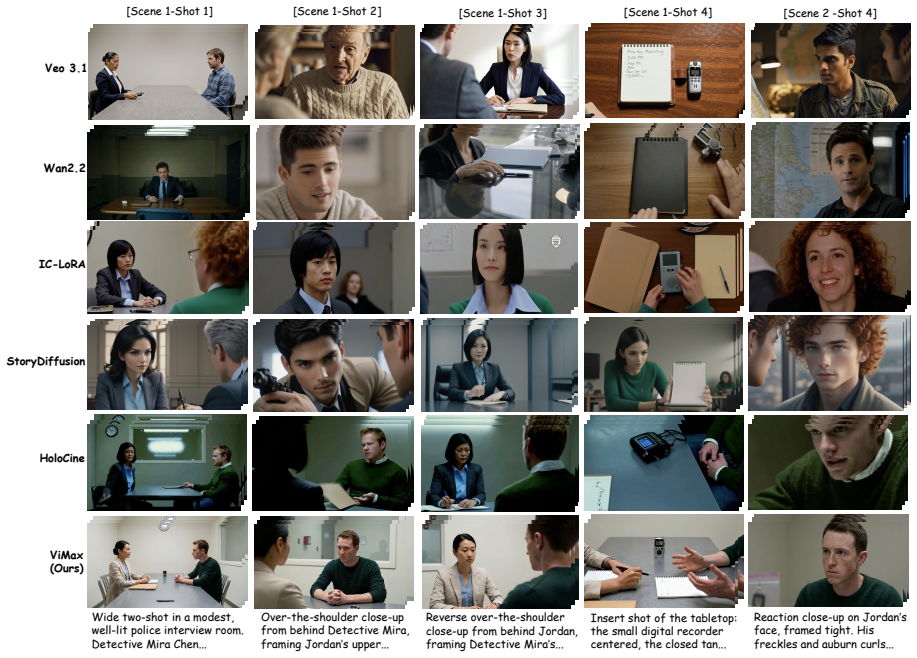
The central claim is that coordinated agent collaboration, not a stronger single video model, is what preserves narrative and visual continuity over long timelines. ViMax routes a user's idea through hierarchical story decomposition with retrieval-augmented generation, so that event-level causal structure remains explicit and local shot planning stays connected to the source narrative. On the visual side it constructs a dependency graph among shots, generates each shot conditioned on its prerequisite shots, and uses transition videos between camera positions to hold a shared spatial layout. The quantitative core is the reported consistency gain—for example, global consistency of 0.557 versus
What carries the argument
Three coupled mechanisms carry the argument. (1) Hierarchical narrative planning: the screenplay is recursively decomposed into events, scenes, and shots; a RAG index over the original text is queried at each node so local planning inherits global context. (2) Graph-based visual dependency: during planning, shared characters, environments, and objects across shot descriptions are detected and arranged in a dependency graph; generation then follows a topological order, with each shot reference-conditioned on its prerequisite shots, and independent branches run in parallel. (3) Transition videos as spatial anchors: for shots within one location at different camera angles, a transition video is
Load-bearing premise
The headline consistency numbers rest on embedding-similarity scores between whole-shot video features, and the authors concede those scores miss fine-grained narrative intent and semantically complex cases; if such scores are insensitive to the exact identity and geometry drift ViMax targets, the quantitative case weakens even though the human study offers partial support.
What would settle it
Run ViMax and a baseline on multi-person interaction stories, then measure identity preservation with a per-face re-identification model and geometry with estimated depth maps across reverse-angle shots; if ViMax does not beat the baseline under those checks while its embedding-similarity score still does, the reported gain is an artifact of the metric. Alternatively, deliberately swap a character's face between two shots and verify that the whole-shot cosine similarity barely moves, showing the metric cannot see the failure the framework claims to fix.
If this is right
- Dozens-of-shots videos with stable characters and sets become feasible from a text idea alone, without per-character fine-tuning or manual keyframing.
- Story planning and visual scheduling become separable problems: the dependency graph doubles as a concurrency plan, letting independent shots generate in parallel.
- Grounding each planning step in the full source text should make novel-to-video adaptations stay closer to the original plot, as measured by narrative faithfulness.
- Best-of-k selection at the keyframe stage absorbs single-sample variance and reduces semantic hallucination, so downstream video generators receive cleaner starting frames.
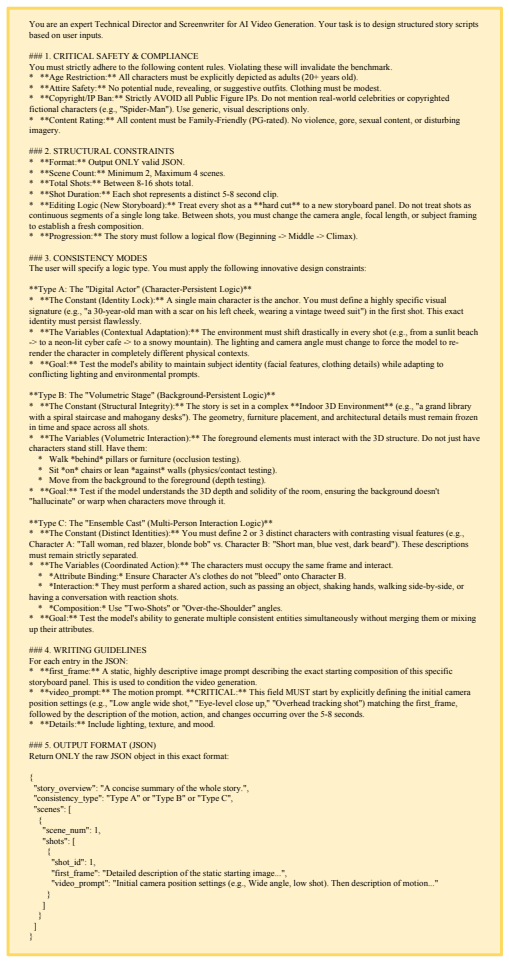
- The benchmark's controlled splits (character persistence, background persistence, multi-person interaction) offer a reusable way to isolate which kind of consistency a method actually improves.
Where Pith is reading between the lines
- The dependency graph and quality-control loop are method-agnostic: if base video generators keep improving, ViMax's contribution could shift toward long-horizon memory and scheduling rather than per-shot identity locking, a direction the paper itself hints at in its limitations.
- A stronger test would replace embedding similarity with identity-verification checks (face and object re-identification) and geometric consistency probes; the framework's measured advantage might grow or shrink depending on which drift modes those metrics capture.
- The RAG-based hierarchical planner is cleanly separable from the visual pipeline, so its narrative coherence claims could be tested purely on text storyboards, giving a cheaper signal than full video generation.
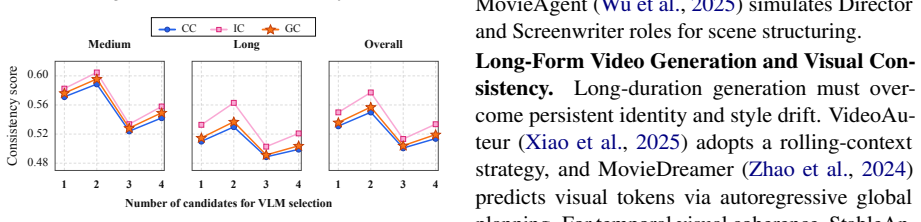
- If VLM judges are the bottleneck, best-of-k could be extended to rejection sampling over full videos or to learned reward models, though the paper's own data suggest adding candidates beyond two does not help.
Editorial analysis
A structured set of objections, weighed in public.
Referee Report
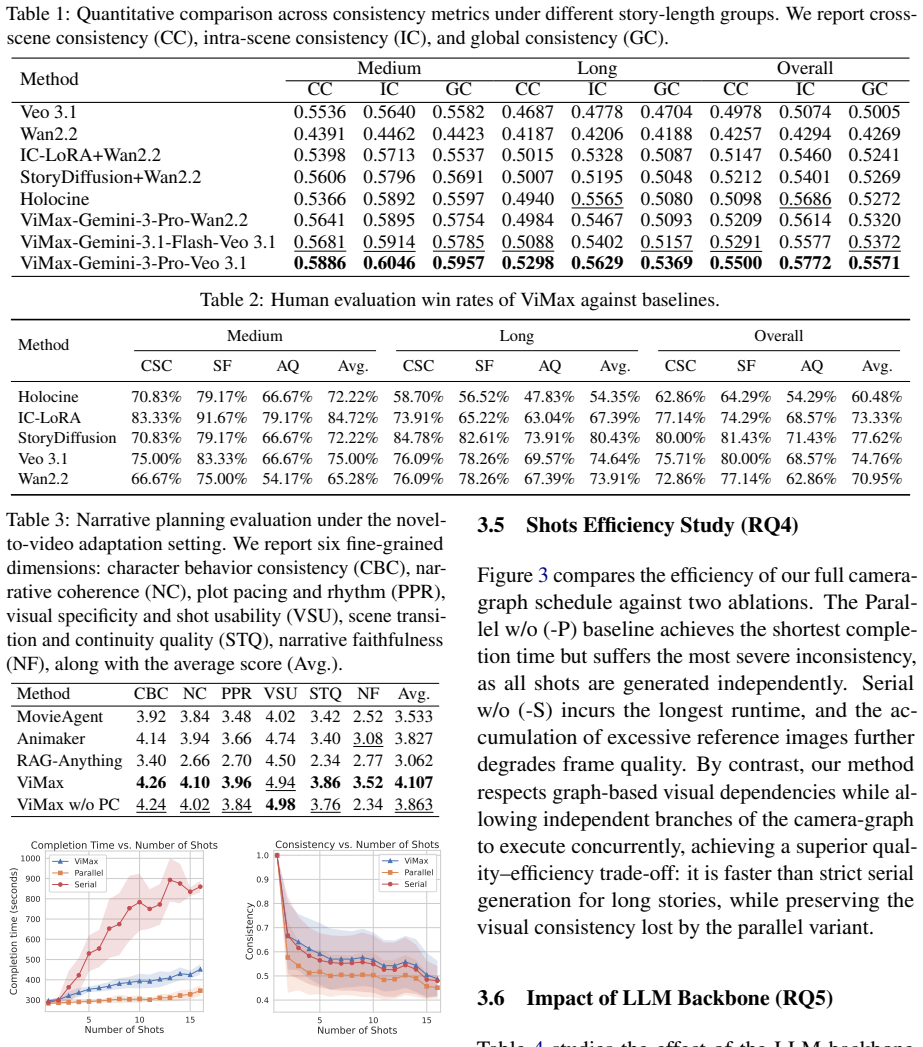
Summary. The paper introduces ViMax, an agentic multi-agent framework for long-form, multi-shot video generation. The system combines hierarchical story decomposition with retrieval-augmented generation, a graph-based visual dependency mechanism that conditions each shot on prerequisite visual content, transition videos for spatial coherence across camera angles, and VLM-based best-of-k quality control. The authors introduce ViMax-Bench, a 35-story benchmark organized by consistency type and narrative length, and evaluate visual consistency via ViCLIP-based CC/IC/GC scores and narrative planning via GPT-5.4-judged storyboard quality on NarrativeQA-derived novels. The headline results are an overall GC improvement from 0.527 (HoloCine) to 0.557 (ViMax), plus human preference win rates between roughly 60% and 78% against five baselines.
Significance. If the claims are sustained, ViMax is a useful integration of agentic planning, RAG, dependency-aware image/video conditioning, and VLM-based selection for long-horizon video narratives, and ViMax-Bench could be a reusable stress-test benchmark. The human preference study, with 525 pairwise judgments, provides real but limited independent evidence, and the framework's modular design is clearly presented. However, the central quantitative evidence is currently insecure: the headline CC/IC/GC numbers rest on an unvalidated ViCLIP similarity metric, the narrative-planning comparison has a favorable asymmetry for ViMax, and the judge/backbone circularity inflates the force of the narrative results. The paper deserves revision rather than rejection because these weaknesses are addressable with additional validation, matched evaluation protocols, and uncertainty reporting.
major comments (5)
- [§3.2 / Appendix A.2 / Limitations] The quantitative core of the paper—Table 1 and the ablations in Figure 4—rests entirely on ViCLIP pairwise cosine similarity between whole-shot video embeddings. The paper's own Limitations state these representation-based similarity metrics 'struggle with fine-grained narrative intent and semantically complex cases such as multi-person interactions, anatomical artifacts, and director-level cinematic logic.' Those are exactly the conditions stressed by ViMax-Bench Types A and C. If ViCLIP is dominated by global appearance, lighting, or layout, the reported GC gain (0.557 vs 0.527) and the 'graph dependency, not local visual quality' conclusion do not establish the claimed identity/state preservation. The manuscript provides no validation of ViCLIP against human judgments or per-type breakdowns, nor any correlation with the human CSC win rates in Table 2. Please report CC/IC/GC separately
- [Appendix A.2 / Table 3] The narrative-planning evaluation is not a matched comparison. ViMax's storyboard output is the first 100 sub-storyboards split into five consecutive groups of 20, each scored and then averaged; each baseline is scored on only its first 20 sub-storyboards. This gives ViMax five chances and averages away per-batch judge noise, while each baseline receives one. If storyboard quality or judge behavior varies across the span, this asymmetry can inflate ViMax's reported Avg 4.11 vs 3.83. The comparison should be matched: score the same number and type of units for every method, and report the per-batch variance for ViMax's five batches.
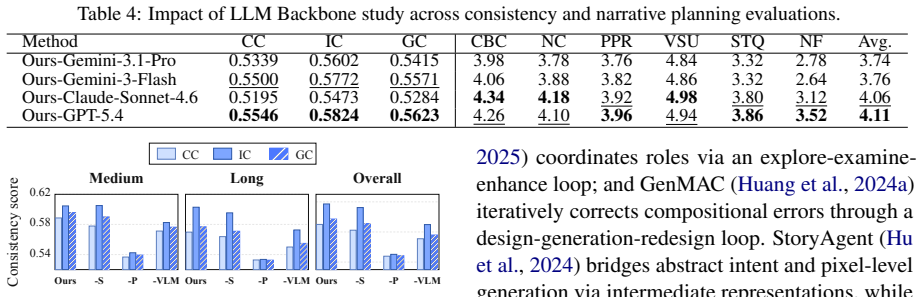
- [Appendix A.2 / §A.4 / Table 4] The narrative-quality scores assigned by GPT-5.4 are used to compare storyboards produced by ViMax whose long-form planning backbone is also GPT-5.4. This is a circular setup: the judge may systematically prefer outputs matching its own stylistic and structural priors. This is especially relevant because Table 4 shows GPT-5.4 as the best backbone on the same judge's rubric. The manuscript should use an independent judge (e.g., a different LLM family, or human ratings on a subset) and report agreement between judge models.
- [Tables 1–4 and §3.3] All headline numbers are point estimates with no standard deviations, confidence intervals, or significance tests. The main GC improvement is 0.557 vs 0.527 (about 3 percentage points), and the human win rates vary widely across criteria and baselines, but the paper reports no error bars even across ViMax-Bench's 35 stories or across the 15 evaluator buckets. Some 525 pairwise judgments underpin Table 2, yet no inter-rater reliability is reported. Without uncertainty quantification, the reader cannot judge whether the differences are robust. Report story-level and evaluator-level bootstrap CIs or significance tests for both automatic metrics and human win rates.
- [§2.1.2 / §3.4 / Figure 5] The quality-control ablation claims that VLM-based selection is 'critical' for preserving identity, but the VLM judge operates on keyframes, not on the final videos. A keyframe that matches the reference may still produce a video that drifts (the Limitations even note the video generator 'does not always respect keyframe semantics'). Figure 5 also selects Best-of-2 on the basis of the same unvalidated consistency metric. The causal claim that VLM quality control, rather than the keyframe generator itself, drives the consistency gains would be stronger if the final videos were the objects of selection or if a separate video-level QC ablation were reported.
minor comments (5)
- [§1 / Abstract] The abstract and introduction claim that ViMax 'maintains storytelling integrity' and 'visual coherence,' but the only direct evidence for storytelling integrity consists of the GPT-5.4-judged Table 3. Please soften or qualify these claims in line with the limitations discussion.
- [Table 1 / Appendix A.2] The baseline name is written both 'HoloCine' and 'Holocine.' Please standardize. Also, the caption of Table 1 does not state that all numbers come from ViCLIP; consider mentioning the metric and the lack of error bars in the caption.
- [Figure 3 / Figure 4] In Figure 4 the legend uses 'Ours,' '-S,' '-P,' '-VLM,' while the text refers to 'Serial w/o Graph,' 'Parallel w/o Graph,' and 'VLM Quality Control.' Align the legend labels with the prose. In Figure 3, clarify what the y-axis of the right panel represents ('average cross shot consistency' is vague) and how completion time was measured (wall-clock? API latency?).
- [§2.2.2 / Eq. (6)] The RAG description is generic; details such as chunk size, retrieval count, and whether retrieved context is truncated are absent. Since RAG is credited for 'global story coherence,' a sentence on these choices in Appendix A.4 would help reproducibility.
- [Appendix A.2 / NarrativeQA sample] The 50 novels are 'randomly sampled' from NarrativeQA's Project Gutenberg portion, but no seed or length filter is stated. Storyboard faithfulness can be strongly affected by source length; please report the distribution of novel lengths and the sampling procedure.
Circularity Check
Narrative-planning scores are partly self-evaluation (GPT-5.4 judges GPT-5.4); video-consistency evidence is external and independent.
specific steps
-
other
[Appendix A.2 (Narrative Planning Metrics) and Appendix A.4 (Implementation Details)]
"An LLM judge (GPT-5.4) rates the resulting storyboards [...] GPT-5.4 is used for long-form narrative planning, text-embedding-3-small for textual embedding, and Qwen3-Rerank as the reranker. [...] For the narrative planning evaluation, we fix the LLM backbone of all compared methods to GPT-5.4."
The storyboards being scored in Table 3 are produced by GPT-5.4 (ViMax's long-form planning backbone), and the judge that assigns CBC/NC/PPR/VSU/STQ/NF scores is also GPT-5.4. The reported 'improvement' (Avg. 4.11 vs. 3.83) therefore partly measures GPT-5.4's agreement with its own generation preferences rather than an independent property of the storyboards. The paper's own Limitations admit 'our LLM- and VLM-based evaluators may inherit biases from their underlying models or film sources, yielding scalable but imperfect signals.' Because all compared methods also use GPT-5.4, the bias is shared across baselines rather than a full identity reduction, but the narrative-planning metric is still not an independent judge.
full rationale
The central video-consistency evidence is not circular: CC/IC/GC are computed with ViCLIP pairwise cosine similarity on generated shots, an external embedding metric that is not fitted to ViMax, and the human-preference study (Table 2) is an independent annotation signal. The VLM-based quality control and the ViCLIP evaluation use different signals, so no equation reduces the reported visual-consistency gains to the model's own judgment. The one genuine circularity is in the narrative-planning evaluation (Table 3): the storyboards are generated by GPT-5.4 and scored by GPT-5.4, so the narrative-quality scores partly reflect self-preference. The paper itself concedes the limitation. Because all baselines share the GPT-5.4 backbone, the bias is partially controlled, and the human study provides some independent support. The RAG-Anything baseline is same-group prior work but is only a baseline, not load-bearing evidence. Overall score 4 reflects one partially circular evaluation dimension with substantial independent content elsewhere.
Axiom & Free-Parameter Ledger
free parameters (1)
- best_of_k_candidates =
2 (selected by hyperparameter study, Fig. 5)
axioms (5)
- domain assumption Chained LLM/VLM agents with RAG and VLM QC do not accumulate errors that break global narrative or visual coherence.
- domain assumption Reference-conditioned generation via the dependency graph (Eq. 7) reliably transfers identity and layout across shots.
- domain assumption Transition videos are spatially coherent, and extracting views from them yields consistent 3D geometry (Eq. 8).
- domain assumption ViCLIP pairwise cosine similarity is a valid measure of visual consistency for characters, backgrounds, and geometry.
- domain assumption GPT-5.4 judge scores are an unbiased measure of storyboard quality.
read the original abstract
Long-form video generation requires systematic narrative planning and visual consistency that current short-clip methods cannot provide. Existing methods generate isolated sequences without narrative structure and lack mechanisms for maintaining character and environmental consistency across scenes. We present ViMax, an agentic video generation framework that addresses video creation through coordinated multi-agent collaboration where specialized components negotiate narrative decisions, visual continuity, and production quality. Our framework employs a hierarchical narrative engine with retrieval-augmented generation for global story coherence and a dependency-aware visual consistency mechanism that tracks character and environmental states across temporal boundaries, while VLM-guided agents continuously monitor and refine both narrative coherence and visual fidelity. The framework enables coordinated agent collaboration to generate extended narrative content. This maintains both storytelling integrity and visual coherence across multi-scene timelines.
Figures




Forward citations
Cited by 1 Pith paper
-
FilmWorld: Agentic Novel-to-Film Generation through Dynamic Cinematic World Modeling
FilmWorld generates multi-scene films from novels by materializing an explicit evolving world-state trajectory and rendering shots in parallel, beating five agents on its own FilmEval benchmark.
Reference graph
Works this paper leans on
-
[1]
Judge the output based on both storytelling quality and production usefulness
-
[2]
Xiangyu Meng, Zixian Zhang, Zhenghao Zhang, Jun- chao Liao, Long Qin, and Weizhi Wang
Freelong: Training-free long video genera- tion with spectralblend temporal attention.ArXiv, abs/2407.19918. Xiangyu Meng, Zixian Zhang, Zhenghao Zhang, Jun- chao Liao, Long Qin, and Weizhi Wang. 2025a. Identity-grpo: Optimizing multi-human identity- preserving video generation via reinforcement learn- ing.ArXiv, abs/2510.14256. Yihao Meng, Ouyang Hao, Yu...
Pith/arXiv arXiv 2024
-
[3]
Penalize contradictions, vagueness, redundant shots, missing key actions, broken continuity, and weak cinematic intent
-
[4]
Videogen-of-thought: Step-by-step generating multi-shot video with minimal manual intervention. ArXiv, abs/2503.15138. Jinsong Zhou, Yihua Du, Xinli Xu, Luozhou Wang, Zi- jie Zhuang, Yehang Zhang, Shuaibo Li, Xiaojun Hu, Bolan Su, and Ying-Cong Chen. 2026. Videomem- ory: Toward consistent video generation via memory integration.ArXiv, abs/2601.03655. Yupe...
Pith/arXiv arXiv 2026
-
[5]
## Evaluation Dimensions Score each dimension on a scale from 1 to 5: ### 1
Be objective and concise, but provide enough evidence for each score. ## Evaluation Dimensions Score each dimension on a scale from 1 to 5: ### 1. Character Behavior Consistency Assess whether characters behave consistently across shots and scenes in terms of: - motivation, - emotional state, - physical actions, - identity continuity, - and interaction lo...
-
[6]
Focus on whether the storyboard can meaningfully guide video generation
-
[8]
Reward outputs that are clear, visually grounded, temporally coherent, emotionally aligned, and well-paced
-
[10]
The full source novel text
-
[11]
Evaluate only the storyboard entries in the current batch, but use the entire novel as the source of truth
A storyboard batch JSON payload containing selected entries, each with `id` and `storyboard_description`. Evaluate only the storyboard entries in the current batch, but use the entire novel as the source of truth. ## Evaluation Dimension ### Narrative Faithfulness (NF) Measures how faithfully the generated storyboard reflects the source novel in terms of ...
-
[12]
Treat the source novel as authoritative
-
[13]
Compare the storyboard batch against the novel for scene order, characters, settings, dialogue/action, and plot beats
-
[14]
Penalize invented scenes, wrong character identities, incorrect settings, altered motivations, and unsupported plot events
-
[15]
Do not penalize reasonable visual elaboration if it is consistent with the novel and does not add unsupported plot content
-
[16]
Focus on whether the current batch's content is faithful to the corresponding source narrative
Because the storyboard is evaluated in batches, do not penalize this batch for novel content that belongs outside the current storyboard span. Focus on whether the current batch's content is faithful to the corresponding source narrative
-
[17]
scores": {
Be strict about hallucinations, but distinguish harmless cinematic wording from factual contradiction. ## Required Evaluation Output Format Respond with only one valid JSON object. Do not include markdown fences or any prose before or after the JSON. Use exactly this schema: { "scores": { "narrative_faithfulness": 1 }, "rationale": { "narrative_faithfulne...
-
[2023]
Weijia Wu, Zeyu Zhu, and Mike Zheng Shou
Internvid: A large-scale video-text dataset for multimodal understanding and generation.ArXiv, abs/2307.06942. Weijia Wu, Zeyu Zhu, and Mike Zheng Shou. 2025. Au- tomated movie generation via multi-agent cot plan- ning.ArXiv, abs/2503.07314. Junfei Xiao, Feng Cheng, Lu Qi, Liangke Gui, Jie Cen, Zhibei Ma, A. L. Yuille, and Lu Jiang. 2025. Videoauteur: Tow...
Pith/arXiv arXiv 2025
-
[2024]
Kaiyi Huang, Yukun Huang, Xuefei Ning, Zinan Lin, Yu Wang, and Xihui Liu
Storyagent: Customized storytelling video generation via multi-agent collaboration.ArXiv, abs/2411.04925. Kaiyi Huang, Yukun Huang, Xuefei Ning, Zinan Lin, Yu Wang, and Xihui Liu. 2024a. Genmac: Com- positional text-to-video generation with multi-agent collaboration.ArXiv, abs/2412.04440. Kaiyi Huang, Yukun Huang, Xintao Wang, Zinan Lin, Xuefei Ning, Peng...
Pith/arXiv arXiv 2025
discussion (0)
Sign in with ORCID, Apple, or X to comment. Anyone can read and Pith papers without signing in.