Quantum algorithms for stochastic nonlinear differential equations
Pith reviewed 2026-06-27 19:16 UTC · model grok-4.3
The pith
Quantum algorithm approximates low-order correlations for nonlinear stochastic differential equations at polylogarithmic cost in dimension when the drift preserves norm.
A machine-rendered reading of the paper's core claim, the machinery that carries it, and where it could break.
Core claim
We present a quantum algorithm for a broad class of N-dimensional stochastic differential equations with dissipation and quadratic drift. The algorithm applies to strongly nonlinear systems with all-to-all interactions. For norm-preserving drifts, a condition satisfied by key fluid dynamics discretizations, our method approximates expectation values of low-order correlation functions with rigorous error bounds at a cost polynomial in log(N) and linear in the evolution time. Our main technical advance is a subroutine for simulating an auxiliary system of N interacting quantum harmonic oscillators with cost polylogarithmic in N. We formulate turbulence models, including Navier-Stokes and dampe
What carries the argument
Subroutine for simulating an auxiliary system of N interacting quantum harmonic oscillators, which produces the polylog(N) scaling for the overall SDE solver.
If this is right
- Navier-Stokes and damped Euler equations become candidates for quantum simulation under the stated cost bounds.
- Expectation values of low-order correlations in these fluid models can be obtained with error guarantees linear in time.
- The same framework covers other quadratic-drift SDEs that satisfy the norm-preserving property.
- Strongly nonlinear all-to-all interactions are now inside the scope of quantum algorithms for stochastic dynamics.
Where Pith is reading between the lines
- If hardware can realize the oscillator subroutine, small-N turbulence simulations could serve as an early test bed for the scaling claim.
- The norm-preserving restriction may limit direct application to compressible flows or systems with strong external forcing.
- The approach opens a possible route to quantum treatment of nonlinear wave equations that admit similar quadratic-drift representations.
Load-bearing premise
The quadratic drift term must obey a norm-preserving condition that makes the auxiliary oscillator simulation efficient.
What would settle it
Explicit gate-count measurement for the oscillator subroutine at N equals 8 that exceeds any polynomial in log(8) while the claimed error bound on a low-order correlation still holds.
Figures

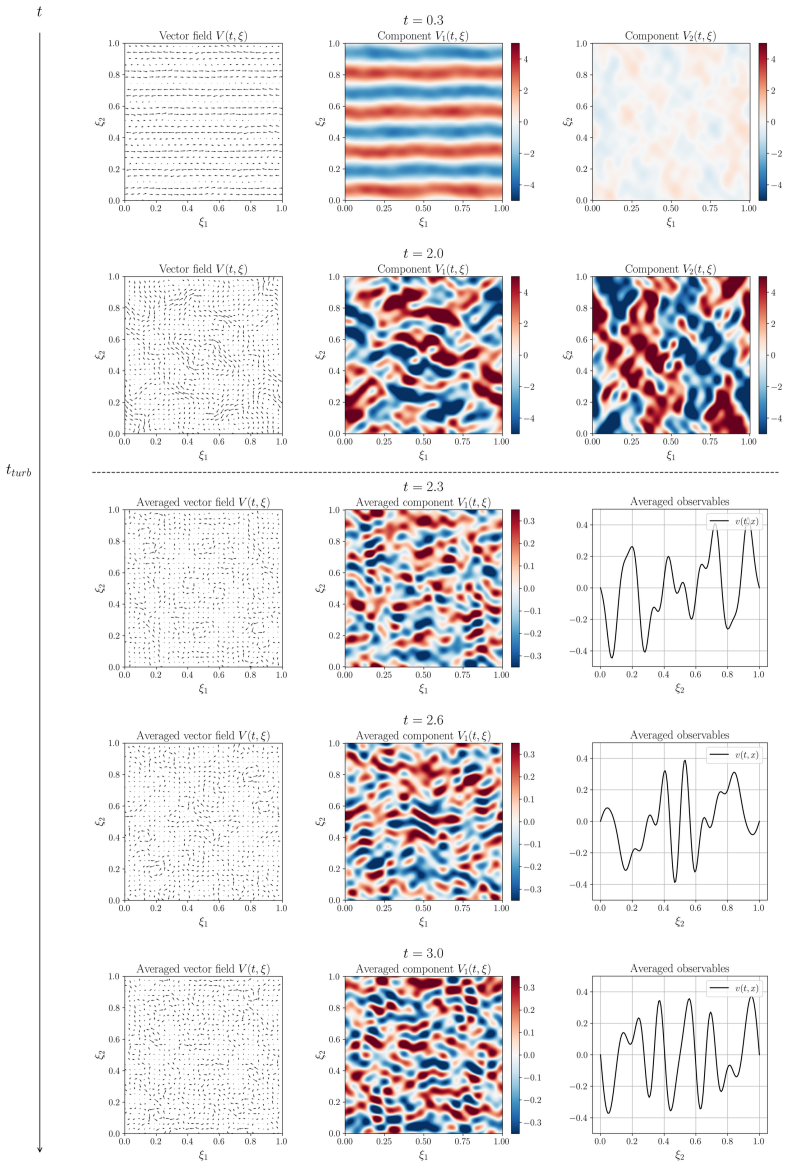
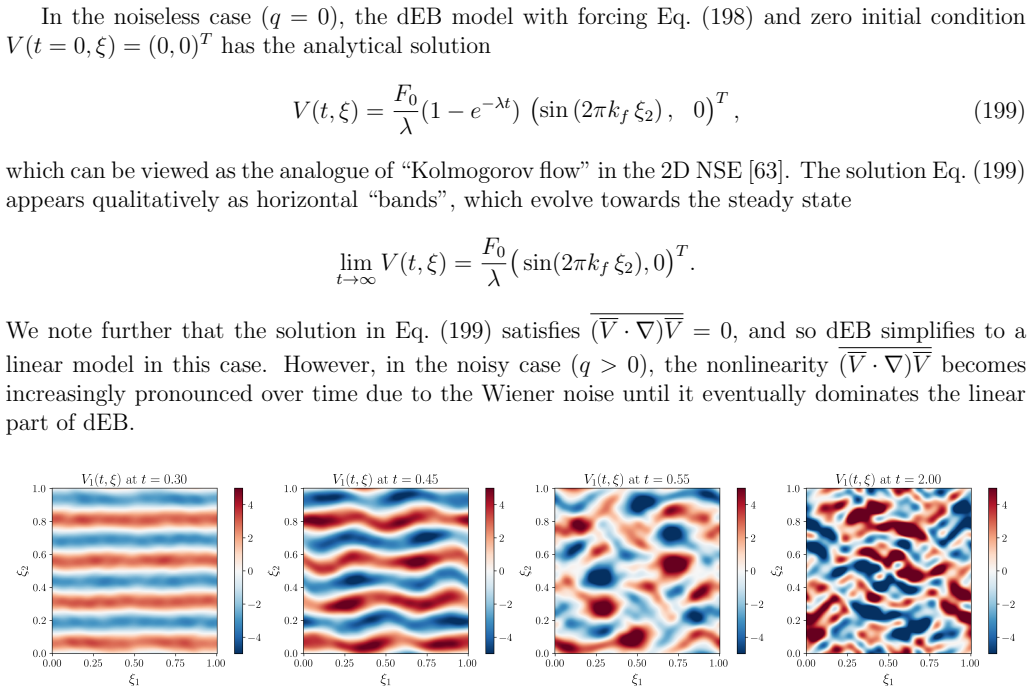
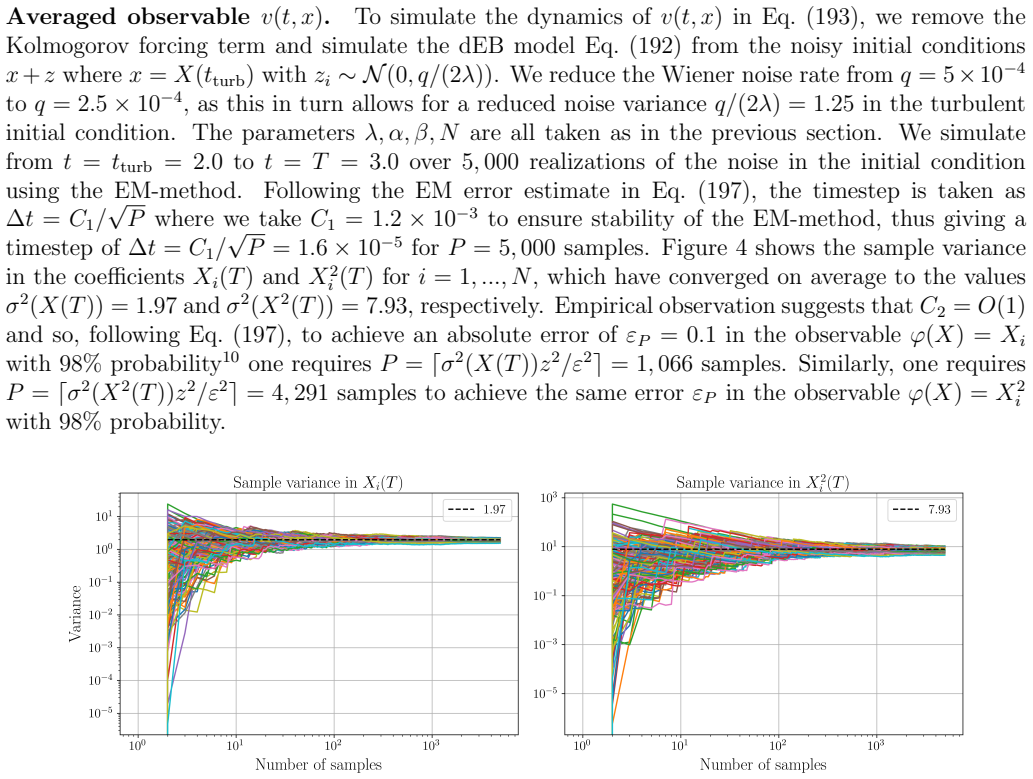
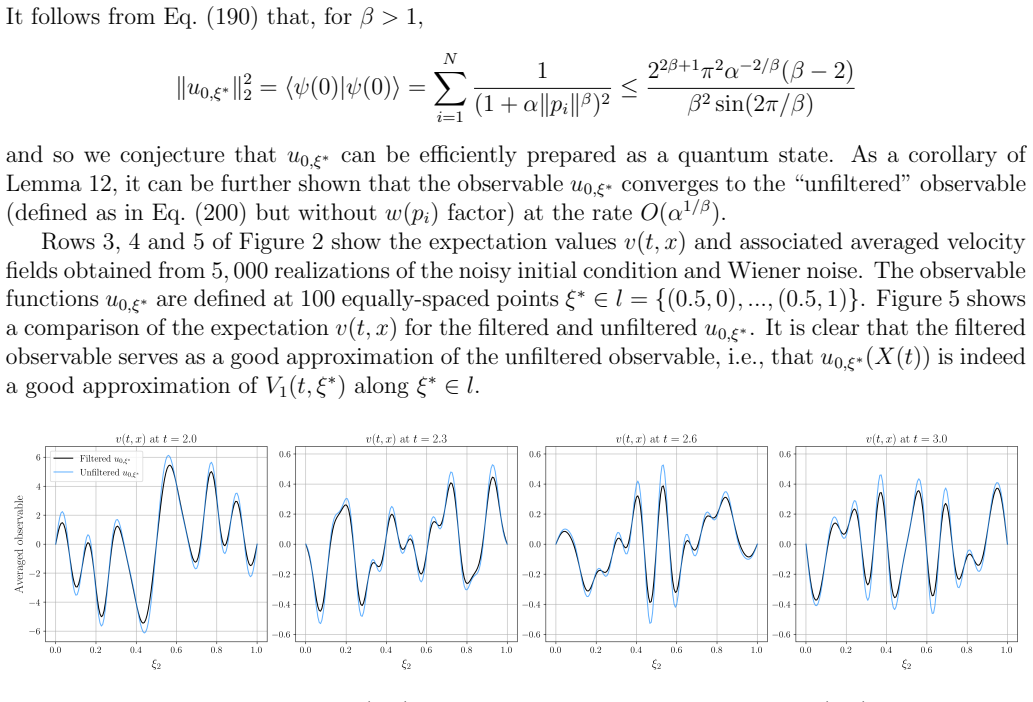

read the original abstract
Stochastic nonlinear dynamics underlie many models in engineering and computational physics, yet accurate high-dimensional simulation remains challenging. We present a quantum algorithm for a broad class of $N$-dimensional stochastic differential equations with dissipation and quadratic drift. The algorithm applies to strongly nonlinear systems with all-to-all interactions, thereby extending the scope of previously known quantum algorithms that were limited to weak nonlinearity and sparse systems. For norm-preserving drifts, a condition satisfied by key fluid dynamics discretizations, our method approximates expectation values of low-order correlation functions with rigorous error bounds at a cost polynomial in $\log{(N)}$ and linear in the evolution time. Our main technical advance is a subroutine for simulating an auxiliary system of $N$ interacting quantum harmonic oscillators with cost polylogarithmic in $N$. Finally, we formulate turbulence models, including Navier-Stokes and damped Euler equations, within this framework, opening a route to quantum simulation of strongly nonlinear SDEs governing turbulence and nonlinear wave dynamics.
Editorial analysis
A structured set of objections, weighed in public.
Referee Report
Summary. The manuscript presents a quantum algorithm for simulating a broad class of N-dimensional stochastic differential equations (SDEs) with dissipation and quadratic drift terms. It claims that when the drift satisfies a norm-preserving condition (asserted to hold for discretizations of Navier-Stokes and damped Euler equations), expectation values of low-order correlation functions can be approximated with rigorous error bounds at a cost that is polynomial in log(N) and linear in evolution time. The central technical contribution is a polylog(N)-cost subroutine for simulating an auxiliary system of N interacting quantum harmonic oscillators. The work also formulates turbulence models within this SDE framework.
Significance. If the norm-preserving condition holds for the target models and the error analysis is complete, the result would extend quantum simulation techniques to strongly nonlinear, all-to-all interacting SDEs, a regime previously inaccessible to polylog scaling. The oscillator simulation subroutine, if rigorously established, constitutes a reusable primitive with potential applications beyond the SDE setting.
major comments (2)
- [Abstract and turbulence models section] Abstract and the section formulating turbulence models: the claim that 'key fluid dynamics discretizations' satisfy the norm-preserving condition on the quadratic drift is asserted without an explicit verification that the chosen spatial discretization of the Navier-Stokes or damped Euler equations preserves the required norm (or equivalent structural property) under the quadratic term. This condition is load-bearing for invoking the polylog(N) oscillator subroutine at the stated cost.
- [Abstract (and any error analysis section)] The abstract asserts 'rigorous error bounds' for the approximation of low-order correlation functions, yet the provided text does not include the full derivation or explicit propagation of errors from the oscillator subroutine through the SDE discretization; without this, the polynomial-in-log(N) claim cannot be verified as stated.
minor comments (1)
- [Abstract] Notation for the norm-preserving condition should be defined explicitly (e.g., as an equation) rather than described only in prose, to allow direct checking against the fluid discretizations.
Simulated Author's Rebuttal
We thank the referee for the careful review and constructive feedback on our manuscript. We address each major comment below, indicating planned revisions where appropriate to strengthen the presentation.
read point-by-point responses
-
Referee: [Abstract and turbulence models section] Abstract and the section formulating turbulence models: the claim that 'key fluid dynamics discretizations' satisfy the norm-preserving condition on the quadratic drift is asserted without an explicit verification that the chosen spatial discretization of the Navier-Stokes or damped Euler equations preserves the required norm (or equivalent structural property) under the quadratic term. This condition is load-bearing for invoking the polylog(N) oscillator subroutine at the stated cost.
Authors: We agree that an explicit verification of the norm-preserving condition for the chosen discretizations would improve clarity and verifiability, as this property is essential for the polylog(N) scaling. The manuscript asserts the condition based on the structural form of the quadratic drift term in the SDE formulation of these fluid models. We will add a dedicated paragraph or subsection in the turbulence models section that explicitly derives the norm preservation (or equivalent invariant) for the specific spatial discretizations employed, including the relevant algebraic steps for the quadratic term. revision: yes
-
Referee: [Abstract (and any error analysis section)] The abstract asserts 'rigorous error bounds' for the approximation of low-order correlation functions, yet the provided text does not include the full derivation or explicit propagation of errors from the oscillator subroutine through the SDE discretization; without this, the polynomial-in-log(N) claim cannot be verified as stated.
Authors: The manuscript contains the complete error analysis, including propagation of errors from the quantum harmonic oscillator subroutine through the SDE discretization, sampling procedure, and final estimation of low-order correlations, with all bounds derived rigorously in the technical sections. The abstract summarizes the resulting complexity. To address the concern, we will revise the abstract to explicitly reference the theorem or section containing the full error propagation and add a brief summary paragraph in the main text if needed for accessibility. revision: partial
Circularity Check
No significant circularity; derivation relies on standard quantum primitives
full rationale
The paper's central result is a quantum algorithm for SDEs under a norm-preserving drift condition, with cost polynomial in log(N) derived from a new subroutine simulating N interacting oscillators. This builds on established quantum simulation techniques without reducing the claimed bounds or complexity to a fitted parameter, self-defined quantity, or load-bearing self-citation chain. The condition is presented as an external structural assumption satisfied by target models; no step equates the output complexity to the input by construction. The derivation remains self-contained against external benchmarks.
Axiom & Free-Parameter Ledger
axioms (2)
- domain assumption The SDE belongs to the class with quadratic drift and dissipation terms.
- domain assumption Drift is norm-preserving, enabling the stated error bounds and scaling.
Forward citations
Cited by 1 Pith paper
-
Quantum Derivative Pricing for SPDEs via BDSDE Representation
Quantum-accelerated MLMC methods for BDSDE-based SPDE derivative pricing and Greeks achieve sampling complexity improvement from O(ε^{-2}) to O(ε^{-1}).
Reference graph
Works this paper leans on
-
[1]
Grid-point and time-step requirements for direct numerical simulation and large-eddy simulation.Physics of Fluids, 33(1), 2021
Xiang IA Yang and Kevin P Griffin. Grid-point and time-step requirements for direct numerical simulation and large-eddy simulation.Physics of Fluids, 33(1), 2021
2021
-
[2]
Efficient quantum algorithm for dissipative nonlinear differential equations
Jin-Peng Liu, Herman Øie Kolden, Hari K Krovi, Nuno F Loureiro, Konstantina Trivisa, and Andrew M Childs. Efficient quantum algorithm for dissipative nonlinear differential equations. Proceedings of the National Academy of Sciences, 118(35):e2026805118, 2021
2021
-
[3]
Bharadwaj, and Mikel Sanz
Javier Gonzalez-Conde, Dylan Lewis, Sachin S. Bharadwaj, and Mikel Sanz. Quantum carleman linearization efficiency in nonlinear fluid dynamics.Phys. Rev. Res., 7:023254, Jun 2025
2025
-
[4]
A quantum algorithm to solve nonlinear differential equations
Sarah K Leyton and Tobias J Osborne. A quantum algorithm to solve nonlinear differential equations.arXiv preprint arXiv:0812.4423, 2008
work page internal anchor Pith review Pith/arXiv arXiv 2008
-
[5]
Nonlinear quantum mechanics implies polynomial-time solu- tion for np-complete and #p problems.Physical Review Letters, 81(18):3992, 1998
Daniel S Abrams and Seth Lloyd. Nonlinear quantum mechanics implies polynomial-time solu- tion for np-complete and #p problems.Physical Review Letters, 81(18):3992, 1998
1998
-
[6]
Optimal state discrimination and unstructured search in nonlinear quantum mechanics.Physical Review A, 93(2):022314, 2016
Andrew M Childs and Joshua Young. Optimal state discrimination and unstructured search in nonlinear quantum mechanics.Physical Review A, 93(2):022314, 2016
2016
-
[7]
Quantum and classical algorithms for nonlinear unitary dynamics.Quantum, 9:1741, 2025
Noah Brustle and Nathan Wiebe. Quantum and classical algorithms for nonlinear unitary dynamics.Quantum, 9:1741, 2025
2025
-
[8]
Childs, and Hari Krovi
Abtin Ameri, Joseph Carolan, Andrew M. Childs, and Hari Krovi. Quantum lower bounds for simulating fluid dynamics.arXiv preprint, 2026
2026
-
[9]
Hamiltonian systems and transformation in hilbert space.Proceedings of the National Academy of Sciences, 17(5):315–318, 1931
Bernard O Koopman. Hamiltonian systems and transformation in hilbert space.Proceedings of the National Academy of Sciences, 17(5):315–318, 1931
1931
-
[10]
Zur operatorenmethode in der klassischen mechanik.Annals of Mathemat- ics, 33(3):587–642, 1932
John von Neumann. Zur operatorenmethode in der klassischen mechanik.Annals of Mathemat- ics, 33(3):587–642, 1932
1932
-
[11]
Nonlinear dynamical systems and classical orthogonal polynomials.Journal of Mathematical Physics, 38(5):2483–2505, 1997
Krzysztof Kowalski. Nonlinear dynamical systems and classical orthogonal polynomials.Journal of Mathematical Physics, 38(5):2483–2505, 1997
1997
-
[12]
Linear embedding of nonlinear dynamical systems and prospects for efficient quantum algorithms.Physics of Plasmas, 28(6), 2021
Alexander Engel, Graeme Smith, and Scott E Parker. Linear embedding of nonlinear dynamical systems and prospects for efficient quantum algorithms.Physics of Plasmas, 28(6), 2021
2021
-
[13]
Yu Tanaka and Keisuke Fujii. A polynomial time quantum algorithm for exponentially large scale nonlinear differential equations via hamiltonian simulation.arXiv preprint arXiv:2305.00653, 2023. 91
-
[14]
Quantum algorithm for the advection-diffusion equation and the Koopman-von Neumann approach to nonlinear dynamical systems.Computer Physics Commu- nications, 309:109498, 2025
Ivan Novikau and Ilon Joseph. Quantum algorithm for the advection-diffusion equation and the Koopman-von Neumann approach to nonlinear dynamical systems.Computer Physics Commu- nications, 309:109498, 2025
2025
-
[15]
Koopman spectral linearization vs
Dongwei Shi and Xiu Yang. Koopman spectral linearization vs. carleman linearization: A computational comparison study.arXiv preprint arXiv:2310.19078, 2023
-
[16]
Springer Science & Business Media, 2004
Iosif I Gikhman and Anatoli V Skorokhod.The Theory of Stochastic Processes: I, volume 210. Springer Science & Business Media, 2004
2004
-
[17]
Springer Science & Business Media, 2004
Giuseppe Da Prato.Kolmogorov equations for stochastic PDEs. Springer Science & Business Media, 2004
2004
-
[18]
Kolmogorov equation associated to a stochastic Navier– Stokes equation.journal of functional analysis, 160(1):312–336, 1998
Franco Flandoli and Fausto Gozzi. Kolmogorov equation associated to a stochastic Navier– Stokes equation.journal of functional analysis, 160(1):312–336, 1998
1998
-
[19]
A numerical approach to kolmogorov equation in high dimension based on gaussian analysis.Journal of Mathematical Analysis and Applica- tions, 493(1):124505, 2021
Franco Flandoli, Dejun Luo, and Cristiano Ricci. A numerical approach to kolmogorov equation in high dimension based on gaussian analysis.Journal of Mathematical Analysis and Applica- tions, 493(1):124505, 2021
2021
-
[20]
Existence and smoothness of the navier-stokes equation.The millennium prize problems, 57(67):22, 2006
Charles L Fefferman. Existence and smoothness of the navier-stokes equation.The millennium prize problems, 57(67):22, 2006
2006
-
[21]
Navier–stokes equation
Clay Mathematics Institute. Navier–stokes equation. URLhttps://www.claymath.org/ millennium/navier-stokes-equation/. Accessed 2026-03-29
2026
-
[22]
Springer, 2015
Robert C Dalang, Marco Dozzi, Franco Flandoli, and Francesco Russo.Stochastic Analysis: A Series of Lectures. Springer, 2015
2015
-
[23]
Foias, O
C. Foias, O. Manley, R. Rosa, and R. Temam.Navier-Stokes Equations and Turbulence. Ency- clopedia of Mathematics and its Applications. Cambridge University Press, 2001
2001
-
[24]
Predictability: A problem partly solved
Edward N Lorenz. Predictability: A problem partly solved. InProc. Seminar on predictability, volume 1, pages 1–18. Reading, 1996
1996
-
[25]
A detectability criterion and data assimilation for nonlinear differential equations.Nonlinearity, 31(11):5235, 2018
Jason Frank and Sergiy Zhuk. A detectability criterion and data assimilation for nonlinear differential equations.Nonlinearity, 31(11):5235, 2018
2018
-
[26]
Evidence that random behavior is generic for non- linear differential equations.Physica D: Nonlinear Phenomena, 1(1):68–79, 1980
Steven A Orszag and John B McLaughlin. Evidence that random behavior is generic for non- linear differential equations.Physica D: Nonlinear Phenomena, 1(1):68–79, 1980
1980
-
[27]
From optimization to sampling through gradient flows.Notices of the American Mathematical Society, 70(6), 2023
N Garc´ ıa Trillos, Bamdad Hosseini, and Daniel Sanz-Alonso. From optimization to sampling through gradient flows.Notices of the American Mathematical Society, 70(6), 2023
2023
-
[28]
Multistep parametric processes in nonlinear optics
Solomon M Saltiel, Andrey A Sukhorukov, and Yuri S Kivshar. Multistep parametric processes in nonlinear optics. InProgress in optics, volume 47, pages 1–73. Elsevier, 2005. 92
2005
-
[29]
Bardina, J
J. Bardina, J. H. Ferziger, and W. C. Reynolds. Improved subgrid-scale models for large-eddy simulation. InProceedings of the 13th AIAA Fluid and Plasma Dynamics Conference, Snowmass, Colorado, jul 1980. American Institute of Aeronautics and Astronautics. AIAA Paper 80-1357
1980
-
[30]
Layton and R
W. Layton and R. Lewandowski. On a well-posed turbulence model.Discrete and Continuous Dynamical Systems - Series B, 6(1):111–128, 2006
2006
-
[31]
Lunasin, and Edriss S
Yanping Cao, Evelyn M. Lunasin, and Edriss S. Titi. Global well-posedness of the three- dimensional viscous and inviscid simplified bardina turbulence models.Communications in Mathematical Sciences, 4(4):823–848, 2006
2006
-
[32]
Bardina, J
J. Bardina, J. H. Ferziger, and W. C. Reynolds. Improved turbulence models based on large eddy simulation of homogeneous, incompressible, turbulent flows. Nasa contractor report, National Aeronautics and Space Administration, may 1983. Stanford University Thermosciences Division Technical Report TF-19
1983
-
[33]
Gambetta, Dario Gil, and Zaira Nazario
Sergey Bravyi, Oliver Dial, Jay M. Gambetta, Dario Gil, and Zaira Nazario. The future of quantum computing with superconducting qubits.Journal of Applied Physics, 132(16):160902, 2022
2022
-
[34]
Massimo Germano, Ugo Piomelli, Parviz Moin, and William H. Cabot. A dynamic subgrid-scale eddy viscosity model.Physics of Fluids A: Fluid Dynamics, 3(7):1760–1765, 1991
1991
-
[35]
Douglas K. Lilly. A proposed modification of the germano subgrid-scale closure method.Physics of Fluids A: Fluid Dynamics, 4(3):633–635, 1992
1992
-
[36]
Improved quantum algorithms for linear and nonlinear differential equations.Quan- tum, 7:913, 2023
Hari Krovi. Improved quantum algorithms for linear and nonlinear differential equations.Quan- tum, 7:913, 2023
2023
-
[37]
Further improving quantum algorithms for nonlinear differential equations via higher-order methods and rescaling
Pedro CS Costa, Philipp Schleich, Mauro ES Morales, and Dominic W Berry. Further improving quantum algorithms for nonlinear differential equations via higher-order methods and rescaling. npj Quantum Information, 11(1):141, 2025
2025
-
[38]
Efficient quantum algorithm for nonlinear reaction–diffusion equations and energy estimation.Commu- nications in Mathematical Physics, 404(2):963–1020, 2023
Jin-Peng Liu, Dong An, Di Fang, Jiasu Wang, Guang Hao Low, and Stephen Jordan. Efficient quantum algorithm for nonlinear reaction–diffusion equations and energy estimation.Commu- nications in Mathematical Physics, 404(2):963–1020, 2023
2023
-
[39]
An efficient quantum algorithm for simulating polynomial dynamical systems: A
Amit Surana, Abeynaya Gnanasekaran, and Tuhin Sahai. An efficient quantum algorithm for simulating polynomial dynamical systems: A. surana et al.Quantum Information Processing, 23(3):105, 2024
2024
-
[40]
Quantum algorithms for nonlinear differential equations via pivot-shifted carleman linearization.arXiv preprint, 2026
Ke Wang, Zikang Jia, Shravan Veerapaneni, and Zhiyan Ding. Quantum algorithms for nonlinear differential equations via pivot-shifted carleman linearization.arXiv preprint, 2026
2026
-
[41]
Quantum algorithms for nonlinear dynamics: Revisiting carleman linearization with no dissipative conditions.SIAM Journal on Scientific Computing, 47(2):A943–A970, 2025
Hsuan-Cheng Wu, Jingyao Wang, and Xiantao Li. Quantum algorithms for nonlinear dynamics: Revisiting carleman linearization with no dissipative conditions.SIAM Journal on Scientific Computing, 47(2):A943–A970, 2025. 93
2025
-
[42]
Koopman–von neumann approach to quantum simulation of nonlinear classical dynamics.Physical Review Research, 2(4):043102, 2020
Ilon Joseph. Koopman–von neumann approach to quantum simulation of nonlinear classical dynamics.Physical Review Research, 2(4):043102, 2020
2020
-
[43]
Sergey Bravyi, Robert Manson-Sawko, Mykhaylo Zayats, and Sergiy Zhuk. Quantum simu- lation of a noisy classical nonlinear dynamics.arXiv preprint arXiv:2507.06198v2, oct 2025. arXiv:2507.06198
-
[44]
Linear combination of hamiltonian simulation for nonuni- tary dynamics with optimal state preparation cost.Physical Review Letters, 131(15):150603, 2023
Dong An, Jin-Peng Liu, and Lin Lin. Linear combination of hamiltonian simulation for nonuni- tary dynamics with optimal state preparation cost.Physical Review Letters, 131(15):150603, 2023
2023
-
[45]
Quantum algorithm for linear non-unitary dynamics with near-optimal dependence on all parameters.Communications in Mathematical Physics, 407(1):19, 2026
Dong An, Andrew M Childs, and Lin Lin. Quantum algorithm for linear non-unitary dynamics with near-optimal dependence on all parameters.Communications in Mathematical Physics, 407(1):19, 2026
2026
-
[46]
Optimal quantum simulation of linear non-unitary dynamics.arXiv preprint arXiv:2508.19238, 2025
Guang Hao Low and Rolando D Somma. Optimal quantum simulation of linear non-unitary dynamics.arXiv preprint arXiv:2508.19238, 2025
-
[47]
Turbulence and Interaction-TI2006
Roel Verstappen. On restraining the production of small scales of motion in a turbulent chan- nel flow.Computers and Fluids, 37(7):887–897, 2008. ISSN 0045-7930. Special Issue of the “Turbulence and Interaction-TI2006” Conference
2008
-
[48]
Continuous markov processes and stochastic equations.Rendiconti del Circolo Matematico di Palermo, 4:48–90, 1955
Gisirˆ o Maruyama. Continuous markov processes and stochastic equations.Rendiconti del Circolo Matematico di Palermo, 4:48–90, 1955
1955
-
[49]
Campbell
Earl T. Campbell. A random compiler for fast hamiltonian simulation.Physical Review Letters, 123(7):070503, 2019
2019
-
[50]
Sornborger, Yigit Subasi, and Guoming Wang
David Jennings, Kamil Korzekwa, Matteo Lostaglio, Andrew T. Sornborger, Yigit Subasi, and Guoming Wang. Quantum algorithms for general nonlinear dynamics based on the carleman embedding.arXiv preprint arXiv:2509.07155, 2025
-
[51]
David Jennings, Kamil Korzekwa, Matteo Lostaglio, Richard Ashworth, Emanuele Marsili, and Stephen Rolston. An end-to-end quantum algorithm for nonlinear fluid dynamics with bounded quantum advantage.arXiv preprint arXiv:2512.03758, 2025
-
[52]
Springer Science & Business Media, 2013
Bernt Oksendal.Stochastic differential equations: an introduction with applications. Springer Science & Business Media, 2013
2013
-
[53]
Cambridge university press Cambridge, 1999
George E Andrews, Richard Askey, Ranjan Roy, Ranjan Roy, and Richard Askey.Special functions, volume 71. Cambridge university press Cambridge, 1999
1999
-
[54]
Quantum singular value transfor- mation and beyond: Exponential improvements for quantum matrix arithmetics
Andr´ as Gily´ en, Yuan Su, Guang Hao Low, and Nathan Wiebe. Quantum singular value transfor- mation and beyond: Exponential improvements for quantum matrix arithmetics. InProceedings of the 51st Annual ACM SIGACT Symposium on Theory of Computing (STOC 2019), pages 193–204. ACM, 2019. 94
2019
-
[55]
Toward optimal circuit size for sparse quantum state preparation.Physical Review A, 110(3):032439, 2024
Rui Mao, Guojing Tian, and Xiaoming Sun. Toward optimal circuit size for sparse quantum state preparation.Physical Review A, 110(3):032439, 2024
2024
-
[56]
Simulating hamiltonian dynamics with a truncated taylor series.Physical review letters, 114(9): 090502, 2015
Dominic W Berry, Andrew M Childs, Richard Cleve, Robin Kothari, and Rolando D Somma. Simulating hamiltonian dynamics with a truncated taylor series.Physical review letters, 114(9): 090502, 2015
2015
-
[57]
Hamiltonian simulation by qubitization.Quantum, 3: 163, 2019
Guang Hao Low and Isaac L Chuang. Hamiltonian simulation by qubitization.Quantum, 3: 163, 2019
2019
-
[58]
Yanping Cao and Edriss S. Titi. On the rate of convergence of the two-dimensional alpha-models of turbulence to the navier–stokes equations.Numerical Functional Analysis and Optimization, 30(11-12):1231–1271, 2009
2009
-
[59]
Gronwall
Thomas H. Gronwall. Note on the derivatives with respect to a parameter of the solutions of a system of differential equations.Annals of Mathematics, 20(4):292–296, 1919
1919
-
[60]
Classical solutions for a generalized euler equation in two dimensions.Journal of Mathematical Analysis and Applications, 215(2):471–484, 1997
Marcel Oliver. Classical solutions for a generalized euler equation in two dimensions.Journal of Mathematical Analysis and Applications, 215(2):471–484, 1997. ISSN 0022-247X
1997
-
[61]
Kloeden and Eckhard Platen.Numerical Solution of Stochastic Differential Equations, volume 23 ofApplications of Mathematics
Peter E. Kloeden and Eckhard Platen.Numerical Solution of Stochastic Differential Equations, volume 23 ofApplications of Mathematics. Springer, Berlin, Heidelberg, 1992
1992
-
[62]
Fishman.Monte Carlo: Concepts, Algorithms, and Applications
George S. Fishman.Monte Carlo: Concepts, Algorithms, and Applications. Springer, New York,
-
[63]
LD Meshalkin and Ia G Sinai. Investigation of the stability of a stationary solution of a system of equations for the plane movement of an incompressible viscous liquid.Journal of Applied Mathematics and Mechanics, 25(6):1700–1705, 1961
1961
-
[64]
Zhuk and T
S. Zhuk and T. Tchrakian. Parameter estimation for euler equations with uncertain inputs. InProceedings of the IEEE 54th Annual Conference on Decision and Control (CDC), pages 7405–7410, Osaka, Japan, 2015. IEEE
2015
-
[65]
Importance sampling for stochastic quan- tum simulations.Quantum, 7:977, 2023
Oriel Kiss, Michele Grossi, and Alessandro Roggero. Importance sampling for stochastic quan- tum simulations.Quantum, 7:977, 2023
2023
-
[66]
Berndt, Amita Malik, and Alexandru Zaharescu
Bruce C. Berndt, Amita Malik, and Alexandru Zaharescu. Partitions intokth powers of terms in an arithmetic progression.Mathematische Zeitschrift, 290(3–4):1277–1307, 2018
2018
-
[67]
Power partitions and saddle-point method.Journal of Number Theory, 204:435–445, 2019
G´ erald Tenenbaum, Jie Wu, and Ya-Li Li. Power partitions and saddle-point method.Journal of Number Theory, 204:435–445, 2019. 95
2019
discussion (0)
Sign in with ORCID, Apple, or X to comment. Anyone can read and Pith papers without signing in.