DeepMine-Mamba: Mitigating Information Dilution in Mamba-Based State Space Models for Document Image Binarization
Pith reviewed 2026-06-27 18:45 UTC · model grok-4.3
The pith
Mamba-based binarization dilutes faint text strokes during state propagation, but an Anti-Dilution Gate restores stroke-sensitive responses to fix it.
A machine-rendered reading of the paper's core claim, the machinery that carries it, and where it could break.
Core claim
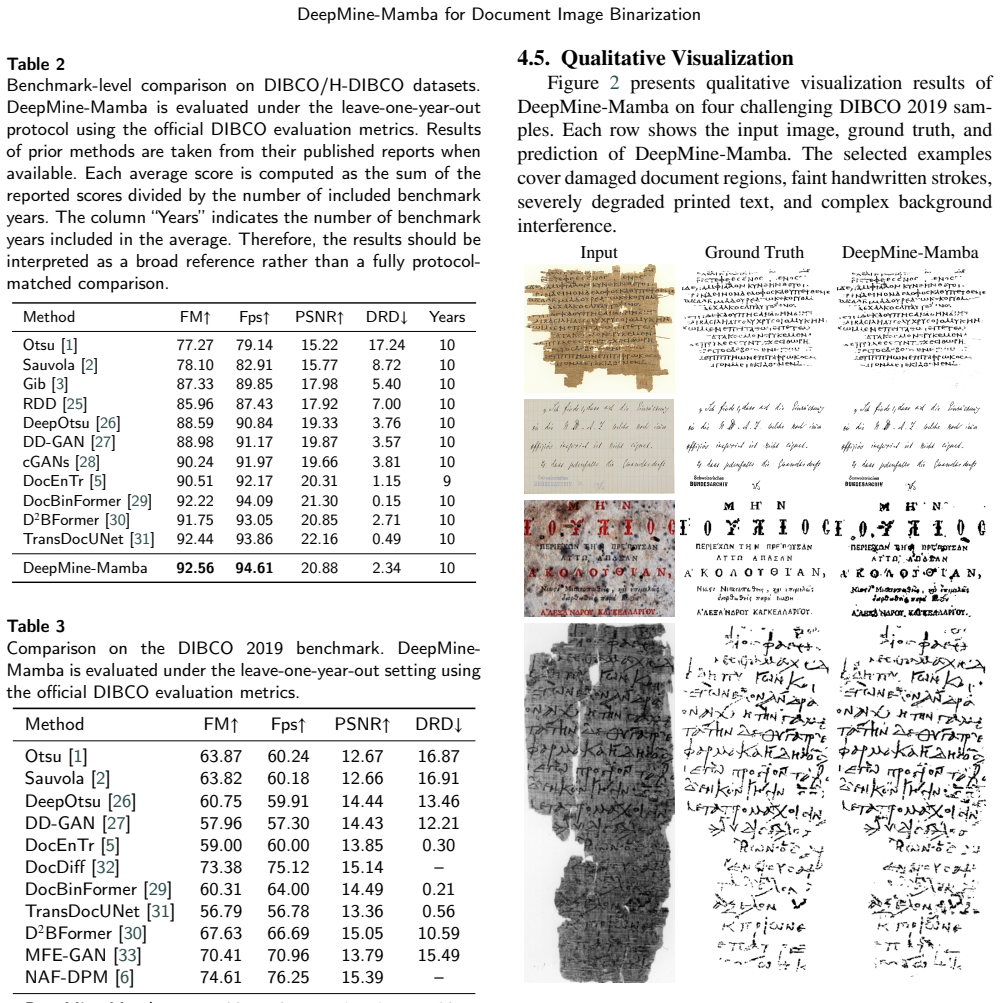
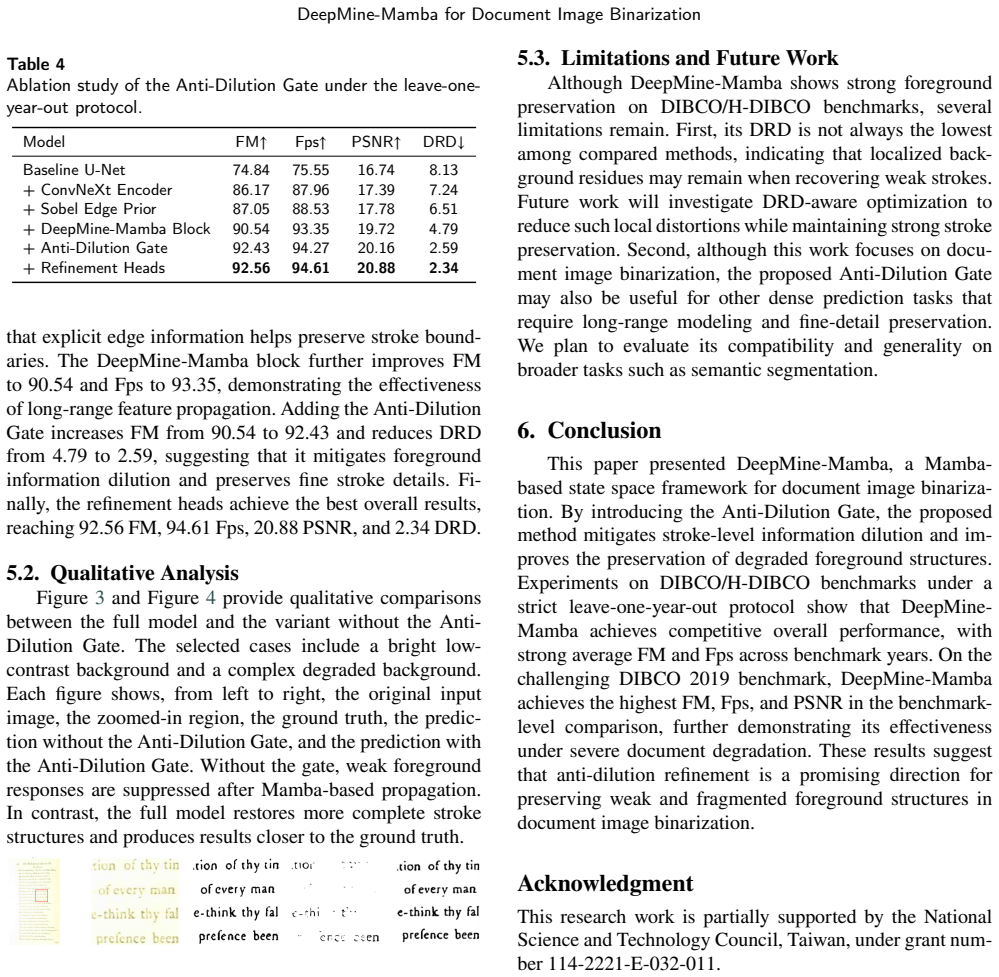
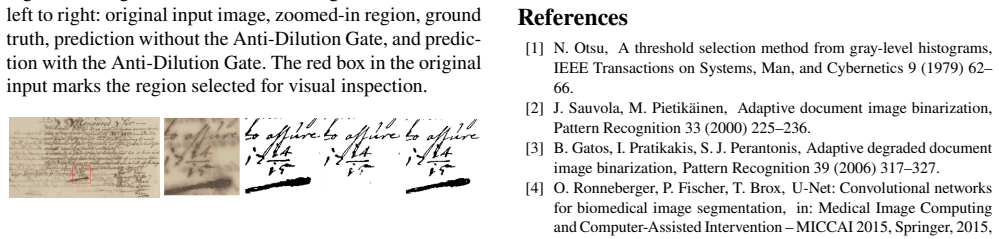
Direct state-space propagation in Mamba models for document binarization dilutes weak foreground cues, especially faint ink traces, fragmented characters, and boundary-sensitive stroke details. DeepMine-Mamba counters this with a novel Anti-Dilution Gate that estimates propagation-induced feature changes and selectively restores stroke-sensitive local responses while suppressing unnecessary background enhancement. Experiments on DIBCO/H-DIBCO benchmarks under strict leave-one-year-out evaluation show competitive overall performance with strong average FM and Fps across years, and ablations confirm the gate improves stroke preservation and reduces perceptually significant errors.
What carries the argument
The Anti-Dilution Gate, which estimates propagation-induced feature changes to restore stroke-sensitive local responses and suppress background enhancement.
If this is right
- The gate improves preservation of thin, broken, and low-contrast strokes on standard benchmarks.
- DeepMine-Mamba reaches competitive average FM and Fps scores across multiple DIBCO/H-DIBCO years.
- Mamba-based pipelines become viable for binarization once equipped with targeted correction for local detail loss.
- Ablation evidence ties the gate directly to reduced perceptually significant binarization errors.
Where Pith is reading between the lines
- The same gate design could be tested on other state-space vision tasks that require retention of sparse local signals.
- If dilution arises from long-range state updates, analogous modules might benefit non-Mamba sequence models in image restoration.
- Extending evaluation to additional degradation types beyond DIBCO years would clarify whether the mechanism generalizes.
Load-bearing premise
The observed gains on DIBCO benchmarks are caused by the Anti-Dilution Gate mitigating dilution rather than by other modeling choices or dataset-specific tuning.
What would settle it
An ablation that removes only the Anti-Dilution Gate from the full DeepMine-Mamba architecture, then measures the change in stroke-specific metrics such as Fps and thin-stroke FM on the same DIBCO leave-one-year-out splits.
Figures

read the original abstract
Document image binarization aims to separate foreground text from degraded backgrounds while preserving thin, broken, and low-contrast strokes. Although deep learning methods have improved binarization performance, most existing approaches rely on convolutional, transformer-based, or generative architectures, while Mamba-based state space models remain largely unexplored for this task. In this work, we investigate Mamba-based feature propagation and observe that direct state-space propagation may dilute weak foreground cues during long-range modeling, especially faint ink traces, fragmented characters, and boundary-sensitive stroke details. To address this problem, we propose DeepMine-Mamba, a Mamba-based binarization framework equipped with a novel Anti-Dilution Gate that estimates propagation-induced feature changes and selectively restores stroke-sensitive local responses while suppressing unnecessary background enhancement. Experiments on DIBCO/H-DIBCO benchmarks under a strict leave-one-year-out protocol show that DeepMine-Mamba achieves competitive overall performance, with strong average FM and Fps across benchmark years. Ablation results further demonstrate that the Anti-Dilution Gate improves stroke preservation and reduces perceptually significant binarization errors.
Editorial analysis
A structured set of objections, weighed in public.
Referee Report
Summary. The paper proposes DeepMine-Mamba, a Mamba-based state-space model for document image binarization. It observes that direct SSM propagation can dilute weak foreground cues (thin strokes, low-contrast ink) and introduces an Anti-Dilution Gate that estimates propagation-induced feature changes to selectively restore stroke-sensitive local responses while suppressing background enhancement. On DIBCO/H-DIBCO benchmarks under a leave-one-year-out protocol the model reports competitive average FM and Fps scores; ablations are said to confirm that the gate improves stroke preservation and reduces perceptually significant errors.
Significance. If the Anti-Dilution Gate can be shown to specifically counteract dilution rather than provide generic local enhancement, the work would supply a targeted architectural motif for preserving fine detail under long-range SSM propagation, a setting relevant to many degraded-image tasks. The leave-one-year-out protocol is a positive design choice that reduces temporal overfitting risk on the DIBCO series.
major comments (2)
- [Ablation study] Ablation study (mentioned in abstract): the reported FM/Fps gains from adding the Anti-Dilution Gate are not accompanied by a control that replaces the gate with an equivalent non-dilution-aware module (e.g., a standard local convolution or generic gating block); without this isolation the causal link between the gate and mitigation of propagation-induced dilution remains untested.
- [Method] Method description (abstract and § on Anti-Dilution Gate): no equations, feature-map visualizations, or quantitative diagnostics (state-difference norm, foreground-response histograms before/after propagation) are supplied to demonstrate that the gate detects and counters dilution of weak cues rather than performing generic feature modulation.
minor comments (1)
- [Abstract] The abstract states 'competitive overall performance' without quoting the numerical margins relative to the strongest published baselines; adding these deltas would clarify the practical advance.
Simulated Author's Rebuttal
We thank the referee for the constructive comments. We address each major point below and will revise the manuscript to strengthen the empirical isolation of the Anti-Dilution Gate's effect.
read point-by-point responses
-
Referee: [Ablation study] Ablation study (mentioned in abstract): the reported FM/Fps gains from adding the Anti-Dilution Gate are not accompanied by a control that replaces the gate with an equivalent non-dilution-aware module (e.g., a standard local convolution or generic gating block); without this isolation the causal link between the gate and mitigation of propagation-induced dilution remains untested.
Authors: We agree that the current ablation lacks a direct control isolating dilution-specific behavior from generic local enhancement. In the revised manuscript we will add an ablation replacing the Anti-Dilution Gate with both a standard local convolution block and a generic gating block, reporting the resulting FM and Fps scores under the same leave-one-year-out protocol. revision: yes
-
Referee: [Method] Method description (abstract and § on Anti-Dilution Gate): no equations, feature-map visualizations, or quantitative diagnostics (state-difference norm, foreground-response histograms before/after propagation) are supplied to demonstrate that the gate detects and counters dilution of weak cues rather than performing generic feature modulation.
Authors: We acknowledge that the manuscript currently provides insufficient mechanistic evidence. The revised version will include the full equations of the Anti-Dilution Gate, feature-map visualizations highlighting weak foreground responses, and quantitative diagnostics (state-difference norms and foreground-response histograms before/after propagation) to demonstrate targeted restoration of diluted cues. revision: yes
Circularity Check
No circularity: empirical proposal with independent benchmark validation
full rationale
The paper proposes the Anti-Dilution Gate as an architectural addition to Mamba-based models for document binarization, motivated by an observed dilution phenomenon during state propagation. Performance is evaluated via standard DIBCO benchmarks under leave-one-year-out protocol, with ablations reporting downstream FM/Fps metrics. No equations, fitted parameters, or self-citations are described that would reduce the gate's claimed effect to a tautology, a renamed input, or a self-referential prediction. The derivation chain consists of standard model design followed by external empirical testing and remains self-contained against the provided benchmarks.
Axiom & Free-Parameter Ledger
axioms (1)
- domain assumption Mamba state-space models are suitable for image feature propagation in binarization tasks
invented entities (1)
-
Anti-Dilution Gate
no independent evidence
Forward citations
Cited by 1 Pith paper
-
Reload-Mamba: Hierarchical Anti-Dilution State-Space Modeling for Multi-Class Semantic Segmentation
Reload-Mamba augments a ConvNeXt-Tiny + four-directional Mamba encoder-decoder with boundary-supervised detail prior, entropy-aware Reload Gate, and three-level hierarchical reload, reporting 47.9% mIoU on ADE20K and ...
Reference graph
Works this paper leans on
-
[1]
Otsu, A threshold selection method from gray-level histograms, IEEE Transactions on Systems, Man, and Cybernetics 9 (1979) 62– 66
N. Otsu, A threshold selection method from gray-level histograms, IEEE Transactions on Systems, Man, and Cybernetics 9 (1979) 62– 66
1979
-
[2]
Sauvola, M
J. Sauvola, M. Pietikäinen, Adaptive document image binarization, Pattern Recognition 33 (2000) 225–236
2000
-
[3]
B.Gatos,I.Pratikakis,S.J.Perantonis, Adaptivedegradeddocument image binarization, Pattern Recognition 39 (2006) 317–327
2006
-
[4]
In: International Conference on Medical image com- puting and computer-assisted intervention
O. Ronneberger, P. Fischer, T. Brox, U-Net: Convolutional networks for biomedical image segmentation, in: Medical Image Computing andComputer-AssistedIntervention–MICCAI2015,Springer,2015, pp. 234–241. doi:10.1007/978-3-319-24574-4_28
-
[5]
M. A. Souibgui, S. Biswas, S. K. Jemni, Y. Kessentini, A. Fornés, J. Lladós, U. Pal, DocEnTr: An end-to-end document image en- hancement transformer, in: Proceedings of the 26th International Conference on Pattern Recognition, 2022, pp. 1699–1705. doi:10. 1109/ICPR56361.2022.9956101
arXiv 2022
-
[6]
G. Cicchetti, D. Comminiello, NAF-DPM: A nonlinear activation- free diffusion probabilistic model for document enhancement, arXiv preprint arXiv:2404.05669 (2024). S.W. Chan:Preprint submitted to ElsevierPage 6 of 7 DeepMine-Mamba for Document Image Binarization
arXiv 2024
-
[7]
A.Gu,T.Dao,Mamba:Linear-timesequencemodelingwithselective state spaces, arXiv preprint arXiv:2312.00752 (2023)
Pith/arXiv arXiv 2023
-
[8]
Z. Liu, H. Mao, C.-Y. Wu, C. Feichtenhofer, T. Darrell, S. Xie, A convnet for the 2020s, in: Proceedings of the IEEE/CVF conference on computer vision and pattern recognition, 2022, pp. 11976–11986
2022
-
[9]
Presented at the Stanford Artificial Intelligence Project
I.Sobel,G.Feldman,Anisotropic3x3imagegradientoperator,1968. Presented at the Stanford Artificial Intelligence Project
1968
-
[10]
S. S. M. Salehi, D. Erdogmus, A. Gholipour, Tversky loss function for image segmentation using 3d fully convolutional deep networks, in:InternationalWorkshoponMachineLearninginMedicalImaging, Springer, 2017, pp. 379–387. doi:10.1007/978-3-319-67389-9_44
-
[11]
Russakovsky, J
O. Russakovsky, J. Deng, H. Su, J. Krause, S. Satheesh, S. Ma, Z. Huang, A. Karpathy, A. Khosla, M. Bernstein, A. C. Berg, L. Fei- Fei, ImageNet large scale visual recognition challenge, International Journal of Computer Vision 115 (2015) 211–252
2015
-
[12]
Loshchilov, F
I. Loshchilov, F. Hutter, Decoupled weight decay regularization, in: International Conference on Learning Representations, 2019
2019
-
[13]
Micikevicius, S
P. Micikevicius, S. Narang, J. Alben, G. Diamos, E. Elsen, D. Gar- cia, B. Ginsburg, M. Houston, O. Kuchaiev, G. Venkatesh, H. Wu, Mixed precision training, in: International Conference on Learning Representations, 2018
2018
-
[14]
B. Gatos, K. Ntirogiannis, I. Pratikakis, ICDAR 2009 document imagebinarizationcontest(DIBCO2009),in:Proceedingsofthe10th International Conference on Document Analysis and Recognition, 2009, pp. 1375–1382. doi:10.1109/ICDAR.2009.246
-
[15]
I.Pratikakis,B.Gatos,K.Ntirogiannis,H-DIBCO2010:Handwritten documentimagebinarizationcompetition,in:Proceedingsofthe12th International Conference on Frontiers in Handwriting Recognition, 2010, pp. 727–732. doi:10.1109/ICFHR.2010.118
-
[16]
I. Pratikakis, B. Gatos, K. Ntirogiannis, Icdar 2011 document image binarization contest, in: Proceedings of the International Confer- ence on Document Analysis and Recognition, 2011, pp. 1506–1510. doi:10.1109/ICDAR.2011.299
-
[17]
I. Pratikakis, B. Gatos, K. Ntirogiannis, Icfhr 2012 competition on handwritten document image binarization, in: Proceedings of the International Conference on Frontiers in Handwriting Recognition, 2012, pp. 817–822. doi:10.1109/ICFHR.2012.216
-
[18]
I. Pratikakis, B. Gatos, K. Ntirogiannis, Icdar 2013 document image binarization contest, in: Proceedings of the International Confer- ence on Document Analysis and Recognition, 2013, pp. 1471–1476. doi:10.1109/ICDAR.2013.219
-
[19]
K. Ntirogiannis, B. Gatos, I. Pratikakis, Icfhr 2014 competition on handwritten document image binarization, in: Proceedings of the International Conference on Frontiers in Handwriting Recognition, 2014, pp. 809–813. doi:10.1109/ICFHR.2014.141
-
[20]
I.Pratikakis,K.Zagoris,G.Barlas,B.Gatos, Icfhr2016handwritten document image binarization contest, in: Proceedings of the Interna- tionalConferenceonFrontiersinHandwritingRecognition,2016,pp. 619–623. doi:10.1109/ICFHR.2016.0118
-
[21]
I.Pratikakis,K.Zagoris,G.Barlas,B.Gatos, Icdar2017competition ondocumentimagebinarization, in:ProceedingsoftheInternational Conference on Document Analysis and Recognition Workshops, 2017, pp. 1395–1403. doi:10.1109/ICDAR.2017.228
-
[22]
I.Pratikakis,K.Zagoris,P.Kaddas,B.Gatos, Icfhr2018competition on handwritten document image binarization, in: Proceedings of the International Conference on Frontiers in Handwriting Recognition, 2018, pp. 489–493. doi:10.1109/ICFHR-2018.2018.00091
-
[23]
I.Pratikakis,K.Zagoris,X.Karagiannis,L.Tsochatzidis,T.Mondal, I. Marthot-Santaniello, Icdar 2019 competition on document image binarization, in: Proceedings of the International Conference on Document Analysis and Recognition, 2019, pp. 1547–1556. doi:10. 1109/ICDAR.2019.00249
arXiv 2019
-
[24]
H.Lu,A.C.Kot,Y.Q.Shi,Distance-reciprocaldistortionmeasurefor binary document images, IEEE Signal Processing Letters 11 (2004) 228–231
2004
-
[25]
B. Su, S. Lu, C. L. Tan, Robust document image binarization technique for degraded document images, IEEE Transactions on Image Processing 22 (2013) 1408–1417
2013
-
[26]
S.He,L.Schomaker, Documentenhancementandbinarizationusing iterative deep learning, Pattern Recognition 91 (2019) 379–390
2019
-
[27]
R.De,A.Chakraborty,R.Sarkar,Documentimagebinarizationusing dual discriminator generative adversarial networks, IEEE Signal Processing Letters 27 (2020) 1090–1094
2020
-
[28]
J. Zhao, C. Shi, F. Jia, Y. Wang, B. Xiao, Document image binariza- tion with cascaded generators of conditional generative adversarial networks, Pattern Recognition 96 (2019) 106968
2019
- [29]
-
[30]
Yang, et al., A novel degraded document binarization model through vision transformer, Information Fusion 93 (2023) 159–173
M. Yang, et al., A novel degraded document binarization model through vision transformer, Information Fusion 93 (2023) 159–173
2023
- [31]
-
[32]
Z. Yang, Z. Zhang, N. Wang, T. Chen, X. Liu, Docdiff: Docu- ment enhancement via residual diffusion models, arXiv preprint arXiv:2305.03892 (2023)
arXiv 2023
-
[33]
R.-Y. Ju, K. Wong, Y. Jin, J.-S. Chiang, Mfe-gan: Efficient gan- based framework for document image enhancement and binarization with multi-scale feature extraction, arXiv preprint arXiv:2512.14114 (2025). S.W. Chan:Preprint submitted to ElsevierPage 7 of 7
arXiv 2025
discussion (0)
Sign in with ORCID, Apple, or X to comment. Anyone can read and Pith papers without signing in.