A self-consistent EOB--Teukolsky framework for generic extreme mass-ratio inspirals
Pith reviewed 2026-06-27 15:30 UTC · model grok-4.3
The pith
A waveform model for extreme mass-ratio inspirals inserts mass-ratio-informed geodesics from a deformed Kerr metric into the Teukolsky source term to connect orbital dynamics directly to gravitational-wave emission.
A machine-rendered reading of the paper's core claim, the machinery that carries it, and where it could break.
Core claim
The model incorporates analytical, mass-ratio-informed geodesic solutions within a deformed Kerr metric into the source term of the Teukolsky equation, establishing a direct connection between finite-mass-ratio orbital dynamics and gravitational-wave emission. The frequency-domain formulation is coupled to a high-performance solver, enabling rapid evaluation of the tens of thousands of modes required for accurate EMRI waveforms, and the results show that mass-ratio-dependent deformations produce measurable modifications to radiation fluxes and accumulated waveform phases over observationally relevant timescales.
What carries the argument
Insertion of analytical mass-ratio-informed geodesic solutions from a deformed Kerr metric into the source term of the Teukolsky equation.
If this is right
- Mass-ratio-dependent deformations of the metric produce measurable changes in the emitted radiation fluxes for generic Kerr orbits.
- Accumulated waveform phases diverge from the test-particle limit by amounts large enough to matter over the long observation windows of space-based detectors.
- The frequency-domain setup allows efficient computation of the large number of modes needed for complete EMRI waveforms.
- The framework supplies a ready-to-use generic-orbit waveform model for data analysis of future gravitational-wave observations.
Where Pith is reading between the lines
- Waveform mismatches between this model and pure test-particle templates could be used to measure the mass ratio directly from detected signals.
- The same insertion technique might be extended to other background metrics to test deviations from Kerr geometry in strong-field regimes.
- Rapid evaluation of many modes opens the possibility of building template banks that include self-consistent finite-mass effects for matched filtering.
Load-bearing premise
Analytical mass-ratio-informed geodesic solutions in a deformed Kerr metric can be inserted directly into the Teukolsky source term to capture finite-mass-ratio effects without additional calibration or numerical validation of the deformation.
What would settle it
A side-by-side comparison of radiation fluxes and accumulated phases from this model against those computed from full numerical relativity simulations of finite-mass-ratio inspirals at the same mass ratios and orbits.
Figures
read the original abstract
We present a full-relativistic waveform model for extreme mass-ratio inspirals (EMRIs) by self-consistently combining the effective one-body (EOB) formalism with the Teukolsky equation. The model incorporates analytical, mass-ratio-informed geodesic solutions within a deformed Kerr metric into the source term of the Teukolsky equation, establishing a direct connection between finite-mass-ratio orbital dynamics and gravitational-wave emission. The resulting frequency-domain formulation is coupled to a high-performance solver for the homogeneous Teukolsky equation, enabling rapid evaluation of the tens of thousands of modes required for accurate EMRI waveforms. We generate waveforms and radiation fluxes for generic Kerr orbits and investigate the influence of finite-mass-ratio corrections beyond the test-particle limit. The results show that mass-ratio-dependent deformations produce measurable modifications to radiation fluxes, and accumulated waveform phases over observationally relevant timescales. Our framework provides a generic-orbit EOB--Teukolsky waveform model for future space-based GW data analysis.
Editorial analysis
A structured set of objections, weighed in public.
Referee Report
Summary. The paper presents a framework for EMRI waveforms that combines the EOB formalism with the Teukolsky equation by inserting analytical mass-ratio-informed geodesic solutions from a deformed Kerr metric into the Teukolsky source term (solved on Kerr background), yielding a frequency-domain model that captures finite-mass-ratio effects on radiation fluxes and waveform phases for generic orbits.
Significance. If internally consistent, the approach would provide an efficient route to include finite-mass-ratio corrections in generic-orbit EMRI waveforms, bridging EOB and black-hole perturbation theory in a manner directly relevant to LISA data analysis. The coupling to a high-performance homogeneous Teukolsky solver for rapid evaluation of many modes is a practical strength.
major comments (2)
- [Abstract] Abstract: the claim that the framework is 'self-consistent' rests on the hybrid construction in which geodesics are taken from a mass-ratio-deformed Kerr metric while the Teukolsky operator and background remain exactly Kerr; without an explicit demonstration that the deformation corresponds to a consistent first-order metric perturbation (i.e., without additional interaction terms or back-reaction adjustments), the computed fluxes and phases may mix inconsistent backgrounds.
- [Abstract] Abstract: the reported 'measurable modifications' to fluxes and phases are presented without error budgets, direct comparisons to the test-particle limit, or cross-checks against existing EOB calibrations or numerical Teukolsky solutions; this leaves open whether the effects follow from the claimed construction or from the approximation itself.
minor comments (1)
- The abstract refers to 'tens of thousands of modes' without specifying the truncation or convergence criteria used for the mode sum.
Simulated Author's Rebuttal
We thank the referee for their careful reading of the manuscript and for highlighting important points regarding the self-consistency of the framework and the presentation of results. We respond to each major comment below.
read point-by-point responses
-
Referee: [Abstract] Abstract: the claim that the framework is 'self-consistent' rests on the hybrid construction in which geodesics are taken from a mass-ratio-deformed Kerr metric while the Teukolsky operator and background remain exactly Kerr; without an explicit demonstration that the deformation corresponds to a consistent first-order metric perturbation (i.e., without additional interaction terms or back-reaction adjustments), the computed fluxes and phases may mix inconsistent backgrounds.
Authors: The EOB effective metric is constructed precisely so that its geodesics reproduce the conservative dynamics including O(ν) finite-mass-ratio corrections, with the deformation parameters chosen to match known self-force results at the appropriate post-Newtonian orders. The Teukolsky equation is solved on the Kerr background because, at leading order in the mass ratio, the wave operator receives no O(ν) correction from the small body's stress-energy when the source is evaluated along the deformed geodesic; any additional interaction terms would enter only at higher order. We will add an explicit paragraph in the revised manuscript deriving the consistency of this construction at first order in the mass ratio and confirming the absence of extra back-reaction terms at the level of the source. revision: partial
-
Referee: [Abstract] Abstract: the reported 'measurable modifications' to fluxes and phases are presented without error budgets, direct comparisons to the test-particle limit, or cross-checks against existing EOB calibrations or numerical Teukolsky solutions; this leaves open whether the effects follow from the claimed construction or from the approximation itself.
Authors: We agree that the current presentation would benefit from explicit comparisons. In the revised manuscript we will include (i) direct overlays of the radiation fluxes and accumulated phases against the exact test-particle (ν = 0) limit to isolate the finite-mass-ratio corrections, (ii) convergence tests and error budgets for the homogeneous Teukolsky solver, and (iii) a brief discussion of how the EOB deformation parameters are calibrated against existing self-force data. Full cross-checks against independent numerical Teukolsky evolutions or other EOB models require additional infrastructure and are noted as future work. revision: yes
Circularity Check
No significant circularity; derivation combines independent EOB and Teukolsky elements
full rationale
The abstract describes a framework that inserts analytical mass-ratio-informed geodesics from a deformed Kerr metric into the Teukolsky source term solved on Kerr background. No equations, self-citations, or fitted parameters are quoted that reduce the claimed radiation fluxes or waveform phases to inputs by construction. The combination of EOB orbital dynamics with Teukolsky emission introduces independent content without self-definitional loops, load-bearing self-citations, or ansatz smuggling visible in the provided text. The derivation chain remains self-contained against external benchmarks.
Axiom & Free-Parameter Ledger
Forward citations
Cited by 1 Pith paper
-
Massive scalar fields in eccentric regime: Detectability and constraints from LISA observations of extreme mass-ratio inspirals
Computes scalar and tensor fluxes for eccentric EMRIs with massive scalars, quantifies dephasing, and shows via Fisher matrix that LISA can constrain scalar charge and mass.
Reference graph
Works this paper leans on
-
[1]
Local solution at the horizon: Uses Frobenius series expansions to represent the ingoing and outgoing solutions near the event horizon
-
[2]
Local solution at infinity: Employs asymptotic se- ries expansions to represent the ingoing and outgo- ing solutions at large radii
-
[3]
bridg- ing
Bridging with ordinary point expansion: In the in- termediate region, ordinary point power series ex- pansions are used to analytically continue the solu- tions from the horizon or infinity, effectively “bridg- ing” the domain
-
[4]
(35)-(45) and (50)-(54) of Ref
Global matching and amplitude extraction: The lo- cal solutions are matched at a chosen point to deter- mine the connection coefficients between the hori- zon and infinity bases, as detailed in Eqs. (35)-(45) and (50)-(54) of Ref. [30]. This directly yields the asymptotic amplitudesB trans,B inc,C trans, etc., 6 which are proportional to theZ ∞,H lmkn amp...
-
[5]
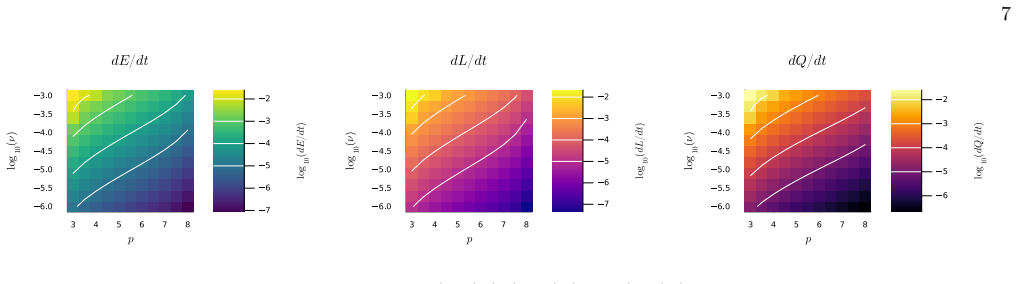
For a given set of orbital parameters (p, e, θ inc), mass-ratioνand the Kerr parameteraat an in- stant, compute the fundamental frequencies Ω r,θ,ϕ and the Fourier representations ofr(w r) andθ(w θ) using the analytical framework of Sec. II. 7 FIG. 1. Relative differences in the orbit-averaged fluxes⟨dE/dt⟩,⟨dL z/dt⟩, and⟨dQ/dt⟩between the EOB–Teukolsky c...
-
[6]
Use the EOB orbital functions to construct the mode decomposition of the source termT lmkn(r) via integrals overw r andw θ [31]
-
[7]
For each mode (l, m, k, n), (a) Compute the mode frequencyω mkn via Eq. (35). (b) Use the JH method to efficiently compute the homogeneous solutionsR ∞ lmkn(r) and RH lmkn(r) and their WronskianW lmkn. (c) Perform the integrals in Eqs. (30a) and (30b) to obtain the amplitudesZ ∞,H lmkn
-
[8]
(38) and com- pute the flux sums in Eqs
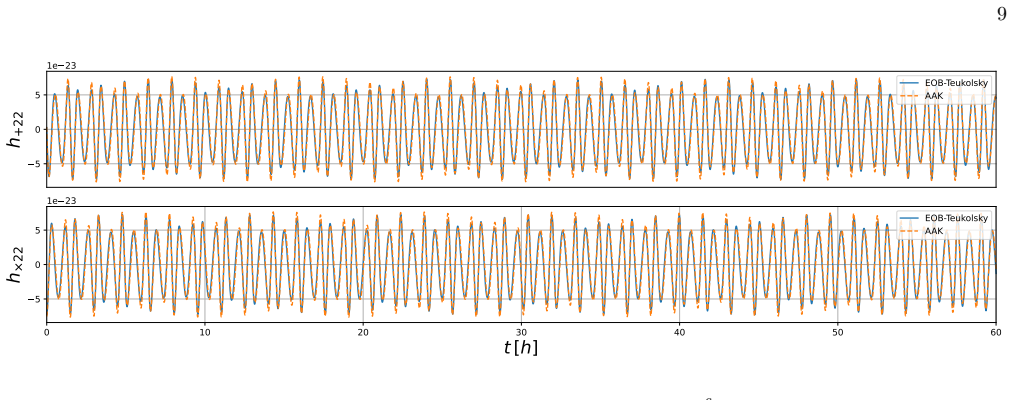
Construct the waveform using Eq. (38) and com- pute the flux sums in Eqs. (39a–39f ). The in- finite sums are truncated adaptively: thel-sum terminates when the currentl-mode contribution drops belowε flux times the maximum contribu- tion across alll-modes; thek-sum terminates af- terB= 2 consecutive harmonic contributions fall belowε flux times the peak ...
-
[9]
Return to step 1 with the new parameters, iterating to produce the full inspiral and its accom- panying waveform
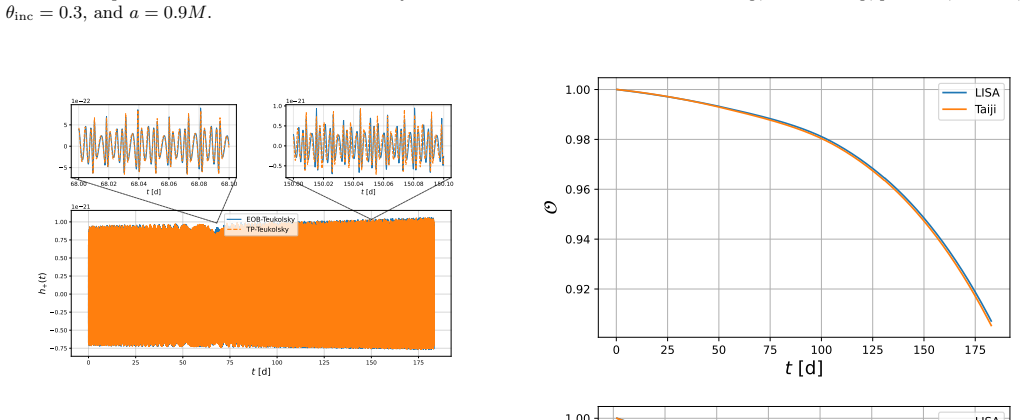
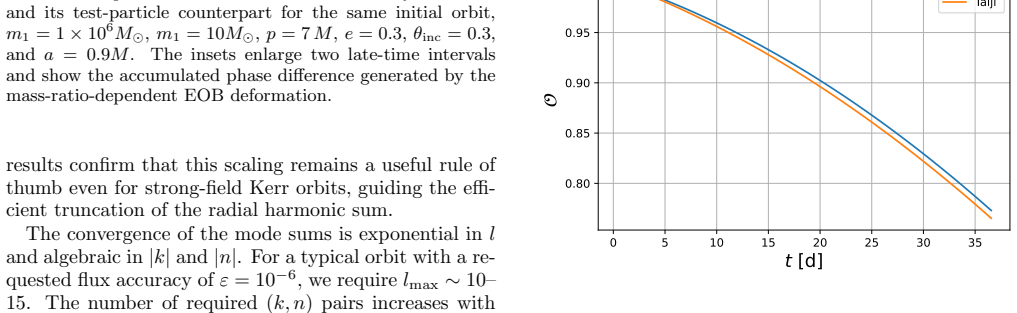
Use the fluxes to evolve the orbital parameters (p, e, θinc) over a time step ∆tusing flux-balance laws. Return to step 1 with the new parameters, iterating to produce the full inspiral and its accom- panying waveform. The integration of the analytic EOB orbital input with the highly efficient JH solver for the perturbation equa- tions creates a powerful ...
-
[10]
Compute the orbital constants (E, L z, Q) and the fundamental Mino-time frequencies (Υr,Υ θ,Γ,Υ ϕ) using the analytic formulas in Sec. II C. Con- struct the Fourier representations ofr(w r),θ(w θ), ∆t(wr, wθ), and ∆ϕ(w r, wθ)
-
[11]
(30a) and (30b)
For a specific (l, m, k, n) mode, evaluate the source integrals forZ ∞ lmkn andZ H lmkn as defined in Eqs. (30a) and (30b). The integrand requires the EOB orbital functions and their derivatives. The double integral over the angle variablesw r and wθ is performed using a tensor-product Clenshaw- Curtis quadrature rule, with a variable transforma- tionψ→ζt...
-
[12]
We employ the highly accurate and efficient JH method to solve the homogeneous equation, which is then transformed to the Teukolsky solutions
Compute the homogeneous radial solutions R∞ lmkn(r) andR H lmkn(r) and their Wronskian Wlmkn for the frequencyω mkn. We employ the highly accurate and efficient JH method to solve the homogeneous equation, which is then transformed to the Teukolsky solutions. 8
-
[13]
The infinite sums are truncated adaptively
Sum the contributions of all (l, m, k, n) modes to construct the waveform (38) or fluxes. The infinite sums are truncated adaptively. The sum overlis terminated when the contribution of anl-mode,F l, satisfies|F l|< ε·max l′ |Fl′|, whereεis the target fractional accuracy (we useε= 10 −6). The sums overkandnare truncated using a buffer rule: we stop whenBc...
-
[14]
The number of required (k, n) pairs increases with eccentricity and inclination; an orbit withe= 0.7 may require radial indices up to|n| ≃50 and polar indices up to|k| ≃10. The use of the analytic JH solver for the homogeneous solutions reduces the computation time per (l, m, k, n) mode by approximately an order of mag- nitude compared with direct integra...
2004
-
[15]
T. L. S. Collaboration, J. Aasi, B. P. Abbott, R. Ab- bott, T. Abbott, M. R. Abernathy, K. Ackley, C. Adams, T. Adams, and e. a. P Addesso, Classical and Quantum Gravity32, 074001 (2015)
2015
-
[16]
Acernese, M
F. Acernese, M. Agathos, and K. A. et al., Classical and Quantum Gravity32, 024001 (2014)
2014
-
[17]
Akutsuet al., Progress of Theoretical and Experimen- tal Physics2021, 05A101 (2021)
T. Akutsuet al., Progress of Theoretical and Experimen- tal Physics2021, 05A101 (2021)
2021
-
[18]
et al., arXiv e-prints , arXiv:2508.18082 (2025),
The LIGO Scientific Collaboration, the Virgo Collabo- ration, the KAGRA Collaboration, and A. et al., arXiv e-prints , arXiv:2508.18082 (2025),
Pith/arXiv arXiv 2025
-
[19]
A. et al. (LIGO Scientific, Virgo, and KAGRA Collabo- rations), Phys. Rev. Lett.135, 111403 (2025)
2025
-
[20]
Hu and Y.-L
W.-R. Hu and Y.-L. Wu, National Science Review (2017)
2017
-
[21]
Luo, L.-S
J. Luo, L.-S. Chen, H.-Z. Duan, Y.-G. Gong, S. Hu, J. Ji, Q. Liu, J. Mei, V. Milyukov, M. Sazhin, C.-G. Shao, V. T. Toth, H.-B. Tu, Y. Wang, Y. Wang, H.-C. Yeh, M.-S. Zhan, Y. Zhang, V. Zharov, and Z.-B. Zhou, Classical and Quantum Gravity33, 035010 (2016),
2016
-
[22]
Amaro-Seoane, J
P. Amaro-Seoane, J. R. Gair, M. Freitag, M. C. Miller, I. Mandel, C. J. Cutler, and S. Babak, Classical and Quantum Gravity24, R113 (2007)
2007
-
[23]
Babak, J
S. Babak, J. Gair, A. Sesana, E. Barausse, C. F. Sop- uerta, C. P. L. Berry, E. Berti, P. Amaro-Seoane, A. Pe- titeau, and A. Klein, Phys. Rev. D95, 103012 (2017),
2017
-
[24]
Barausse, L
E. Barausse, L. Rezzolla, D. Petroff, and M. Ansorg, Phys. Rev. D75, 064026 (2007)
2007
-
[25]
Barausse and L
E. Barausse and L. Rezzolla, Phys. Rev. D77, 104027 (2008)
2008
-
[26]
C. L. MacLeod and C. J. Hogan, Phys. Rev. D77, 043512 (2008)
2008
-
[27]
J. R. Gair, C. Tang, and M. Volonteri, Phys. Rev. D81, 104014 (2010)
2010
-
[28]
Laghi, N
D. Laghi, N. Tamanini, W. Del Pozzo, A. Sesana, J. Gair, S. Babak, and D. Izquierdo-Villalba, Mon. Not. Roy. As- tron. Soc.508, 4512 (2021),
2021
-
[29]
Hinderer and E
T. Hinderer and E. E. Flanagan, Phys. Rev. D78, 064028 (2008)
2008
-
[30]
Burke, G
O. Burke, G. A. Piovano, N. Warburton, P. Lynch, L. Speri, C. Kavanagh, B. Wardell, A. Pound, L. Durkan, and J. Miller, Phys. Rev. D109, 124048 (2024),
2024
-
[31]
van de Meent, Phys
M. van de Meent, Phys. Rev. D97, 104033 (2018)
2018
-
[32]
Wardell, A
B. Wardell, A. Pound, N. Warburton, J. Miller, L. Durkan, and A. Le Tiec, Phys. Rev. Lett.130, 241402 (2023)
2023
-
[33]
Buonanno and T
A. Buonanno and T. Damour, Phys. Rev. D59, 084006 (1999),
1999
-
[34]
Pompili, A
L. Pompili, A. Buonanno, H. Estell´ es, M. Khalil, M. van de Meent, D. P. Mihaylov, S. Ossokine, M. P¨ urrer, A. Ramos-Buades, A. K. Mehta, R. Cotesta, S. Marsat, M. Boyle, L. E. Kidder, H. P. Pfeiffer, M. A. Scheel, H. R. R¨ uter, N. Vu, R. Dudi, S. Ma, K. Mitman, D. Melchor, S. Thomas, and J. Sanchez, Phys. Rev. D108, 124035 (2023),
2023
-
[35]
van de Meent, A
M. van de Meent, A. Buonanno, D. P. Mihaylov, S. Os- sokine, L. Pompili, N. Warburton, A. Pound, B. Wardell, L. Durkan, and J. Miller, Phys. Rev. D108, 124038 (2023),
2023
-
[36]
Zhang and W.-B
C. Zhang and W.-B. Han, Phys. Rev. D112, 104012 (2025)
2025
-
[37]
Buonanno and T
A. Buonanno and T. Damour, Phys. Rev. D62, 064015 (2000)
2000
-
[38]
Damour, P
T. Damour, P. Jaranowski, and G. Sch¨ afer, Phys. Rev. D62, 084011 (2000)
2000
-
[39]
Barausse and A
E. Barausse and A. Buonanno, Phys. Rev. D81, 084024 (2010)
2010
-
[40]
Zhang, W.-B
C. Zhang, W.-B. Han, X.-Y. Zhong, and G. Wang, Phys. Rev. D104, 024050 (2021)
2021
-
[41]
S. Mano, H. Suzuki, and E. Takasugi, Prog. Theor. Phys. 95, 1079 (1996)
1996
-
[42]
S. A. Hughes, Phys. Rev. D61, 084004 (2000)
2000
-
[43]
Jiang and W.-B
Y. Jiang and W.-B. Han, Phys. Rev. D113, 024001 (2026)
2026
-
[44]
Drasco and S
S. Drasco and S. A. Hughes, Phys. Rev. D73, 024027 (2006). 12
2006
-
[45]
Glampedakis and D
K. Glampedakis and D. Kennefick, Phys. Rev. D66, 044002 (2002)
2002
-
[46]
Fujita, W
R. Fujita, W. Hikida, and H. Tagoshi, Progress of Theo- retical Physics121, 843 (2009),
2009
-
[47]
Pound, E
A. Pound, E. Poisson, and B. G. Nickel, Phys. Rev. D 72, 124001 (2005)
2005
discussion (0)
Sign in with ORCID, Apple, or X to comment. Anyone can read and Pith papers without signing in.