Massive scalar fields in eccentric regime: Detectability and constraints from LISA observations of extreme mass-ratio inspirals
Pith reviewed 2026-06-29 01:49 UTC · model grok-4.3
The pith
Eccentric EMRIs can constrain the mass and charge of a scalar field via LISA observations.
A machine-rendered reading of the paper's core claim, the machinery that carries it, and where it could break.
Core claim
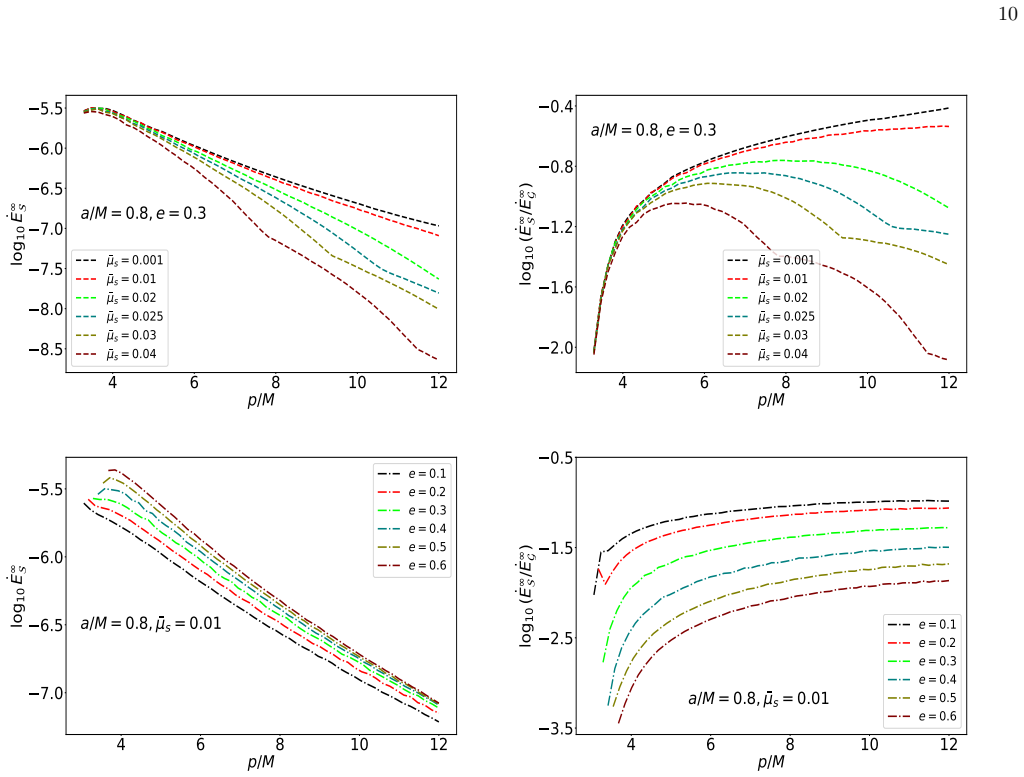
Massive scalar radiation generates significant gravitational-wave dephasing in eccentric EMRIs; the dephasing increases with orbital eccentricity but is suppressed by larger scalar-field mass. Within the adiabatic treatment, the frequency-domain fluxes can be interpolated efficiently, and a Fisher information matrix analysis demonstrates that LISA observations of such systems can place meaningful constraints on both the scalar charge and the scalar mass.
What carries the argument
Adiabatic relativistic fluxes computed from the frequency-domain solution of the scalar perturbation equation around Kerr, interpolated with Chebyshev polynomials to evolve eccentric orbits.
If this is right
- Larger eccentricity amplifies the gravitational-wave dephasing produced by massive scalar radiation.
- Higher scalar-field mass reduces the scalar flux and therefore weakens the observable dephasing.
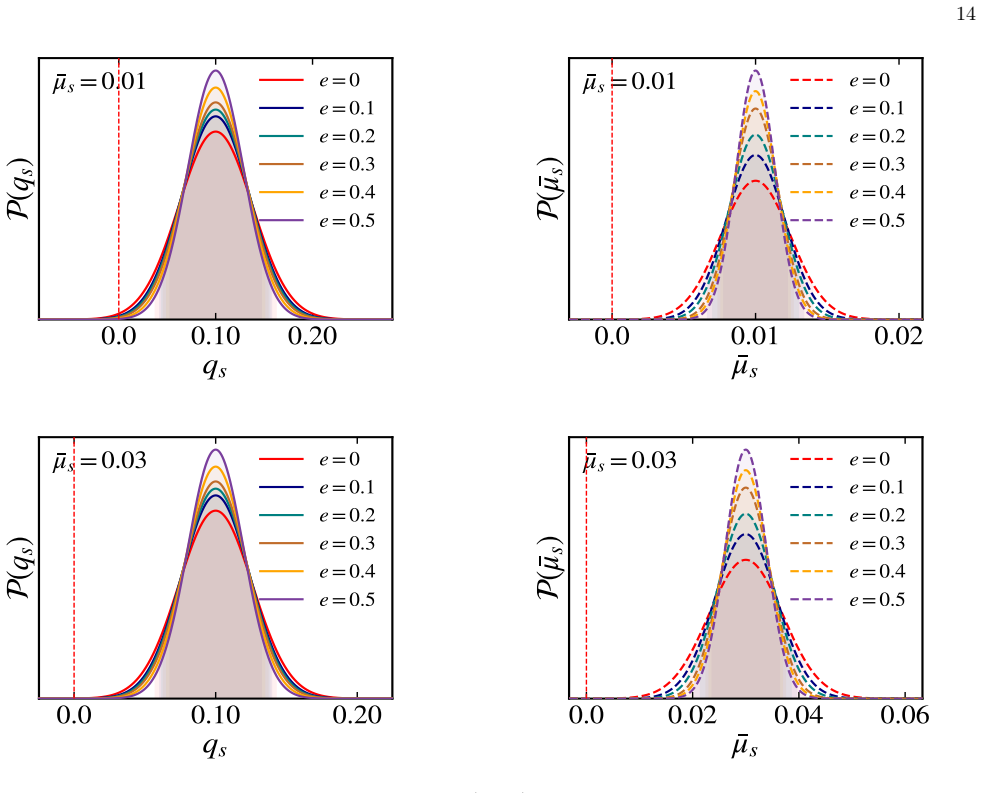
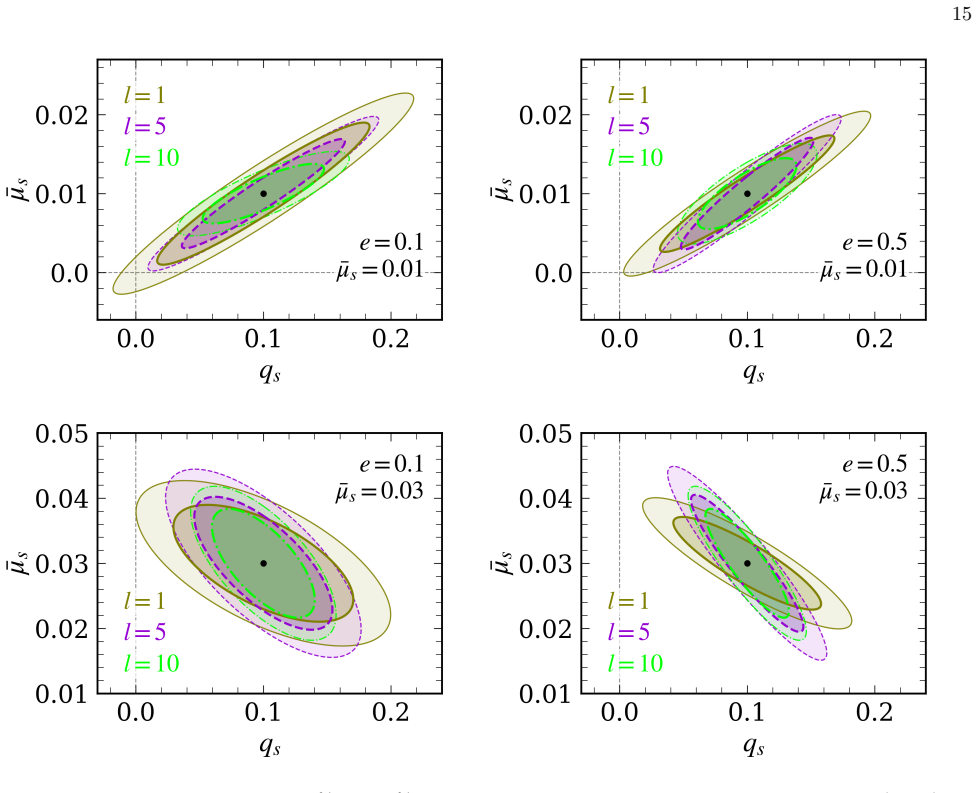
- LISA Fisher-matrix forecasts indicate that both scalar charge and scalar mass can be measured or bounded from eccentric EMRIs.
- These constraints test scalar-tensor extensions of gravity in the strong-field regime near black holes.
Where Pith is reading between the lines
- The same flux-interpolation technique could be reused for other massive fields once their perturbation equations are solved in the frequency domain.
- If the adiabatic assumption fails at high eccentricity, the reported dephasing bounds would need recalibration with self-consistent orbital evolution.
- Multi-band observations combining LISA with ground-based detectors could tighten the scalar-mass limits by capturing different portions of the same inspiral.
Load-bearing premise
The adiabatic treatment of the inspiral remains valid when a massive scalar field is present.
What would settle it
A side-by-side comparison of the adiabatic phase evolution against a non-adiabatic waveform for one specific eccentric EMRI with nonzero scalar charge would show whether the predicted dephasing matches the full evolution.
Figures





read the original abstract
Extreme mass-ratio inspirals (EMRIs) are among the prime sources for future space-borne gravitational wave (GW) observatories and provide a useful setting for testing the presence of fundamental fields and possible deviations from general relativity (GR) in both strong and weak gravity regimes. In this work, we study the effect of a massive scalar field on eccentric equatorial EMRI dynamics around Kerr black holes. Considering that the inspiralling stellar-mass object carries a scalar charge and emits scalar radiation together with tensor GWs, we compute the relevant relativistic fluxes within the adiabatic treatment of the inspiral. With the solution of the scalar perturbation equation in the frequency domain, the resulting fluxes are presented through the Chebyshev interpolants in order to have the efficient inspiral evolution across the parameter space considered. We quantify the impact of scalar field mass and scalar charge on the orbital evolution and GW signal through phase shifts and waveform mismatches relative to both GR and the massless-scalar scenario. We find that massive scalar radiation can generate significant GW dephasing that increases with orbital eccentricity; however, the scalar flux is suppressed as the scalar field mass is becoming larger. Using a Fisher information matrix (FIM) analysis, we estimate the ability of Laser Interferometer Space Antenna (LISA) to measure or constrain the scalar charge and scalar field mass. Our results indicate that eccentric EMRIs can place meaningful constraints on massive scalar fields and provide a promising as well as important avenue for testing scalar-tensor extensions of gravity in the region of a strong gravitational field.
Editorial analysis
A structured set of objections, weighed in public.
Referee Report
Summary. The paper claims that eccentric equatorial EMRIs around Kerr black holes, with the secondary carrying a scalar charge, produce scalar and tensor fluxes that can be computed in the frequency domain under the adiabatic approximation; these fluxes are interpolated via Chebyshev polynomials to evolve the orbit, yielding measurable GW dephasing that grows with eccentricity but is suppressed for larger scalar mass m_s; a Fisher-matrix analysis then shows that LISA can place meaningful constraints on both the scalar charge and m_s.
Significance. If the adiabatic treatment is valid, the work supplies a concrete, falsifiable route to bounding massive scalar fields with LISA EMRIs in the strong-field regime, extending existing massless-scalar studies to the eccentric case and highlighting the diagnostic power of eccentricity-dependent dephasing.
major comments (1)
- [Abstract; flux computation section] Abstract and the section describing the flux computation: the central claim that eccentric EMRIs yield meaningful LISA constraints rests on the adiabatic orbital evolution driven by the computed scalar and tensor fluxes. For m_s > 0 the massive Klein-Gordon equation admits quasi-bound states whose back-reaction can shorten the radiation-reaction timescale; the manuscript provides no explicit verification that t_rr ≫ T_orb holds across the explored (e, m_s, scalar charge) domain once these states are present. Without that check the interpolated fluxes, phase-shift integrals, and Fisher-matrix forecasts do not map to observable waveforms.
minor comments (2)
- [Numerical methods] The description of the Chebyshev interpolants should include explicit convergence tests (e.g., residual norms versus polynomial degree) and the range of (p,e) over which the interpolants remain accurate to better than the waveform mismatch threshold used later.
- [Throughout] Notation for the scalar field mass (m_s versus μ) and the scalar charge should be unified between the abstract, the perturbation equation, and the Fisher-matrix parameter vector.
Simulated Author's Rebuttal
We thank the referee for their careful reading of the manuscript and for highlighting an important point regarding the adiabatic approximation. We address the major comment below and are prepared to revise the paper accordingly.
read point-by-point responses
-
Referee: [Abstract; flux computation section] Abstract and the section describing the flux computation: the central claim that eccentric EMRIs yield meaningful LISA constraints rests on the adiabatic orbital evolution driven by the computed scalar and tensor fluxes. For m_s > 0 the massive Klein-Gordon equation admits quasi-bound states whose back-reaction can shorten the radiation-reaction timescale; the manuscript provides no explicit verification that t_rr ≫ T_orb holds across the explored (e, m_s, scalar charge) domain once these states are present. Without that check the interpolated fluxes, phase-shift integrals, and Fisher-matrix forecasts do not map to observable waveforms.
Authors: We acknowledge that the manuscript does not contain an explicit verification that t_rr ≫ T_orb remains valid when quasi-bound states of the massive scalar field are present. The fluxes are computed from the frequency-domain solution of the sourced Klein-Gordon equation under the assumption that the orbital evolution is driven by the radiated fluxes, and the adiabatic condition is taken to hold for the small scalar charges considered. In the explored range the scalar flux is suppressed for larger m_s, which indirectly limits the amplitude of any bound-state contribution, but this is not quantified. To address the referee’s concern we will add, in the revised flux-computation section, a brief estimate of the back-reaction timescale associated with possible quasi-bound states (comparing the energy stored in such states to the orbital energy-loss rate) and confirm that the adiabatic hierarchy holds for the (e, m_s, q) values used in the subsequent dephasing and Fisher analyses. revision: yes
Circularity Check
No circularity: fluxes computed from perturbation equation, not reduced to inputs
full rationale
The derivation solves the scalar perturbation equation in the frequency domain to obtain relativistic fluxes, interpolates them via Chebyshev polynomials for orbital evolution under the adiabatic approximation, then computes dephasing and applies standard FIM analysis. None of these steps are self-definitional, fitted inputs renamed as predictions, or dependent on self-citations. The adiabatic treatment is stated as an assumption without internal reduction to the target observables. The chain remains independent of its outputs.
Axiom & Free-Parameter Ledger
free parameters (2)
- scalar charge
- scalar field mass
axioms (2)
- domain assumption Adiabatic approximation holds for the inspiral evolution
- domain assumption Equatorial eccentric orbits around Kerr black holes
Reference graph
Works this paper leans on
-
[1]
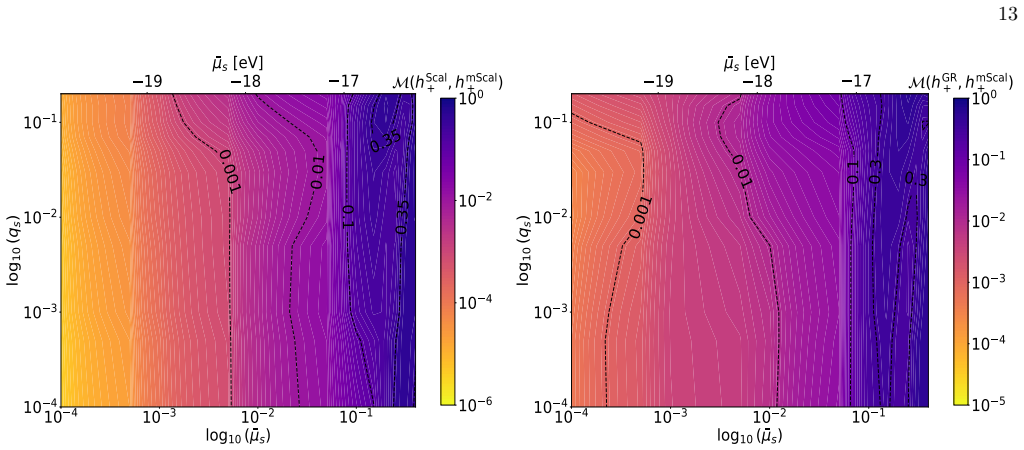
The distinguishability between two wave- forms from different EMRI systems can then be esti- mated using the standard rule-of-thumb criterionM≳ 1/(2ρ2)[104, 105]
[11, 103]. The distinguishability between two wave- forms from different EMRI systems can then be esti- mated using the standard rule-of-thumb criterionM≳ 1/(2ρ2)[104, 105]. Therefore, in the following discussion, we assume a threshold mismatch ofMc∼0.001. Finally, we perform the FIM analysis to estimate the EMRI parameters and to forecast the constraints...
-
[2]
int” denotes the interpolated fluxes. The column labelled of “Relative difference
The relative difference was found to be smaller than 10−10%over the integration domain2.4M≤r≤15M and10 −5≤¯µs ≤0.4. We adopt the same truncation order for the low-eccentricity cases. For larger eccen- tricities, we increaseN max when necessary and require the relative change between two consecutive truncation orders,N max andN max + 1, to be smaller than1...
Pith/arXiv arXiv 2016
-
[3]
Testing General Relativity with Low-Frequency, Space-Based Gravitational-Wave Detectors,
J. R. Gair, M. Vallisneri, S. L. Larson, and J. G. Baker, “Testing General Relativity with Low-Frequency, Space-Based Gravitational-Wave Detectors,”Living Rev. Rel.16(2013) 7,arXiv:1212.5575 [gr-qc]
Pith/arXiv arXiv 2013
-
[4]
Testing General Relativity with Present and Future Astrophysical Observations,
E. Bertiet al., “Testing General Relativity with Present and Future Astrophysical Observations,” Class. Quant. Grav.32(2015) 243001, arXiv:1501.07274 [gr-qc]
Pith/arXiv arXiv 2015
-
[5]
Research Update on Extreme-Mass-Ratio Inspirals,
P. Amaro-Seoane, J. R. Gair, A. Pound, S. A. Hughes, and C. F. Sopuerta, “Research Update on Extreme-Mass-Ratio Inspirals,”J. Phys. Conf. Ser. 610no. 1, (2015) 012002,arXiv:1410.0958 [astro-ph.CO]
Pith/arXiv arXiv 2015
-
[6]
A. Cárdenas-Avendaño and C. F. Sopuerta,Testing Gravity with Extreme-Mass-Ratio Inspirals. 2024. arXiv:2401.08085 [gr-qc]
arXiv 2024
-
[7]
Testing the nature of dark compact objects: a status report,
V. Cardoso and P. Pani, “Testing the nature of dark compact objects: a status report,”Living Rev. Rel.22 no. 1, (2019) 4,arXiv:1904.05363 [gr-qc]. [10]LISA Consortium Waveform Working Group Collaboration, N. Afshordiet al., “Waveform modelling for the Laser Interferometer Space Antenna,”Living Rev. Rel.28no. 1, (2025) 9, arXiv:2311.01300 [gr-qc]
Pith/arXiv arXiv 2019
-
[8]
Science with the space-based interferometer LISA. V: Extreme mass-ratio inspirals,
S. Babak, J. Gair, A. Sesana, E. Barausse, C. F. Sopuerta, C. P. L. Berry, E. Berti, P. Amaro-Seoane, A. Petiteau, and A. Klein, “Science with the space-based interferometer LISA. V: Extreme mass-ratio inspirals,”Phys. Rev. D95no. 10, (2017) 103012,arXiv:1703.09722 [gr-qc]
Pith/arXiv arXiv 2017
-
[9]
Laser Interferometer Space Antenna,
P. Amaro-Seoane, H. Audley, S. Babak, J. Baker, E. Barausse, P. Bender, E. Berti, P. Binetruy, M. Born, D. Bortoluzzi, J. Camp, C. Caprini, V. Cardoso, M. Colpi, J. Conklin, N. Cornish, C. Cutler, K. Danzmann, R. Dolesi, L. Ferraioli, V. Ferroni, E. Fitzsimons, J. Gair, L. Gesa Bote, D. Giardini, F. Gibert, C. Grimani, H. Halloin, G. Heinzel, T. Hertog, M...
Pith/arXiv arXiv 2017
-
[10]
TianQin: a space-borne gravitational wave detector,
S. Barsanti,Testing general relativity with gravitational waves from extreme mass-ratio inspirals. PhD thesis, Università degli Studi di Roma ”La Sapienza”, Italy, Rome U., 1, 2024. [16]TianQinCollaboration, J. Luoet al., “TianQin: a space-borne gravitational wave detector,”Class. Quant. Grav.33no. 3, (2016) 035010, arXiv:1512.02076 [astro-ph.IM]. [17]Tia...
Pith/arXiv arXiv 2024
-
[11]
Taiji program: Gravitational-wave sources,
W.-H. Ruan, Z.-K. Guo, R.-G. Cai, and Y.-Z. Zhang, “Taiji program: Gravitational-wave sources,”Int. J. Mod. Phys. A35no. 17, (2020) 2050075, arXiv:1807.09495 [gr-qc]
arXiv 2020
-
[12]
N. Seto, S. Kawamura, and T. Nakamura, “Possibility of direct measurement of the acceleration of the universe using 0.1-Hz band laser interferometer gravitational wave antenna in space,”Phys. Rev. Lett. 87(2001) 221103,arXiv:astro-ph/0108011
Pith/arXiv arXiv 2001
-
[13]
Current status of space gravitational wave antenna DECIGO and B-DECIGO,
S. Kawamuraet al., “Current status of space gravitational wave antenna DECIGO and B-DECIGO,”PTEP2021no. 5, (2021) 05A105, arXiv:2006.13545 [gr-qc]
Pith/arXiv arXiv 2021
-
[14]
Constructing EOB dynamics with numerical energy flux for intermediate-mass-ratio inspirals,
W.-B. Han and Z. Cao, “Constructing EOB dynamics with numerical energy flux for intermediate-mass-ratio inspirals,”Phys. Rev. D84(2011) 044014, 22 arXiv:1108.0995 [gr-qc]
Pith/arXiv arXiv 2011
-
[15]
W.-B. Han, “Fast evolution and waveform generator for extreme-mass-ratio inspirals in equatorial-circular orbits,”Class. Quant. Grav.33no. 6, (2016) 065009, arXiv:1609.06817 [gr-qc]
Pith/arXiv arXiv 2016
-
[16]
Testing general relativity using binary extreme-mass-ratio inspirals,
W.-B. Han and X. Chen, “Testing general relativity using binary extreme-mass-ratio inspirals,”Mon. Not. Roy. Astron. Soc.485no. 1, (2019) L29–L33, arXiv:1801.07060 [gr-qc]
Pith/arXiv arXiv 2019
-
[17]
Influence of mass-ratio corrections in extreme-mass-ratio inspirals for testing general relativity,
P. Shen, W.-B. Han, C. Zhang, S.-C. Yang, X.-Y. Zhong, Y. Jiang, and Q. Cui, “Influence of mass-ratio corrections in extreme-mass-ratio inspirals for testing general relativity,”Phys. Rev. D108no. 6, (2023) 064015,arXiv:2303.13749 [gr-qc]
arXiv 2023
-
[18]
T.-G. Zi, J.-D. Zhang, H.-M. Fan, X.-T. Zhang, Y.-M. Hu, C. Shi, and J. Mei, “Science with the TianQin Observatory: Preliminary results on testing the no-hair theorem with extreme mass ratio inspirals,” Phys. Rev. D104no. 6, (2021) 064008, arXiv:2104.06047 [gr-qc]
arXiv 2021
-
[19]
P. Shen, Q. Cui, and W.-B. Han, “Assessing the systematic errors of extreme-mass-ratio inspirals waveforms for testing general relativity,”Phys. Rev. D 111no. 2, (2025) 024004,arXiv:2501.07264 [gr-qc]
arXiv 2025
-
[20]
Gravitational waves from extreme-mass-ratio inspirals around a hairy Kerr black hole,
T. Zi and P.-C. Li, “Gravitational waves from extreme-mass-ratio inspirals around a hairy Kerr black hole,”Phys. Rev. D108no. 8, (2023) 084001, arXiv:2306.02683 [gr-qc]
arXiv 2023
-
[21]
A self-consistent EOB–Teukolsky framework for generic extreme mass-ratio inspirals,
X. Zhong, W.-B. Han, Y. Jiang, C. Zhang, and X. Zou, “A self-consistent EOB–Teukolsky framework for generic extreme mass-ratio inspirals,” arXiv:2606.09445 [gr-qc]
-
[22]
Measuring scalar charge with compact binaries: High accuracy modeling with self-force,
A. Spiers, A. Maselli, and T. P. Sotiriou, “Measuring scalar charge with compact binaries: High accuracy modeling with self-force,”Phys. Rev. D109no. 6, (2024) 064022,arXiv:2310.02315 [gr-qc]
arXiv 2024
-
[23]
Dark matter distributions around massive black holes: A general relativistic analysis,
L. Sadeghian, F. Ferrer, and C. M. Will, “Dark matter distributions around massive black holes: A general relativistic analysis,”Phys. Rev. D88no. 6, (2013) 063522,arXiv:1305.2619 [astro-ph.GA]
Pith/arXiv arXiv 2013
-
[24]
Probing beyond-vacuum general relativistic effects with extreme mass-ratio inspirals,
T. Zi, M. Rahman, and S. Kumar, “Probing beyond-vacuum general relativistic effects with extreme mass-ratio inspirals,”arXiv:2601.03374 [gr-qc]
-
[25]
Extreme mass ratio inspirals in dark matter halos: Dynamics and distinguishability of halo models,
S. Gliorio, E. Berti, A. Maselli, and N. Speeney, “Extreme mass ratio inspirals in dark matter halos: Dynamics and distinguishability of halo models,” Phys. Rev. D112no. 12, (2025) 124050, arXiv:2503.16649 [gr-qc]
arXiv 2025
-
[26]
Exploring waveforms with non-GR deviations for extreme mass-ratio inspirals,
S. Kumar, R. K. Singh, A. Chowdhuri, and A. Bhattacharyya, “Exploring waveforms with non-GR deviations for extreme mass-ratio inspirals,”JCAP10 (2024) 047,arXiv:2405.18508 [gr-qc]
arXiv 2024
-
[27]
Extreme mass-ratio inspirals and extra dimensions: Insights from modified Teukolsky framework,
S. Kumar, T. Zi, and A. Bhattacharyya, “Extreme mass-ratio inspirals and extra dimensions: Insights from modified Teukolsky framework,” arXiv:2507.03380 [gr-qc]
-
[28]
Imprints of extra dimensions in eccentric EMRI gravitational waveforms,
S. Kumar, T. Zi, and A. Bhattacharyya, “Imprints of extra dimensions in eccentric EMRI gravitational waveforms,”arXiv:2504.09460 [gr-qc]
-
[29]
Extreme mass-ratio inspiral within an ultralight scalar cloud: Scalar radiation,
D. Li, C. Weller, P. Bourg, M. LaHaye, N. Yunes, and H. Yang, “Extreme mass-ratio inspiral within an ultralight scalar cloud: Scalar radiation,”Phys. Rev. D 112no. 8, (2025) 084057,arXiv:2507.02045 [gr-qc]
arXiv 2025
-
[30]
Gravitational waves from regular black holes in extreme mass-ratio inspirals,
S. Kumar and T. Zi, “Gravitational waves from regular black holes in extreme mass-ratio inspirals,” arXiv:2412.11847 [gr-qc]
-
[31]
Extreme-mass-ratio inspirals in relativistic accretion discs,
F. Duque, L. Sberna, A. Spiers, and R. Vicente, “Extreme-mass-ratio inspirals in relativistic accretion discs,”arXiv:2510.02433 [gr-qc]
-
[32]
Probing astrophysical environment with eccentric extreme mass-ratio inspirals,
M. Rahman, S. Kumar, and A. Bhattacharyya, “Probing astrophysical environment with eccentric extreme mass-ratio inspirals,”JCAP01(2024) 035, arXiv:2306.14971 [gr-qc]
arXiv 2024
-
[33]
T. Zi, P.-C. Li, B.-M. Gu, and F.-W. Shu, “Constraint on massive vector field with extreme-mass-ratio inspirals around a slowly rotating black hole,” arXiv:2511.18435 [gr-qc]
-
[34]
Black holes surrounded by generic matter distributions: Polar perturbations and energy flux,
N. Speeney, E. Berti, V. Cardoso, and A. Maselli, “Black holes surrounded by generic matter distributions: Polar perturbations and energy flux,” Phys. Rev. D109no. 8, (2024) 084068, arXiv:2401.00932 [gr-qc]
arXiv 2024
-
[35]
Probing Accretion Physics with Gravitational Waves,
L. Speri, A. Antonelli, L. Sberna, S. Babak, E. Barausse, J. R. Gair, and M. L. Katz, “Probing Accretion Physics with Gravitational Waves,”Phys. Rev. X13no. 2, (2023) 021035,arXiv:2207.10086 [gr-qc]
arXiv 2023
-
[36]
Extreme-Mass-Ratio Inspirals in Ultralight Dark Matter,
F. Duque, C. F. B. Macedo, R. Vicente, and V. Cardoso, “Extreme-Mass-Ratio Inspirals in Ultralight Dark Matter,”Phys. Rev. Lett.133no. 12, (2024) 121404,arXiv:2312.06767 [gr-qc]
arXiv 2024
-
[37]
Gravitational Waves from Extreme-Mass-Ratio Systems in Astrophysical Environments,
V. Cardoso, K. Destounis, F. Duque, R. Panosso Macedo, and A. Maselli, “Gravitational Waves from Extreme-Mass-Ratio Systems in Astrophysical Environments,”Phys. Rev. Lett.129 no. 24, (2022) 241103,arXiv:2210.01133 [gr-qc]
arXiv 2022
-
[38]
Extreme mass-ratio inspiral around the horizonless massive object,
T. Zi, L. Ren, and J. Cheng, “Extreme mass-ratio inspiral around the horizonless massive object,”Eur. Phys. J. C84no. 8, (2024) 828
2024
-
[39]
Black holes surrounded by generic dark matter profiles: Appearance and gravitational-wave emission,
E. Figueiredo, A. Maselli, and V. Cardoso, “Black holes surrounded by generic dark matter profiles: Appearance and gravitational-wave emission,”Phys. Rev. D107no. 10, (2023) 104033,arXiv:2303.08183 [gr-qc]
arXiv 2023
-
[40]
Post-adiabatic waveforms from extreme mass ratio inspirals in the presence of dark matter,
M. Rahman and T. Takahashi, “Post-adiabatic waveforms from extreme mass ratio inspirals in the presence of dark matter,”arXiv:2507.06923 [gr-qc]
-
[41]
Constraining accretion physics with gravitational waves from eccentric extreme-mass-ratio inspirals,
F. Duque, S. Kejriwal, L. Sberna, L. Speri, and J. Gair, “Constraining accretion physics with gravitational waves from eccentric extreme-mass-ratio inspirals,”Phys. Rev. D111no. 8, (2025) 084006, arXiv:2411.03436 [gr-qc]
arXiv 2025
-
[42]
Probing deviations to Kerr geometry with extreme mass-ratio inspirals,
S. Kumar, “Probing deviations to Kerr geometry with extreme mass-ratio inspirals,” in17th Marcel Grossmann Meeting: On Recent Developments in Theoretical and Experimental General Relativity, Gravitation, and Relativistic Field Theories. 10, 2024. arXiv:2410.08544 [gr-qc]
arXiv 2024
-
[43]
First post-Newtonian generation of gravitational waves in Einstein-Cartan theory,
E. Battista and V. De Falco, “First post-Newtonian generation of gravitational waves in Einstein-Cartan theory,”Phys. Rev. D104no. 8, (2021) 084067, arXiv:2109.01384 [gr-qc]
arXiv 2021
-
[44]
E. Battista and V. De Falco, “Gravitational waves at the first post-Newtonian order with the Weyssenhoff fluid in Einstein–Cartan theory,”Eur. Phys. J. C82 no. 7, (2022) 628,arXiv:2206.12907 [gr-qc]
arXiv 2022
-
[45]
Black hole hair in 23 generalized scalar-tensor gravity,
T. P. Sotiriou and S.-Y. Zhou, “Black hole hair in 23 generalized scalar-tensor gravity,”Phys. Rev. Lett. 112(2014) 251102,arXiv:1312.3622 [gr-qc]
Pith/arXiv arXiv 2014
-
[46]
Post-Newtonian dynamics and black hole thermodynamics in Einstein-scalar-Gauss-Bonnet gravity,
F.-L. Julié and E. Berti, “Post-Newtonian dynamics and black hole thermodynamics in Einstein-scalar-Gauss-Bonnet gravity,”Phys. Rev. D 100no. 10, (2019) 104061,arXiv:1909.05258 [gr-qc]
arXiv 2019
-
[47]
Detecting scalar fields with Extreme Mass Ratio Inspirals,
A. Maselli, N. Franchini, L. Gualtieri, and T. P. Sotiriou, “Detecting scalar fields with Extreme Mass Ratio Inspirals,”Phys. Rev. Lett.125(2020) 141101, arXiv:2004.11895 [gr-qc]
arXiv 2020
-
[48]
A. Maselli, N. Franchini, L. Gualtieri, T. P. Sotiriou, S. Barsanti, and P. Pani, “Detecting fundamental fields with LISA observations of gravitational waves from extreme mass-ratio inspirals,”Nature Astron.6 no. 4, (2022) 464–470,arXiv:2106.11325 [gr-qc]
arXiv 2022
-
[49]
S. Barsanti, N. Franchini, L. Gualtieri, A. Maselli, and T. P. Sotiriou, “Extreme mass-ratio inspirals as probes of scalar fields: Eccentric equatorial orbits around Kerr black holes,”Phys. Rev. D106no. 4, (2022) 044029,arXiv:2203.05003 [gr-qc]
arXiv 2022
-
[50]
M. Della Rocca, S. Barsanti, L. Gualtieri, and A. Maselli, “Extreme mass-ratio inspirals as probes of scalar fields: Inclined circular orbits around Kerr black holes,”Phys. Rev. D109no. 10, (2024) 104079, arXiv:2401.09542 [gr-qc]
arXiv 2024
-
[51]
Probing scalar field with generic extreme mass-ratio inspirals around Kerr black holes,
T. Zi and S. Kumar, “Probing scalar field with generic extreme mass-ratio inspirals around Kerr black holes,” arXiv:2508.00516 [gr-qc]
-
[52]
L. Speri, S. Barsanti, A. Maselli, T. P. Sotiriou, N. Warburton, M. van de Meent, A. J. K. Chua, O. Burke, and J. Gair, “Probing fundamental physics with Extreme Mass Ratio Inspirals: a full Bayesian inference for scalar charge,”arXiv:2406.07607 [gr-qc]
-
[53]
S. Gliorio, M. Della Rocca, S. Barsanti, L. Gualtieri, A. Maselli, and T. P. Sotiriou, “Adiabatic evolution of asymmetric binaries on generic orbits with new fundamental fields I: characterization of gravitational wave fluxes,”arXiv:2603.10116 [gr-qc]
-
[54]
Gravitational waves from eccentric extreme mass-ratio inspirals as probes of scalar fields,
C. Zhang, Y. Gong, D. Liang, and B. Wang, “Gravitational waves from eccentric extreme mass-ratio inspirals as probes of scalar fields,”JCAP 06(2023) 054,arXiv:2210.11121 [gr-qc]
arXiv 2023
-
[55]
Detection of scalar fields by extreme mass ratio inspirals with a Kerr black hole,
H. Guo, Y. Liu, C. Zhang, Y. Gong, W.-L. Qian, and R.-H. Yue, “Detection of scalar fields by extreme mass ratio inspirals with a Kerr black hole,”Phys. Rev. D 106no. 2, (2022) 024047,arXiv:2201.10748 [gr-qc]
arXiv 2022
-
[57]
Bayesian Search of Massive Scalar Fields from LIGO-Virgo-KAGRA Binaries,
Y. Xie, A. K.-W. Chung, T. P. Sotiriou, and N. Yunes, “Bayesian Search of Massive Scalar Fields from LIGO-Virgo-KAGRA Binaries,”Phys. Rev. Lett.134 no. 19, (2025) 191402,arXiv:2410.14801 [gr-qc]
arXiv 2025
-
[58]
Comparison of 4.5PN and 2SF gravitational energy fluxes from quasicircular compact binaries,
N. Warburton, B. Wardell, D. Trestini, Q. Henry, A. Pound, L. Blanchet, L. Durkan, G. Faye, and J. Miller, “Comparison of 4.5PN and 2SF gravitational energy fluxes from quasicircular compact binaries,” Phys. Rev. D113no. 8, (2026) 084050, arXiv:2407.00366 [gr-qc]
Pith/arXiv arXiv 2026
-
[59]
G. Compère and L. Küchler, “Asymptotically matched quasi-circular inspiral and transition-to-plunge in the small mass ratio expansion,”SciPost Phys.13no. 2, (2022) 043,arXiv:2112.02114 [gr-qc]
arXiv 2022
-
[60]
Constraints on the astrophysical environment of binaries with gravitational-wave observations,
V. Cardoso and A. Maselli, “Constraints on the astrophysical environment of binaries with gravitational-wave observations,”Astron. Astrophys. 644(2020) A147,arXiv:1909.05870 [astro-ph.HE]
arXiv 2020
-
[61]
Black holes in galaxies: Environmental impact on gravitational-wave generation and propagation,
V. Cardoso, K. Destounis, F. Duque, R. P. Macedo, and A. Maselli, “Black holes in galaxies: Environmental impact on gravitational-wave generation and propagation,”Phys. Rev. D105no. 6, (2022) L061501,arXiv:2109.00005 [gr-qc]
arXiv 2022
-
[62]
N. Speeney, A. Antonelli, V. Baibhav, and E. Berti, “Impact of relativistic corrections on the detectability of dark-matter spikes with gravitational waves,”Phys. Rev. D106no. 4, (2022) 044027,arXiv:2204.12508 [gr-qc]
arXiv 2022
-
[63]
Extreme mass ratio inspirals in rotating dark matter spikes,
S. Mitra, N. Speeney, S. Chakraborty, and E. Berti, “Extreme mass ratio inspirals in rotating dark matter spikes,”Phys. Rev. D112no. 4, (2025) 044030, arXiv:2505.04697 [gr-qc]
arXiv 2025
-
[64]
Eccentric extreme mass-ratio inspirals: a gateway to probe quantum gravity effects,
T. Zi and S. Kumar, “Eccentric extreme mass-ratio inspirals: a gateway to probe quantum gravity effects,” Eur. Phys. J. C85no. 5, (2025) 592, arXiv:2409.17765 [gr-qc]
arXiv 2025
-
[65]
Probing Kerr Symmetry Breaking with LISA Extreme-Mass-Ratio Inspirals,
P. F. Muguruza and C. F. Sopuerta, “Probing Kerr Symmetry Breaking with LISA Extreme-Mass-Ratio Inspirals,”arXiv:2604.06053 [gr-qc]
-
[66]
Gravitational waves from extreme mass ratio inspirals in Kerr-MOG spacetimes,
X. Qiao, Z.-W. Xia, Q. Pan, H. Guo, W.-L. Qian, and J. Jing, “Gravitational waves from extreme mass ratio inspirals in Kerr-MOG spacetimes,”JCAP03(2025) 006,arXiv:2408.10022 [gr-qc]
arXiv 2025
-
[67]
Detecting dark matter halos with extreme mass-ratio inspirals,
C. Zhang, G. Fu, and N. Dai, “Detecting dark matter halos with extreme mass-ratio inspirals,”JCAP04 (2024) 088,arXiv:2401.04467 [gr-qc]
arXiv 2024
-
[68]
Detecting massive vector fields with extreme-mass-ratio inspirals,
T. Zi and C. Zhang, “Detecting massive vector fields with extreme-mass-ratio inspirals,”Phys. Rev. D111 no. 10, (2025) 104062,arXiv:2406.11724 [gr-qc]
arXiv 2025
-
[69]
Importance of including higher signal harmonics in the modeling of extreme mass-ratio inspirals,
C. Zhang, N. Dai, and D. Liang, “Importance of including higher signal harmonics in the modeling of extreme mass-ratio inspirals,”Phys. Rev. D108no. 4, (2023) 044076,arXiv:2306.13871 [gr-qc]
arXiv 2023
-
[70]
Classification of shift-symmetric Horndeski theories and hairy black holes,
M. Saravani and T. P. Sotiriou, “Classification of shift-symmetric Horndeski theories and hairy black holes,”Phys. Rev. D99no. 12, (2019) 124004, arXiv:1903.02055 [gr-qc]
Pith/arXiv arXiv 2019
-
[71]
Black hole perturbation theory and gravitational self-force,
A. Pound and B. Wardell, “Black hole perturbation theory and gravitational self-force,”arXiv:2101.04592 [gr-qc]
-
[72]
Perturbations of a rotating black hole. 1. Fundamental equations for gravitational electromagnetic and neutrino field perturbations,
S. A. Teukolsky, “Perturbations of a rotating black hole. 1. Fundamental equations for gravitational electromagnetic and neutrino field perturbations,” Astrophys. J.185(1973) 635–647
1973
-
[73]
Rotating black holes - separable wave equations for gravitational and electromagnetic perturbations,
S. A. Teukolsky, “Rotating black holes - separable wave equations for gravitational and electromagnetic perturbations,”Phys. Rev. Lett.29(1972) 1114–1118
1972
-
[74]
Evolution of circular, nonequatorial orbits of Kerr black holes due to gravitational-wave emission,
S. A. Hughes, “Evolution of circular, nonequatorial orbits of Kerr black holes due to gravitational-wave emission,”arXiv:gr-qc/9910091 [gr-qc]
-
[75]
Systematic errors in fast relativistic waveforms for Extreme Mass Ratio Inspirals,
H. Khalvati, P. Lynch, O. Burke, L. Speri, M. van de Meent, and Z. Nasipak, “Systematic errors in fast relativistic waveforms for Extreme Mass Ratio Inspirals,”arXiv:2509.08875 [gr-qc]
-
[76]
New numerical methods to evaluate homogeneous solutions of the Teukolsky 24 equation,
R. Fujita and H. Tagoshi, “New numerical methods to evaluate homogeneous solutions of the Teukolsky 24 equation,”Prog. Theor. Phys.112(2004) 415–450, arXiv:gr-qc/0410018
Pith/arXiv arXiv 2004
-
[77]
M. Vallisneri, “Use and abuse of the Fisher information matrix in the assessment of gravitational-wave parameter-estimation prospects,”Phys. Rev. D77 (2008) 042001,arXiv:gr-qc/0703086
Pith/arXiv arXiv 2008
-
[78]
E. M. Sängeret al., “Tests of general relativity with GW230529: A neutron star merging with a lower mass-gap compact object,”Phys. Rev. D113no. 8, (2026) 084070,arXiv:2406.03568 [gr-qc]
Pith/arXiv arXiv 2026
-
[79]
Tight constraints on Einstein-dilation-Gauss-Bonnet gravity from GW190412 and GW190814,
H.-T. Wang, S.-P. Tang, P.-C. Li, M.-Z. Han, and Y.-Z. Fan, “Tight constraints on Einstein-dilation-Gauss-Bonnet gravity from GW190412 and GW190814,”Phys. Rev. D104no. 2, (2021) 024015,arXiv:2104.07590 [gr-qc]
arXiv 2021
-
[80]
R. Nair, S. Perkins, H. O. Silva, and N. Yunes, “Fundamental Physics Implications for Higher-Curvature Theories from Binary Black Hole Signals in the LIGO-Virgo Catalog GWTC-1,”Phys. Rev. Lett.123no. 19, (2019) 191101, arXiv:1905.00870 [gr-qc]
arXiv 2019
-
[81]
Astrophysical and theoretical physics implications from multimessenger neutron star observations,
H. O. Silva, A. M. Holgado, A. Cárdenas-Avendaño, and N. Yunes, “Astrophysical and theoretical physics implications from multimessenger neutron star observations,”Phys. Rev. Lett.126no. 18, (2021) 181101,arXiv:2004.01253 [gr-qc]
arXiv 2021
discussion (0)
Sign in with ORCID, Apple, or X to comment. Anyone can read and Pith papers without signing in.