Thermal Signatures of the Slater-Mott Crossover in the Hubbard Model: From Double Occupancy to Antiferromagnetic Correlation Length
Pith reviewed 2026-06-27 11:28 UTC · model grok-4.3
The pith
The sign change of the temperature derivative of double occupancy marks the Slater-Mott crossover at U_cross/t = 4.0(2) for the half-filled 2D Hubbard model.
A machine-rendered reading of the paper's core claim, the machinery that carries it, and where it could break.
Core claim
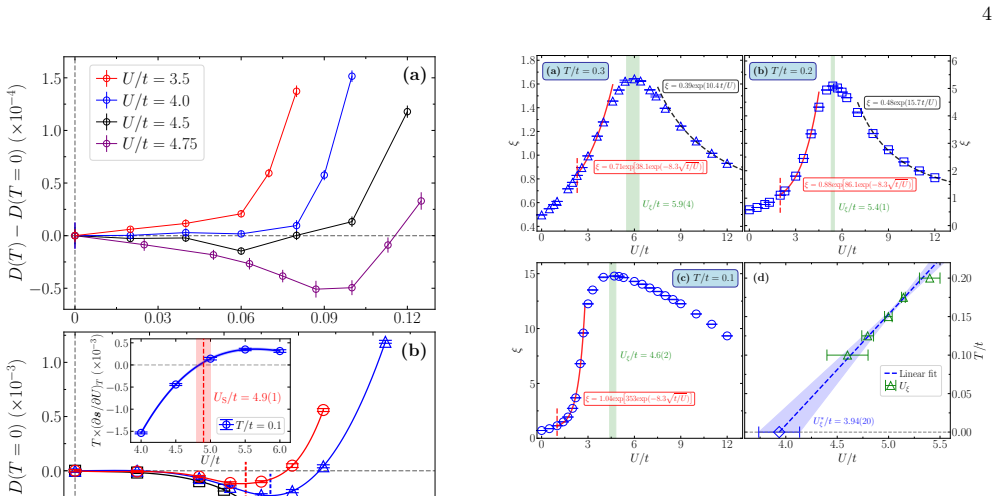
The central claim is that the sign change of (∂D/∂T)_U near zero temperature cleanly separates the Slater regime, where charge fluctuations set the sign positive, from the Mott regime, where the anomalous negative sign signals dominance of low-energy spin superexchange. This criterion fixes the crossover at U_cross/t=4.0(2) in the half-filled two-dimensional Hubbard model and is independently recovered from the maximum of the antiferromagnetic correlation length, with both unified by the local minimum of thermal entropy as a function of U at low temperatures.
What carries the argument
The temperature derivative of double occupancy (∂D/∂T)_U near zero temperature, whose sign change separates charge-fluctuation-dominated from spin-superexchange-dominated regimes.
If this is right
- The crossover boundary sits at U_cross/t = 4.0(2) for the half-filled 2D Hubbard model.
- The antiferromagnetic correlation length reaches a maximum at the same interaction strength due to superexchange physics.
- Thermal entropy versus U exhibits a local minimum at low temperatures that unifies the two signatures.
- The criterion supplies a direct, measurable framework for identifying the crossover in optical lattice experiments.
Where Pith is reading between the lines
- The same sign-change criterion could be tested in three dimensions or at finite doping to map how the crossover boundary shifts.
- Measuring the temperature dependence of double occupancy in cold-atom systems would directly locate the regime boundary without needing full correlation functions.
- The Pomeranchuk-like negative derivative suggests that entropy considerations could influence other low-temperature observables near the crossover.
Load-bearing premise
The assumption that the sign change of (∂D/∂T)_U near zero temperature cleanly separates regimes dominated by charge fluctuations from those dominated by spin superexchange, without being shifted by finite-size and finite-temperature effects in the simulations.
What would settle it
A simulation or measurement in which the sign change of (∂D/∂T)_U and the maximum of the antiferromagnetic correlation length occur at substantially different values of U would falsify the claim of a unified thermal criterion.
Figures


read the original abstract
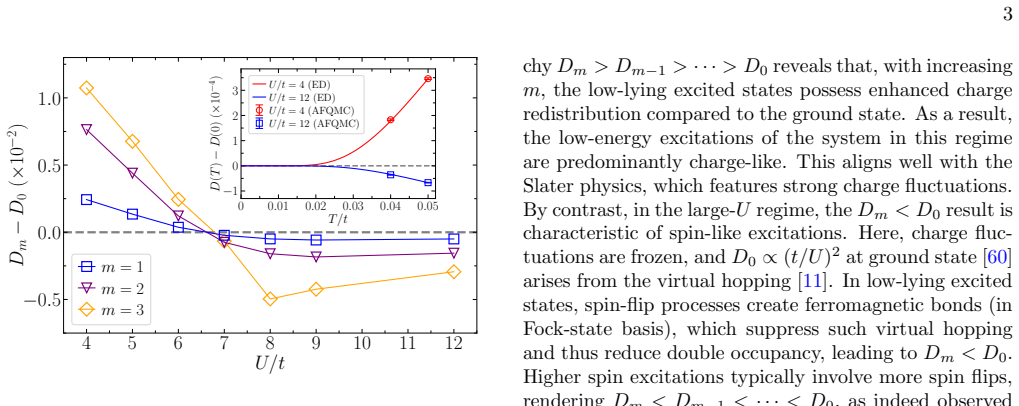
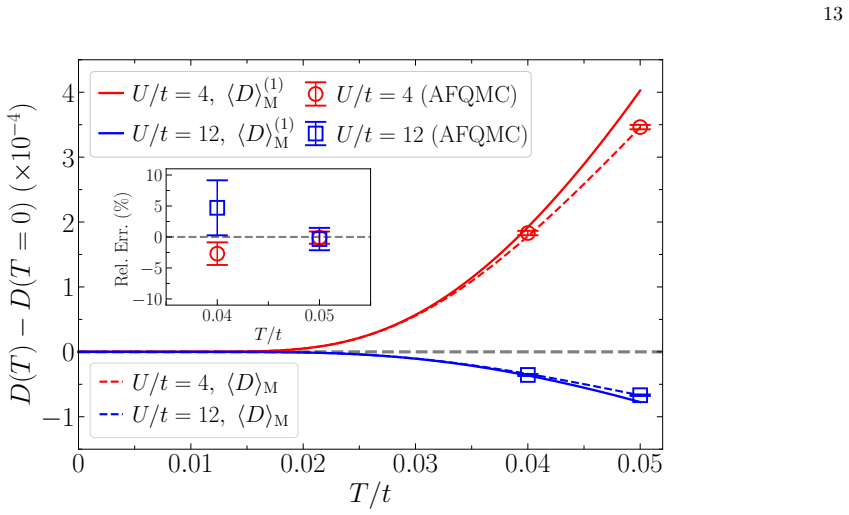
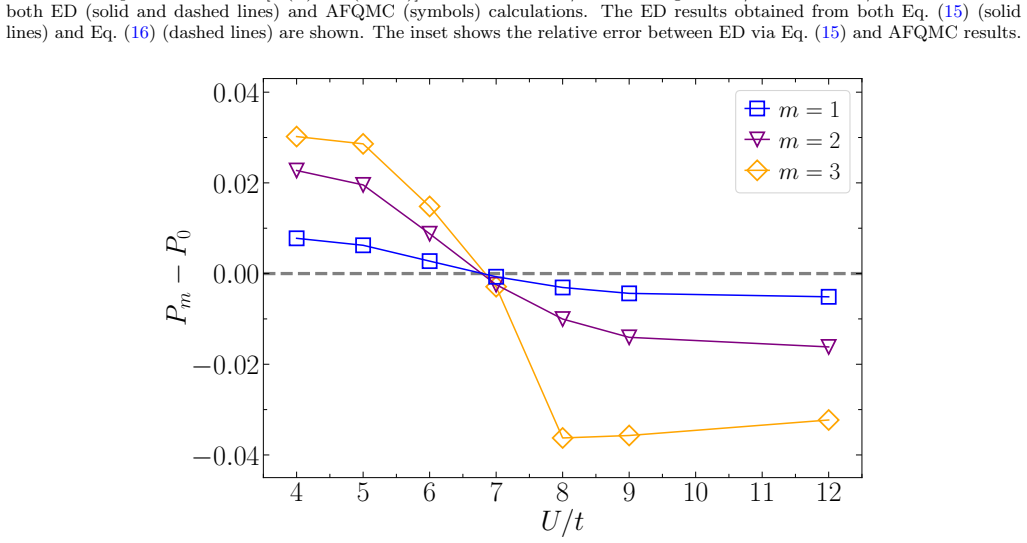
The interaction-driven crossover from a Slater insulator to a Mott insulator in the N\'{e}el-ordered ground state of the Hubbard model is a fundamental paradigm of strongly correlated electrons, yet its quantitative characterization has remained elusive. Here we establish a clear and experimentally accessible thermal criterion for this crossover via the sign change of the temperature derivative of double occupancy, $(\partial D/\partial T)_U$, near zero temperature. In the Slater regime, $(\partial D/\partial T)_U>0$ reflects the major role of charge fluctuations; in the Mott regime, the anomalous $(\partial D/\partial T)_U<0$, a manifestation of the Pomeranchuk effect, signals the dominance of low-energy spin superexchange physics. Using exact diagonalization and {\it numerically exact} quantum Monte Carlo simulations, we demonstrate that this criterion determines the crossover boundary at $U_{\rm cross}/t=4.0(2)$ for the half-filled two-dimensional Hubbard model. Furthermore, we obtain a consistent boundary independently from the maximum in the antiferromagnetic correlation length, which also arises from the superexchange physics. These two thermal signatures are theoretically unified through the local minimum of thermal entropy versus interaction $U$ at low temperatures. Our results offer a direct, measurable, and physically intuitive framework to identify the Slater-Mott crossover in optical lattice experiments.
Editorial analysis
A structured set of objections, weighed in public.
Referee Report
Summary. The manuscript proposes a thermal criterion for the Slater-Mott crossover in the half-filled 2D Hubbard model: the sign change of (∂D/∂T)_U near T=0 separates the Slater regime (positive derivative, charge-fluctuation dominated) from the Mott regime (negative derivative, superexchange dominated). Using exact diagonalization and numerically exact QMC, the authors locate the crossover at U_cross/t=4.0(2) and obtain a consistent boundary from the maximum in the antiferromagnetic correlation length; both signatures are unified via a local minimum in thermal entropy versus U at low T.
Significance. If the numerical evidence holds, the work supplies an experimentally measurable, physically intuitive marker for the crossover that can be accessed in optical-lattice realizations of the Hubbard model. The use of two independent, unbiased numerical methods and the entropy-based unification constitute concrete strengths.
major comments (2)
- [Abstract and §3] Abstract and §3 (numerical results): the central claim that the sign change of (∂D/∂T)_U at the lowest accessible temperatures already reflects the T→0 limit and cleanly locates U_cross/t=4.0(2) is load-bearing. The manuscript must demonstrate that the temperatures reached are well below the charge gap and the superexchange scale J=4t²/U, and that finite-size effects (cluster sizes, extrapolation procedure) do not shift the apparent zero-crossing; without this control the separation into charge- versus spin-dominated regimes remains unproven.
- [§4] §4 (AF correlation length): the reported maximum in the antiferromagnetic correlation length is presented as an independent confirmation of the same U_cross. The manuscript should show the finite-size scaling of this maximum and its relation to the sign-change temperature of (∂D/∂T)_U; if both quantities are extracted on the same clusters without explicit extrapolation, the consistency may be affected by the same finite-size rounding.
minor comments (2)
- [Methods] The numerical differentiation procedure used to obtain (∂D/∂T)_U should be stated explicitly (finite-difference stencil, smoothing, error propagation).
- [Figures] Figure captions should specify the system sizes and temperature ranges shown for each panel.
Simulated Author's Rebuttal
We thank the referee for the constructive report and positive assessment of the significance of our work. We address the two major comments below with additional analysis and will incorporate clarifications and new data presentations in the revised manuscript.
read point-by-point responses
-
Referee: [Abstract and §3] Abstract and §3 (numerical results): the central claim that the sign change of (∂D/∂T)_U at the lowest accessible temperatures already reflects the T→0 limit and cleanly locates U_cross/t=4.0(2) is load-bearing. The manuscript must demonstrate that the temperatures reached are well below the charge gap and the superexchange scale J=4t²/U, and that finite-size effects (cluster sizes, extrapolation procedure) do not shift the apparent zero-crossing; without this control the separation into charge- versus spin-dominated regimes remains unproven.
Authors: We agree that explicit verification of the temperature and size scales is essential. Our QMC simulations reach T/t ≈ 0.05, which lies below J/t = 4/(U/t) ≈ 1 near U/t=4 and well below the charge gap (of order U on the Mott side and ~ bandwidth on the Slater side). The zero-crossing location is stable across ED clusters (up to 4×4) and QMC lattices (up to 8×8) within statistical errors, with no detectable shift. In the revision we will add a dedicated paragraph and supplementary panel comparing the lowest T to J and the charge gap (extracted from compressibility), together with a table of (∂D/∂T)_U zero-crossings versus cluster size. revision: yes
-
Referee: [§4] §4 (AF correlation length): the reported maximum in the antiferromagnetic correlation length is presented as an independent confirmation of the same U_cross. The manuscript should show the finite-size scaling of this maximum and its relation to the sign-change temperature of (∂D/∂T)_U; if both quantities are extracted on the same clusters without explicit extrapolation, the consistency may be affected by the same finite-size rounding.
Authors: We will strengthen this section by including the finite-size scaling analysis for the AF correlation length. The maximum in ξ_AF(U) is obtained after standard extrapolation on lattices up to L=16; its location coincides with the (∂D/∂T)_U sign-change point within the quoted uncertainty of 0.2t. The double-occupancy derivative is cross-validated on both ED and QMC clusters, mitigating shared finite-size bias. The revision will add scaling plots of ξ_AF versus U for several L together with the extrapolated curve and a direct overlay of the two crossover loci. revision: yes
Circularity Check
Numerical extraction of crossover boundary from ED/QMC data exhibits no circularity
full rationale
The paper identifies the Slater-Mott crossover location at U_cross/t=4.0(2) by direct computation of the sign change in (∂D/∂T)_U and the maximum in antiferromagnetic correlation length using exact diagonalization and quantum Monte Carlo on the Hubbard Hamiltonian. These are independent numerical observables extracted from simulation output rather than any fitted functional form, self-referential definition, or load-bearing self-citation. The post-hoc unification via the local minimum of thermal entropy is a theoretical interpretation that does not alter the primary results, which remain self-contained against external benchmarks.
Axiom & Free-Parameter Ledger
free parameters (1)
- U_cross/t =
4.0(2)
axioms (1)
- domain assumption The two-dimensional half-filled Hubbard model with nearest-neighbor hopping t and on-site repulsion U is the appropriate microscopic description.
Forward citations
Cited by 1 Pith paper
-
Finite temperature precursors of Mottness in the Fermi Hubbard model
Finite-temperature Mottness precursors in the Hubbard model appear first via suppressed charge fluctuations and momentum-resolved spectral weight redistribution in an anomalous metallic regime, generating doped Mott s...
Reference graph
Works this paper leans on
-
[1]
Georges, G
A. Georges, G. Kotliar, W. Krauth, and M. J. Rozen- berg, Dynamical mean-field theory of strongly correlated fermion systems and the limit of infinite dimensions, Rev. Mod. Phys.68, 13 (1996)
1996
-
[2]
Imada, A
M. Imada, A. Fujimori, and Y. Tokura, Metal-insulator transitions, Rev. Mod. Phys.70, 1039 (1998)
1998
-
[3]
P. A. Lee, N. Nagaosa, and X.-G. Wen, Doping a mott in- sulator: Physics of high-temperature superconductivity, Rev. Mod. Phys.78, 17 (2006)
2006
-
[4]
Hubbard, Electron correlations in narrow energy bands, Proc
J. Hubbard, Electron correlations in narrow energy bands, Proc. R. Soc. London A276, 238 (1963)
1963
-
[5]
Kanamori, Electron correlation and ferromagnetism of 6 transition metals, Prog
J. Kanamori, Electron correlation and ferromagnetism of 6 transition metals, Prog. Theor. Phys30, 275 (1963)
1963
-
[6]
M. C. Gutzwiller, Effect of correlation on the ferromag- netism of transition metals, Phys. Rev. Lett.10, 159 (1963)
1963
-
[7]
D. P. Arovas, E. Berg, S. A. Kivelson, and S. Raghu, The Hubbard model, Annu. Rev. Condens. Matter Phys.13, 239 (2022)
2022
-
[8]
M. Qin, T. Sch¨ afer, S. Andergassen, P. Corboz, and E. Gull, The Hubbard model: A computational perspec- tive, Annu. Rev. Condens. Matter Phys.13, 275 (2022)
2022
-
[9]
J. E. Hirsch, Two-dimensional hubbard model: Numeri- cal simulation study, Phys. Rev. B31, 4403 (1985)
1985
-
[10]
J. C. Slater, Magnetic effects and the hartree-fock equa- tion, Phys. Rev.82, 538 (1951)
1951
-
[11]
J.-Y. P. Delannoy, M. J. P. Gingras, P. C. W. Holdsworth, and A.-M. S. Tremblay, N´ eel order, ring exchange, and charge fluctuations in the half-filled hubbard model, Phys. Rev. B72, 115114 (2005)
2005
-
[12]
N. F. Mott, The basis of the electron theory of met- als, with special reference to the transition metals, Proc. Phys. Soc. A62, 416 (1949)
1949
-
[13]
N. F. MOTT, Metal-insulator transition, Rev. Mod. Phys.40, 677 (1968)
1968
-
[14]
J. Yang, L. Hao, D. Meyers, T. Dasa, L. Xu, L. Horak, P. Shafer, E. Arenholz, G. Fabbris, Y. Choi, D. Haskel, J. Karapetrova, J.-W. Kim, P. J. Ryan, H. Xu, C. D. Batista, M. P. M. Dean, and J. Liu, Strain-modulated slater-mott crossover of pseudospin-half square-lattice in (sriro3)1/(srtio3)1 superlattices, Phys. Rev. Lett.124, 177601 (2020)
2020
-
[15]
Pruschke and R
T. Pruschke and R. Zitzler, From slater to mott- heisenberg physics: the antiferromagnetic phase of the hubbard model, J. Phys.: Condens. Matter15, 7867 (2003)
2003
-
[16]
Borejsza and N
K. Borejsza and N. Dupuis, Antiferromagnetism and single-particle properties in the two-dimensional half- filled hubbard model: Slater vs. mott-heisenberg, Euro- phys. Lett.63, 722 (2003)
2003
-
[17]
Fratino, P
L. Fratino, P. S´ emon, M. Charlebois, G. Sordi, and A.- M. S. Tremblay, Signatures of the mott transition in the antiferromagnetic state of the two-dimensional hubbard model, Phys. Rev. B95, 235109 (2017)
2017
-
[18]
D. Wang, L. Wang, and C. Wu, Slater and mott insu- lating states in the su(6) hubbard model, Phys. Rev. B 100, 115155 (2019)
2019
-
[19]
E. Gull, P. Werner, X. Wang, M. Troyer, and A. J. Mil- lis, Local order and the gapped phase of the hubbard model: A plaquette dynamical mean-field investigation, Europhys. Lett.84, 37009 (2008)
2008
-
[20]
Rohringer and A
G. Rohringer and A. Toschi, Impact of nonlocal corre- lations over different energy scales: A dynamical vertex approximation study, Phys. Rev. B94, 125144 (2016)
2016
-
[21]
E. G. C. P. van Loon, H. Hafermann, and M. I. Kat- snelson, Precursors of the insulating state in the square- lattice hubbard model, Phys. Rev. B97, 085125 (2018)
2018
-
[22]
A. J. Kim, F. Simkovic, and E. Kozik, Spin and charge correlations across the metal-to-insulator crossover in the half-filled 2d hubbard model, Phys. Rev. Lett.124, 117602 (2020)
2020
-
[23]
Sch¨ afer, F
T. Sch¨ afer, F. Geles, D. Rost, G. Rohringer, E. Arrigoni, K. Held, N. Bl¨ umer, M. Aichhorn, and A. Toschi, Fate of the false mott-hubbard transition in two dimensions, Phys. Rev. B91, 125109 (2015)
2015
-
[24]
Mazurenko, C
A. Mazurenko, C. S. Chiu, G. Ji, M. F. Parsons, M. Kan´ asz-Nagy, R. Schmidt, F. Grusdt, E. Demler, D. Greif, and M. Greiner, A cold-atom Fermi-Hubbard antiferromagnet, Nature545, 462 (2017)
2017
-
[25]
M. Xu, L. H. Kendrick, A. Kale, Y. Gang, C. Feng, S. Zhang, A. W. Young, M. Lebrat, and M. Greiner, A neutral-atom hubbard quantum simulator in the cryo- genic regime, Nature642, 909 (2025)
2025
-
[26]
L. H. Kendrick, A. Kale, Y. Gang, A. D. Deters, M. Le- brat, A. W. Young, and M. Greiner, Pseudogap in a fermi-hubbard quantum simulator, arXiv:2509.18075 (2025)
arXiv 2025
-
[27]
Bourgund, T
D. Bourgund, T. Chalopin, P. Bojovi´ c, H. Schl¨ omer, S. Wang, T. Franz, S. Hirthe, A. Bohrdt, F. Grusdt, I. Bloch, and T. A. Hilker, Formation of individual stripes in a mixed-dimensional cold-atom fermi-hubbard system, Nature637, 57 (2025)
2025
-
[28]
Shao, Y.-X
H.-J. Shao, Y.-X. Wang, D.-Z. Zhu, Y.-S. Zhu, H.-N. Sun, S.-Y. Chen, C. Zhang, Z.-J. Fan, Y. Deng, X.-C. Yao, Y.- A. Chen, and J.-W. Pan, Antiferromagnetic phase tran- sition in a 3d fermionic hubbard model, Nature632, 267 (2024)
2024
-
[29]
Wang, H.-J
Y.-X. Wang, H.-J. Shao, Y.-S. Zhu, D.-Z. Zhu, H.-N. Sun, S.-Y. Chen, X.-C. Yao, Y.-A. Chen, and J.-W. Pan, Homogeneous fermionic hubbard gases in a flattop optical lattice, Phys. Rev. Lett.134, 043403 (2025)
2025
-
[30]
Chalopin, P
T. Chalopin, P. Bojovi´ c, S. Wang, T. Franz, A. Sinha, Z. Wang, D. Bourgund, J. Obermeyer, F. Grusdt, A. Bohrdt, L. Pollet, A. Wietek, A. Georges, T. Hilker, and I. Bloch, Observation of emergent scaling of spin- charge correlations at the onset of the pseudogap, Proc. Natl. Acad. Sci. U.S.A123, e2525539123 (2026)
2026
-
[31]
N. D. Mermin and H. Wagner, Absence of ferromag- netism or antiferromagnetism in one- or two-dimensional isotropic heisenberg models, Phys. Rev. Lett.17, 1133 (1966)
1966
-
[32]
Dagotto, Correlated electrons in high-temperature su- perconductors, Rev
E. Dagotto, Correlated electrons in high-temperature su- perconductors, Rev. Mod. Phys.66, 763 (1994)
1994
-
[33]
H. Lin, J. Gubernatis, H. Gould, and J. Tobochnik, Exact diagonalization methods for quantum systems, Computer in Physics7, 400 (1993)
1993
-
[34]
Prelovˇ sek and J
P. Prelovˇ sek and J. Bonˇ ca, Ground state and finite temperature lanczos methods, in Strongly Correlated Systems: Numerical Methods, edited by A. Avella and F. Mancini (Springer Berlin Heidelberg, Berlin, Heidelberg, 2013) pp. 1–30
2013
-
[35]
Wu, Y.-Y
H.-Q. Wu, Y.-Y. He, C. Fang, Z. Y. Meng, and Z.-Y. Lu, Diagnosis of interaction-driven topological phase via ex- act diagonalization, Phys. Rev. Lett.117, 066403 (2016)
2016
-
[36]
Blankenbecler, D
R. Blankenbecler, D. J. Scalapino, and R. L. Sugar, Monte carlo calculations of coupled boson-fermion sys- tems. i, Phys. Rev. D24, 2278 (1981)
1981
-
[37]
J. E. Hirsch, Discrete hubbard-stratonovich transforma- tion for fermion lattice models, Phys. Rev. B28, 4059 (1983)
1983
-
[38]
S. R. White, D. J. Scalapino, R. L. Sugar, E. Y. Loh, J. E. Gubernatis, and R. T. Scalettar, Numerical study of the two-dimensional hubbard model, Phys. Rev. B40, 506 (1989)
1989
-
[39]
R. T. Scalettar, R. M. Noack, and R. R. P. Singh, Er- godicity at large couplings with the determinant monte carlo algorithm, Phys. Rev. B44, 10502 (1991)
1991
-
[40]
Wu and S.-C
C. Wu and S.-C. Zhang, Sufficient condition for absence of the sign problem in the fermionic quantum monte carlo algorithm, Phys. Rev. B71, 155115 (2005). 7
2005
-
[41]
Assaad and H
F. Assaad and H. Evertz, World-line and determinan- tal quantum Monte Carlo methods for spins, phonons and electrons, in Computational Many-Particle Physics, Lecture Notes in Physics, Vol. 739, edited by H. Fehske, R. Schneider, and A. Weiße (Springer,Berlin, 2008) pp. 277–356
2008
-
[42]
Y.-Y. He, M. Qin, H. Shi, Z.-Y. Lu, and S. Zhang, Finite-temperature auxiliary-field quantum monte carlo: Self-consistent constraint and systematic approach to low temperatures, Phys. Rev. B99, 045108 (2019)
2019
-
[43]
Sun and X
F. Sun and X. Y. Xu, Delay update in determinant quan- tum Monte Carlo, Phys. Rev. B109, 235140 (2024)
2024
-
[44]
Y.-F. Song, Y. Deng, and Y.-Y. He, Extended metal- insulator crossover with strong antiferromagnetic spin correlation in half-filled 3d hubbard model, Phys. Rev. Lett.134, 016503 (2025); Magnetic, thermodynamic, and dynamical properties of the three-dimensional fermionic hubbard model: A comprehensive monte carlo study, Phys. Rev. B111, 035123 (2025)
2025
-
[45]
Y.-Y. He, Condensate fraction scaling and specific heat anomaly around berezinskii-kosterlitz-thouless tran- sition of superconductivity and superfluidity, arXiv: 2505.17411(2025)
arXiv 2025
-
[46]
Sugiyama and S
G. Sugiyama and S. Koonin, Auxiliary field monte-carlo for quantum many-body ground states, Annals of Physics 168, 1 (1986)
1986
-
[47]
Sorella, S
S. Sorella, S. Baroni, R. Car, and M. Parrinello, A novel technique for the simulation of interacting fermion sys- tems, Europhys. Lett.8, 663 (1989)
1989
-
[48]
Du and Y.-Y
H. Du and Y.-Y. He, Accelerating ground-state auxiliary- field quantum monte carlo simulations by delayed update and block force-bias update, Phys. Rev. B112, 235120 (2025)
2025
-
[49]
C. Lin, F. H. Zong, and D. M. Ceperley, Twist-averaged boundary conditions in continuum quantum monte carlo algorithms, Phys. Rev. E64, 016702 (2001)
2001
-
[50]
Xu, C.-M
H. Xu, C.-M. Chung, M. Qin, U. Schollw¨ ock, S. R. White, and S. Zhang, Coexistence of superconductivity with par- tially filled stripes in the hubbard model, Science384, eadh7691 (2024)
2024
-
[51]
M. Qin, H. Shi, and S. Zhang, Benchmark study of the two-dimensional hubbard model with auxiliary-field quantum monte carlo method, Phys. Rev. B94, 085103 (2016)
2016
-
[52]
Vitali, H
E. Vitali, H. Shi, M. Qin, and S. Zhang, Computation of dynamical correlation functions for many-fermion sys- tems with auxiliary-field quantum monte carlo, Phys. Rev. B94, 085140 (2016)
2016
-
[53]
See Supplemental Material at http://link.aps.org/supplemental/10.1103/xxx for the key algorithmic ingredients of AFQMC, the compu- tation of thermal entropy andU S, the signal locations (includingU S,T D, andU ξ), supplemental results from ED, and the proof for Eq. (3)
-
[54]
Lu, Y.-F
M. Lu, Y.-F. Song, Y. Deng, and Y.-Y. He, Quantum monte carlo study of the metal-insulator crossover in the square-lattice hubbard model, Phys. Rev. B113, 195154 (2026)
2026
-
[55]
ˇSimkovic, J
F. ˇSimkovic, J. P. F. LeBlanc, A. J. Kim, Y. Deng, N. V. Prokof’ev, B. V. Svistunov, and E. Kozik, Ex- tended crossover from a fermi liquid to a quasiantiferro- magnet in the half-filled 2d hubbard model, Phys. Rev. Lett.124, 017003 (2020)
2020
-
[56]
E. V. Gorelik, D. Rost, T. Paiva, R. Scalettar, A. Kl¨ umper, and N. Bl¨ umer, Universal probes for anti- ferromagnetic correlations and entropy in cold fermions on optical lattices, Phys. Rev. A85, 061602 (2012)
2012
-
[57]
G. Li, A. E. Antipov, A. N. Rubtsov, S. Kirchner, and W. Hanke, Competing phases of the hubbard model on a triangular lattice: Insights from the entropy, Phys. Rev. B89, 161118 (2014)
2014
-
[58]
Wietek, R
A. Wietek, R. Rossi, F. ˇSimkovic, M. Klett, P. Hans- mann, M. Ferrero, E. M. Stoudenmire, T. Sch¨ afer, and A. Georges, Mott insulating states with competing or- ders in the triangular lattice hubbard model, Phys. Rev. X11, 041013 (2021)
2021
-
[59]
Q. Li, Y. Gao, Y.-Y. He, Y. Qi, B.-B. Chen, and W. Li, Tangent space approach for thermal tensor network sim- ulations of the 2d hubbard model, Phys. Rev. Lett.130, 226502 (2023)
2023
-
[60]
Avella, F
A. Avella, F. Mancini, and T. Saikawa, The 2-site hub- bard andt-jmodels, Eur. Phys. J. B36, 445 (2003)
2003
-
[61]
Y.-F. Song, Y. Deng, and Y.-Y. He, Computation of thermal entropy for the doped hubbard model, arXiv: 2603.18998(2026)
arXiv 2026
-
[62]
Sch¨ afer, N
T. Sch¨ afer, N. Wentzell, F.ˇSimkovic, Y.-Y. He, C. Hille, M. Klett, C. J. Eckhardt, B. Arzhang, V. Harkov, F. m. c.-M. Le R´ egent, A. Kirsch, Y. Wang, A. J. Kim, E. Kozik, E. A. Stepanov, A. Kauch, S. Andergassen, P. Hansmann, D. Rohe, Y. M. Vilk, J. P. F. LeBlanc, S. Zhang, A.-M. S. Tremblay, M. Ferrero, O. Parcollet, and A. Georges, Tracking the foot...
2021
-
[63]
Chakravarty, B
S. Chakravarty, B. I. Halperin, and D. R. Nelson, Two- dimensional quantum heisenberg antiferromagnet at low temperatures, Phys. Rev. B39, 2344 (1989)
1989
-
[64]
Borejsza and N
K. Borejsza and N. Dupuis, Antiferromagnetism and single-particle properties in the two-dimensional half- filled hubbard model: A nonlinear sigma model approach, Phys. Rev. B69, 085119 (2004)
2004
-
[65]
B. B. Beard, R. J. Birgeneau, M. Greven, and U.- J. Wiese, Square-lattice heisenberg antiferromagnet at very large correlation lengths, Phys. Rev. Lett.80, 1742 (1998)
1998
-
[66]
E. Langmann and J. Lenells, On the mean-field antifer- romagnetic gap for the half-filled 2d hubbard model at zero temperature, arXiv:2501.18141(2025)
Pith/arXiv arXiv 2025
-
[67]
Gukelberger, L
J. Gukelberger, L. Wang, and L. Pollet, Ising antiferro- magnet in the two-dimensional Hubbard model with mis- matched Fermi surfaces, Phys. Rev. B95, 205121 (2017)
2017
-
[68]
Xie, Y.-F
Z. Xie, Y.-F. Song, and Y.-Y. He, Ising phase transi- tions and thermodynamics of correlated fermions in a two-dimensional spin-dependent lattice potential, Phys. Rev. B111, 125105 (2025)
2025
-
[69]
S. S. Kancharla and S. Okamoto, Band insulator to mott insulator transition in a bilayer hubbard model, Phys. Rev. B75, 193103 (2007)
2007
-
[70]
Golor, T
M. Golor, T. Reckling, L. Classen, M. M. Scherer, and S. Wessel, Ground-state phase diagram of the half-filled bilayer hubbard model, Phys. Rev. B90, 195131 (2014)
2014
-
[71]
M. Gall, N. Wurz, J. Samland, C. F. Chan, and M. K¨ ohl, Competing magnetic orders in a bilayer hubbard model with ultracold atoms, Nature589, 40 (2021)
2021
-
[72]
Cai, H.-h
Z. Cai, H.-h. Hung, L. Wang, D. Zheng, and C. Wu, Pomeranchuk cooling of SU(2n) ultracold fermions in op- tical lattices, Phys. Rev. Lett.110, 220401 (2013). 8
2013
-
[73]
Z. Zhou, Z. Cai, C. Wu, and Y. Wang, Quantum monte carlo simulations of thermodynamic properties of SU(2n) ultracold fermions in optical lattices, Phys. Rev. B90, 235139 (2014)
2014
-
[74]
D. Wang, Y. Li, Z. Cai, Z. Zhou, Y. Wang, and C. Wu, Competing orders in the 2d half-filled SU(2n) hubbard model through the pinning-field quantum monte carlo simulations, Phys. Rev. Lett.112, 156403 (2014)
2014
-
[75]
Y.-F. Song, Y. Deng, and Y.-Y. He, Thermal entropy, density disorder, and antiferromagnetism of repulsive fermions in 3d optical lattice, Chin. Phys. Lett.42, 110710 (2025)
2025
-
[76]
Thermal Signatures of the Slater-Mott Crossover in the Hubbard model: From Double Occupancy to Antiferromagnetic Correlation Length
Private communication with Xing-Can Yao. 9 Supplementary Material for “Thermal Signatures of the Slater-Mott Crossover in the Hubbard model: From Double Occupancy to Antiferromagnetic Correlation Length” I. OVER VIEW OF THIS SUPPLEMENT AR Y MA TERIAL This Supplemental Material is divided into two parts. First, we concentrate on the details of the auxiliar...
discussion (0)
Sign in with ORCID, Apple, or X to comment. Anyone can read and Pith papers without signing in.