Mach's principle in atomic transitions
Pith reviewed 2026-06-27 09:48 UTC · model grok-4.3
The pith
Atomic transition probabilities in two circular-motion atom-mirror setups become equivalent when the driving field frequencies are interchanged.
A machine-rendered reading of the paper's core claim, the machinery that carries it, and where it could break.
Core claim
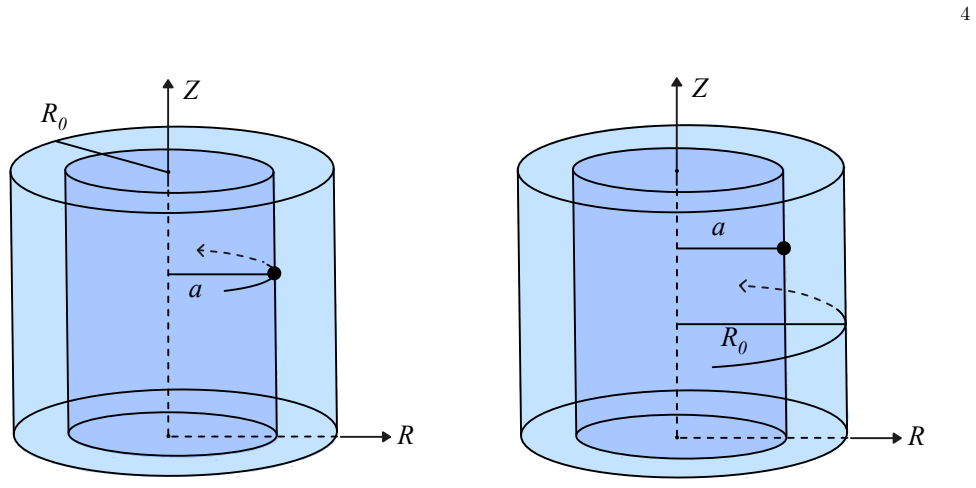
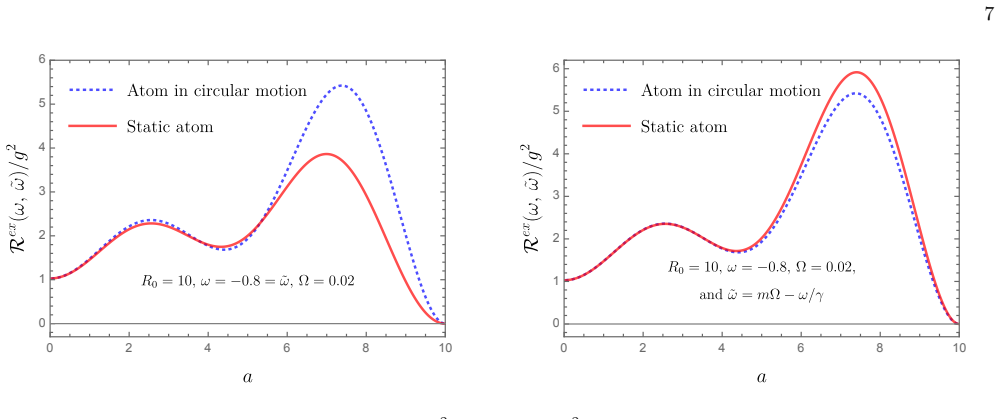
In atom-mirror systems undergoing circular motion, the transition probabilities when the atom moves inside a static mirror are equivalent to those when the mirror rotates around a static atom, provided the field frequencies are interchanged between the cases. This equivalence is reported as a semi-classical phenomenon analogous to Mach's principle.
What carries the argument
The frequency-interchange equivalence of transition probabilities between the atom-moving and mirror-rotating scenarios, which establishes the analog to Mach's principle.
If this is right
- The transition probabilities are equivalent upon interchanging the field frequencies between the two scenarios.
- This structural similarity is observed in the circular motion configurations.
- The observation is interpreted as a semi-classical analog to Mach's principle.
Where Pith is reading between the lines
- The equivalence could be explored in linear motion or other geometries to test generality.
- Laboratory setups with rotating mirrors and laser-driven atoms might verify the frequency mapping.
- This finding may relate to how accelerated frames affect quantum processes in other contexts.
Load-bearing premise
The two physically distinct motion scenarios produce transition probabilities that map exactly via frequency interchange without additional effects, and this mapping is an analog to Mach's principle.
What would settle it
Computing the transition probabilities explicitly for both scenarios and specific frequencies and observing that they do not match after the interchange would disprove the claimed equivalence.
Figures
read the original abstract
We investigate the atomic transition probabilities in atom-mirror set-ups that are in circular motion. In one scenario, the atom is in circular motion inside a static cylindrical mirror. In the other scenario, the cylindrical mirror rotates around its central axis while the atom remains static. We report structural similarity in the atomic transition probabilities between these two cases -- these probabilities are equivalent upon interchanging the field frequencies between the two scenarios. We interpret such an observation as a semi-classical phenomenon analogous to the classical Mach's principle.
Editorial analysis
A structured set of objections, weighed in public.
Referee Report
Summary. The manuscript investigates atomic transition probabilities in two atom-mirror configurations undergoing circular motion: an atom in circular motion inside a static cylindrical mirror, and a static atom with a rotating cylindrical mirror. It reports a structural similarity whereby the transition probabilities in the two scenarios are equivalent upon interchanging the electromagnetic field frequencies, and interprets this as a semi-classical analog of Mach's principle.
Significance. If substantiated, the reported frequency-interchange equivalence would constitute an interesting semi-classical quantum-optical illustration of Mach's principle, underscoring relational aspects of motion without introducing free parameters. The identification of the symmetry itself is a potential strength, but its significance hinges on whether the calculations fully capture the field dynamics in both scenarios.
major comments (1)
- [Abstract and main text] The central claim of exact equivalence between the transition probabilities under field-frequency interchange is load-bearing. In the rotating-mirror scenario the electromagnetic boundary conditions are explicitly time-dependent; this generally produces additional mode mixing and possible particle creation that are absent from the static-mirror plus moving-atom case. The manuscript does not demonstrate that these extra contributions either vanish or transform identically under the interchange (Abstract and main text).
Simulated Author's Rebuttal
We thank the referee for their careful reading of the manuscript and for highlighting this important point regarding the time-dependent boundary conditions. We address the major comment below.
read point-by-point responses
-
Referee: [Abstract and main text] The central claim of exact equivalence between the transition probabilities under field-frequency interchange is load-bearing. In the rotating-mirror scenario the electromagnetic boundary conditions are explicitly time-dependent; this generally produces additional mode mixing and possible particle creation that are absent from the static-mirror plus moving-atom case. The manuscript does not demonstrate that these extra contributions either vanish or transform identically under the interchange (Abstract and main text).
Authors: We agree that the rotating-mirror scenario features explicitly time-dependent boundary conditions, which in general can induce mode mixing and dynamical particle creation absent from the static-mirror case. Our calculations employ a perturbative treatment of the atomic transitions driven by the prescribed motion, without explicitly incorporating these higher-order dynamical effects. To strengthen the central claim, the revised manuscript will include an explicit discussion (in the main text) of the regime of validity—specifically, slow rotations where the mirror angular frequency is much smaller than the relevant field frequencies—under which particle-creation contributions are negligible to the order considered and do not alter the reported frequency-interchange equivalence. If a more detailed mode-expansion calculation is required, we will add it as an appendix. revision: yes
Circularity Check
No circularity; equivalence derived from explicit calculations in each scenario
full rationale
The paper performs separate computations of atomic transition probabilities for the moving-atom/static-mirror case and the static-atom/rotating-mirror case, then reports an observed structural similarity under frequency interchange. This mapping is presented as an output of the calculations rather than an input assumption or a fitted parameter renamed as a prediction. No self-citations are invoked to justify uniqueness or to smuggle in an ansatz; the Mach's principle analogy is an interpretive label placed after the reported equivalence, not a load-bearing premise that reduces the result to itself. The derivation chain therefore remains self-contained against external benchmarks.
Axiom & Free-Parameter Ledger
Reference graph
Works this paper leans on
-
[1]
– the trajectories of a particle under gravity are indistinguishable locally from those for a free particle viewed with respect to an accelerated frame. In recent times, there has been renewed interest in further investigating and comparing the quantum responses of these observers, which are in classically equivalent scenarios [3–7] and those in analogous...
Pith/arXiv arXiv 2026
-
[2]
Particle creation by black holes,
S. W. Hawking, “Particle creation by black holes,”Comm. Math. Phys.43no. 3, (1975) 199–220
1975
-
[3]
Notes on black hole evaporation,
W. Unruh, “Notes on black hole evaporation,”Phys.Rev.D14(1976) 870
1976
-
[4]
Equivalence Principle in Classical and Quantum Gravity,
N. Paunkovic and M. Vojinovic, “Equivalence Principle in Classical and Quantum Gravity,”Universe8no. 11, (2022) 598,arXiv:2210.00133 [gr-qc]
arXiv 2022
-
[5]
On the equivalence principle in quantum theory,
C. Lammerzahl, “On the equivalence principle in quantum theory,”Gen. Rel. Grav.28(1996) 1043, arXiv:gr-qc/9605065
Pith/arXiv arXiv 1996
-
[6]
Testing the equivalence principle through freely falling quantum objects,
L. Viola and R. Onofrio, “Testing the equivalence principle through freely falling quantum objects,”Phys. Rev. D55 (1997) 455–462,arXiv:quant-ph/9612039
Pith/arXiv arXiv 1997
-
[7]
Quantum formulation of the Einstein Equivalence Principle,
M. Zych and ˇC. Brukner, “Quantum formulation of the Einstein Equivalence Principle,”Nature Phys.14no. 10, (2018) 1027–1031,arXiv:1502.00971 [gr-qc]
Pith/arXiv arXiv 2018
-
[8]
Entanglement-induced deviation from the geodesic motion in quantum gravity,
F. Pipa, N. Paunkovi´ c, and M. Vojinovi´ c, “Entanglement-induced deviation from the geodesic motion in quantum gravity,”JCAP09(2019) 057,arXiv:1801.03207 [gr-qc]
arXiv 2019
-
[9]
Excitation of an Atom by a Uniformly Accelerated Mirror through Virtual Transitions,
A. A. Svidzinsky, J. S. Ben-Benjamin, S. A. Fulling, and D. N. Page, “Excitation of an Atom by a Uniformly Accelerated Mirror through Virtual Transitions,”Phys. Rev. Lett.121no. 7, (2018) 071301
2018
-
[10]
The Equivalence Principle at Work in Radiation from Unaccelerated Atoms and Mirrors,
S. A. Fulling and J. H. Wilson, “The Equivalence Principle at Work in Radiation from Unaccelerated Atoms and Mirrors,”Phys. Scripta94no. 1, (2019) 014004,arXiv:1805.01013 [quant-ph]. 9
arXiv 2019
-
[11]
Particle detectors, geodesic motion, and the equivalence principle,
S. Sonego and H. Westman, “Particle detectors, geodesic motion, and the equivalence principle,”Class. Quant. Grav.21 (2004) 433–444,arXiv:gr-qc/0307040
Pith/arXiv arXiv 2004
-
[12]
P. K. Kumawat, S. Barman, and B. R. Majhi, “Equivalence in virtual transitions between uniformly accelerated and static atoms: from a bird’s eye,”JCAP02(2025) 046,arXiv:2410.21051 [gr-qc]
arXiv 2025
-
[13]
S. Barman, P. K. Kumawat, and B. R. Majhi, “Timelike transitions in an atom by a mirror in light cone and Kruskal-Szekeres regions: a status of quantum equivalence,”JCAP02(2026) 055,arXiv:2408.12378 [gr-qc]
arXiv 2026
-
[14]
Detector’s response to coherent Rindler and Minkowski photons,
P. K. Kumawat, D. Barman, and B. R. Majhi, “Detector’s response to coherent Rindler and Minkowski photons,” arXiv:2601.20557 [quant-ph]
-
[15]
G. Rosi, G. D’Amico, L. Cacciapuoti, F. Sorrentino, M. Prevedelli, M. Zych, C. Brukner, and G. M. Tino, “Quantum test of the equivalence principle for atoms in superpositions of internal energy eigenstates,”Nature Commun.8(2017) 5529,arXiv:1704.02296 [physics.atom-ph]
Pith/arXiv arXiv 2017
-
[16]
Proposal for a Quantum Test of the Weak Equivalence Principle with Entangled Atomic Species,
R. Geiger and M. Trupke, “Proposal for a Quantum Test of the Weak Equivalence Principle with Entangled Atomic Species,”Phys. Rev. Lett.120no. 4, (2018) 043602,arXiv:1801.08604 [gr-qc]
Pith/arXiv arXiv 2018
-
[17]
Precision Gravity Tests and the Einstein Equivalence Principle,
G. M. Tino, L. Cacciapuoti, S. Capozziello, G. Lambiase, and F. Sorrentino, “Precision Gravity Tests and the Einstein Equivalence Principle,”Prog. Part. Nucl. Phys.112(2020) 103772,arXiv:2002.02907 [gr-qc]
arXiv 2020
-
[18]
Cavity Optimization for Unruh Effect at Small Accelerations,
D. J. Stargen and K. Lochan, “Cavity Optimization for Unruh Effect at Small Accelerations,”Phys. Rev. Lett.129 no. 11, (2022) 111303,arXiv:2107.00049 [gr-qc]
arXiv 2022
-
[19]
Strong noninertial radiative shifts in atomic spectra at low accelerations,
N. Arya, D. J. Stargen, K. Lochan, and S. K. Goyal, “Strong noninertial radiative shifts in atomic spectra at low accelerations,”Phys. Rev. D110no. 8, (2024) 085007,arXiv:2406.13481 [quant-ph]
arXiv 2024
-
[20]
Influence of thermal bath on Pancharatnam-Berry phase in an accelerated frame,
D. Ghosh and B. R. Majhi, “Influence of thermal bath on Pancharatnam-Berry phase in an accelerated frame,”Phys. Lett. B858(2024) 139015,arXiv:2406.13416 [gr-qc]
arXiv 2024
-
[21]
Mirror-enhanced acceleration-induced geometric phase,
D. Barman, D. Ghosh, and B. R. Majhi, “Mirror-enhanced acceleration-induced geometric phase,”Eur. Phys. J. C85 no. 4, (2025) 410,arXiv:2405.07711 [quant-ph]
arXiv 2025
-
[22]
Electrons as accelerated thermometers,
J. S. Bell and J. M. Leinaas, “Electrons as accelerated thermometers,”Nucl. Phys. B212(1983) 131
1983
-
[23]
P. C. W. Davies, T. Dray, and C. A. Manogue, “The Rotating quantum vacuum,”Phys. Rev. D53(1996) 4382–4387, arXiv:gr-qc/9601034
Pith/arXiv arXiv 1996
-
[24]
The Fulling-Unruh effect in general stationary accelerated frames,
J. I. Korsbakken and J. M. Leinaas, “The Fulling-Unruh effect in general stationary accelerated frames,”Phys. Rev. D 70(2004) 084016,arXiv:hep-th/0406080
Pith/arXiv arXiv 2004
-
[25]
Modified dispersion relations and the response of the rotating Unruh-DeWitt detector,
S. Gutti, S. Kulkarni, and L. Sriramkumar, “Modified dispersion relations and the response of the rotating Unruh-DeWitt detector,”Phys. Rev. D83(2011) 064011,arXiv:1005.1807 [gr-qc]
Pith/arXiv arXiv 2011
-
[26]
Low energy Lorentz violation from high energy modified dispersion in inertial and circular motion,
J. Louko and S. D. Upton, “Low energy Lorentz violation from high energy modified dispersion in inertial and circular motion,”Phys. Rev. D97no. 2, (2018) 025008,arXiv:1710.06954 [gr-qc]
arXiv 2018
-
[27]
Unruh and analogue Unruh temperatures for circular motion in 3+1 and 2+1 dimensions,
S. Biermann, S. Erne, C. Gooding, J. Louko, J. Schmiedmayer, W. G. Unruh, and S. Weinfurtner, “Unruh and analogue Unruh temperatures for circular motion in 3+1 and 2+1 dimensions,”Phys. Rev. D102no. 8, (2020) 085006, arXiv:2007.09523 [gr-qc]
arXiv 2020
-
[28]
S. Barman, B. R. Majhi, and L. Sriramkumar, “Radiative processes of single and entangled detectors on circular trajectories in (2+1)-dimensional Minkowski spacetime,”Phys. Rev. D109no. 10, (2024) 105025,arXiv:2205.01305 [gr-qc]
arXiv 2024
-
[29]
Y. Peng, Y. Zhou, J. Hu, and H. Yu, “Extensive Manipulation of Transition Rates and Substantial Population Inversion of Rotating Atoms Inside a Cavity,”Phys. Rev. Lett.136no. 1, (2026) 013202,arXiv:2412.20411 [quant-ph]
arXiv 2026
-
[30]
Quantum Computing with Circular Rydberg Atoms,
S. R. Cohen and J. D. Thompson, “Quantum Computing with Circular Rydberg Atoms,”PRX Quantum2no. 3, (2021) 030322,arXiv:2103.12744 [quant-ph]
arXiv 2021
-
[31]
Quantum coherence of a circularly accelerated atom in a spacetime with a reflecting boundary,
W. Zhang, X. Liu, and T. Yang, “Quantum coherence of a circularly accelerated atom in a spacetime with a reflecting boundary,”Sci. Rep.12no. 1, (2022) 12577
2022
-
[32]
Newton,Philosophiæ Naturalis Principia Mathematica
I. Newton,Philosophiæ Naturalis Principia Mathematica. Jussu Societatis Regiae ac Typis Josephi Streater, London, 1687
-
[33]
Barbour and H
J. Barbour and H. Pfister,Mach’s Principle: From Newton’s Bucket to Quantum Gravity. Birkh¨ auser, Boston, 1995
1995
-
[34]
On the wavy mechanics of particles,
S. Das, “On the wavy mechanics of particles,”arXiv:1206.0923 [gr-qc]
-
[35]
A Rotating vacuum and the quantum Mach’s principle,
R. D. M. De Paola and N. F. Svaiter, “A Rotating vacuum and the quantum Mach’s principle,”arXiv:gr-qc/0009058
-
[36]
Emergent physics on Mach’s principle and the rotating vacuum,
G. Jannes and G. E. Volovik, “Emergent physics on Mach’s principle and the rotating vacuum,”JETP Lett.102no. 2, (2015) 73–79,arXiv:1506.00882 [gr-qc]
Pith/arXiv arXiv 2015
-
[37]
Radiative Processes of Entangled Detectors in Rotating Frames,
G. Pican¸ co, N. F. Svaiter, and C. A. D. Zarro, “Radiative Processes of Entangled Detectors in Rotating Frames,”JHEP 08(2020) 025,arXiv:2002.06085 [hep-th]
arXiv 2020
-
[38]
The Quantized Scalar Field in the Stationary Coordinate Systems of Flat Space-time,
J. R. Letaw and J. D. Pfautsch, “The Quantized Scalar Field in the Stationary Coordinate Systems of Flat Space-time,” Phys. Rev. D24(1981) 1491
1981
-
[39]
Padmanabhan,Gravitation: Foundations and Frontiers
T. Padmanabhan,Gravitation: Foundations and Frontiers. Cambridge University Press, 2010
2010
discussion (0)
Sign in with ORCID, Apple, or X to comment. Anyone can read and Pith papers without signing in.