Slots, Transitions, Loops: Learning Composable World Models for ARC
Pith reviewed 2026-06-27 09:54 UTC · model grok-4.3
The pith
ARC rules can be learned as composable transitions over visual-symbolic world states.
A machine-rendered reading of the paper's core claim, the machinery that carries it, and where it could break.
Core claim
Loop-OWM is an object-centric world-modeling architecture that learns ARC rules as composable transitions over structured states. It combines color-prototype slots, demonstration-conditioned task summaries, and a looped transition model with dense propagation and slot-conditioned correction. On both ARC-1 and ARC-2, Loop-OWM outperforms non-looped and looped baselines with comparable or fewer parameters. These results suggest that ARC rules can be learned not only as language descriptions or searched programs, but also as transitions over visual-symbolic world states.
What carries the argument
The looped transition model with dense propagation and slot-conditioned correction, which learns composable transitions over color-prototype slotted states conditioned on demonstration summaries.
If this is right
- ARC rules manifest as grid transitions over objects, colors, shapes, and spatial relations that can be modeled directly as state changes.
- Demonstration-conditioned task summaries allow the transition model to adapt to the specific rule of each task.
- Dense propagation combined with slot-conditioned correction improves the accuracy of applying the learned transitions to query inputs.
- The architecture achieves higher performance on ARC-1 and ARC-2 while using comparable or fewer parameters than baselines.
Where Pith is reading between the lines
- The same slot-and-loop structure might be applied to other visual reasoning benchmarks that involve few-shot rule induction from image pairs.
- Because the transitions are defined over explicit slots, the learned rules could be inspected by examining which slots change between input and output states.
- Hybrid systems could combine the learned transitions with symbolic program search to verify or refine the inferred rules.
Load-bearing premise
The specific combination of color-prototype slots, demonstration-conditioned task summaries, and looped transition model with dense propagation and slot-conditioned correction is sufficient to capture the hidden rules from limited demonstrations in ARC tasks.
What would settle it
A controlled test on ARC tasks whose rules depend on counting or symmetry relations that cannot be represented by fixed color-prototype slots, where Loop-OWM would show no accuracy gain over non-looped baselines.
Figures



read the original abstract
ARC tests in-context rule induction: given a few input-output demonstrations, a model must infer the hidden rule and apply it to a new query. While many approaches express ARC rules through language, code, or symbolic programs, ARC itself is visual-symbolic: rules appear as grid transitions over objects, colors, shapes, and spatial relations. We introduce Loop-OWM, an object-centric world-modeling architecture that learns these rules as composable transitions over structured states. It combines color-prototype slots, demonstration-conditioned task summaries, and a looped transition model with dense propagation and slot-conditioned correction. On both ARC-1 and ARC-2, Loop-OWM outperforms non-looped and looped baselines with comparable or fewer parameters. These results suggest that ARC rules can be learned not only as language descriptions or searched programs, but also as transitions over visual-symbolic world states.
Editorial analysis
A structured set of objections, weighed in public.
Referee Report
Summary. The paper introduces Loop-OWM, an object-centric world-modeling architecture for ARC that learns rules as composable transitions over visual-symbolic states. It combines color-prototype slots, demonstration-conditioned task summaries, and a looped transition model with dense propagation and slot-conditioned correction. The central empirical claim is that Loop-OWM outperforms non-looped and looped baselines on both ARC-1 and ARC-2 with comparable or fewer parameters.
Significance. If the results hold under rigorous evaluation, the work would demonstrate that ARC-style rule induction can be achieved via learned transitions in structured object-centric states rather than language descriptions or program search, strengthening the case for composable world models in visual-symbolic domains.
major comments (2)
- [Abstract] Abstract: the performance claims are stated without any reference to experimental setup, number of tasks evaluated, exact metrics, baselines, or statistical significance testing; this absence makes it impossible to assess whether the data support the outperformance claim.
- [Method] Method section (description of Loop-OWM): the claim that the specific combination of color-prototype slots, demonstration-conditioned summaries, dense propagation, and slot-conditioned correction is sufficient rests on the weakest assumption that this architecture captures hidden rules from limited demonstrations; no ablation isolating each component or comparison to simpler variants is referenced to substantiate necessity.
minor comments (1)
- Notation for the transition model (dense propagation and slot-conditioned correction) would benefit from explicit equations or pseudocode to clarify the loop structure and conditioning mechanism.
Simulated Author's Rebuttal
Thank you for the constructive feedback on our manuscript. We address each major comment point by point below, with plans for revisions where the concerns are valid.
read point-by-point responses
-
Referee: [Abstract] Abstract: the performance claims are stated without any reference to experimental setup, number of tasks evaluated, exact metrics, baselines, or statistical significance testing; this absence makes it impossible to assess whether the data support the outperformance claim.
Authors: We agree that the abstract lacks sufficient context to evaluate the claims. In the revised manuscript, we will expand the abstract to reference the experimental setup on ARC-1 and ARC-2 (including task counts where space permits), the accuracy metric on query grids, the non-looped and looped baselines, and that results are means over multiple seeds with standard deviations. This will make the outperformance claim more assessable without altering the core message. revision: yes
-
Referee: [Method] Method section (description of Loop-OWM): the claim that the specific combination of color-prototype slots, demonstration-conditioned summaries, dense propagation, and slot-conditioned correction is sufficient rests on the weakest assumption that this architecture captures hidden rules from limited demonstrations; no ablation isolating each component or comparison to simpler variants is referenced to substantiate necessity.
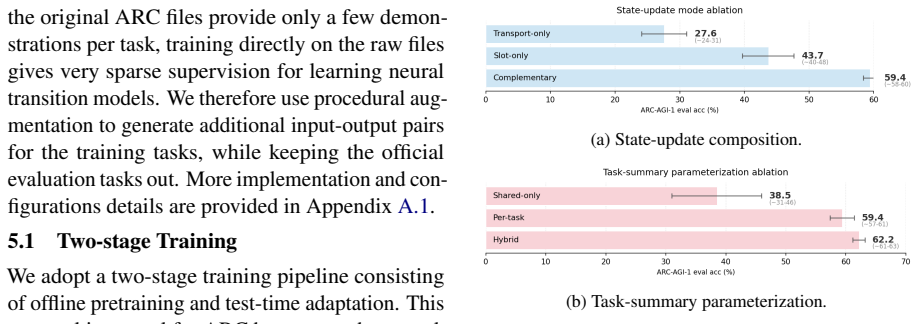
Authors: The manuscript already includes comparisons against non-looped and looped baselines to support the looped transition component. However, we acknowledge that dedicated ablations isolating color-prototype slots, demonstration-conditioned summaries, dense propagation, and slot-conditioned correction are not present. We will add an ablation study in the revised version to directly address necessity of the combination. revision: yes
Circularity Check
No significant circularity; empirical comparison only
full rationale
The paper introduces an object-centric architecture (Loop-OWM) combining color-prototype slots, demonstration-conditioned summaries, and looped transitions, then reports empirical outperformance on ARC-1/ARC-2 versus baselines. No derivation chain, equations, or first-principles claims are present in the provided text; the central claim is an experimental result rather than a reduction of predictions to fitted inputs or self-citations. The architecture is presented as a modeling choice whose sufficiency is tested directly against data, with no load-bearing self-citation or ansatz smuggling visible. This is the standard case of a self-contained empirical paper.
Axiom & Free-Parameter Ledger
invented entities (1)
-
Loop-OWM
no independent evidence
Forward citations
Cited by 1 Pith paper
-
Trajectory Forcing: Structure-First Generation with Controllable Semantic Trajectories
Trajectory Forcing makes generative image synthesis trajectory-centric by organizing it into decodable semantic stages derived from clustered visual representations and trained with one-step flow-matching models.
Reference graph
Works this paper leans on
-
[1]
2024 , url =
Jordan and Keller and Jin and Yuchen and Boza and Vlado and Jiacheng and You and Cecista and Franz and Newhouse and Laker and Bernstein and Jeremy , title =. 2024 , url =
2024
-
[2]
arXiv preprint arXiv:1911.01547 , year=
On the Measure of Intelligence , author=. arXiv preprint arXiv:1911.01547 , year=
Pith/arXiv arXiv 1911
-
[3]
2025 , url=
ConceptSearch: Towards Efficient Program Search Using LLMs for Abstraction and Reasoning Corpus (ARC) , author=. 2025 , url=
2025
-
[4]
arXiv preprint arXiv:2403.11793 , year=
Reasoning Abilities of Large Language Models: In-Depth Analysis on the Abstraction and Reasoning Corpus , author=. arXiv preprint arXiv:2403.11793 , year=
-
[5]
arXiv preprint arXiv:2511.14761 , year=
ARC Is a Vision Problem! , author=. arXiv preprint arXiv:2511.14761 , year=
-
[6]
arXiv preprint arXiv:2602.02156 , year=
LoopViT: Scaling Visual ARC with Looped Transformers , author=. arXiv preprint arXiv:2602.02156 , year=
-
[7]
arXiv preprint arXiv:1901.11390 , year=
MONet: Unsupervised Scene Decomposition and Representation , author=. arXiv preprint arXiv:1901.11390 , year=
Pith/arXiv arXiv 1901
-
[8]
Object-Centric Learning with Slot Attention , author=
-
[9]
2024 , url=
Object-Centric Learning with Slot Mixture Module , author=. 2024 , url=
2024
-
[10]
2023 , url=
Object-Centric Learning for Real-World Videos by Predicting Temporal Feature Similarities , author=. 2023 , url=
2023
-
[11]
2023 , url=
SlotFormer: Unsupervised Visual Dynamics Simulation with Object-Centric Models , author=. 2023 , url=
2023
-
[12]
arXiv preprint arXiv:2602.11389 , year=
Causal-JEPA: Learning World Models through Object-Level Latent Interventions , author=. arXiv preprint arXiv:2602.11389 , year=
-
[13]
arXiv preprint arXiv:2505.11831 , year=
Chollet, Fran. arXiv preprint arXiv:2505.11831 , year=
-
[14]
and Gureckis, Todd M
LeGris, Solim and Vong, Wai Keen and Lake, Brenden M. and Gureckis, Todd M. , journal=. 2024 , url=
2024
-
[15]
arXiv preprint arXiv:2506.21734 , year=
Hierarchical Reasoning Model , author=. arXiv preprint arXiv:2506.21734 , year=
-
[16]
arXiv preprint arXiv:2510.04871 , year=
Less is More: Recursive Reasoning with Tiny Networks , author=. arXiv preprint arXiv:2510.04871 , year=
-
[17]
arXiv preprint arXiv:2404.07353 , year=
Addressing the Abstraction and Reasoning Corpus via Procedural Example Generation , author=. arXiv preprint arXiv:2404.07353 , year=
-
[18]
Moffitt, Michael D. , year=. 2511.00162 , archivePrefix=
-
[19]
Neurocomputing , volume=
RoFormer: Enhanced Transformer with Rotary Position Embedding , author=. Neurocomputing , volume=. 2024 , publisher=
2024
-
[20]
Masked Autoencoders Are Scalable Vision Learners , author=
-
[21]
, howpublished=
Wind, Johan S. , howpublished=
-
[22]
Towards Efficient Neurally-Guided Program Induction for
Ouellette, Simon , journal=. Towards Efficient Neurally-Guided Program Induction for. 2024 , url=
2024
-
[23]
, journal=JMLR, year=
Xu, Yudong and Li, Wenhao and Vaezipoor, Pashootan and Sanner, Scott and Khalil, Elias B. , journal=JMLR, year=
-
[24]
2025 , url=
Reasoning with Latent Thoughts: On the Power of Looped Transformers , author=. 2025 , url=
2025
-
[25]
2025 , url=
Scaling up Test-Time Compute with Latent Reasoning: A Recurrent Depth Approach , author=. 2025 , url=
2025
-
[26]
2021 , url=
Can You Learn an Algorithm? Generalizing from Easy to Hard Problems with Recurrent Networks , author=. 2021 , url=
2021
-
[27]
2021 , url=
An Image is Worth 16x16 Words: Transformers for Image Recognition at Scale , author=. 2021 , url=
2021
-
[28]
2017 , url=
Attention is All you Need , author=. 2017 , url=
2017
-
[29]
arXiv preprint arXiv:2412.04604 , year=
Chollet, Fran. arXiv preprint arXiv:2412.04604 , year=
discussion (0)
Sign in with ORCID, Apple, or X to comment. Anyone can read and Pith papers without signing in.