Black Hole Polarimetry III: Universal Polarization of Synchrotron Radiation at the Horizon
Pith reviewed 2026-06-27 08:32 UTC · model grok-4.3
The pith
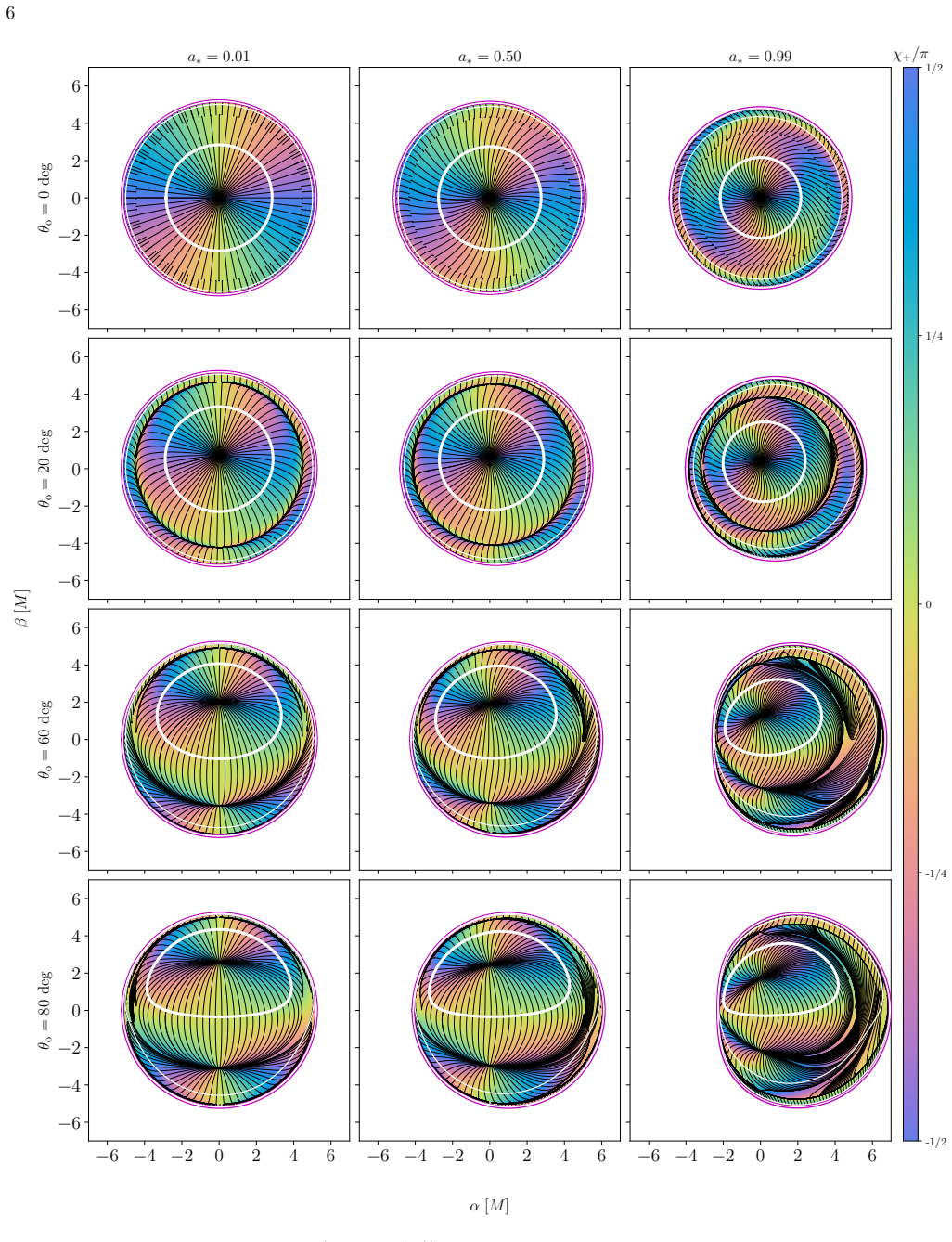
The linear polarization of synchrotron radiation at a black hole horizon is fixed solely by the black hole spin and observer inclination.
A machine-rendered reading of the paper's core claim, the machinery that carries it, and where it could break.
Core claim
In a time-stationary, axisymmetric, and degenerate Kerr magnetosphere, the linear polarization of synchrotron radiation emitted from the base of horizon-threading field lines follows a universal pattern that is completely determined by the black hole spin and observer inclination, independent of magnetic field geometry, and is described by a simple analytic formula; time-averaged GRMHD images approach this same pattern.
What carries the argument
The universal horizon polarization pattern for synchrotron emission, obtained from the direction of electromagnetic energy flow along horizon-threading field lines in the degenerate Kerr magnetosphere.
If this is right
- Time-averaged images from general relativistic magnetohydrodynamic simulations converge to the same analytic polarization pattern.
- Future very-long-baseline interferometry at microarcsecond resolution could detect the approach to this horizon polarization value in M87*.
- Detection of the pattern would enable direct measurements of black hole spin from polarization data.
- Confirmation would indicate that magnetic field lines thread the horizon and extract rotational energy through the Blandford-Znajek process.
Where Pith is reading between the lines
- Polarization maps could be used to distinguish spin-powered from accretion-powered energy flows in other supermassive black holes.
- The result suggests that time-averaged polarization observations may recover the universal pattern even in mildly time-dependent flows.
- Next-generation arrays could test whether the predicted pattern appears in additional targets beyond M87*.
Load-bearing premise
Emission originates from the base of horizon-threading field lines inside a time-stationary, axisymmetric, and degenerate Kerr magnetosphere.
What would settle it
If microarcsecond VLBI observations of M87* reveal polarization patterns that change with magnetic field geometry or fail to match the predicted spin- and inclination-dependent formula, the universality claim would be ruled out.
Figures



read the original abstract
Polarized images of a black hole encode the direction of electromagnetic energy flow near its event horizon. Measuring polarization from near-horizon emission can determine whether this energy flow is powered by the accreting plasma or the black hole spin. Here we consider the linear polarization of synchrotron radiation emitted from the base of horizon-threading field lines in a time-stationary, axisymmetric, and degenerate Kerr magnetosphere. We show that the observed polarization pattern displays universal behavior: it is completely determined by the black hole spin and observer inclination and is independent of the magnetic field geometry. We derive a simple analytic formula for this spin-dependent horizon polarization pattern. We find that this predicted pattern is also approached in time-averaged images from General Relativistic Magnetohydrodynamic simulations. Future observations with Very-Long-Baseline Interferometry at microarcsecond resolution could detect the trend of polarization toward the unique horizon value in M87*. Such observations may enable new measurements of black hole spin and provide evidence that magnetic field lines thread the horizon and extract spin energy via the Blandford--Znajek process.
Editorial analysis
A structured set of objections, weighed in public.
Referee Report
Summary. The manuscript claims that synchrotron linear polarization emitted from the base of horizon-threading field lines in a time-stationary, axisymmetric, degenerate Kerr magnetosphere exhibits a universal pattern fixed solely by black-hole spin and observer inclination, independent of magnetic-field geometry. An analytic formula for the spin-dependent horizon polarization is derived and shown to be approached in time-averaged GRMHD images, with suggested applications to VLBI spin measurements in M87* and tests of the Blandford-Znajek process.
Significance. If the central derivation holds, the result supplies a clean, parameter-free (under the stated assumptions) analytic prediction for near-horizon polarization that is directly testable with microarcsecond VLBI. The explicit verification against GRMHD time averages and the transparent conditioning on stationarity, axisymmetry, and degeneracy constitute genuine strengths that elevate the work beyond purely numerical explorations.
minor comments (3)
- [Abstract] Abstract, final paragraph: the statement that the pattern 'is also approached in time-averaged images' would benefit from a quantitative metric (e.g., rms deviation in polarization angle inside 5 r_g) rather than a qualitative description.
- [Introduction] The term 'degenerate Kerr magnetosphere' is used without a one-sentence definition or reference in the introduction; a brief parenthetical clarification would aid readers outside the immediate subfield.
- [Figure 4] Figure captions for the GRMHD comparison panels should explicitly state the time-averaging interval and the radial range over which the analytic formula is evaluated.
Simulated Author's Rebuttal
We thank the referee for their positive evaluation of the manuscript, including the recognition of its analytic derivation, verification against GRMHD, and potential applications to VLBI observations. We are pleased that the referee recommends acceptance.
Circularity Check
No significant circularity in derivation chain
full rationale
The paper derives the claimed universal polarization pattern analytically from the Kerr metric, synchrotron emissivity, and the explicit model assumptions (time-stationary, axisymmetric, degenerate magnetosphere with emission at the base of horizon-threading field lines). The independence from magnetic field geometry is shown to follow directly within this setup, and the result is not obtained by fitting parameters, renaming known results, or load-bearing self-citations. The derivation chain remains self-contained against the stated first-principles inputs.
Axiom & Free-Parameter Ledger
axioms (3)
- standard math Kerr spacetime is the background geometry
- domain assumption Magnetosphere is time-stationary, axisymmetric, and degenerate
- domain assumption Synchrotron radiation is emitted from the base of horizon-threading field lines
Forward citations
Cited by 1 Pith paper
-
Distinct Near-Horizon Trend of Synchrotron Polarization in Kerr Spacetime
Near-horizon synchrotron polarization in Kerr spacetime admits a distinct analytic form where the leading-order pattern depends only on spin and polar angle under stationary axisymmetric degenerate EM field assumptions.
Reference graph
Works this paper leans on
-
[1]
Bardeen, J. M. 1973, in Black Holes (Les Astres Occlus), ed. C. Dewitt & B. S. Dewitt, 215–239
1973
-
[2]
Beloborodov, A. M. 2002, ApJL, 566, L85, doi: 10.1086/339511
-
[3]
Blandford, R. D., & Znajek, R. L. 1977, MNRAS, 179, 433, doi: 10.1093/mnras/179.3.433
-
[4]
2022, eht-imaging, v1.2.4 Zenodo, doi: 10.5281/zenodo.7226661
Chael, A. 2022, eht-imaging, v1.2.4 Zenodo, doi: 10.5281/zenodo.7226661
-
[5]
2023, kgeo, v0.1 Zenodo, doi: 10.5281/zenodo.8092969
Chael, A. 2023, kgeo, v0.1 Zenodo, doi: 10.5281/zenodo.8092969
-
[6]
Chael, A., Johnson, M. D., Bouman, K. L., et al. 2018, ApJ, 857, 23, doi: 10.3847/1538-4357/aab6a8
-
[7]
Chael, A., Johnson, M. D., & Lupsasca, A. 2021, ApJ, 918, 6, doi: 10.3847/1538-4357/ac09ee
-
[8]
Chael, A., Johnson, M. D., Narayan, R., et al. 2016, ApJ, 829, 11, doi: 10.3847/0004-637X/829/1/11
-
[9]
Chael, A., Lupsasca, A., Wong, G. N., & Quataert, E. 2023, ApJ, 958, 65, doi: 10.3847/1538-4357/acf92d
-
[10]
2016, MNRAS, 462, 115, doi: 10.1093/mnras/stw1526 Event Horizon Telescope Collaboration, et al
Dexter, J. 2016, MNRAS, 462, 115, doi: 10.1093/mnras/stw1526 Event Horizon Telescope Collaboration, et al. 2019a, ApJL, 875, L1, doi: 10.3847/2041-8213/ab0ec7 Event Horizon Telescope Collaboration, et al. 2019b, ApJL, 875, L4, doi: 10.3847/2041-8213/ab0e85 Event Horizon Telescope Collaboration, et al. 2019c, ApJL, 875, L5, doi: 10.3847/2041-8213/ab0f43 Ev...
-
[11]
Gammie, C. F., McKinney, J. C., & Tóth, G. 2003, ApJ, 589, 444, doi: 10.1086/374594
-
[12]
2025, ApJ, 981, 204, doi: 10.3847/1538-4357/adb1aa
Gelles, Z., Chael, A., & Quataert, E. 2025, ApJ, 981, 204, doi: 10.3847/1538-4357/adb1aa
-
[13]
2026a, ApJ, 1001, 206, doi: 10.3847/1538-4357/ae5223
Gelles, Z., Chael, A., & Quataert, E. 2026a, ApJ, 1001, 206, doi: 10.3847/1538-4357/ae5223
-
[14]
Gralla, S. E., & Lupsasca, A. 2020a, PhRvD, 101, 044032, doi: 10.1103/PhysRevD.101.044032
-
[15]
Gralla, S. E., & Lupsasca, A. 2020b, PhRvD, 101, 044031, doi: 10.1103/PhysRevD.101.044031
-
[16]
Harris, C. R., Millman, K. J., van der Walt, S. J., et al. 2020, Nature, 585, 357, doi: 10.1038/s41586-020-2649-2
-
[17]
D., Lupsasca, A., & Strominger, A
Himwich, E., Johnson, M. D., Lupsasca, A., & Strominger, A. 2020, PhRvD, 101, 084020, doi: 10.1103/PhysRevD.101.084020
-
[18]
Ho, L. C. 2008, ARA&A, 46, 475, doi: 10.1146/annurev.astro.45.051806.110546
work page internal anchor Pith review Pith/arXiv arXiv doi:10.1146/annurev.astro.45.051806.110546 2008
-
[19]
2025, ApJL, 988, L51, doi: 10.3847/2041-8213/adee09
Hou, Y., Huang, J., Guo, M., Mizuno, Y., & Chen, B. 2025, ApJL, 988, L51, doi: 10.3847/2041-8213/adee09
-
[20]
Hunter, J. D. 2007, Computing in Science and Engineering, 9, 90, doi: 10.1109/MCSE.2007.55
-
[21]
2006, Classical and Quantum Gravity, 23, 2895, doi: 10.1088/0264-9381/23/9/008
Jezierski, J., & Lukasik, M. 2006, Classical and Quantum Gravity, 23, 2895, doi: 10.1088/0264-9381/23/9/008
-
[22]
D., Lupsasca, A., Strominger, A., et al
Johnson, M. D., Lupsasca, A., Strominger, A., et al. 2020, Science Advances, 6, eaaz1310, doi: 10.1126/sciadv.aaz1310
-
[23]
D., Akiyama, K., Baturin, R., et al
Johnson, M. D., Akiyama, K., Baturin, R., et al. 2024, in Society of Photo-Optical Instrumentation Engineers (SPIE) Conference Series, Vol. 13092, Space Telescopes and Instrumentation 2024: Optical, Infrared, and Millimeter Wave, ed. L. E. Coyle, S. Matsuura, & M. D. Perrin, 130922D, doi: 10.1117/12.3019835
-
[24]
1969, Journal of Mathematical Physics, 10, 1195, doi: 10.1063/1.1664958
Kinnersley, W. 1969, Journal of Mathematical Physics, 10, 1195, doi: 10.1063/1.1664958
-
[25]
2020, Proceedings of the Royal Society A:
Strominger, A. 2020, Proceedings of the Royal Society A:
2020
-
[26]
Mathematical, Physical and Engineering Sciences, 476, 20190618, doi: 10.1098/rspa.2019.0618
-
[27]
McKinney, J. C., & Gammie, C. F. 2004, ApJ, 611, 977, doi: 10.1086/422244 Mościbrodzka, M., Falcke, H., & Shiokawa, H. 2016, A&A, 586, A38, doi: 10.1051/0004-6361/201526630 Mościbrodzka, M., & Gammie, C. F. 2018, MNRAS, 475, 43, doi: 10.1093/mnras/stx3162
-
[28]
Narayan, R., Igumenshchev, I. V., & Abramowicz, M. A. 2003, PASJ, 55, L69, doi: 10.1093/pasj/55.6.L69
-
[29]
Noble, S. C., Leung, P. K., Gammie, C. F., & Book, L. G. 2007, Classical and Quantum Gravity, 24, S259, doi: 10.1088/0264-9381/24/12/S17
-
[30]
Palumbo, D. C. M., Wong, G. N., & Prather, B. S. 2020, ApJ, 894, 156, doi: 10.3847/1538-4357/ab86ac
-
[31]
Pandya, A., Zhang, Z., Chandra, M., & Gammie, C. F. 2016, ApJ, 822, 34, doi: 10.3847/0004-637X/822/1/34
-
[32]
W., Blackburn, L., Chaves, R., et al
Pesce, D. W., Blackburn, L., Chaves, R., et al. 2024, ApJ, 968, 69, doi: 10.3847/1538-4357/ad3961
-
[33]
2004, PhRvD, 70, 084044, doi: 10.1103/PhysRevD.70.084044
Poisson, E. 2004, PhRvD, 70, 084044, doi: 10.1103/PhysRevD.70.084044
-
[34]
B., & Lightman, A
Rybicki, G. B., & Lightman, A. P. 1979, Radiative processes in astrophysics
1979
-
[35]
Stone, J. M., Mullen, P. D., Fielding, D., et al. 2026, ApJS, 283, 27, doi: 10.3847/1538-4365/ae3717
-
[36]
1969, Tohoku Mathematical Journal, Second Series, 21, 56, doi: 10.2748/tmj/1178243034
Tachibana, S.-i. 1969, Tohoku Mathematical Journal, Second Series, 21, 56, doi: 10.2748/tmj/1178243034
-
[37]
Teukolsky, S. A. 1973, ApJ, 185, 635, doi: 10.1086/152444
-
[38]
Virtanen, P., Gommers, R., Oliphant, T. E., et al. 2020, Nature Methods, 17, 261, doi: 10.1038/s41592-019-0686-2
-
[39]
1970, Communications in Mathematical Physics, 18, 265, doi: 10.1007/BF01649445
Walker, M., & Penrose, R. 1970, Communications in Mathematical Physics, 18, 265, doi: 10.1007/BF01649445
-
[40]
N., Chael, A., Lupsasca, A., & Quataert, E
Wong, G. N., Chael, A., Lupsasca, A., & Quataert, E. 2026, ApJ, 997, 113, doi: 10.3847/1538-4357/ae20f3
-
[41]
2014, ARA&A, 52, 529, doi: 10.1146/annurev-astro-082812-141003
Yuan, F., & Narayan, R. 2014, ARA&A, 52, 529, doi: 10.1146/annurev-astro-082812-141003
work page internal anchor Pith review doi:10.1146/annurev-astro-082812-141003 2014
-
[42]
Znajek, R. L. 1977, MNRAS, 179, 457, doi: 10.1093/mnras/179.3.457
discussion (0)
Sign in with ORCID, Apple, or X to comment. Anyone can read and Pith papers without signing in.