Predicting Cognitive Load from Speech and Interaction Dynamics in Dyadic Conversations
Pith reviewed 2026-06-27 07:04 UTC · model grok-4.3
The pith
Speech and interaction dynamics in dyadic conversations predict perceived cognitive load related to time pressure and mental demand.
A machine-rendered reading of the paper's core claim, the machinery that carries it, and where it could break.
Core claim
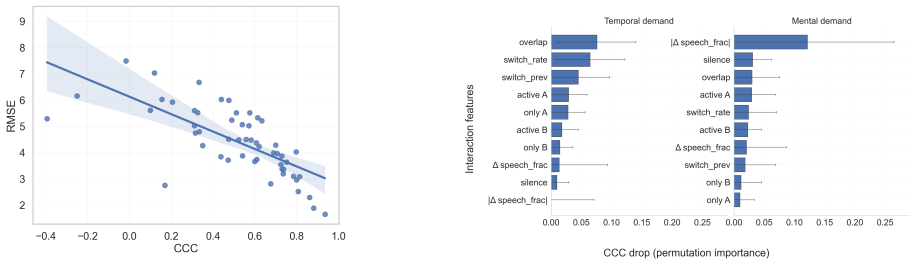
In dyadic collaborative conversations, temporal demand correlates with turn-taking dynamics including overlap and speaker switch, while mental demand correlates with imbalanced participation between speakers; these interaction features, together with acoustic and dynamic speech measures, supply useful predictive signals for cognitive load dimensions tied to time pressure, mental work, effort, and task performance.
What carries the argument
Two-head Gated Recurrent Unit encoder trained on static acoustic, dynamic, and interaction features extracted from audio recordings of 53 dyads.
Load-bearing premise
Self-reported cognitive load scores collected after tasks accurately reflect the load experienced during the conversations, and the extracted features capture the relevant variance without substantial confounding from task-specific content or individual differences.
What would settle it
A controlled experiment that manipulates time pressure and mental demand independently while holding conversational content fixed, then checks whether the same overlap, switch, and participation-balance features still predict the manipulated load dimensions.
Figures
read the original abstract
Estimating cognitive load from speech has largely been studied in controlled laboratory settings, with limited understanding of its reliability in natural collaborative conversations. We investigate whether speech and interaction dynamics predict perceived cognitive load during dyadic conversations. We analyze audio from 53 dyads performing nine collaborative tasks and extract static acoustic, dynamic, and interaction features to train a two-head Gated Recurrent Unit encoder to predict cognitive load scores. Results show conversational interaction provides useful signals for predicting cognitive load related to time pressure, mental work, effort, and task performance. Temporal demand is associated with turn-taking dynamics such as overlap and speaker switch, while mental demand is linked to imbalanced participation between speakers. These findings highlight the importance of task structure and conversational interaction for modeling cognitive load in natural collaborative settings.
Editorial analysis
A structured set of objections, weighed in public.
Referee Report
Summary. The paper claims that speech and interaction dynamics extracted from audio of 53 dyads performing nine collaborative tasks can be used to predict perceived cognitive load via a two-head GRU encoder. Static acoustic, dynamic, and interaction features are shown to provide useful signals, with temporal demand associated with turn-taking features such as overlap and speaker switches, and mental demand linked to imbalanced participation; the work emphasizes the role of task structure in natural collaborative settings.
Significance. If the associations survive controls for confounds, the result would be significant as one of the first demonstrations that conversational interaction dynamics carry predictive information for distinct NASA-TLX dimensions outside laboratory monologue settings. The multi-task dyadic design and explicit separation of temporal versus mental demand are strengths that could inform downstream applications in team monitoring or adaptive interfaces.
major comments (2)
- [Data collection / ground-truth subsection] Data collection / ground-truth subsection: the central claim that interaction features predict cognitive load rests on post-task self-reported scores serving as reliable targets for the GRU; the manuscript provides no description of controls for retrospective bias, task-identity confounds (the nine tasks differ systematically in structure), or speaker-level random effects, any of which would render the reported turn-taking associations spurious.
- [Results / feature analysis] Results / feature analysis: the associations between overlap/speaker-switch statistics and temporal demand, and between participation imbalance and mental demand, are presented without reported statistical tests that partial out task identity or individual differences; if these tests are absent or under-powered, the load-bearing empirical claim is not yet supported.
minor comments (2)
- [Model architecture] The two-head GRU architecture and exact definition of the interaction features are described at a high level only; adding a table or pseudocode would improve reproducibility.
- [Evaluation] No mention of cross-validation scheme or confidence intervals on the reported prediction performance; these should be added for standard ML reporting.
Simulated Author's Rebuttal
We thank the referee for the constructive critique, which identifies key gaps in our handling of potential confounds and statistical controls. We address each major comment below and commit to revisions that directly strengthen the empirical support for the reported associations.
read point-by-point responses
-
Referee: [Data collection / ground-truth subsection] the manuscript provides no description of controls for retrospective bias, task-identity confounds (the nine tasks differ systematically in structure), or speaker-level random effects, any of which would render the reported turn-taking associations spurious.
Authors: We agree the current manuscript lacks explicit discussion of these issues. Post-task NASA-TLX ratings are the standard ground truth in cognitive-load studies, but retrospective bias is a recognized limitation we will now acknowledge in a dedicated limitations paragraph. Task-identity confounds are partially mitigated by the multi-task design, yet we will add a mixed-effects analysis treating task as a random factor and report whether turn-taking coefficients remain significant. Speaker-level random effects will be addressed by clarifying that the GRU processes dyad-level sequences while we will include participant ID as a covariate in supplementary regression models. These additions will appear in the revised Data Collection and Results sections. revision: yes
-
Referee: [Results / feature analysis] the associations between overlap/speaker-switch statistics and temporal demand, and between participation imbalance and mental demand, are presented without reported statistical tests that partial out task identity or individual differences; if these tests are absent or under-powered, the load-bearing empirical claim is not yet supported.
Authors: The manuscript currently presents these links via feature-importance rankings from the trained GRU rather than explicit partial-correlation or regression tests. We will add supplementary analyses that compute partial correlations and linear mixed models controlling for task identity and participant as random effects. If the associations survive these controls we will report the updated coefficients and p-values; if power is insufficient we will note this limitation and qualify the claims accordingly. The revised Results section will include these tests. revision: yes
Circularity Check
No circularity: empirical ML prediction from features to self-report targets
full rationale
The paper describes an empirical pipeline: extract acoustic and interaction features from dyadic audio, train a GRU encoder on those features to regress NASA-TLX-style self-reported cognitive load scores collected after tasks. No equations, ansatzes, or uniqueness theorems are invoked; the reported associations are statistical outputs of supervised training rather than quantities defined in terms of the model's own fitted parameters or prior self-citations. The work is therefore self-contained as a standard feature-based prediction study and does not reduce any central claim to its inputs by construction.
Axiom & Free-Parameter Ledger
axioms (2)
- domain assumption Self-reported cognitive load scores collected after collaborative tasks accurately reflect experienced load during the interaction.
- domain assumption Extracted static acoustic, dynamic, and interaction features capture the relevant variance in cognitive load without substantial confounding from task content or speaker identity.
Reference graph
Works this paper leans on
-
[1]
Introduction The recent rapid shift toward remote and hybrid work has in- tensified reliance on voice-mediated collaboration across geo- graphically distributed teams. Prior research in safety-critical domains such as driving and construction shows that cogni- tive overload from voice communication during a task can de- grade task performance, increase er...
-
[2]
Predicting Cognitive Load from Speech and Interaction Dynamics in Dyadic Conversations
Data In this work, we used A VCAffe [26], an audiovisual dataset of remote collaboration and conversation recorded over a video- conferencing platform. Each conversation involves a dyad col- laborating to complete up to nine tasks of varying levels of cog- nitive demand. We choose this dataset for several reasons: 1) the dataset is not collected from the ...
work page internal anchor Pith review Pith/arXiv arXiv 2026
-
[3]
Method 3.1. Features Static Acoustic Features.For any sample with speech activ- ity, we use OpenSMILE [28] with its eGeMAPSv02 (extended Geneva Minimalistic Acoustic Parameter Set) [29] feature set, designed and widely used in voice research and affective com- puting. The feature set includes prosodic, spectral, cepstral, and voice-quality descriptors (e....
-
[4]
Note thatnmodels are trained onn−1dyads, tested on hold-out dyads (n= 53)
Can we model cognitive load during dyadic conversations as a regression task using speech samples? To answer this question, we trained our baseline (RF) and GRU-based neural encoder model with static acoustic features to predict all six dimensions of task load. Note thatnmodels are trained onn−1dyads, tested on hold-out dyads (n= 53). We report performanc...
-
[5]
Specif- ically, we considered three primary sets (section 3.1): static Figure 1:Per dyad CCC vs
Do dynamic acoustic and interaction features provide complementary signals to acoustic features that improve cognitive load prediction? To answer this, we assessed prediction performance for 4 workload dimensions (excluding frustration and physical de- mand) with different feature sets used for modeling. Specif- ically, we considered three primary sets (s...
-
[6]
To what extent does predictive signal reflect task- specific interaction pattern rather than cognitive load itself? Dyad Variability.We observed from our earlier experi- ments that cognitive load prediction performance varied for dif- ferent load dimensions. While dyad-level meanCCCis0.51, which is moderate, it weakens the dyad-specific signal.CCC for eac...
-
[7]
Our results here are based solely on speech dynamics and conversational coordination, calculated from voice activity
Limitations and Future Work The work presented here is based on a relatively small dataset (53 dyads and 475 task samples), which limits the ability of se- quence models like GRU with attention to fully leverage tempo- ral conversational dynamics. Our results here are based solely on speech dynamics and conversational coordination, calculated from voice a...
-
[8]
We also thank the reviewers for their helpful comments to im- prove this work
Acknowledgments We thank the AIIM lab, Queen’s University, Canada, for col- lecting, preparing, and making this dataset publicly available. We also thank the reviewers for their helpful comments to im- prove this work. This work was supported by the Henry Luce Foundation
-
[9]
Generative AI Use Disclosure Generative AI (GPT 5.2) was used for LaTex table and figure formatting
-
[10]
V oice con- trol tasks on cognitive workload and driving performance: Impli- cations of modality, difficulty, and duration,
E. E. Miller, L. N. Boyle, J. W. Jenness, and J. D. Lee, “V oice con- trol tasks on cognitive workload and driving performance: Impli- cations of modality, difficulty, and duration,”Transportation Re- search Record, vol. 2672, no. 37, pp. 84–93, 2018
2018
-
[11]
Effects of voice tech- nology on test track driving performance: Implications for driver distraction,
T. A. Ranney, J. L. Harbluk, and Y . I. Noy, “Effects of voice tech- nology on test track driving performance: Implications for driver distraction,”Human factors, vol. 47, no. 2, pp. 439–454, 2005
2005
-
[12]
Using hierarchical task analysis to compare four vehicle manufacturers’ infotainment systems,
I. J. Reagan and D. G. Kidd, “Using hierarchical task analysis to compare four vehicle manufacturers’ infotainment systems,” in Proceedings of the Human Factors and Ergonomics Society An- nual Meeting, vol. 57, no. 1. SAGE Publications Sage CA: Los Angeles, CA, 2013, pp. 1495–1499
2013
-
[13]
Cognitive load reduces perceived linguis- tic convergence between dyads,
J. Abel and M. Babel, “Cognitive load reduces perceived linguis- tic convergence between dyads,”Language and Speech, vol. 60, no. 3, pp. 479–502, 2017
2017
-
[14]
Development of nasa-tlx (task load index): Results of empirical and theoretical research,
S. G. Hart and L. E. Staveland, “Development of nasa-tlx (task load index): Results of empirical and theoretical research,” inAd- vances in psychology. Elsevier, 1988, vol. 52, pp. 139–183
1988
-
[15]
Cognitive load estimation from speech commands to simulated aircraft,
M. Vukovic, M. Stolar, and M. Lech, “Cognitive load estimation from speech commands to simulated aircraft,”IEEE/ACM Trans- actions on Audio, Speech, and Language Processing, vol. 29, pp. 1011–1022, 2021
2021
-
[16]
Cognitive load assessment of air traffic controller based on scnn-transe network using speech data,
J. Yang, H. Yang, Z. Wu, and X. Wu, “Cognitive load assessment of air traffic controller based on scnn-transe network using speech data,”Aerospace, vol. 10, no. 7, 2023
2023
-
[17]
Beyond the black box: V ocal biomarkers for moni- toring stress in pilot-atc communication,
M. Gnerre, “Beyond the black box: V ocal biomarkers for moni- toring stress in pilot-atc communication,” Ph.D. dissertation, Pub- lications at Universit `a Cattolica del Sacro Cuore, Milano, Italy, 2026
2026
-
[18]
Systematic review of neu- rophysiological assessment techniques and metrics for mental workload evaluation in real-world settings,
M. Diarra, J. Theurel, and B. Paty, “Systematic review of neu- rophysiological assessment techniques and metrics for mental workload evaluation in real-world settings,”Frontiers in Neuroer- gonomics, 2025
2025
-
[19]
Estimating cognitive load from speech gathered in a complex real-life training exercise,
M. Vukovic, V . Sethu, J. Parker, L. Cavedon, M. Lech, and J. Thangarajah, “Estimating cognitive load from speech gathered in a complex real-life training exercise,”International Journal of Human-Computer Studies, vol. 124, pp. 116–133, 2019
2019
-
[20]
Analysis of collabora- tive communication for linguistic cues of cognitive load,
M. A. Khawaja, F. Chen, and N. Marcus, “Analysis of collabora- tive communication for linguistic cues of cognitive load,”Human factors, vol. 54, no. 4, pp. 518–529, 2012
2012
-
[21]
Vlachostergiou, A
A. Vlachostergiou, A. Harisson, and P. Khooshabeh, “See with your eyes, hear with your ears and listen to your heart: Moving from dyadic teamwork interaction towards a more effective team cohesion and collaboration in long-term spaceflights under stress- ful conditions,”Big Data and Cognitive Computing, vol. 4, no. 3, p. 18, 2020
2020
-
[22]
Automatic cognitive load detection from speech features,
B. Yin, N. Ruiz, F. Chen, and M. Khawaja, “Automatic cognitive load detection from speech features,” 2007
2007
-
[23]
Speech-based cognitive load mon- itoring system,
B. Yin, F. Chen, and N. Ruiz, “Speech-based cognitive load mon- itoring system,” inIEEE International Conference on Acoustics, Speech and Signal Processing (ICASSP), 2008
2008
-
[24]
The interspeech 2014 computational paralinguistics challenge: Cognitive & phys- ical load, multitasking,
B. Schuller, S. Steidl, A. Batliner, J. Eppset al., “The interspeech 2014 computational paralinguistics challenge: Cognitive & phys- ical load, multitasking,” inProceedings of Interspeech, 2014
2014
-
[25]
Classification of cognitive load from speech using an i-vector framework,
M. Van Segbroeck, R. Travadi, C. Vaz, J. Kim, and M. Black, “Classification of cognitive load from speech using an i-vector framework,” inProceedings of Interspeech, 2014
2014
-
[26]
Cognitive load estimation from speech commands to simulated aircraft,
M. Vukovic, M. Stolar, and M. Lech, “Cognitive load estimation from speech commands to simulated aircraft,”IEEE/ACM Trans. Audio, Speech and Lang. Proc., vol. 29, p. 1011–1022, Feb
-
[27]
Available: https://doi.org/10.1109/TASLP.2021
[Online]. Available: https://doi.org/10.1109/TASLP.2021. 3057492
-
[28]
Recognising and explaining mental workload using low-interference method by fusing speech, ecg and eye tracking signals during simulated flight,
H. Xu, L. Wang, J. Zou, J. Zhang, R. Liet al., “Recognising and explaining mental workload using low-interference method by fusing speech, ecg and eye tracking signals during simulated flight,”Ergonomics, 2025
2025
-
[29]
Cognitive load pre- diction from multimodal physiological signals using multiview learning,
Y . Liu, Y . Yu, H. Tao, Z. Ye, S. Wanget al., “Cognitive load pre- diction from multimodal physiological signals using multiview learning,”IEEE Journal of Biomedical and Health Informatics, 2023
2023
-
[30]
Personalized task load prediction in speech communication,
R. P. Spang, K. El Hajal, S. M ¨oller, and M. Cernak, “Personalized task load prediction in speech communication,” inICASSP 2023 - 2023 IEEE International Conference on Acoustics, Speech and Signal Processing (ICASSP), 2023, pp. 1–5
2023
-
[31]
Comparison of psychophysiological and dual-task measures of listening effort,
S. Seeman and R. Sims, “Comparison of psychophysiological and dual-task measures of listening effort,”Journal of Speech, Lan- guage, and Hearing Research, 2015
2015
-
[32]
Human voice as a measure of mental load level,
S. Boyer, P. Paubel, R. Ruiz, and R. El Yagoubi, “Human voice as a measure of mental load level,”Journal of Speech, Language, and Hearing Research, 2018
2018
-
[33]
Prediction of mental effort derived from an automated vocal biomarker using machine learning in a large-scale remote sample,
N. Taptiklis, M. Su, J. Barnett, and C. Skirrow, “Prediction of mental effort derived from an automated vocal biomarker using machine learning in a large-scale remote sample,”Frontiers in Ar- tificial Intelligence, 2023
2023
-
[34]
Mental workload estimation with electroencephalogram signals by combining multi-space deep models,
H.-H. Nguyen, N. K. Iyortsuun, S. Kim, H.-J. Yang, and S.-H. Kim, “Mental workload estimation with electroencephalogram signals by combining multi-space deep models,”Biomedical Sig- nal Processing and Control, vol. 94, p. 106284, 2024
2024
-
[35]
Comparison between artificial neural network and multilinear re- gression models in an evaluation of cognitive workload in a flight simulator,
M. Hannula, K. Huttunen, J. Koskelo, T. Laitinen, and T. Leino, “Comparison between artificial neural network and multilinear re- gression models in an evaluation of cognitive workload in a flight simulator,”Computers in biology and medicine, vol. 38, no. 11- 12, pp. 1163–1170, 2008
2008
-
[36]
Avcaffe: A large scale audio- visual dataset of cognitive load and affect for remote work,
P. Sarkar, A. Posen, and A. Etemad, “Avcaffe: A large scale audio- visual dataset of cognitive load and affect for remote work,” in Proceedings of the AAAI Conference on Artificial Intelligence, vol. 37, no. 1, 2023, pp. 76–85
2023
-
[37]
Silero vad: pre-trained enterprise-grade voice activity detector (vad), number detector and language classifier,
S. Team, “Silero vad: pre-trained enterprise-grade voice activity detector (vad), number detector and language classifier,” https:// github.com/snakers4/silero-vad, 2024
2024
-
[38]
Opensmile: the mu- nich versatile and fast open-source audio feature extractor,
F. Eyben, M. W ¨ollmer, and B. Schuller, “Opensmile: the mu- nich versatile and fast open-source audio feature extractor,” in Proceedings of the 18th ACM international conference on Mul- timedia, 2010, pp. 1459–1462
2010
-
[39]
The geneva minimalistic acoustic parameter set (gemaps) for voice research and affective computing,
F. Eyben, K. R. Scherer, B. W. Schuller, J. Sundberg, E. Andr ´e, C. Busso, L. Y . Devillers, J. Epps, P. Laukka, S. S. Narayanan et al., “The geneva minimalistic acoustic parameter set (gemaps) for voice research and affective computing,”IEEE transactions on affective computing, vol. 7, no. 2, pp. 190–202, 2015
2015
-
[40]
Embedded inter- ruptions and task complexity influence schema-related cognitive load progression in an abstract learning task,
M. Wirzberger, S. E. Bijarsari, and G. D. Rey, “Embedded inter- ruptions and task complexity influence schema-related cognitive load progression in an abstract learning task,”Acta Psychologica, vol. 179, pp. 30–41, 2017
2017
-
[41]
Nasa-task load index (nasa-tlx); 20 years later,
S. G. Hart, “Nasa-task load index (nasa-tlx); 20 years later,” in Proceedings of the human factors and ergonomics society annual meeting, vol. 50, no. 9. Sage publications Sage CA: Los Angeles, CA, 2006, pp. 904–908
2006
-
[42]
On the properties of neural machine translation: Encoder–decoder ap- proaches,
K. Cho, B. Van Merri ¨enboer, D. Bahdanau, and Y . Bengio, “On the properties of neural machine translation: Encoder–decoder ap- proaches,” inProceedings of SSST-8, eighth workshop on syntax, semantics and structure in statistical translation, 2014, pp. 103– 111
2014
-
[43]
Empirical Evaluation of Gated Recurrent Neural Networks on Sequence Modeling
J. Chung, C. Gulcehre, K. Cho, and Y . Bengio, “Empirical evalu- ation of gated recurrent neural networks on sequence modeling,” arXiv preprint arXiv:1412.3555, 2014
work page internal anchor Pith review Pith/arXiv arXiv 2014
-
[44]
Continuous affect pre- diction using eye gaze and speech,
J. O’Dwyer, R. Flynn, and N. Murray, “Continuous affect pre- diction using eye gaze and speech,” in2017 IEEE International Conference on Bioinformatics and Biomedicine (BIBM). IEEE, 2017, pp. 2001–2007
2017
-
[45]
Detecting depression using vocal, facial and semantic communication cues,
K. Brady, Y . Gwon, P. Khorrami, E. Godoy, W. Campbell, C. Dagli, and T. S. Huang, “Multi-modal audio, video and physiological sensor learning for continuous emotion prediction,” inProceedings of the 6th International Workshop on Audio/Visual Emotion Challenge, 2016, pp. 97–104. [Online]. Available: https://doi.org/10.1145/2988257.2988264
-
[46]
Estimation of continuous valence and arousal levels from faces in naturalistic conditions,
A. Toisoul, J. Kossaifi, A. Bulat, G. Tzimiropoulos, and M. Pantic, “Estimation of continuous valence and arousal levels from faces in naturalistic conditions,”Nature Machine Intelligence, vol. 3, no. 1, pp. 42–50, 2021
2021
-
[47]
A multitask approach to continuous five-dimensional affect sensing in natural speech,
F. Eyben, M. W ¨ollmer, and B. Schuller, “A multitask approach to continuous five-dimensional affect sensing in natural speech,” ACM Transactions on Interactive Intelligent Systems (TiiS), vol. 2, no. 1, pp. 1–29, 2012
2012
-
[48]
Predicting exact valence and arousal values from eeg,
F. Galv ˜ao, S. M. Alarc ˜ao, and M. J. Fonseca, “Predicting exact valence and arousal values from eeg,”Sensors, vol. 21, no. 10, p. 3414, 2021
2021
-
[49]
Strength modelling for real-worldautomatic continuous affect recognition from audiovisual signals,
J. Han, Z. Zhang, N. Cummins, F. Ringeval, and B. Schuller, “Strength modelling for real-worldautomatic continuous affect recognition from audiovisual signals,”Image and Vision Comput- ing, vol. 65, pp. 76–86, 2017
2017
-
[50]
There was a long pause: influencing turn-taking behaviour in human-human and human-computer spoken dialogues,
A. Johnstone, U. Berry, T. Nguyen, and A. Asper, “There was a long pause: influencing turn-taking behaviour in human-human and human-computer spoken dialogues,”International Journal of Human-Computer Studies, vol. 42, no. 4, pp. 383–411, 1995
1995
-
[51]
Individual differences between interviewers and their effect on interviewees’ conversational behaviour,
F. Goldman-Eisler, “Individual differences between interviewers and their effect on interviewees’ conversational behaviour,”Jour- nal of Mental Science, vol. 98, no. 413, pp. 660–671, 1952
1952
discussion (0)
Sign in with ORCID, Apple, or X to comment. Anyone can read and Pith papers without signing in.