A Scalable Deflated Conjugate Gradient Solver for the Time-Dependent Pseudo-Stress Stokes Problem
Pith reviewed 2026-06-27 05:54 UTC · model grok-4.3
The pith
Deflated conjugate gradient paired with multigrid solves pseudo-stress Stokes equations stably as time steps shrink.
A machine-rendered reading of the paper's core claim, the machinery that carries it, and where it could break.
Core claim
By selecting the deflation subspace so the inner system of the deflated conjugate gradient method becomes a Laplace problem on the singular modes of the dev-dev operator, and solving that inner system with a W-cycle multigrid scheme employing a restricted additive Schwarz smoother, the resulting iteration accelerates conjugate gradient convergence and keeps iteration counts independent of the time step size for the time-dependent pseudo-stress Stokes problem.
What carries the argument
The deflation subspace chosen so that the inner system inside deflated CG reduces to a Laplace problem on the singular modes of the dev-dev operator.
If this is right
- Conjugate gradient convergence is accelerated for the target linear systems.
- Iteration counts remain stable when the time step is reduced.
- The solver is robust across different choices of spatial discretization.
- The combination of deflation and multigrid applies directly to the pseudo-stress formulation.
Where Pith is reading between the lines
- The same deflation idea could be tested on other mixed problems whose operators share similar singular kernels.
- The method may allow time-step sizes in flow simulations to be chosen purely from accuracy considerations rather than solver cost.
- Parallel performance in three space dimensions would depend on how well the inner Laplace multigrid scales on the chosen deflation space.
Load-bearing premise
The deflation subspace can be chosen so the inner system inside the deflated CG scheme is a Laplace problem on the singular modes of the dev-dev operator and does not depend on the spatial discretization method.
What would settle it
Numerical runs on the pseudo-stress Stokes problem in which the proposed solver shows no reduction in iteration count or in which convergence still slows as the time step is decreased.
Figures

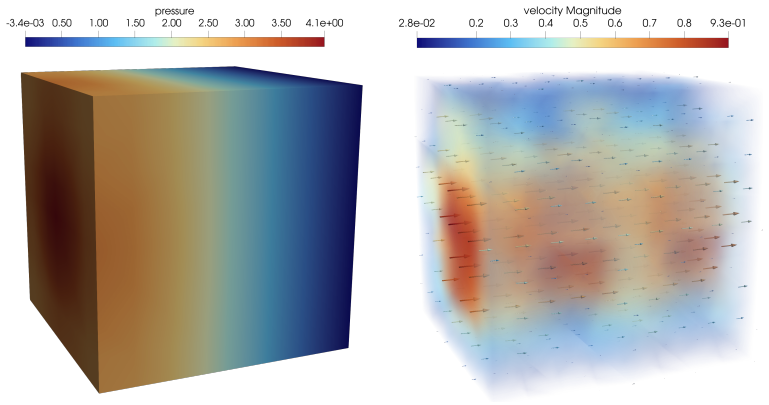
read the original abstract
We propose a novel iterative solution framework for the unsteady Stokes equations in the pseudo-stress formulation. When solving this class of problems by using implicit time-integration schemes, standard solvers suffer from deteriorating convergence properties for small time steps, independently of the chosen space discretisation method. This is due to the singular modes of the dev-dev operator. For this reason, we introduce a computational framework obtained by combining a deflated Conjugate Gradient method with a W-cycle multigrid scheme that employs a Restricted Additive Schwarz smoother. The key point is to choose the deflation subspace so that the inner system to be solved within a deflated Conjugate Gradient scheme corresponds to a Laplace problem defined on the singular modes of the original dev-dev operator. This results to be independent of the spatial discretisation method and allows one to use efficient multigrid iterative solvers. Numerical experiments show that the proposed strategy significantly accelerates the Conjugate Gradient convergence and provides stable performance with respect to the time step, confirming its robustness for solving linear systems in the pseudo-stress framework.
Editorial analysis
A structured set of objections, weighed in public.
Referee Report
Summary. The manuscript proposes a deflated Conjugate Gradient solver combined with a W-cycle multigrid scheme (using Restricted Additive Schwarz smoother) for the time-dependent pseudo-stress Stokes problem. The central claim is that an appropriate choice of deflation subspace reduces the inner system to a Laplace problem on the singular modes of the dev-dev operator; this reduction is asserted to be independent of the spatial discretization method. Numerical experiments are stated to demonstrate significant acceleration of CG convergence and stability with respect to the time step.
Significance. If the discretization-independence claim holds and is supported by explicit construction and cross-method verification, the approach would supply a robust, scalable solver for this class of singular systems where standard CG deteriorates for small time steps. The constructive combination of deflation and multigrid is a clear algorithmic strength.
major comments (2)
- [Abstract] Abstract: the claim that the deflation subspace can be chosen so the inner deflated-CG system 'corresponds to a Laplace problem ... independent of the spatial discretisation method' is load-bearing for the robustness and scalability assertions, yet the manuscript supplies neither the explicit subspace construction nor any numerical confirmation that the same Laplace operator arises for distinct discretizations (e.g., different finite-element spaces).
- [Numerical experiments] Numerical experiments (as summarized in the abstract): the statement that experiments 'significantly accelerate ... and provide stable performance' is presented without quantitative metrics, iteration counts, error bars, or implementation details, rendering the central performance claim unverifiable.
minor comments (1)
- Clarify the precise definition of the dev-dev operator and its singular modes in the continuous and discrete settings.
Simulated Author's Rebuttal
We thank the referee for the careful review and constructive comments. We address each major comment below and will make the indicated revisions to strengthen the manuscript.
read point-by-point responses
-
Referee: [Abstract] Abstract: the claim that the deflation subspace can be chosen so the inner deflated-CG system 'corresponds to a Laplace problem ... independent of the spatial discretisation method' is load-bearing for the robustness and scalability assertions, yet the manuscript supplies neither the explicit subspace construction nor any numerical confirmation that the same Laplace operator arises for distinct discretizations (e.g., different finite-element spaces).
Authors: The manuscript derives the deflation subspace from the kernel of the dev-dev operator and shows theoretically that this choice reduces the inner system to a Laplace problem on the singular modes. We agree, however, that an explicit construction of the subspace and numerical verification across distinct discretizations are not sufficiently detailed. We will add a dedicated subsection providing the explicit subspace construction and include additional experiments using at least two different finite-element spaces to confirm that the reduced operator is the same Laplace problem independent of the discretization method. revision: yes
-
Referee: [Numerical experiments] Numerical experiments (as summarized in the abstract): the statement that experiments 'significantly accelerate ... and provide stable performance' is presented without quantitative metrics, iteration counts, error bars, or implementation details, rendering the central performance claim unverifiable.
Authors: The full manuscript contains numerical experiments in Section 5 that demonstrate the claimed acceleration and stability with respect to the time step. We acknowledge that the abstract and the summary of results lack specific quantitative metrics. We will revise the abstract to report key quantitative results (e.g., iteration counts for representative time-step sizes) and expand the numerical section with tables containing iteration counts, implementation details, and error bars where appropriate. revision: yes
Circularity Check
No significant circularity; algorithmic construction is self-contained
full rationale
The paper constructs a deflated CG + multigrid solver by explicitly choosing a deflation subspace that reduces the inner system to a Laplace problem on the singular modes of the dev-dev operator. This choice is presented as a design decision that yields discretization independence, with the resulting performance claims supported by numerical experiments rather than any fitted parameters, self-referential predictions, or load-bearing self-citations. No derivation step reduces by construction to its own inputs; the method is a standard algorithmic combination tested on the target problem class.
Axiom & Free-Parameter Ledger
axioms (2)
- standard math Conjugate gradient converges for symmetric positive definite matrices
- domain assumption Multigrid methods converge efficiently for elliptic Laplace problems
Forward citations
Cited by 1 Pith paper
-
Online Spectral Deflation for State Constrained Optimal Control Problems
Spectral deflation anchored to a single reference Schur complement reduces CG iterations 55-98% across diffusion, convection-diffusion, and heat-transfer benchmarks by restricting low eigenmodes to varying inactive sets.
Reference graph
Works this paper leans on
-
[1]
Antonietti, P. F. and Bonetti, S. and Botti, M. and Corti, M. and Fumagalli, I. and Mazzieri, I. lymph: discontinuous poLYtopal methods for Multi-PHysics differential problems.ACM Trans. Math. Softw., 51 (2025), pp. 1–22
2025
-
[2]
Antonietti, P. F. and Botti, M. and Cancrini, A. and Mazzieri, I. A polytopal discontin- uous Galerkin method for the pseudo-stress formulation of the unsteady Stokes problem. Comput. Methods Appl. Mech. Eng., 447 (2025)
2025
-
[3]
Antonietti, P. F. and Cancrini, A. and Ciaramella, G. Numerical verification of PolyDG algebraic solvers for the pseudo-stress Stokes problem.arXiv preprintarXiv:2512.02537 (2025). Accepted in DD29 Proceedings, Springer
arXiv 2025
-
[4]
Antonietti, P. F. and Houston, P. and Sarti, M. and Verani, M. Multigrid algorithms for hp-version interior penalty discontinuous Galerkin methods on polygonal and polyhedral meshes.Numer. Math., 54 (2014), pp. 2009–2041
2014
-
[5]
Antonietti, P. F. and Pennesi, G. V-cycle multigrid algorithms for discontinuous Galerkin methods on non-nested polytopic meshes.J. Sci. Comput., 78 (2017), pp. 625–652
2017
-
[6]
Antonietti, P. F. and Sarti, M. and Verani, M. and Zikatanov, L. T. A uniform additive Schwarz preconditioner for high-order discontinuous Galerkin approximations of elliptic problems.J. Sci. Comput., 70 (2017), pp. 608–630
2017
-
[7]
Arnold, D. N. and Douglas, J. Jr. and Gupta, C. P. A family of higher order mixed finite element methods for plane elasticity.Numer. Math., 45 (1984), pp. 1–22
1984
-
[8]
Arnold, D. N. and Winther, R. Mixed finite elements for elasticity.Numer. Math., 92 (2002), pp. 401–419
2002
-
[9]
Cambridge University Press, 1996
Axelsson, O.Iterative Solution Methods. Cambridge University Press, 1996. 22
1996
-
[10]
Baaijens, F. P. T. Mixed finite element methods for viscoelastic flow analysis: A review. J. Non-Newtonian Fluid Mech., 79 (1998), pp. 361–385
1998
-
[11]
Bramble, J. H. and Ewing, R. E. and Pasciak, J. E. and Shen, J. The analysis of multigrid algorithms for cell centered finite difference methods.Adv. Comp. Math., 5 (1996), pp. 15–29
1996
-
[12]
Bramble, J. H. and Pasciak, J. E. The analysis of smoothers for multigrid algorithms. Math. Comp., 58 (1992), pp. 467–488
1992
-
[13]
Bramble, J. H. and Pasciak, J. E. and Xu, J. The analysis of multigrid algorithms with nonnested spaces or noninherited quadratic forms.Math. Comp., 56 (1991), pp. 1–34
1991
-
[14]
and Douglas, J
Brezzi, F. and Douglas, J. and Duran, R. and Fortin, M. Mixed finite elements for second order elliptic problems in three variables.Numer. Math., 51 (1987), pp. 237–250
1987
-
[15]
and Douglas, J
Brezzi, F. and Douglas, J. and Marini, L. Two families of mixed finite elements for second order elliptic problems.Numer. Math., 47 (1985), pp. 217–235
1985
-
[16]
and Sarkis, M
Cai, X.-C. and Sarkis, M. V. A restricted additive Schwarz preconditioner for general sparse linear systems.SIAM J. Sci. Comput., 21 (1999), pp. 792–797
1999
-
[17]
and Lee, B
Cai, Z. and Lee, B. and Wang, P. Least-squares methods for incompressible Newtonian fluid flow: Linear stationary problems.SIAM J. Numer. Anal., 42 (2004), pp. 843–859
2004
-
[18]
and Tong, C
Cai, Z. and Tong, C. and Vassilevski, P. and Wang, C. Mixed finite element methods for incompressible flow: Stationary Stokes equations.Numer. Methods Partial Differ. Equ., 26 (2009), pp. 957–978
2009
-
[19]
and Wang, Y
Cai, Z. and Wang, Y. A multigrid method for the pseudostress formulation of Stokes problems.SIAM J. Sci. Comput., 29 (2007), pp. 2078–2095
2007
-
[20]
A polytopal discontinuous Galerkin method for the Stokes-Brinkman prob- lem with application to the modeling of the glymphatic system
Cancrini, A. A polytopal discontinuous Galerkin method for the Stokes-Brinkman prob- lem with application to the modeling of the glymphatic system. Master’s thesis, Politec- nico di Milano - Dipartimento di Matematica, Milan (Italy), a.y. 2022/2023
2022
-
[21]
and Dong, Z
Cangiani, A. and Dong, Z. and Georgoulis, E. H. and Houston, P.hp-Version Discon- tinuous Galerkin Methods on Polygonal and Polyhedral Meshes. SpringerBriefs Math. Springer, 2017
2017
-
[22]
and Dong, Z
Cangiani, A. and Dong, Z. and Georgoulis, E. H.hp-version discontinuous Galerkin methods on essentially arbitrarily-shaped elements.Math. Comp., 91 (2022), pp. 1–35
2022
-
[23]
and Georgoulis, E
Cangiani, A. and Georgoulis, E. H. and Houston, P.hp-version discontinuous Galerkin methods on polygonal and polyhedral meshes.Math. Models Methods Appl. Sci., 24 (2014), pp. 2009–2041
2014
-
[24]
and Gander, M
Ciaramella, G. and Gander, M. J.Iterative Methods and Preconditioners for Systems of Linear Equations. Fundam. Algorithms. SIAM, 2022
2022
-
[25]
Conjugate gradient method with preconditioning by projector.Int
Dost´ al, Z. Conjugate gradient method with preconditioning by projector.Int. J. Comp. Math., 23 (1988), pp. 315–323. 23
1988
-
[26]
and Vuik, C
Frank, J. and Vuik, C. On the construction of deflation-based preconditioners.SIAM J. Sci. Comput., 23 (2001), pp. 442–462
2001
-
[27]
Gander, M. J. Schwarz methods over the course of time.Electron. Trans. Numer. Anal., 31 (2008), pp. 228–255
2008
-
[28]
and Gutknecht, M
Gaul, A. and Gutknecht, M. H. and Liesen, J. and Nabben, R. A framework for deflated and augmented Krylov subspace methods.SIAM J. Matrix Anal. Appl., 34 (2013), pp. 495–518
2013
-
[29]
Gerritsma, M. I. and Phillips, T. N. Compatible spectral approximations for the velocity- pressure-stress formulation of the Stokes problem.SIAM J. Sci. Comput., 20 (1999), pp. 1530–1550
1999
-
[30]
and Kanschat, G
Gopalakrishnan, J. and Kanschat, G. A multilevel discontinuous Galerkin method.Nu- mer. Math., 95 (2003), pp. 527–550
2003
-
[31]
Hestenes, M. R. and Stiefel, E. Methods of conjugate gradients for solving linear systems. J. Res. Natl. Bur. Stand., 49 (1952), pp. 409–435
1952
-
[32]
and Rittich, H
Kahl, K. and Rittich, H. The deflated conjugate gradient method: Convergence, pertur- bation and accuracy.Linear Algebra Appl., 515 (2017), pp. 111–129
2017
-
[33]
Advances in the computer modeling of the flow of polymeric liquids.Comp
Keunings, R. Advances in the computer modeling of the flow of polymeric liquids.Comp. Fluid Dyn. J., 9 (2001), pp. 449–458
2001
-
[34]
and Vuik, C
Nabben, R. and Vuik, C. A comparison of deflation and the balancing preconditioner. SIAM J. Sci. Comput., 27 (2006), pp. 1742–1759
2006
-
[35]
N´ ed´ elec, J. C. Mixed finite elements in R3.Numer. Math., 35 (1980), pp. 315–341
1980
-
[36]
Nicolaides, R. A. Deflation of conjugate gradients with applications to boundary value problems.SIAM J. Numer. Anal., 24 (1987), pp. 355–365
1987
-
[37]
Flexible conjugate gradients.SIAM J
Notay, Y. Flexible conjugate gradients.SIAM J. Sci. Comput., 22 (2000), pp. 1444–1460
2000
-
[38]
and Zhao, L.H(div)-conforming HDG methods for the stress-velocity formula- tion of the Stokes equations and the Navier–Stokes equations.Numer
Qiu, W. and Zhao, L.H(div)-conforming HDG methods for the stress-velocity formula- tion of the Stokes equations and the Navier–Stokes equations.Numer. Math., 156 (2024), pp. 1639–1678
2024
-
[39]
Raviart, P. A. and Thomas, J. M. A mixed finite element method for second order elliptic problems.Math. Aspects of Finite Element Methods(1977), pp. 292–315
1977
-
[40]
SIAM, 2003
Saad, Y.Iterative Methods for Sparse Linear Systems, 2nd ed. SIAM, 2003
2003
-
[41]
and Yeung, M
Saad, Y. and Yeung, M. and Erhel, J. and Guyomarc’h, F. A deflated version of the conjugate gradient algorithm.SIAM J. Sci. Comput., 21 (2000), pp. 1909–1926
2000
-
[42]
and van der Vorst, H
van der Sluis, A. and van der Vorst, H. A. The rate of convergence of conjugate gradients. Numer. Math., 48 (1986), pp. 543–560. 24
1986
discussion (0)
Sign in with ORCID, Apple, or X to comment. Anyone can read and Pith papers without signing in.