A New Scaling of Neutron Star Tidal Deformability for Directly Probing the Core Equation of State
Pith reviewed 2026-06-26 13:43 UTC · model grok-4.3
The pith
Tidal deformability of neutron stars scales directly with the central pressure-to-energy-density ratio in an equation-of-state-independent way.
A machine-rendered reading of the paper's core claim, the machinery that carries it, and where it could break.
Core claim
A perturbative treatment of the dimensionless stellar-structure and tidal-response equations in scaled intrinsic variables produces an EOS-insensitive scaling relation Lambda proportional to a simple function of X = P_c / epsilon_c. The relation is validated on a broad ensemble of viable equations of state and, when applied to observed tidal deformabilities such as those from GW170817, yields a direct determination of the central EOS parameter X. The same framework supplies the bound Lambda_TOV greater than or equal to approximately 9.2 for maximum-mass neutron stars along stable sequences.
What carries the argument
The EOS-insensitive scaling relation between Lambda and the central ratio X = P_c / epsilon_c obtained from perturbative analysis of the stellar-structure and tidal-response equations in scaled intrinsic variables.
If this is right
- Inspiral-phase Lambda measurements become a direct, largely model-independent probe of the core equation of state.
- Existing tidal-deformability constraints from GW170817 can be reinterpreted as bounds on the central pressure-to-energy-density ratio X.
- Maximum-mass neutron stars on stable sequences satisfy Lambda_TOV greater than or equal to 9.2, keeping them separated from black holes where Lambda equals zero.
- The scaling supplies a quantitative link between gravitational-wave observables and the microphysics of ultradense matter at the stellar center.
Where Pith is reading between the lines
- Future high-precision tidal measurements could map the radial profile of the equation of state by combining the X scaling with radius or mass inferences.
- The same scaled-variable approach might be tested on hybrid stars or stars with phase transitions to check whether the relation survives sharp density jumps.
- If the scaling holds, it offers a consistency check for equations of state derived from nuclear theory or heavy-ion collisions when confronted with gravitational-wave data.
Load-bearing premise
The perturbative analysis in scaled variables yields a relation that stays accurate and insensitive to the choice of equation of state for every physically viable model.
What would settle it
A new equation of state that satisfies all stability and causality conditions but produces Lambda values that deviate systematically from the predicted scaling with X would falsify the claimed insensitivity.
Figures

read the original abstract
The dimensionless tidal deformability, $\Lambda$, of neutron stars (NSs), inferred from gravitational-wave (GW) observations, has thus far been used primarily to constrain the pressure of dense matter near twice nuclear saturation density, leaving the core equation of state (EOS) largely inaccessible to inspiral-phase GW observations. We show that the core EOS can be probed directly through $\Lambda$ using a perturbative analysis of the dimensionless stellar-structure and tidal-response equations formulated in terms of scaled intrinsic variables, without invoking any specific EOS model. We uncover a remarkable EOS-insensitive scaling relation between $\Lambda$ and the central EOS parameter $\mathrm{X}\equiv P_{\rm c}/\varepsilon_{\rm c}$, where $P_{\rm c}$ and $\varepsilon_{\rm c}$ denote the central pressure and energy density, respectively. The relation is validated against a broad ensemble of physically viable EOSs. Applying it to tidal deformabilities inferred from events such as GW170817 enables a direct determination of $\mathrm{X}$. We further derive a tight lower bound, $\Lambda_{\rm{TOV}}\gtrsim 9.2^{+1.2}_{-1.2}$, for maximum-mass NSs along stable mass-radius sequences, quantitatively demonstrating that even the most compact stable NSs remain distinctly separated from black holes, for which $\Lambda_{\rm{BH}}=0$. These findings reveal a previously unrecognized connection between inspiral-phase tidal deformability and the core EOS, establishing a direct link between GW observables and the microphysics of ultradense matter in the strong-gravity regime. The resulting scaling establishes inspiral-phase tidal deformability as a direct and largely model-insensitive probe of the EOS of NS cores.
Editorial analysis
A structured set of objections, weighed in public.
Referee Report
Summary. The paper derives, via perturbative analysis of the dimensionless stellar-structure and tidal-response equations in scaled intrinsic variables, an EOS-insensitive scaling relation connecting the tidal deformability Λ directly to the central parameter X ≡ P_c/ε_c. The relation is validated on a broad ensemble of physically viable EOSs, applied to GW170817 data to extract X, and used to obtain a lower bound Λ_TOV ≳ 9.2 for maximum-mass neutron stars, thereby linking inspiral-phase GW observables to core microphysics.
Significance. If the claimed scaling holds with the stated accuracy and insensitivity, the work would provide a previously unavailable direct route from GW tidal measurements to the central EOS parameter, bypassing the usual integration over the full density profile. The additional lower bound on Λ_TOV for stable TOV configurations would also sharpen the observational separation between neutron stars and black holes. These results rest on a parameter-free perturbative derivation rather than numerical fitting, which strengthens their potential impact if the validation is shown to be robust.
major comments (2)
- [Abstract, §4] Abstract and §4 (validation section): the claim of a 'remarkable EOS-insensitive scaling relation' is supported only by a statement that the relation 'is validated against a broad ensemble'; no quantitative residuals, RMS errors, or maximum deviations are reported, nor is the size, selection criteria, or composition of the ensemble (e.g., inclusion of EOSs with first-order phase transitions or sharp central stiffness changes) specified. This information is load-bearing for the central universality claim.
- [§3] §3 (perturbative derivation): the scaled-variable expansion assumes that the central X fully decouples the core contribution from the integrated tidal response; the manuscript does not demonstrate that residual dependence on the sound-speed profile between the core and surface remains negligible for all viable EOSs, particularly those with discontinuities near the center. A concrete test against such EOSs is required to substantiate the 'largely model-insensitive' assertion.
minor comments (2)
- [Abstract] The abstract states the lower bound as Λ_TOV ≳ 9.2^{+1.2}_{-1.2} but does not indicate whether the uncertainty is statistical, systematic, or derived from the ensemble spread; this should be clarified in the main text.
- [§2] Notation: the definition X ≡ P_c/ε_c is introduced without an explicit statement of the units or normalization convention used in the scaled equations; a brief remark would aid readability.
Simulated Author's Rebuttal
We thank the referee for their careful reading and constructive comments, which help strengthen the presentation of our results. We address each major comment below and agree that additional quantitative details and explicit tests will improve the manuscript.
read point-by-point responses
-
Referee: [Abstract, §4] Abstract and §4 (validation section): the claim of a 'remarkable EOS-insensitive scaling relation' is supported only by a statement that the relation 'is validated against a broad ensemble'; no quantitative residuals, RMS errors, or maximum deviations are reported, nor is the size, selection criteria, or composition of the ensemble (e.g., inclusion of EOSs with first-order phase transitions or sharp central stiffness changes) specified. This information is load-bearing for the central universality claim.
Authors: We agree that the validation section requires more quantitative support to substantiate the EOS-insensitivity claim. The manuscript currently states validation on a broad ensemble without providing residuals, RMS errors, maximum deviations, or ensemble details. In the revised version we will expand §4 to report these metrics explicitly (including a residuals plot), specify the ensemble size and selection criteria (including EOSs with first-order phase transitions and central stiffness discontinuities), and briefly reference the improved validation in the abstract. These additions directly address the load-bearing nature of the universality claim. revision: yes
-
Referee: [§3] §3 (perturbative derivation): the scaled-variable expansion assumes that the central X fully decouples the core contribution from the integrated tidal response; the manuscript does not demonstrate that residual dependence on the sound-speed profile between the core and surface remains negligible for all viable EOSs, particularly those with discontinuities near the center. A concrete test against such EOSs is required to substantiate the 'largely model-insensitive' assertion.
Authors: The referee correctly notes that while the §3 derivation is general and parameter-free, explicit validation against EOSs with central discontinuities is needed to confirm negligible residual dependence. We will add concrete numerical tests in the revised manuscript (new subsection in §4 or appendix) using EOS models with first-order phase transitions and sharp central stiffness changes. We will quantify the maximum deviations from the scaling relation for these cases to demonstrate that the central X dominance holds to the claimed accuracy, thereby substantiating the model-insensitive assertion with direct evidence. revision: yes
Circularity Check
No circularity: derivation from scaled structure equations is self-contained
full rationale
The central claim rests on a perturbative reformulation of the dimensionless stellar-structure and tidal-response equations in scaled intrinsic variables, performed without reference to any specific EOS functional form. The resulting Λ(X) scaling is presented as a direct consequence of that reformulation and is then checked for accuracy on an external ensemble of EOS models. No step in the provided text reduces the claimed relation to a fit, a self-citation, or a redefinition of the input; the validation step is post-derivation confirmation rather than part of the derivation itself. The absence of any load-bearing self-citation or ansatz imported from prior author work keeps the chain independent of the target result.
Axiom & Free-Parameter Ledger
axioms (2)
- standard math The stellar structure and tidal response are governed by the Einstein equations in the slow-rotation, linear-perturbation regime.
- domain assumption Neutron-star matter is described by a barotropic equation of state P(ε) that is the same throughout the star.
Forward citations
Cited by 1 Pith paper
-
Universal EOS-Radius Inverse Mappings Govern Precision-Dependent Inference of the Neutron Star Equation of State
Nearly universal inverse mappings between neutron star radius R1.4 and empirical EOS parameters cause precision-dependent shifts in Bayesian posterior means via nonlinear filtering of the radius distribution.
Reference graph
Works this paper leans on
-
[1]
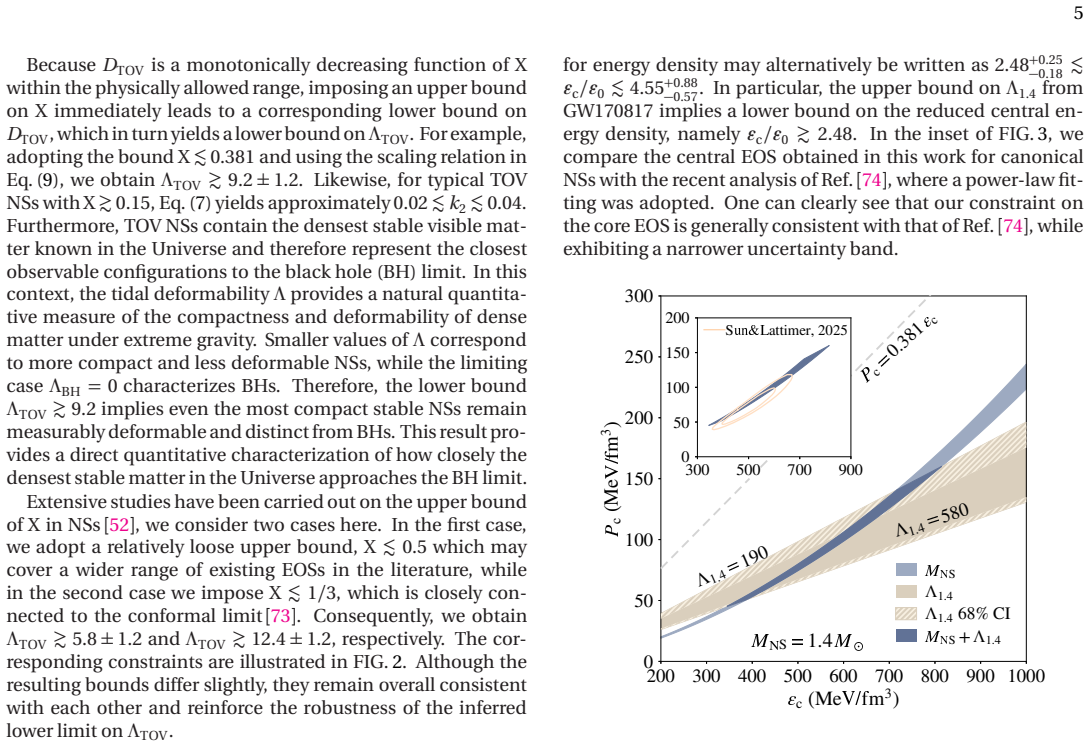
1.4” on the parameter X. Besides, 33 widely used microscopic EOSs from the literature are also shown in the plot (green “ +
andξby Eq. (6). We re- fer to D (X, Ψ) as the intrinsic tidal-response function , as it en- capsulates the essential EOS dependence of the dimensionless tidal deformability Λ. In the following sections, we investigate the scaling relation between D (X, Ψ) and the tidal deformabil- ity Λobtained from exact numerical solutions of Eqs. ( 2) and (3). We demon...
-
[2]
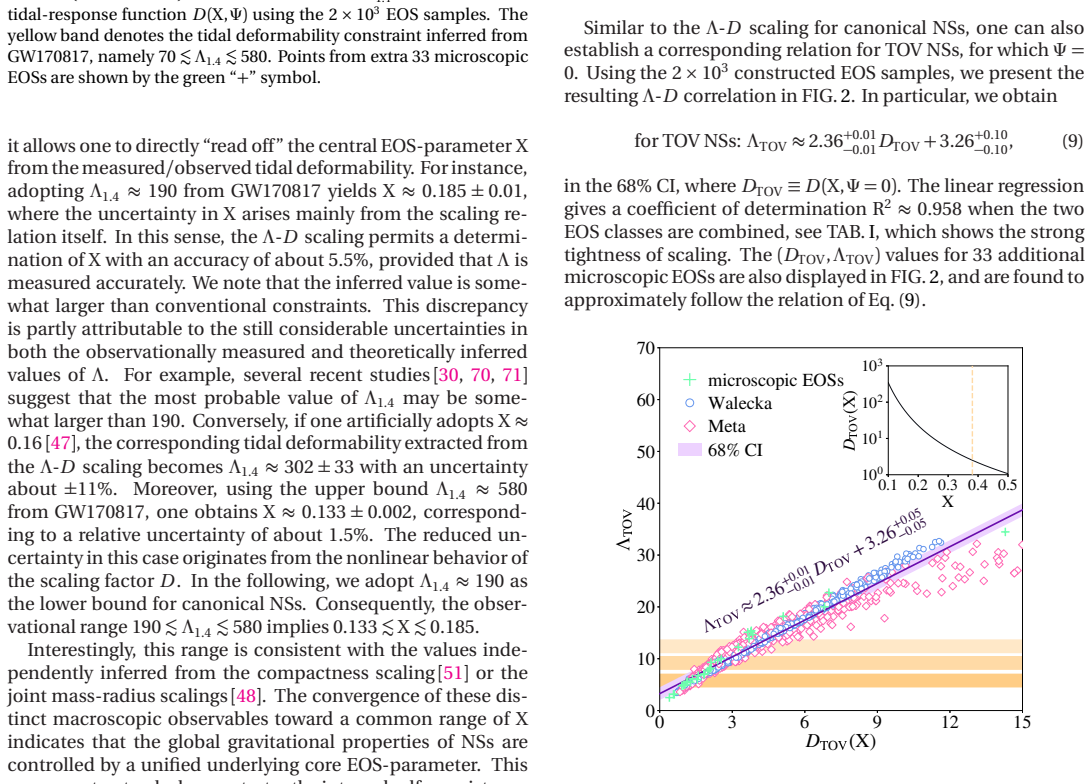
Using the 2 ×10³ constructed EOS samples, we present the resulting Λ-D correlation in FIG. 2. In particular, we obtain for TOV NSs: ΛTOV ≈2.36+0.01 −0.01DTOV + 3.26+0.10 −0.10, (9) in the 68% CI, where DTOV ≡D (X, Ψ= 0). The linear regression gives a coefficient of determination R 2 ≈0.958 when the two EOS classes are combined, see TAB. I, which shows the ...
2025
-
[3]
0” labels the zeroth com - ponent of the four-vector, while the superscript “(3)
Nonlinear Walecka Model Firstly , we introduce the nonlinear Walecka model under the mean field approximation [63, 83]. The Lagrangian of this model reads [84]: L =ψ /parenleftbig1 i∂µγµ−MN /parenrightbig1 ψ + gσσψψ−gωωµψγµψ−gρ⃗ ρµψγµ⃗ τψ+ gδ⃗δψ⃗ τψ + 1 2 /parenleftbig1 ∂µσ∂µσ−m 2 σσ2/parenrightbig1 −1 3 bσMN(gσσ)3 −1 4 cσ(gσσ)4 −1 4ωµνωµν+ 1 2 m 2 ωωµωµ+ ...
-
[4]
Meta-model EOSs The meta-model provides a flexible and largely model- independent framework for constructing the EOS of dense nu- clear matter. Instead of adopting a specific microscopic int er- action or energy-density functional, it characterizes the EOS directly in terms of the empirical nuclear-matter paramete rs introduced in Eqs. ( A1)–( A4). In this ...
-
[5]
NSs generally consist of three regions: the cor e, the inner crust and the outer crust
β-stable NS EOS and sampling schemes Here, we describe the construction of the charge neutral and β-stable NS EOSs adopted in this work, together with the corre- sponding sampling schemes for the empirical nuclear matter parameters. NSs generally consist of three regions: the cor e, the inner crust and the outer crust. We employ either the non- linear Wal...
-
[6]
As shown in the figure, both the shapes of the curves and their slopes d MNS/ dR exhibit broad variations. For in- stance, the radius R1.4 of a canonical NS spans approximately from 11 km to 15 km, indicating that the resulting M-R relations cover a wide and physically relevant EOS parameter space. Another quantity closely related to our analysis is the lo...
-
[7]
and (7), respectively . D. Correlation between Λ1.4 and R1.4 In FIG. 3, we display the correlation betweenΛ1.4 and R1.4 for canonical NSs obtained from our 2 ×10³ EOS samples. Such correlations have been widely used to infer the canonical ra - dius R1.4 from measured tidal deformabilities[27, 103, 104]. Us- ing the effective parametrization Λ1.4 ≈a R b 1....
-
[8]
Abbott et al
B. Abbott et al. (LIGO Scientific Collaboration and Virgo Collab- oration), Phys. Rev. Lett. 119, 161101 (2017)
2017
-
[9]
Abbott et al
B. Abbott et al. (LIGO Scientific Collaboration and Virgo Collab- oration), Phys. Rev. Lett. 121, 161101 (2018)
2018
-
[10]
Riley et al.,Astrophys
T . Riley et al.,Astrophys. J. Lett. 887, L21 (2019)
2019
-
[11]
Miller et al., Astrophys
M. Miller et al., Astrophys. J. Lett. 887, L24 (2019)
2019
-
[15]
Salmi et al.,Astrophys
T . Salmi et al.,Astrophys. J. 941, 150 (2022)
2022
-
[16]
Choudhury et al., Astrophys
D. Choudhury et al., Astrophys. J. Lett. 971, L20 (2024)
2024
-
[17]
Reardon et al., Astrophys
D. Reardon et al., Astrophys. J. Lett. 971, L18 (2024)
2024
-
[18]
Mauviard et al., Astrophys
L. Mauviard et al., Astrophys. J. 995, 60 (2025)
2025
-
[19]
Baym et al., Rep
G. Baym et al., Rep. Prog. Phys. 81, 056902 (2018)
2018
-
[20]
Vida/tildewide1na, Proc
I. Vida/tildewide1na, Proc. Roy. Soc. Lond. A 474, 0145 (2018)
2018
-
[21]
Li et al., Universe 7, 182 (2021)
B.A. Li et al., Universe 7, 182 (2021)
2021
-
[22]
Lattimer, Ann
J. Lattimer, Ann. Rev. Nucl. Part. Sci. 71, 433 (2021)
2021
-
[23]
Oertel et al., Rev
M. Oertel et al., Rev. Mod. Phys. 89, 015007 (2017)
2017
-
[24]
Baiotti, Prog
L. Baiotti, Prog. Part. Nucl. Phys. 109, 103714 (2019)
2019
-
[25]
Drischler, J
C. Drischler, J. Holt, and C. Wellenhofer, Annu. Rev. Nucl. Part. Sci. 71, 403 (2021)
2021
- [26]
-
[27]
Sorensen et al., Prog
A. Sorensen et al., Prog. Part. Nucl. Phys. 134, 104080 (2024)
2024
-
[28]
Chatziioannou et al., Rev
K. Chatziioannou et al., Rev. Mod. Phys. 97, 045007 (2025)
2025
- [29]
-
[30]
Li et al.,SCIENCE CHINA Physics, Mechanics and Astronomy 68, 119503 (2025)
A. Li et al.,SCIENCE CHINA Physics, Mechanics and Astronomy 68, 119503 (2025)
2025
-
[31]
Watts et al., Rev
A. Watts et al., Rev. Mod. Phys. 88, 021001 (2016)
2016
-
[32]
Lattimer and M
J. Lattimer and M. Prakash, Astrophys. J. 550, 426 (2001)
2001
-
[33]
Fattoyev et al.,Phys
F . Fattoyev et al.,Phys. Rev. C 87, no.1, 015806 (2013)
2013
-
[34]
De et al., Phys
S. De et al., Phys. Rev. Lett. 121, 091102 (2018)
2018
-
[35]
Lim and J
Y. Lim and J. Holt, Phys. Rev. Lett. 121, 062701 (2018)
2018
-
[36]
Zhao and J
T . Zhao and J. Lattimer,Phys. Rev. D 98, 063020 (2018)
2018
-
[37]
Most et al., Phys
E. Most et al., Phys. Rev. Lett. 120, 261103 (2018)
2018
-
[38]
Zhou and L.W
Y. Zhou and L.W . Chen,Astrophys. J. 886, 52 (2019)
2019
-
[39]
Li et al., Eur
B.A. Li et al., Eur. Phys. J. A 55, no.7, 117 (2019)
2019
-
[40]
Chatziioannou, Gen
K. Chatziioannou, Gen. Relativ. Gravit. 52, 109 (2020)
2020
-
[41]
Ferreira and C
M. Ferreira and C. Providência,Phys. Rev. D110, 063018 (2024)
2024
-
[42]
Ferreira and C
M. Ferreira and C. Providência,Phys. Rev. D112, 083058 (2025)
2025
-
[43]
Zhou and J
J. Zhou and J. Xu, SCIENCE CHINA Physics, Mechanics and As- tronomy 67, 282011 (2024)
2024
-
[44]
Tsang et al., Nature Astron
C. Tsang et al., Nature Astron. 8, 328 (2024)
2024
-
[45]
Mroczek et al., Phys
D. Mroczek et al., Phys. Rev. D 110, 123009 (2024)
2024
-
[46]
Ripley et al., Nature Astron
J. Ripley et al., Nature Astron. 8, 1277 (2024)
2024
-
[47]
Malik et al.,Astron
T . Malik et al.,Astron. Astrophys. 689, A242 (2024)
2024
-
[48]
Cui et al
Y. Cui et al. Nucl. Sci. Tech. 36, 141 (2025)
2025
-
[49]
Hotokezaka et al., Phys
K. Hotokezaka et al., Phys. Rev. D 83, 124008 (2011)
2011
-
[50]
Bauswein and H
A. Bauswein and H. T . Janka,Phys. Rev. Lett.108, 011101 (2012)
2012
-
[51]
Rezzolla and K
L. Rezzolla and K. Takami, Phys. Rev. D 93, 124051 (2016)
2016
-
[52]
Bauswein, N
A. Bauswein, N. Stergioulas and H. Janka, Eur. Phys. J. A 52, 56 (2016)
2016
-
[53]
Most et al., Phys
E. Most et al., Phys. Rev. Lett. 122, 061101 (2019)
2019
-
[54]
Cai and B.A
B.J. Cai and B.A. Li, Eur. Phys. J. A 61, 55 (2025)
2025
-
[55]
Cai, B.A
B.J. Cai, B.A. Li, and Z. Zhang, Astrophys. J. 952, 147 (2023)
2023
-
[56]
Cai, B.A
B.J. Cai, B.A. Li, and Z. Zhang, Phys. Rev. D 108, 103041 (2023)
2023
-
[57]
Cai and B.A
B.J. Cai and B.A. Li, Phys. Rev. D 109, 083015 (2024)
2024
-
[58]
Cai and B.A
B.J. Cai and B.A. Li, Phys. Rev. D,112, 023023 (2025)
2025
-
[59]
Cai and B.A
B.J. Cai and B.A. Li, Front. Astron. Space Sci. 11, 1502868 (2024)
2024
-
[60]
Cai, B.A
B.J. Cai, B.A. Li, and Y.G. Ma, Phys. Rev. D 113, 023002 (2026)
2026
- [61]
-
[62]
Tolman, Phys
R. Tolman, Phys. Rev. 55, 364 (1939)
1939
-
[63]
Oppenheimer and G
J. Oppenheimer and G. Volkoff, Phys. Rev. 55, 374 (1939)
1939
-
[64]
Weber,Pulsars as Astrophysical Laboratories for Nuclear and Particle Physics, Routledge, Chapter 14
F . Weber,Pulsars as Astrophysical Laboratories for Nuclear and Particle Physics, Routledge, Chapter 14
-
[65]
Hinderer,Astrophys
T . Hinderer,Astrophys. J. 677, 1216 (2008)
2008
-
[66]
Fujimoto et al., Phys
Y. Fujimoto et al., Phys. Rev. Lett. 129, 252702 (2022)
2022
-
[67]
J. Saes, R. Mendes, and N. Yunes, Phys. Rev. D 110, 024011 (2024)
2024
-
[68]
Marczenko, Phys
M. Marczenko, Phys. Rev. C 110, 04581 (2024)
2024
-
[69]
Li, Phys
B.A. Li, Phys. Rev. Lett. 136, 242301 (2026). 11
2026
-
[70]
Serot and J
B. Serot and J. Walecka, Adv. Nucl. Phys. 16, 1 (1986)
1986
-
[71]
Zhang, B.A
N.B. Zhang, B.A. Li, and J. Xu, Astrophys. J. 859, 90 (2018)
2018
-
[72]
Zhang and B.A
N.B. Zhang and B.A. Li, Astrophys. J. 879, 99 (2019)
2019
-
[73]
Xie and B.A
W .J. Xie and B.A. Li,Astrophys. J. 899, 4 (2020)
2020
-
[74]
Zhang and B.A
N.B. Zhang and B.A. Li, Astrophys. J. 921, 111 (2021)
2021
-
[75]
Typel, M
S. Typel, M. Oertel, and T . Klähn,Phys. Part. Nucl.46, 633 (2015)
2015
-
[76]
Ofengeim, P
D. Ofengeim, P . Shternin, and T . Piran,Phys. Rev. D 110, 103046 (2024)
2024
-
[77]
Dong et al., Phys
X. Dong et al., Phys. Rev. D 112, 063043 (2025)
2025
-
[78]
Golomb et al., Phys
J. Golomb et al., Phys. Rev. D 111, 023029 (2025)
2025
-
[79]
Chen et al., Nucl
J.H. Chen et al., Nucl. Sci. Tech. 35, 214 (2024)
2024
-
[80]
Annala et al., Nat
E. Annala et al., Nat. Comm. 14, 8451 (2023)
2023
-
[81]
Sun and J
B. Sun and J. Lattimer, Astrophys. J. 984, 30 (2025)
2025
-
[82]
Yagi and N
K. Yagi and N. Yunes, Science 341, 365 (2013)
2013
-
[83]
Yagi and N
K. Yagi and N. Yunes, Phys. Rev. D 88, 023009 (2013)
2013
discussion (0)
Sign in with ORCID, Apple, or X to comment. Anyone can read and Pith papers without signing in.