Modeling Direct Waves in Binary Black Hole Ringdowns
Pith reviewed 2026-06-25 22:02 UTC · model grok-4.3
The pith
Direct waves in binary black hole ringdowns can be extracted with adapted quasinormal mode techniques, but their frequencies deviate from the horizon value.
A machine-rendered reading of the paper's core claim, the machinery that carries it, and where it could break.
Core claim
Direct waves are identified in numerical-relativity waveforms over a range of ringdown start times by adapting quasinormal mode techniques, which demonstrates the utility of the horizon mode model, yet the direct wave frequency deviates from the horizon value and therefore limits its utility as a probe of the event horizon.
What carries the argument
The horizon mode model, which treats direct wave properties as directly related to event horizon geometry and allows simplified extraction from waveforms.
If this is right
- Direct waves can be isolated from ringdown signals using fitting methods adapted from quasinormal mode studies.
- The horizon mode model successfully identifies direct wave components over varying ringdown start times.
- Frequency mismatch means direct waves cannot serve as reliable probes of horizon geometry.
- Ringdown modeling must include both quasinormal modes and separate direct wave contributions.
Where Pith is reading between the lines
- Persistent frequency deviations may indicate additional effects during propagation from the horizon to distant observers.
- Future gravitational wave observations could require separate templates for direct waves to avoid parameter biases.
- Applying the same extraction to spinning or unequal-mass mergers might reveal whether the deviation depends on binary parameters.
Load-bearing premise
Techniques developed for quasinormal modes can be applied to isolate direct waves without introducing systematic biases that affect frequency comparisons.
What would settle it
A high-resolution numerical relativity simulation in which the extracted direct wave frequency either matches the horizon value across multiple start times or shows a clear, reproducible mismatch.
Figures
read the original abstract
Direct waves, prompt signals propagating from a plunging object to the observer, exist alongside quasinormal modes in binary black hole ringdown. It has been suggested that the properties of the direct wave are related to the event horizon; this simplifies modeling the direct wave and suggests the possibility of using it as a new observational probe of the horizon geometry. This paradigm is tested by extracting direct waves from numerical-relativity waveforms, adapting techniques originally developed for studying quasinormal modes. The direct wave is identified over a range of ringdown start times, demonstrating the utility of the horizon mode model. However, the direct wave frequency is found to deviate from the horizon value, limiting its utility as a probe of the event horizon.
Editorial analysis
A structured set of objections, weighed in public.
Referee Report
Summary. The manuscript tests the horizon-mode model for direct waves in binary black hole ringdowns by extracting these prompt signals from numerical-relativity waveforms. Techniques originally developed for quasinormal modes are adapted to identify the direct wave over a range of ringdown start times. The extraction succeeds, but the measured frequency deviates from the horizon-mode prediction, leading to the conclusion that direct waves have limited utility as probes of the event horizon.
Significance. If the extraction procedure is free of systematic bias, the result would provide a concrete counter-example to the horizon-mode paradigm for direct waves and would constrain ringdown modeling. The variation over start times and use of NR data constitute a direct test of the model. The negative finding on frequency match is the key deliverable, but its robustness rests on the isolation method.
major comments (1)
- [extraction-method paragraph] Extraction-method paragraph: the central claim that the extracted frequency deviates from the horizon value rests on the adapted QNM fit cleanly isolating the direct-wave component. Direct waves are prompt, non-ringing signals whose time dependence differs from the exponentially damped sinusoids assumed in standard QNM fits. No cross-validation against an independent isolation technique (e.g., time-domain subtraction or alternate basis) is reported; without it the reported deviation could be an artifact of projection of other waveform content onto the fitted parameters. This is load-bearing for the negative result on horizon-mode utility.
Simulated Author's Rebuttal
We thank the referee for their careful reading and constructive feedback on our manuscript. We address the major comment regarding the extraction method below.
read point-by-point responses
-
Referee: Extraction-method paragraph: the central claim that the extracted frequency deviates from the horizon value rests on the adapted QNM fit cleanly isolating the direct-wave component. Direct waves are prompt, non-ringing signals whose time dependence differs from the exponentially damped sinusoids assumed in standard QNM fits. No cross-validation against an independent isolation technique (e.g., time-domain subtraction or alternate basis) is reported; without it the reported deviation could be an artifact of projection of other waveform content onto the fitted parameters. This is load-bearing for the negative result on horizon-mode utility.
Authors: We appreciate the referee highlighting this potential vulnerability in our isolation procedure. The direct wave is indeed a prompt signal whose time dependence differs from the damped-sinusoid form assumed by standard QNM fits. Our adaptation applies the fitting procedure over a range of early ringdown start times at which the direct wave is expected to be the dominant contribution. The fact that a stable frequency is recovered across this range of start times provides supporting evidence that the extracted component is not merely an artifact of projecting unrelated waveform content onto the fit parameters. Nevertheless, we agree that the absence of an independent cross-validation (such as time-domain subtraction or an alternate basis) leaves the result open to the concern raised. We will revise the manuscript to include an expanded discussion of the method's assumptions, its domain of applicability, and this specific limitation. revision: partial
Circularity Check
No significant circularity; comparison to external prediction
full rationale
The paper extracts direct-wave components from NR waveforms by adapting existing QNM techniques, then compares the resulting frequency against an independent horizon-mode prediction. This is a direct comparison rather than a fit of the model to the same data or a self-definition. No quoted equations or steps reduce the reported deviation to the extraction inputs by construction. The central negative result (deviation from horizon value) retains independent content against external benchmarks.
Axiom & Free-Parameter Ledger
axioms (1)
- domain assumption Techniques developed for quasinormal modes can be adapted to isolate direct waves without introducing uncontrolled systematics.
Reference graph
Works this paper leans on
-
[1]
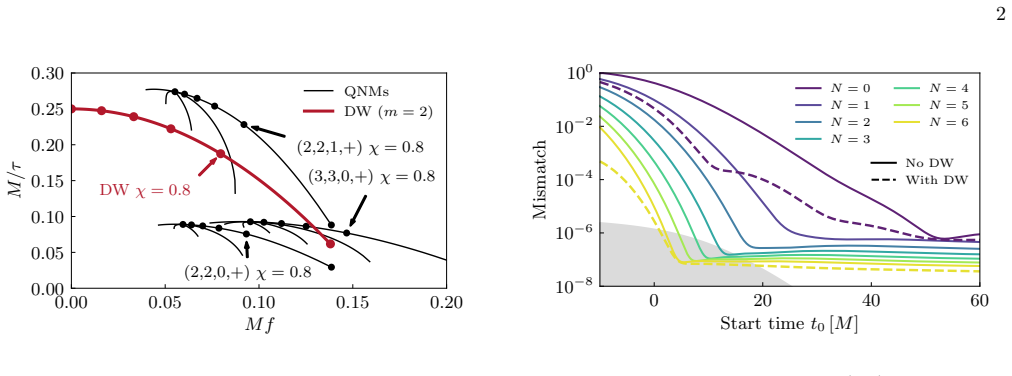
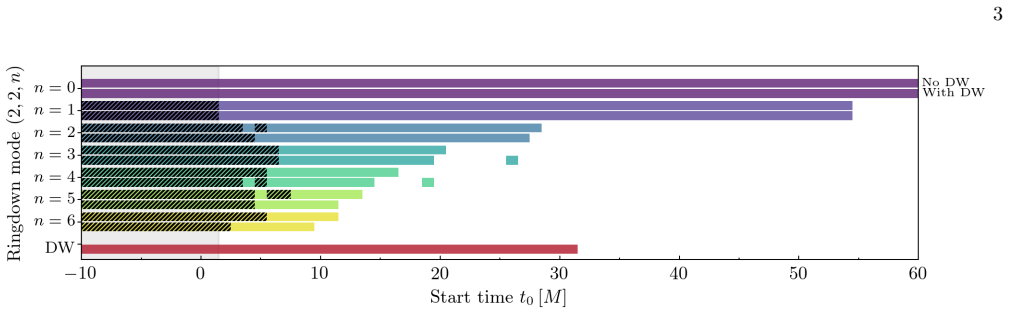
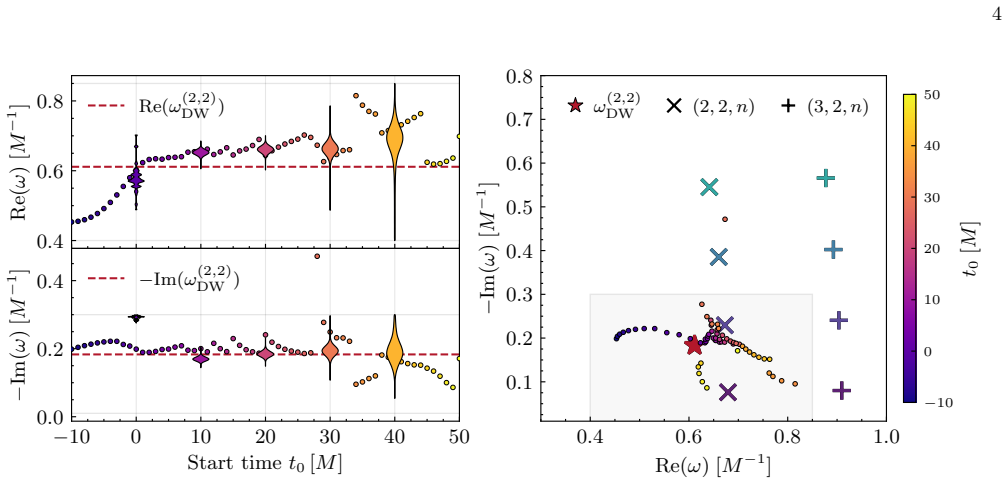
How accurately, and for what range of start times, can the DW be modeled by a damped sinusoid with frequency given by the horizon quantities in Eq. 1?
-
[2]
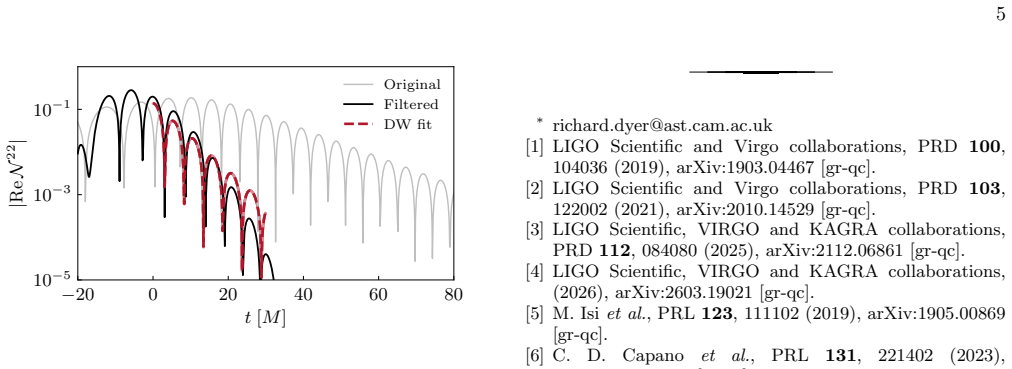
To what extent does the horizon-mode picture de- rived from BH perturbation theory remain valid for the comparable-mass mergers? These questions are answered using techniques orig- inally developed for studies of QNMs in numerical- relativity (NR) waveforms. Models incorporating both QNM and DW contributions are fit to multiple spher- ical harmonics of st...
Pith/arXiv arXiv 2026
-
[3]
LIGO Scientific and Virgo collaborations, PRD100, 104036 (2019), arXiv:1903.04467 [gr-qc]
Pith/arXiv arXiv 2019
-
[4]
LIGO Scientific and Virgo collaborations, PRD103, 122002 (2021), arXiv:2010.14529 [gr-qc]
Pith/arXiv arXiv 2021
-
[5]
LIGO Scientific, VIRGO and KAGRA collaborations, PRD112, 084080 (2025), arXiv:2112.06861 [gr-qc]
Pith/arXiv arXiv 2025
-
[6]
LIGO Scientific, VIRGO and KAGRA collaborations, (2026), arXiv:2603.19021 [gr-qc]
Pith/arXiv arXiv 2026
-
[7]
Isiet al., PRL123, 111102 (2019), arXiv:1905.00869 [gr-qc]
M. Isiet al., PRL123, 111102 (2019), arXiv:1905.00869 [gr-qc]
Pith/arXiv arXiv 2019
-
[8]
C. D. Capanoet al., PRL131, 221402 (2023), arXiv:2105.05238 [gr-qc]
arXiv 2023
-
[9]
Isiet al., PRL127, 011103 (2021), arXiv:2012.04486 [gr-qc]
M. Isiet al., PRL127, 011103 (2021), arXiv:2012.04486 [gr-qc]
arXiv 2021
-
[10]
LIGO Scientific, Virgo and KAGRA collaborations, PRL 135, 111403 (2025), arXiv:2509.08054 [gr-qc]
Pith/arXiv arXiv 2025
-
[11]
Y. Mino and J. Brink, PRD78, 124015 (2008), arXiv:0809.2814 [gr-qc]
Pith/arXiv arXiv 2008
-
[12]
A. Zimmerman and Y. Chen, PRD84, 084012 (2011), arXiv:1106.0782 [gr-qc]
Pith/arXiv arXiv 2011
-
[13]
E. Berti and V. Cardoso, PRD74, 104020 (2006), arXiv:gr-qc/0605118
Pith/arXiv arXiv 2006
-
[14]
Della Roccaet al., (2025), arXiv:2512.07959 [gr-qc]
M. Della Roccaet al., (2025), arXiv:2512.07959 [gr-qc]
arXiv 2025
- [15]
-
[16]
Oshitaet al., (2025), arXiv:2509.09165 [gr-qc]
N. Oshitaet al., (2025), arXiv:2509.09165 [gr-qc]
arXiv 2025
-
[17]
Luet al., (2025), arXiv:2510.01001 [gr-qc]
N. Luet al., (2025), arXiv:2510.01001 [gr-qc]
Pith/arXiv arXiv 2025
- [18]
- [19]
-
[20]
A. K.-W. Chunget al., (2026), arXiv:2606.06592 [gr-qc]
Pith/arXiv arXiv 2026
-
[21]
The LIGO Scientific, Virgo and Kagra Collaborations, (2026), arXiv:2605.27223 [gr-qc]
Pith/arXiv arXiv 2026
-
[22]
org/waveforms/extcce_catalog.html[Accessed: 2024]
The SXS project, (2024),https://data.black-holes. org/waveforms/extcce_catalog.html[Accessed: 2024]
2024
-
[23]
R. Dyer and C. J. Moore, PRL136, 191403 (2026), arXiv:2510.13954 [gr-qc]
Pith/arXiv arXiv 2026
-
[24]
R. Dyer and C. J. Moore, PRD113, 104031 (2026), arXiv:2510.11783 [gr-qc]
Pith/arXiv arXiv 2026
-
[25]
Luet al., PRD112, 064047 (2025), arXiv:2505.18560 [gr-qc]
N. Luet al., PRD112, 064047 (2025), arXiv:2505.18560 [gr-qc]
arXiv 2025
-
[26]
Maet al., PRD106, 084036 (2022), arXiv:2207.10870 [gr-qc]
S. Maet al., PRD106, 084036 (2022), arXiv:2207.10870 [gr-qc]
arXiv 2022
-
[27]
Finch,Black-hole Ringdown, Thesis, PhD (2023), https://etheses.bham.ac.uk/id/eprint/13992/
E. Finch,Black-hole Ringdown, Thesis, PhD (2023), https://etheses.bham.ac.uk/id/eprint/13992/
2023
- [28]
-
[29]
Giesleret al., PRD111, 084041 (2025), arXiv:2411.11269 [gr-qc]
M. Giesleret al., PRD111, 084041 (2025), arXiv:2411.11269 [gr-qc]
arXiv 2025
-
[30]
Dyer and C
R. Dyer and C. J. Moore,Applications of Bayesian infer- ence to QNM fits in numerical relativity(in prep) (2026)
2026
-
[31]
Pacilioet al., PRD110, 103037 (2024), arXiv:2408.05276 [gr-qc]
C. Pacilioet al., PRD110, 103037 (2024), arXiv:2408.05276 [gr-qc]
arXiv 2024
-
[32]
Mitmanet al., PRD112, 064016 (2025), arXiv:2503.09678 [gr-qc]
K. Mitmanet al., PRD112, 064016 (2025), arXiv:2503.09678 [gr-qc]
arXiv 2025
-
[33]
Dyer and C
R. Dyer and C. J. Moore, (2024),https://github.com/ BGP-QNM-FITS/bgp_qnm_fits[Accessed: June 2026]
2024
-
[34]
Dyer and C
R. Dyer and C. J. Moore, (2026),https://github.com/ Richardvnd/direct_waves[Accessed: June 2026]. 1 Supplemental Material MODE AMPLITUDES The Bayesian fits used to determine the ringdown mode content in the main Letter also produce posteri- ors on all of the mode amplitudes. For all times when a particular mode is identified the posterior on its mode ampl...
2026
discussion (0)
Sign in with ORCID, Apple, or X to comment. Anyone can read and Pith papers without signing in.