Pith. sign in

REVIEW 3 major objections 5 minor 1 cited by

Visual generators have a shifting, model-specific knowledge boundary that teach-then-search co-training can discover, so search is used only for what cannot be internalized.

Reviewed by Pith at T0; open to challenge. T0 means a machine referee read the full paper against a public rubric. the ladder, T0–T4 →

T0 review · grok-4.5

2026-07-11 07:08 UTC pith:DYO6ZH7I

load-bearing objection Solid production-scale benchmark plus a clean teach-then-search recipe that actually shows naive search hurts; the judge-dependence worry is real but not load-bearing. the 3 major comments →

arxiv 2607.05382 v4 pith:DYO6ZH7I submitted 2026-07-06 cs.CV cs.AI

Search Beyond What Can Be Taught: Evolving the Knowledge Boundary in Agentic Visual Generation

classification cs.CV cs.AI
keywords agentic visual generationknowledge boundarysearch-augmented generationtext-to-imageco-trainingworld knowledge bottleneckretrieval noiseSearchGen-Bench
verification ladder T0 review T1 audit T2 compute T3 formal T4 reserved

The pith

A machine-rendered reading of the paper's core claim, the machinery that carries it, and where it could break.

Image generators render polished scenes but invent details when they lack world knowledge—new characters, post-cutoff events, rare cultural symbols, and other long-tailed requests. On a new benchmark of more than 20,000 production-style prompts, open generators fall to roughly 21–28 out of 100, a collapse invisible to existing tests that stay inside known concepts. Blind search does not fix this: it injects noise and can corrupt prompts the model already handles. The paper’s claim is that the root issue is a generator-specific knowledge boundary—the divide between knowledge stable enough to absorb into parameters and knowledge that must stay external—and that this boundary, though hard to specify ahead of time, is discoverable by co-training. A minimal recipe first teaches the generator on search-augmented examples, then recalibrates a small search reasoner to the new boundary, producing steady gains and letting the calibrated searcher match a frontier oracle on the same generator. The released prompts, trajectories, and frozen search corpus turn the problem into a replayable research harness.

Core claim

World-knowledge failures in visual generation are governed by a generator-specific, evolving knowledge boundary: the partition between internalizable knowledge (where search adds little once the model has been taught) and contextual knowledge (too rare, too fast-changing, or too compositional to parameterize). That boundary cannot be written down in advance, but it is discoverable through teach-then-search co-training. Even a single iteration—warm-start an 8B reasoner, expand the generator with online preference training on search-augmented outputs, then rejection-finetune the reasoner—yields monotonic improvement from no search through blind search to generator-adaptive search, recovers qua

What carries the argument

The knowledge boundary B(θ): the split of world-knowledge units into internalizable set K_int(θ) (search barely helps) and contextual set K_ctx(θ) (search is necessary). Co-training discovers it with a noise-resistant gate–filter–integrate search protocol plus a teach-then-search loop that first expands the generator, then recalibrates when the reasoner is allowed to search.

Load-bearing premise

The automated judge’s scores are faithful enough across all failure types that training on them truly expands what the generator knows rather than merely gaming the judge.

What would settle it

Rerun the same single-iteration co-training recipe but build DPO pairs and rejection-finetuning advantages from human preference labels on a held-out SearchGen-Bench slice; if the monotonic gains, NoSearch recovery, and generator-specific policy behavior disappear, the boundary-discovery claim fails.

Watch this falsifier — get emailed when new claim-graph text bears on it.

If this is right

  • Indiscriminate retrieval is actively harmful; search policy must be calibrated to each generator’s current boundary, not applied uniformly.
  • Further co-training rounds can push more knowledge into parameters while tightening when search fires, forming a recursive self-improvement loop for production image generation.
  • Standard compositionality and aesthetics benchmarks systematically miss the world-knowledge gap that dominates real user requests.
  • A modest open stack (small generator plus small calibrated reasoner) can approach frontier-oracle search quality on that same generator without frontier-scale reasoning at inference.
  • Frozen, pre-executed multimodal search corpora make tool-augmented visual generation research reproducible without live API cost or result drift.

Where Pith is reading between the lines

These are editorial extensions of the paper, not claims the author makes directly.

  • The same teach-then-search split likely applies to video, 3D, and other open-world generators that face finite training data and unbounded user requests.
  • If boundary prediction from model internals (uncertainty or probes) works, co-training cost could drop sharply when adapting the method across many generators.
  • Extending the same gate–filter–integrate idea to tools beyond search—editing, code rendering, 3D assets—could turn the knowledge boundary into a general tool-invocation principle.

Editorial analysis

A structured set of objections, weighed in public.

Desk editor's note, referee report, simulated authors' rebuttal, and a circularity audit.

Referee Report

3 major / 5 minor

Summary. The paper argues that modern visual generators suffer a structural world-knowledge bottleneck: they render well but fabricate long-tailed, post-cutoff, and culturally specific content. It introduces SEARCHGEN-20K/BENCH (20,839 prompts, twelve failure categories, twenty-two domains) and a frozen SEARCHGEN-CORPUS-1M for offline search-augmented research, documenting a ~40-point collapse of open generators on search-intensive prompts that existing benchmarks miss. Naive search is shown to inject noise and degrade NoSearch prompts. The authors formalize a generator-specific knowledge boundary B(θ)=(K_int(θ), K_ctx(θ)) (Def. 1) and propose a teach-then-search co-training recipe: SFT of an 8B gate–filter–integrate reasoner, online Diffusion-DPO of the generator on search-augmented preferences, then rejection finetuning of the reasoner. On two open generators (Flux.2-Klein-4B, Bagel-7B), a single iteration yields monotonic gains from NoSearch through BlindSearch to Generator-AdaptiveSearch and matches a frontier VLM oracle on the same generator (Table 6, Fig. 9).

Significance. If the results hold, the paper supplies both a missing evaluation substrate for knowledge-intensive text-to-image generation and an operational principle—discover the generator-specific knowledge boundary by co-training rather than always-on retrieval. The released 20K prompts, 90K+ reasoning traces, 280K+ generations, and 145K archived search sessions form a genuine replayable harness that lowers the barrier for tool-augmented visual generation research. Strengths include: (i) production-grounded taxonomy and bilingual long-tail construction; (ii) clear NoSearch vs Search-Intensive and Visual vs Textual strata; (iii) two architecturally distinct generators with cross-pairing checks for policy specificity; (iv) explicit CDF evidence of a rightward no-search quality shift after DPO (Fig. 9b). These are concrete, falsifiable contributions beyond another RAG-for-images pipeline.

major comments (3)
  1. [§4.1, Def. 1, Fig. 9b, Table 6, Appendix B.2/D.2] Finding 3 and Def. 1 rest on DPO preference pairs and RFT advantages built from the same Gemini-3-Flash judge family used for final evaluation (Appendix B.2, D.2; ρ=0.87 on 500 pairs). Fig. 9b’s rightward CDF shift and Table 6 Phase 0→1→2 gains could therefore reflect judge-aligned style or shortcut preferences rather than genuine expansion of K_int(θ). The manuscript needs an independent check: human ratings and/or a cross-family judge on a held-out co-trained subset (NoSearch recovery and Set III), reporting whether the boundary shift and selectivity survive. Without this, the claim that B(θ) is ‘discoverable’ remains only partially supported.
  2. [Abstract; §6; Algorithm 1; Appendix F] The abstract and conclusion frame a single DPO+RFT pass as laying the foundation for recursive self-improvement, yet all quantitative claims are one-iteration (Algorithm 1; Table 6). Appendix F correctly notes multi-round co-training as future work, but the main-text rhetoric overstates what is demonstrated. Either run a second co-training cycle on at least one generator and report whether the boundary continues to move, or temper the recursive-self-improvement language to match the single-pass evidence.
  3. [Appendix B.1; Table 5; Table 6] Appendix B.1 notes that on TextualSearch, both BlindSearch and Generator-AdaptiveSearch can score below the no-search baseline for Klein-4B-DPO, because some compositional/textual knowledge resists single-pass search and parameterization. This is load-bearing for the claim that co-training calibrates search to K_ctx: if the calibrated reasoner still harms a large textual stratum, the boundary is only partially discovered. Please report TextualSearch vs VisualSearch breakdowns for all Table 6 rows (or an ablation) so readers can see where the policy succeeds and where it remains net harmful.
minor comments (5)
  1. [Abstract; §2.2; Table 2] Prompt/entity counts drift slightly across the abstract, §2.2, and Table 2 (20,839 vs 20,188/20,187; 20,840 production prompts). Harmonize the numbers and state train/val/test splits once.
  2. [Def. 1; Algorithm 1; Fig. 9b] Def. 1 uses quality function Q and tolerance ϵ, but training uses a separate Score(·) from the nine-component judge (Algorithm 1, line 8). State explicitly whether Q and Score are identical and how ϵ is chosen in practice for Fig. 9b.
  3. [Figure 6] Figure 6 y-axis labels and commercial drop magnitudes are hard to read in the preprint layout; consider larger fonts and explicit Δ annotations on the bars.
  4. [§5] Related work cites Gen-Searcher and several RAG-for-T2I methods; a short table contrasting always-on vs selective search and frozen vs co-trained generators would sharpen the novelty claim.
  5. [Appendix E.1; §G; Table 3] Typos/inconsistencies: ‘gate–filter–compress’ in Appendix E.1 vs ‘gate–filter–integrate’ in the main text; ‘AIGC fakeness’ in broader impact vs ‘AI naturalness’ in Table 3.

Circularity Check

0 steps flagged

No significant circularity: knowledge boundary is an operational definition measured by an external quality signal; co-training gains are empirical on held-out data, not forced by construction.

full rationale

This is an empirical systems paper, not a first-principles derivation. Definition 1 partitions knowledge into K_int(θ) and K_ctx(θ) via an external quality function Q (the SEARCHGEN-BENCH judge). Phase-1 DPO and Phase-2 RFT optimize generator and reasoner against that signal on training prompts; reported gains (Table 6, Fig. 9) are on a held-out 751-prompt test set with NoSearch / BlindSearch / Oracle baselines and two generator architectures. Labeling the rightward no-search CDF shift as “boundary expansion” is consistent with Def. 1 but is not a circular prediction: the paper does not fit a parameter on a subset and then claim to predict a forced related quantity, nor does it import a uniqueness theorem or load-bearing ansatz from overlapping-author prior work. Self-citations (e.g., RationalRewards, VL-Rethinker) appear only in related work and do not underwrite the central claim. Using the same judge family for training rewards and evaluation is a validity risk (judge idiosyncrasy), not circularity under the stated patterns. The derivation chain is self-contained against external benchmarks and baselines; score 0 is the correct outcome.

Axiom & Free-Parameter Ledger

4 free parameters · 3 axioms · 1 invented entities

The central empirical claim rests on a small set of modeling choices (quality function Q, severity thresholds, DPO temperature, group-relative advantage filter) and the assumption that an automated VLM judge faithfully ranks images. No new physical entities are postulated; the ‘knowledge boundary’ is an operational partition defined by measurable quality gaps rather than an ontological invention.

free parameters (4)
  • DPO temperature β = 100
    Set to 100 in the flow-matching DPO loss; controls preference sharpness and is chosen by the authors rather than derived.
  • severity threshold for search = critical/important
    Only gaps rated critical or important trigger search (at most 3 queries); the discrete severity labels and cutoff are design choices.
  • group size M and N_traj = M=5, N_traj unspecified but positive-advantage filter
    Number of images sampled per prompt for DPO pairs and number of reasoner trajectories for RFT; affect preference construction and advantage estimates.
  • ϵ tolerance in Def. 1
    Quality-gap threshold that partitions K_int from K_ctx; left as a free positive constant.
axioms (3)
  • domain assumption A bounded quality function Q(G_θ, p, c) ∈ [0,1] exists that correctly ranks generation fidelity for any prompt and conditioning context.
    Definition 1 and all subsequent training and evaluation rest on this; operationalized by the Gemini-3-Flash judge.
  • domain assumption Stable, low-dimensional visual knowledge can be internalized into generator parameters via preference optimization on search-augmented demonstrations.
    Phase-1 claim that DPO expands K_int; supported by CDF shift but not proven for all knowledge types.
  • ad hoc to paper The three-stage gate–filter–integrate protocol is a sufficient noise-suppression mechanism for visual references.
    Introduced in §3.1 as the reasoner’s architecture; success of co-training depends on it.
invented entities (1)
  • generator-specific knowledge boundary B(θ) independent evidence
    purpose: Formal partition of world-knowledge units into internalizable vs. contextual sets that explains when search helps or harms.
    Defined operationally in Def. 1 via quality gaps; measured by no-search score CDFs before/after DPO. Independent evidence is the observed rightward CDF shift and generator-specific policy transfer failure.

pith-pipeline@v1.1.0-grok45 · 34421 in / 2941 out tokens · 28497 ms · 2026-07-11T07:08:30.401611+00:00 · methodology

0 comments
read the original abstract

Visual generators excel at rendering, but they confidently fabricate what they do not know. User requests are unbounded, evolving, and deeply long-tailed: new characters, trending entities, post-cutoff events, and more. This world-knowledge bottleneck is structural: generators are trained on fixed corpora, but the visual world is open-ended. We construct SearchGen-20K and SearchGen-Bench, with 20,839 prompts spanning twelve failure categories and twenty-two domains, paired with a pre-executed multimodal SearchGen-Corpus-1M to support offline, reproducible research. On SearchGen-Bench, frontier open generators score only 21 to 28 out of 100, a 40-point collapse invisible to existing benchmarks. The natural remedy is to employ search tools, enabling agentic visual generation. However, we find that naive search fails: it retrieves indiscriminately, injecting noise into prompts the generator already handles. We trace the root cause to a generator-specific, evolving knowledge boundary: the divide between what a generator can internalize through training and what must remain in external context. Although this boundary is hard to specify in advance, we show that it is discoverable through a teach-then-search co-training framework. Even a minimal version of this co-training recipe produces monotonic improvement, laying the foundation for recursive self-improvement in visual generation that can meet world-knowledge-grounded requests. We release the full dataset, co-training corpus, and search corpus as a replayable harness for tool-augmented, world-knowledge-grounded visual generation.

Figures

Figures reproduced from arXiv: 2607.05382 by Che Liu, Cong Wei, Fangzhen Lin, Haozhe Wang, Jiaming Liu, Jimmy Lin, Jinpeng Yu, Ping Nie, Ruihua Huang, Weijia Feng, Wenhu Chen.

Figure 1
Figure 1. Figure 1: Representative search-augmented generations from SEARCHGEN-20K, spanning all twelve failure categories identified from 20,840 production prompts. SEARCHGEN-20K captures the production￾scale diverse user requests that demand the unbounded, evolving, and deeply long-tailed world knowledge. The world knowledge ranges from entities that benefit from visual shortcut (left), to complex system or scientific proce… view at source ↗
Figure 1
Figure 1. Figure 1: Representative search-augmented generations from SEARCHGEN-20K, spanning all twelve failure categories identified from 20,840 production prompts. SEARCHGEN-20K captures the production￾scale diverse user requests that demand the unbounded, evolving, and deeply long-tailed world knowledge. B: Corresponding Authors. Preprint. arXiv:2607.05382v3 [cs.CV] 9 Jul 2026 [PITH_FULL_IMAGE:figures/full_fig_p001_1.png] view at source ↗
Figure 2
Figure 2. Figure 2: Bilingual composition and prompt length distribution of SEARCHGEN-20K. Left: English (58%) and Chinese (42%) proportions. Right: bimodal prompt length distribution – Chinese prompts are concise (mean 89 characters) while English prompts are more elaborate (mean 266 characters), reflecting authentic cross-lingual user behavior rather than translated templates. rejection-sampling finetuning calibrates the se… view at source ↗
Figure 2
Figure 2. Figure 2: Two paradigms for visual generation. (Left) Prompt rewriting relies on an LLM to expand the user query into a longer textual prompt, which is then passed directly to the generator. (Right) In contrast, our approach equips an agent with a search tool to retrieve relevant knowledge and visual references from a web corpus; the agent then organizes the retrieved evidence into multimodal context and provides it… view at source ↗
Figure 3
Figure 3. Figure 3: SEARCHGEN-20K spans diverse, long-tailed domains. Treemap of benchmark mass across domain categories (area reflects relative prompt counts). The cross-category severity structure between failure modes and domains is deferred to Appendix A.1 ( [PITH_FULL_IMAGE:figures/full_fig_p004_3.png] view at source ↗
Figure 3
Figure 3. Figure 3: Bilingual composition and prompt length distribution of SEARCHGEN-20K. Left: English (58%) and Chinese (42%) proportions. Right: bimodal prompt length distribution – Chinese prompts are concise (mean 89 characters) while English prompts are more elaborate (mean 266 characters), reflecting authentic cross-lingual user behavior rather than translated templates. real requests ( [PITH_FULL_IMAGE:figures/full_… view at source ↗
Figure 4
Figure 4. Figure 4: Dataset composition: entity long-tail and multimodal knowledge gaps. (a) Entity frequency distribution: 93.1% of the 31,537 unique visual entities appear in only a single prompt, confirming the extreme long-tailed nature of real-world image generation requests. (b) Multimodal knowledge gaps: prompts carry a mean of 5.2 simultaneous knowledge gaps (reference slots + text knowledge slots + failure modes); 90… view at source ↗
Figure 4
Figure 4. Figure 4: SEARCHGEN-20K spans diverse, long-tailed domains. Treemap of benchmark mass across domain categories (area reflects relative prompt counts). The cross-category severity structure between failure modes and domains is deferred to Appendix A.1 ( [PITH_FULL_IMAGE:figures/full_fig_p004_4.png] view at source ↗
Figure 5
Figure 5. Figure 5: The world-knowledge bottleneck: per-stratum collapse across nine generators. Grouped bars show the nine-component mean on NoSearch vs. Search-Intensive strata. Every generator, open-weight and commercial alike, collapses on the search-intensive subset, confirming the bottleneck is universal. Drop magnitudes range from −0.1 (GPT-Image-2) to −39.1 (Qwen-Image-2) [PITH_FULL_IMAGE:figures/full_fig_p008_5.png] view at source ↗
Figure 5
Figure 5. Figure 5: Dataset composition: entity long-tail and multimodal knowledge gaps. (a) Entity frequency distribution: 93.1% of the 31,537 unique visual entities appear in only a single prompt, confirming the extreme long-tailed nature of real-world image generation requests. (b) Multimodal knowledge gaps: prompts carry a mean of 5.2 simultaneous knowledge gaps (reference slots + text knowledge slots + failure modes); 90… view at source ↗
Figure 6
Figure 6. Figure 6: Failure examples of search. Search queries executed are colored. Searched contents in￾troduce noise and may degrade generation quality. To diagnose when and where each policy helps or harms, we further partition the Search-Intensive set into two subsets: VisualSearch prompt set that benefits substantially from visual references, e.g., celebrities, or TextualSearch that benefits from textual references, e.g… view at source ↗
Figure 6
Figure 6. Figure 6: The world-knowledge bottleneck: per-stratum collapse across nine generators. Grouped bars show the nine-component mean on NoSearch vs. Search-Intensive strata. Every generator, open-weight and commercial alike, collapses on the search-intensive subset, confirming the bottleneck is universal. Drop magnitudes range from −0.1 (GPT-Image-2) to −39.1 (Qwen-Image-2) [PITH_FULL_IMAGE:figures/full_fig_p008_6.png] view at source ↗
Figure 7
Figure 7. Figure 7: Co-training framework: teach the generator what it can internalize, then calibrate the reasoner to search what it cannot. Given a user prompt, the VLM reasoner identifies knowledge gaps, executes modality-aware search (image or text), filters and integrates results into an enriched final prompt, and routes visual references to the generator. Co-training proceeds in two phases. Phase 1 (top): online DPO sam… view at source ↗
Figure 7
Figure 7. Figure 7: Failure examples of search. Search queries executed are colored. Searched contents in￾troduce noise and may degrade generation quality. generators (e.g., Flux.2-Klein-9B: Checklist 24.2, Visual Reference 16.9). Knowledge-invariant components (Image Quality, Physical Plausibility) remain comparatively high (36.8, 48.6 for the same model), confirming that the collapse reflects knowledge absence, not renderin… view at source ↗
Figure 8
Figure 8. Figure 8: Co-training progression and knowledge boundary shift. (a) Grouped bars show the three co￾training stages (Reasoner SFT, Generator DPO, Reasoner RFT) for Set I (easiest), Set II, and Set III (hardest) search-intensive tiers (Klein-4B). All three tiers show monotonic improvement. (b) Cumulative distribution of per-prompt no-search quality scores for base vs. DPO-finetuned generators on the 647-prompt eval se… view at source ↗
Figure 8
Figure 8. Figure 8: Co-training framework: teach the generator what it can internalize, then calibrate the reasoner to search what it cannot. Given a user prompt, the VLM reasoner identifies knowledge gaps, executes modality-aware search (image or text), filters and integrates results into an enriched final prompt, and routes visual references to the generator. Co-training proceeds in two phases. Phase 1 (top): online DPO sam… view at source ↗
Figure 9
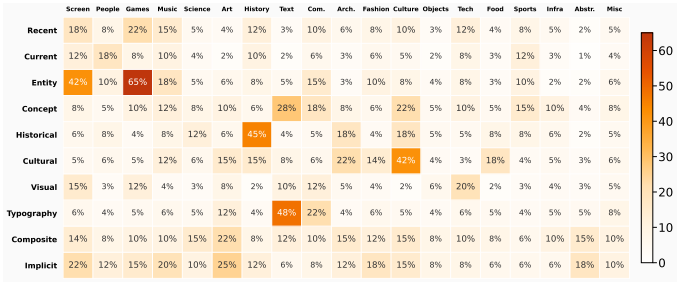
Figure 9. Figure 9: The bottleneck is pervasive: every domain–category combination shows knowledge-driven degradation. Heatmap summarizing cross-category structure between failure modes and domain categories in SEARCHGEN-20K. The uniform severity across all cells rules out the hypothesis that failures concentrate in a few niche categories. Appendix overview This appendix is organized to follow the evidence chain of the paper.… view at source ↗
Figure 9
Figure 9. Figure 9: Co-training progression and knowledge boundary shift. (a) Grouped bars show the three co￾training stages (Reasoner SFT, Generator DPO, Reasoner RFT) for Set I (easiest), Set II, and Set III (hardest) search-intensive tiers (Klein-4B). All three tiers show monotonic improvement. (b) Cumulative distribution of per-prompt no-search quality scores for base vs. DPO-finetuned generators on the 647-prompt eval se… view at source ↗
Figure 10
Figure 10. Figure 10: The end-to-end example’s visual output. The three references the reasoner retrieved and selected (top: scene, costume, likeness) and the image the generator produced from the enriched prompt (bottom), for the Yang Chaoyue request traced in the box above. This is the section’s only image example; it grounds what “retrieved references” and “generation” concretely look like. The per-stage boxes that follow a… view at source ↗
Figure 10
Figure 10. Figure 10: The bottleneck is pervasive: every domain–category combination shows knowledge-driven degradation. Heatmap summarizing cross-category structure between failure modes and domain categories in SEARCHGEN-20K. The uniform severity across all cells rules out the hypothesis that failures concentrate in a few niche categories. Appendix overview This appendix is organized to follow the evidence chain of the paper… view at source ↗
Figure 11
Figure 11. Figure 11: The end-to-end example’s visual output. The three references the reasoner retrieved and selected (top: scene, costume, likeness) and the image the generator produced from the enriched prompt (bottom), for the Yang Chaoyue request traced in the box above. This is the section’s only image example; it grounds what “retrieved references” and “generation” concretely look like. The per-stage boxes that follow a… view at source ↗

discussion (0)

Sign in with ORCID, Apple, or X to comment. Anyone can read and Pith papers without signing in.

Forward citations

Cited by 1 Pith paper

Reviewed papers in the Pith corpus that reference this work. Sorted by Pith novelty score.

  1. Rethinking Classifier-Free Guidance in On-Policy Diffusion Distillation

    cs.CV 2026-07 conditional novelty 6.0

    CFG-composed on-policy distillation is branch-underidentified; privileged negative conditioning causes Negative Branch Asymmetry, which Positive–Direction Matching fixes.