Model-free Friction Observers for Flexible Joint Robots with Torque Measurements
Pith reviewed 2026-05-25 12:17 UTC · model grok-4.3
The pith
A model-free friction observer for flexible joint robots feeds the nominal motor-side signal back to the controller to preserve asymptotic stability and passivity while compensating stiction.
A machine-rendered reading of the paper's core claim, the machinery that carries it, and where it could break.
Core claim
The paper presents a model-free friction observer for flexible joint robots with torque measurements. By feeding the nominal motor-side signal into the controller rather than the measured signal, the observer maintains asymptotic stability and passivity of the controller. The same construction yields an explicit understanding of stiction compensation that prevents overcompensation.
What carries the argument
Model-free friction observer that substitutes the nominal motor-side signal for the measured signal in the controller feedback loop.
If this is right
- Asymptotic stability and passivity of the controller remain intact under the proposed observer.
- Stiction compensation occurs without overcompensation.
- No explicit friction model is needed for the compensation to function.
- The scheme is directly applicable to flexible joint robots equipped with torque sensors.
Where Pith is reading between the lines
- The nominal-signal substitution may simplify controller tuning in other manipulators where friction parameters are uncertain.
- The approach could be tested on rigid-joint robots to check whether the same stability preservation holds without joint flexibility.
- Integration with existing passivity-based controllers might allow model-free friction handling across a wider class of torque-controlled systems.
Load-bearing premise
Replacing the measured motor-side signal with its nominal counterpart in the feedback loop preserves asymptotic stability and passivity without an explicit friction model or further assumptions on the flexible joint dynamics.
What would settle it
An experiment in which the closed-loop robot system loses asymptotic stability or passivity when the nominal motor-side signal is used in place of the measured signal would falsify the central claim.
Figures




read the original abstract
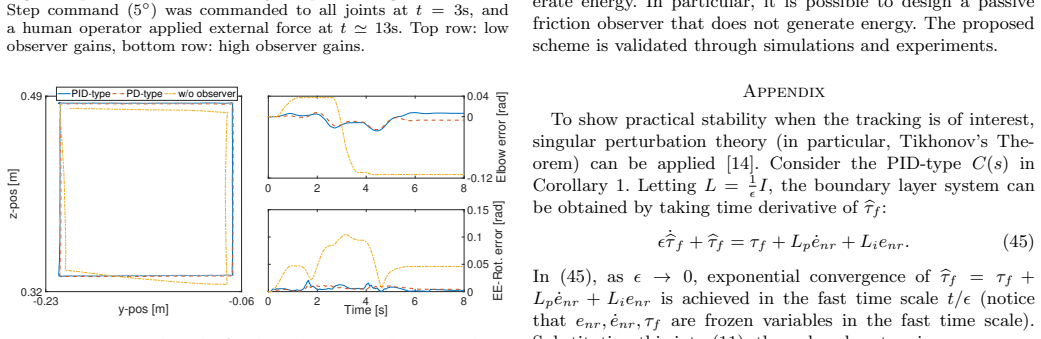
This paper tackles a friction compensation problem without using a friction model. The unique feature of the proposed friction observer is that the nominal motor-side signal is fed back into the controller instead of the measured signal. By doing so, asymptotic stability and passivity of the controller are maintained. Another advantage of the proposed observer is that it provides a clear understanding for the stiction compensation which is hard to be captured in model-free approaches. This allows to design observers that do not overcompensate for the stiction. The proposed scheme is validated through simulations and experiments.
Editorial analysis
A structured set of objections, weighed in public.
Referee Report
Summary. The manuscript proposes a model-free friction observer for flexible-joint robots that uses torque measurements. Its distinctive feature is feeding an observer-generated nominal motor-side signal into the controller in place of the measured signal, with the claim that this substitution preserves asymptotic stability and passivity of the closed-loop system while also clarifying stiction compensation to avoid overcompensation. The approach is validated in simulation and hardware experiments.
Significance. If the passivity and stability arguments hold without unstated restrictions on joint stiffness or torque sensing, the result would be useful for practical friction compensation in flexible-joint robots where explicit friction models are undesirable. The model-free construction and explicit handling of stiction are potentially valuable strengths.
major comments (2)
- [Stability and passivity analysis (the section containing the storage function and its derivative)] The central claim rests on the passivity/Lyapunov argument that substituting the nominal motor-side signal for the measured signal does not destroy negative-semidefiniteness of the storage-function derivative. This step must be shown explicitly for the coupled motor-link dynamics through the joint stiffness; the provided description does not clarify whether boundedness of the stiffness or perfect torque measurement is implicitly used.
- [Observer design and closed-loop equations] The observer error dynamics are stated to be model-free, yet the substitution into the controller feedback loop couples them to the flexible-joint equations. Without an explicit bound on the observer error that is independent of the (unknown) friction and stiffness parameters, the asymptotic-stability claim does not follow in the stated generality.
minor comments (2)
- [Abstract] The abstract asserts stability and passivity but omits any mention of the required assumptions or the form of the observer equations; adding one sentence would improve readability.
- [Notation and figures] Notation for the nominal versus measured motor-side signals should be introduced once and used consistently in all subsequent sections and figures.
Simulated Author's Rebuttal
We thank the referee for the constructive comments regarding the stability/passivity analysis and the observer error dynamics. We address each major comment below.
read point-by-point responses
-
Referee: [Stability and passivity analysis (the section containing the storage function and its derivative)] The central claim rests on the passivity/Lyapunov argument that substituting the nominal motor-side signal for the measured signal does not destroy negative-semidefiniteness of the storage-function derivative. This step must be shown explicitly for the coupled motor-link dynamics through the joint stiffness; the provided description does not clarify whether boundedness of the stiffness or perfect torque measurement is implicitly used.
Authors: We agree that the derivation of the storage-function derivative for the coupled motor-link dynamics should be presented more explicitly. In the revised manuscript we will insert the full step-by-step expansion, confirming that negative semidefiniteness is retained under the standard flexible-joint assumptions and the given torque-measurement availability, without additional restrictions on stiffness boundedness. revision: yes
-
Referee: [Observer design and closed-loop equations] The observer error dynamics are stated to be model-free, yet the substitution into the controller feedback loop couples them to the flexible-joint equations. Without an explicit bound on the observer error that is independent of the (unknown) friction and stiffness parameters, the asymptotic-stability claim does not follow in the stated generality.
Authors: The observer itself remains model-free with respect to friction; the coupling through the controller substitution is already accounted for in the passivity argument. To strengthen the presentation we will add an explicit bound on the observer error expressed solely in terms of measurable signals, showing independence from the unknown friction parameters. Stiffness parameters belong to the plant dynamics and are not required to be known by the observer. revision: yes
Circularity Check
No circularity; derivation grounded in standard passivity arguments
full rationale
The paper presents a model-free friction observer for flexible joint robots that substitutes a nominal motor-side signal for the measured one to preserve asymptotic stability and passivity. No load-bearing step reduces by construction to a fitted parameter, self-definition, or self-citation chain. The abstract and description invoke passivity maintenance without redefining stability in terms of the observer output or renaming empirical patterns. The central claim remains independent of the paper's own fitted values or prior self-referential results, consistent with external passivity theory benchmarks.
Axiom & Free-Parameter Ledger
axioms (1)
- domain assumption Using nominal motor-side signal in feedback preserves asymptotic stability and passivity for the closed-loop system
invented entities (1)
-
Model-free friction observer with nominal-signal feedback
no independent evidence
Reference graph
Works this paper leans on
-
[1]
Adaptive friction com- pensation: A globally stable approach,
K. Verbert, R. T´ oth, and R. Babuˇ ska, “Adaptive friction com- pensation: A globally stable approach,” IEEE/ASME Transac- tions on Mechatronics , vol. 21, no. 1, pp. 351–363, 2016
work page 2016
-
[2]
Observer-based friction compen- sation,
H. Olsson and K. J. ˚Astr¨om, “Observer-based friction compen- sation,” in Proceedings of the 35th IEEE Conference on Decision and Control (CDC) , vol. 4, 1996, pp. 4345–4350
work page 1996
-
[3]
Revisiting the lugre friction model,
K. Johanastrom and C. Canudas-De-Wit, “Revisiting the lugre friction model,” IEEE control Systems , vol. 28, no. 6, pp. 101– 114, 2008
work page 2008
-
[4]
M. Iskandar and S. Wolf, “Dynamic friction model with thermal and load dependency: modeling, compensation, and external force estimation,”in IEEE International Conference on Robotics and Automation (ICRA) , 2019
work page 2019
-
[5]
A motion control of flexible joint based on velocity estimation,
K. Kaneko, S. Kondo, and K. Ohnishi, “A motion control of flexible joint based on velocity estimation,”in16th IEEE Annual Conference of Industrial Electronics Society, 1990, pp. 279–284
work page 1990
-
[6]
Observer of nonlinear friction dynamics for motion control,
M. Ruderman and M. Iwasaki, “Observer of nonlinear friction dynamics for motion control,” IEEE Transactions on Industrial Electronics, vol. 62, no. 9, pp. 5941–5949, 2015
work page 2015
-
[7]
Modeling and control of elastic joint robots,
M. W. Spong, “Modeling and control of elastic joint robots,” ASME J. Dyn. Syst. Meas. Control , vol. 109, pp. 310–319, 1990. 9
work page 1990
-
[8]
Control of robot arms using joint torque sensors,
G. Zhang and J. Furusho, “Control of robot arms using joint torque sensors,” in IEEE International Conference on Robotics and Automation (ICRA) , vol. 4, 1997, pp. 3148–3153
work page 1997
-
[9]
Disturbance observer based robust control for industrial robots with flexible joints,
S.-K. Park and S.-H. Lee, “Disturbance observer based robust control for industrial robots with flexible joints,”inInternational Conference on Control, Automation and Systems (ICCAS) , 2007, pp. 584–589
work page 2007
-
[10]
Friction observer and compensation for control of robots with joint torque measurement,
L. Le Tien, A. Albu-Sch ¨affer, A. De Luca, and G. Hirzinger, “Friction observer and compensation for control of robots with joint torque measurement,” inIEEE/RSJ International Confer- ence on Intelligent Robots and Systems , 2008, pp. 3789–3795
work page 2008
-
[11]
M. J. Kim and W. K. Chung, “Robust control of flexible joint robots based on motor-side dynamics reshaping using distur- bance observer (dob),” in IEEE/RSJ International Conference on Intelligent Robots and Systems (IROS) , 2014, pp. 2381–2388
work page 2014
-
[12]
Disturbance-observer-based pd control of flexible joint robots for asymptotic convergence,
——, “Disturbance-observer-based pd control of flexible joint robots for asymptotic convergence,” Robotics, IEEE Transac- tions on , vol. 31, no. 6, pp. 1508–1516, 2015
work page 2015
-
[13]
A simple pd controller for robots with elastic joints,
P. Tomei, “A simple pd controller for robots with elastic joints,” Automatic Control, IEEE Transactions on , vol. 36, no. 10, pp. 1208–1213, 1991
work page 1991
-
[14]
H. K. Khalil and J. Grizzle, Nonlinear systems. Prentice hall Upper Saddle River, 2002, vol. 3
work page 2002
-
[15]
Bringing nonlinear H∞ optimality to robot controllers,
M. J. Kim, Y. Choi, and W. K. Chung, “Bringing nonlinear H∞ optimality to robot controllers,” Robotics, IEEE Transactions on, vol. 31, no. 3, pp. 682–698, 2015
work page 2015
-
[16]
A new model for control of systems with friction,
C. C. De Wit, H. Olsson, K. J. ˚Astr¨om, and P. Lischinsky, “A new model for control of systems with friction,” IEEE Transac- tions on automatic control , vol. 40, no. 3, pp. 419–425, 1995
work page 1995
-
[17]
On the passivity-based impedance control of flexible joint robots,
C. Ott, A. Albu-Sch ¨affer, A. Kugi, and G. Hirzinger, “On the passivity-based impedance control of flexible joint robots,” Robotics, IEEE Transactions on , vol. 24, no. 2, pp. 416–429, 2008
work page 2008
discussion (0)
Sign in with ORCID, Apple, or X to comment. Anyone can read and Pith papers without signing in.