Creating and Flattening Cusp Singularities by Deformations of Bi-conformal Energy
Pith reviewed 2026-05-24 21:12 UTC · model grok-4.3
The pith
Mappings with finite conformal energy and integrable inner distortion can create and flatten cusp singularities on domain boundaries.
A machine-rendered reading of the paper's core claim, the machinery that carries it, and where it could break.
Core claim
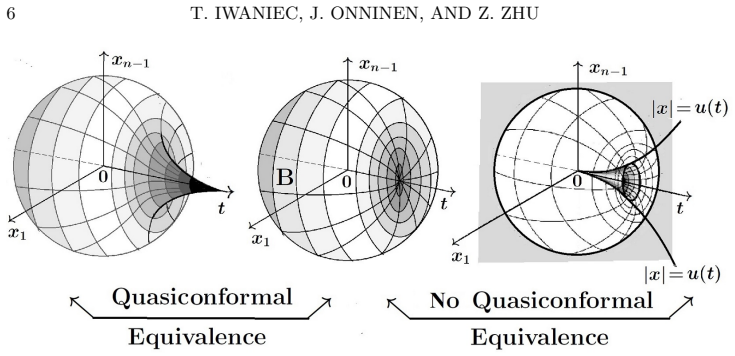
Mappings of bi-conformal energy form the widest class of homeomorphisms that one can hope to build a viable extension of Geometric Function Theory with connections to mathematical models of Nonlinear Elasticity. The present paper establishes the sharp description of boundary singularities that can be created and flattened by such mappings, focusing on domains with exemplary singular boundaries that are not quasiballs.
What carries the argument
Bi-conformal energy mappings, defined as homeomorphisms with finite conformal energy and integrable inner distortion, which serve as the deformations to create or flatten cusp singularities.
If this is right
- These mappings extend the applications of quasiconformal homeomorphisms to degenerate elliptic systems of PDEs.
- The class allows realization of a Riemann-mapping-type theorem on domains with boundaries that are not quasiballs.
- Sharp conditions describe exactly which cusp singularities can be handled by the energy deformations.
- Provides a framework for studying boundary behavior in nonlinear elasticity models.
Where Pith is reading between the lines
- This approach might enable new numerical approximations for energy-minimizing mappings in elasticity simulations with singular boundaries.
- The boundary control could link to regularity questions in geometric measure theory for domains with cusps.
- Similar characterizations may apply to other distortion energies beyond the bi-conformal case.
- The results suggest that certain mappings outside the quasiconformal class can still achieve precise boundary flattening or creation.
- keywords:[
Load-bearing premise
The class of bi-conformal energy mappings is sufficiently rich to realize a Riemann-mapping-type theorem on domains whose boundaries are not quasiballs.
What would settle it
An explicit cusp singularity on a non-quasiball domain boundary for which no bi-conformal energy mapping exists that creates or flattens it according to the claimed sharp description.
Figures



read the original abstract
Mappingsofbi-conformalenergyformthewidestclass of homeomorphisms that one can hope to build a viable extension of Geometric Function Theory with connections to mathematical models of Nonlinear Elasticity. Such mappings are exactly the ones with finite conformal energy and integrable inner distortion. It is in this way, that our studies extend the applications of quasiconformal homeomorphisms to the degenerate elliptic systems of PDEs. The present paper searches a bi-conformal variant of the Riemann Mapping Theorem, focusing on domains with exemplary singular boundaries that are not quasiballs. We establish the sharp description of boundary singularities that can be created and flattened by mappings of bi-conformal energy.
Editorial analysis
A structured set of objections, weighed in public.
Referee Report
Summary. The paper claims to establish the sharp description of boundary singularities that can be created and flattened by mappings of bi-conformal energy (homeomorphisms with finite conformal energy and integrable inner distortion). It develops a bi-conformal variant of the Riemann mapping theorem focused on domains with exemplary singular boundaries that are not quasiballs, extending quasiconformal theory to degenerate elliptic systems.
Significance. If the result holds, the work provides a parameter-free sharp characterization that enlarges the scope of geometric function theory beyond quasiconformal mappings, with direct relevance to nonlinear elasticity models via the wider class of bi-conformal energy mappings.
minor comments (1)
- [Abstract] Abstract: the text contains concatenated words such as 'Mappingsofbi-conformalenergyformthewidestclass' and 'Mappingsofbi-conformalenergy' that require spacing corrections for readability.
Simulated Author's Rebuttal
We thank the referee for the positive summary, significance assessment, and recommendation to accept the manuscript. There are no major comments to address.
Circularity Check
No significant circularity; derivation is self-contained
full rationale
The paper establishes a sharp characterization of cusp singularities creatable or flattenable by bi-conformal energy homeomorphisms (finite conformal energy plus integrable inner distortion), presented as a direct extension of quasiconformal theory to non-quasiball domains. No equations, definitions, or claims reduce by construction to fitted inputs, self-citations, or ansatzes imported from the authors' prior work. The abstract and stated claims are parameter-free and rely on explicit constructions whose validity is independent of the target result. This matches the default expectation for a pure existence/sharpness theorem in geometric function theory.
Axiom & Free-Parameter Ledger
Reference graph
Works this paper leans on
-
[1]
S. S. Antman, Nonlinear problems of elasticity. Applied Mathematical Sciences,
-
[2]
Springer-Verlag, New York, 1995
work page 1995
- [3]
- [4]
-
[5]
J. M. Ball, Convexity conditions and existence theorems in nonlinear elasticity, Arch. Rational Mech. Anal. 63 (1976/77), no. 4, 337–403
work page 1976
-
[6]
Brown, A proof of the generalized Schoenflies theorem , Bull
M. Brown, A proof of the generalized Schoenflies theorem , Bull. Amer. Math. Soc. (N.S.) 66 (1960) 74–76
work page 1960
-
[7]
P. G. Ciarlet, Mathematical elasticity Vol. I. Three-dimensional elasticity , Studies in Mathematics and its Applications, 20. North-Holland Publishing Co., Amsterdam, 1988
work page 1988
-
[8]
M. Cs¨ ornyei, S. Hencl, and J. Mal´ y Homeomorphisms in the Sobolev space W 1,n−1, J. Reine Angew. Math. 644 (2010), 221–235
work page 2010
-
[9]
E. E. Floyd, The extension of homeomorphisms , Duke Math. J. 16, (1949). 225–235
work page 1949
-
[10]
E. E. Floyd and M. K. Fort, A characterization theorem for monotone map- pings, Proc. Amer. Math. Soc. 4, (1953). 828–830
work page 1953
-
[11]
F. W. Gehring, G. J. Martin, and B. P. Palka, An introduction to the theory of higher-dimensional quasiconformal mappings , Mathematical Surveys and Monographs, 216. American Mathematical Society, Providence, RI, (2017)
work page 2017
-
[12]
F. W. Gehring and J. V¨ ais¨ al¨ aThe coefficients of quasiconformality of domains in space, Acta Math. 114 (1965) 1–70
work page 1965
-
[13]
S. Hencl and P. Koskela, Regularity of the inverse of a planar Sobolev homeo- morphism. Arch. Ration. Mech. Anal. 1 80 (2006), no. 1, 75–95
work page 2006
-
[14]
S. Hencl and P. Koskela, Lectures on mappings of finite distortion , Lecture Notes in Mathematics, 2096. Springer, Cham, (2014)
work page 2096
- [15]
-
[16]
S. Hencl and K. Rajala, Optimal assumptions for discreteness , Arch. Ration. Mech. Anal. 207 (2013), no. 3, 775–783
work page 2013
-
[17]
T. Iwaniec and G. Martin, Geometric Function Theory and Non-linear Anal- ysis, Oxford Mathematical Monographs, Oxford University Press, 2001. 22 T. IW ANIEC, J. ONNINEN, AND Z. ZHU
work page 2001
-
[18]
T. Iwaniec and J. Onninen, Deformations of finite conformal energy: Boundary behavior and limit theorems, Trans. Amer. Math. Soc. 363 (2011), no. 11, 5605– 5648
work page 2011
-
[19]
T. Iwaniec and J. Onninen, Variational Integrals in Geometric Function The- ory, Book in progress
-
[20]
T. Iwaniec, J. Onninen and Z. Zhu, Deformations of bi-conformal energy and a new characterization of quasiconformality , arXiv:1904.03793
-
[21]
T. Iwaniec, and V. ˇSver´ ak,On mappings with integrable dilatation, Proc. Amer. Math. Soc. 118 (1993), no. 1, 181–188
work page 1993
-
[22]
Lebesgue, Sur le probl´ eme de Dirichlet, Rend
H. Lebesgue, Sur le probl´ eme de Dirichlet, Rend. Circ. Palermo 27 (1907), 371–402
work page 1907
-
[23]
J. E. Marsden and T. J. R. Hughes, Mathematical foundations of elasticity , Dover Publications, Inc., New York, 1994
work page 1994
-
[24]
C. B. Morrey, The Topology of (Path) Surfaces, Amer. J. Math. 57 (1935), no. 1, 17–50
work page 1935
-
[25]
Onninen, Regularity of the inverse of spatial mappings with finite distortion , Calc
J. Onninen, Regularity of the inverse of spatial mappings with finite distortion , Calc. Var. Partial Differential Equations 26 (2006), no. 3, 331–341
work page 2006
-
[26]
V¨ ais¨ al¨ a,Lectures on n-dimensional quasiconformal mappings
J. V¨ ais¨ al¨ a,Lectures on n-dimensional quasiconformal mappings. Lecture Notes in Mathematics, Vol. 229, Springer-Verlag, Berlin-New York, 1971
work page 1971
-
[27]
Yu. G. Reshetnyak, Space mappings with bounded distortion , American Math- ematical Society, Providence, RI, 1989. Department of Mathematics, Syracuse University, Syracuse, NY 13244, USA E-mail address : tiwaniec@syr.edu Department of Mathematics, Syracuse University, Syracuse, NY 13244, USA and Department of Mathematics and Statistics, P.O.Box 35 (MaD) F...
work page 1989
discussion (0)
Sign in with ORCID, Apple, or X to comment. Anyone can read and Pith papers without signing in.