The Role of Referrals in Immobility, Inequality, and Inefficiency in Labor Markets
Pith reviewed 2026-05-24 14:14 UTC · model grok-4.3
The pith
Job referrals improve hiring matches and productivity but increase inequality and reduce mobility when networks exhibit homophily.
A machine-rendered reading of the paper's core claim, the machinery that carries it, and where it could break.
Core claim
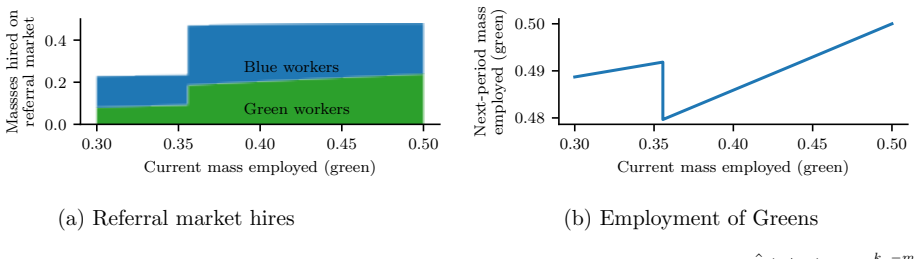
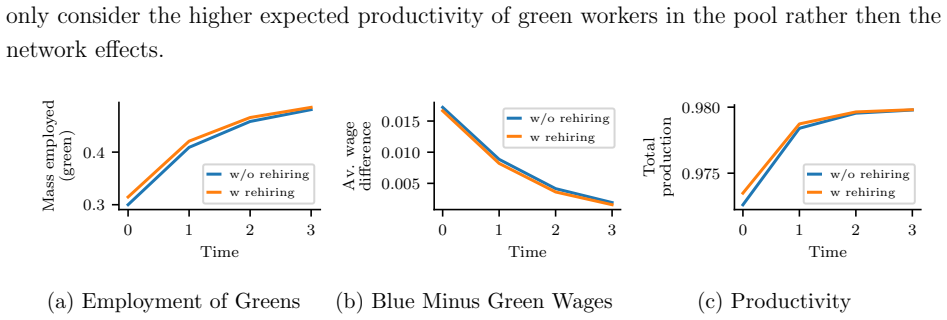
Referrals lead to more opportunities for workers to be hired, which lead to better matches and increased productivity, but also disadvantage job-seekers with few or no connections to employed workers, increasing inequality. Coupled with homophily, referrals also lead to immobility. Conditions exist under which distributing referrals more evenly reduces inequality and improves future productivity and mobility.
What carries the argument
A model of referral-based hiring within homophilous social networks that tracks how referral flows affect match quality, inequality, and intergenerational mobility.
If this is right
- Referrals raise aggregate productivity through improved matches.
- Workers lacking employed connections receive fewer opportunities, widening inequality.
- Homophily channels referrals inside groups and produces immobility across periods.
- Even distribution of referrals can reduce inequality and raise future productivity and mobility under stated conditions.
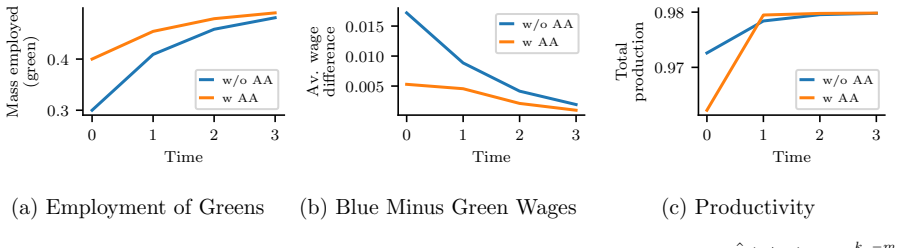
- Policies such as affirmative action and algorithmic fairness alter short-run and long-run welfare through their effects on referral flows.
Where Pith is reading between the lines
- Network position becomes an independent driver of labor-market outcomes that persists even after individual productivity is accounted for.
- Interventions aimed at network formation itself could interact with referral policies in ways the model does not yet explore.
- The same referral process may generate different inequality-mobility trade-offs when labor markets vary in the share of jobs filled by referrals.
Load-bearing premise
The model assumes a specific form of homophily in the underlying social network and a particular process by which referrals are generated and used.
What would settle it
Longitudinal data on worker networks, referral receipt, and wage or occupational mobility that shows no rise in group-level immobility or inequality despite high homophily would falsify the central mechanism.
Figures
read the original abstract
We study the consequences of job markets' heavy reliance on referrals. Referrals lead to more opportunities for workers to be hired, which lead to better matches and increased productivity, but also disadvantage job-seekers with few or no connections to employed workers, increasing inequality. Coupled with homophily, referrals also lead to immobility. We identify conditions under which distributing referrals more evenly reduces inequality and improves future productivity and mobility. We use the model to examine the short and long-run welfare impacts of policies such as affirmative action and algorithmic fairness.
Editorial analysis
A structured set of objections, weighed in public.
Referee Report
Summary. The paper develops a theoretical model of labor markets in which referrals through social networks increase hiring opportunities and improve match quality/productivity, but combined with homophily generate inequality (disadvantaging unconnected workers) and immobility. It derives conditions under which more even referral distribution reduces inequality while raising future productivity and mobility, and uses the framework to evaluate short- and long-run welfare effects of affirmative action and algorithmic fairness policies.
Significance. If the results are robust, the paper offers a useful framework for analyzing efficiency-equity trade-offs in network-based hiring and for ranking policy interventions. The explicit identification of threshold conditions on referral distribution is a constructive contribution. However, the absence of robustness checks on the imposed homophily kernel and referral protocol limits the strength of the conclusions.
major comments (2)
- [Model section] Model section (homophily and referral protocol): the qualitative claims on immobility, inequality, and the ranking of even-distribution policies are shown only for a specific functional form of the homophily kernel and a particular referral-offer/acceptance rule. The manuscript supplies no analytic derivation or numerical sensitivity exercise demonstrating that these results survive changes to either functional form, yet altering the kernel or protocol can eliminate or reverse the reported effects on mobility and the policy welfare ordering.
- [Welfare and policy section] Welfare and policy section: the short- and long-run welfare comparisons for affirmative action and algorithmic fairness are derived under the baseline network-formation rule; because the immobility and inequality magnitudes are not shown to be robust to alternative homophily strengths or referral-matching specifications, the policy conclusions rest on the same untested functional choices.
minor comments (1)
- Notation for network statistics and referral probabilities should be defined once in a dedicated table or appendix to improve readability across equilibrium derivations.
Simulated Author's Rebuttal
We thank the referee for the constructive comments on our manuscript. The concerns about robustness to alternative specifications of the homophily kernel and referral protocol are well-taken, and we address them point by point below, outlining how we plan to strengthen the paper.
read point-by-point responses
-
Referee: [Model section] Model section (homophily and referral protocol): the qualitative claims on immobility, inequality, and the ranking of even-distribution policies are shown only for a specific functional form of the homophily kernel and a particular referral-offer/acceptance rule. The manuscript supplies no analytic derivation or numerical sensitivity exercise demonstrating that these results survive changes to either functional form, yet altering the kernel or protocol can eliminate or reverse the reported effects on mobility and the policy welfare ordering.
Authors: We chose the specific homophily kernel and referral protocol to permit closed-form solutions while capturing the essential feature that connection probabilities decline with social distance. The core mechanisms generating immobility and inequality—differential referral access due to homophily—hold under any kernel satisfying this monotonicity property, which includes several common alternatives. Nevertheless, we agree that explicit sensitivity analysis would improve the paper. In revision we will add numerical exercises that vary the homophily strength parameter and consider an alternative acceptance rule (e.g., random acceptance conditional on meeting a minimum productivity threshold). These checks will confirm whether the qualitative directions of the effects on mobility, inequality, and the ranking of even-distribution policies remain intact. revision: partial
-
Referee: [Welfare and policy section] Welfare and policy section: the short- and long-run welfare comparisons for affirmative action and algorithmic fairness are derived under the baseline network-formation rule; because the immobility and inequality magnitudes are not shown to be robust to alternative homophily strengths or referral-matching specifications, the policy conclusions rest on the same untested functional choices.
Authors: The policy welfare comparisons are presented as illustrations within the baseline framework rather than universal rankings. Once the numerical robustness checks described above are incorporated, we will qualify the policy results by noting the range of homophily and protocol parameters under which the short- and long-run welfare orderings continue to hold. This will make the policy implications more precise without altering the main qualitative insights. revision: partial
Circularity Check
No significant circularity in theoretical model derivations
full rationale
The paper is a self-contained theoretical model deriving labor-market outcomes from explicit assumptions on network homophily and referral generation/acceptance protocols. No equations or claims reduce by construction to fitted parameters, self-citations, or renamed inputs; the immobility/inequality results follow directly from the stated primitives without the forbidden patterns of self-definition or load-bearing self-citation chains. External benchmarks (standard network-formation models) are not required for the internal logic, confirming the derivation chain is independent.
Axiom & Free-Parameter Ledger
axioms (1)
- domain assumption Social networks exhibit homophily in connections
Forward citations
Cited by 1 Pith paper
-
Belief Aggregation under Costly Information
A costly-information model provides an epistemic foundation that rationalizes linear, geometric, power, and multiplicative belief pooling and links the choice of rule to welfare losses and equilibrium prices.
Reference graph
Works this paper leans on
-
[1]
Chapter 22 - Labor Markets and Referrals,
German translation: Campus, 1975; Japanese translation: 1977; Spanish translation: Ed- itorial Critica, 1979; Yugoslav translation: Cekade, 1984. Expanded edition with an annex ”On Economic Inequality after a Quarter Century” [jointly with James Foster], Oxford: Clarendon Press; New York: Oxford University Press, 1997. Topa, Giorgio, “Chapter 22 - Labor M...
work page 1975
-
[2]
By Lemma 6, production before firing is lower under ˜ v′ 1 than under ˜v1 as ˜v <˜v1 < ˜v′
Total production must be higher under ˜v′ 1 than under ˜v1 as is evident from (12). By Lemma 6, production before firing is lower under ˜ v′ 1 than under ˜v1 as ˜v <˜v1 < ˜v′
-
[3]
Hence, it must be that ˜v′ 2 < ˜v2 for total production to be the same under the two thresholds. But then (4) cannot be satisfied for both ˜v1 and ˜v2 and ˜v′ 1 and ˜v′ 2 as the both terms on the right-hand side are larger given ˜v1 and ˜v2 than given ˜v′ 1 and ˜v′ 2 whereas ˜v1< ˜v′ 1 by assumption. Lastly, let us show that ˜v2 is unique. By the uniquenes...
-
[4]
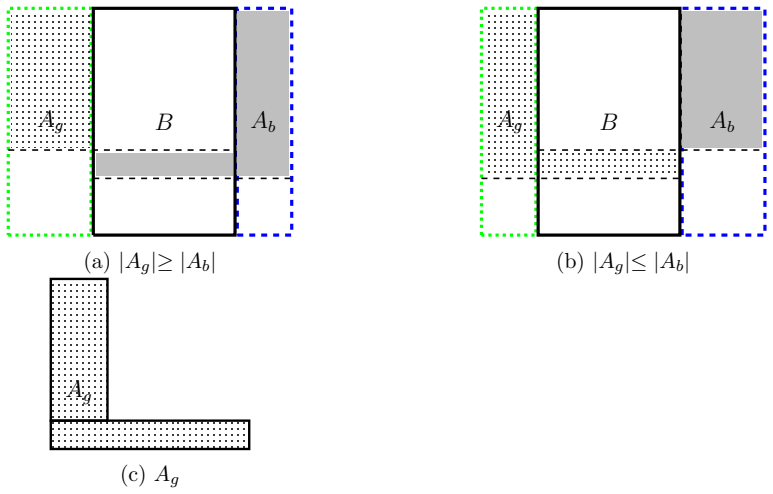
and (˜v1, ˜v2) respectively. We know that ˜v′ 1 > ˜v1. To reach a contradiction suppose that ˜v′ 2≥ ˜v2. We study how production after firing differs given λ and λ′ with λ,λ′ > 0. To this end, we partition the set of workers into several subsets whose aggregate composition of workers stays constant given λ and λ′. We then track the extend to which each of t...
-
[5]
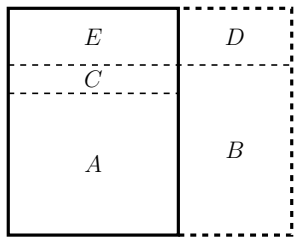
Due to uniform sampling from pool 1, it must be that the same fraction of workers in both rectangles is hired from the aforementioned sets. We graphically represent this fact by placing the rectangles side-by-side and, given λ′, horizontally slice through them (the top dashed lines) with the top area representing the set of unemployed workers and the bott...
discussion (0)
Sign in with ORCID, Apple, or X to comment. Anyone can read and Pith papers without signing in.